






Looking back on 2022, overlooking the opportunities of the next cycle


2022 is about to pass, and Mint Ventures decided to bid farewell to this year with a review and outlook, and to draw an end to a year of Web3 research and learning. We look forward to continuing to witness the growth of the new business world of Web3 in the new year. cognition.
We asked researchers and investment managers in the institution to answer the following three questions:
In the past year, which industry events of Web3 impressed you the most?
In the next 1 or 2 years, or the next bull market cycle, what trends/investment opportunities do you think are worthy of attention?
Do you have anything else you want to share?
Six researchers and investment managers from Mint Ventures, as well as two external research partners (Feifei and Bobo), shared their views and feelings.
The following content retains the core views of the original authors of Mint, but due to space limitations, some of them have been abridged.
first level title
|Alex Xu:In the next cycle, we are still optimistic about DeFi
secondary title
1. Regulatory action against Tornado
Tornado is the largest mixer on Ethereum and is a common tool for many hackers and other users who need to cut off the tracking of funds. The U.S. Treasury Department’s Office of Foreign Assets Control (OFAC) put it on the sanctions list in early August this year, prohibiting U.S. citizens from using it, and Tornado’s developer, Alexey Pertsev, was also arrested by Dutch authorities. Soon, numerous agencies began to proactively follow up on OFAC's sanctions. First, Circle, the second largest stablecoin issuer, quickly froze the USDC in the Tornado protocol and froze the USDC in the highly correlated addresses. Then, Github took down the Tornado codebase. Other institutions have also begun to ban or blacklist Tornado’s addresses with interaction records. There are many decentralized projects, such as Uniswap, which blocked 253 encrypted addresses related to stolen funds or sanctions, and the front end of the lending agreement Aave blocked Numerous addresses that have interacted with Tornado for transfers. Third-party node operators, like Infura and Alchemy, have also stopped supporting Tornado-related services.
This is the first time in history that regulators have taken action against DeFi. Before this incident, although everyone had concerns about it, considering that DeFi is deployed on Ethereum and inherits the security and decentralization of Ethereum, users are also With anonymous addresses, the difficulty and cost of sanctioning DeFi is much higher than that of centralized institutions and individuals. But the Tornado incident revealed the brutal reality: Although DeFi operates based on code trust and a decentralized network, individuals and other institutions that interact with it are still strictly restricted by traditional laws and credit systems, and the ability of supervision to crack down on DeFi Much stronger than imagined.
The greatest value of the Tornado supervision incident is to allow the entire encryption community to start a new self-examination, including:
The security of the business model: Is it safe to use a large number of assets issued by centralized institutions? Rune Christensen, the co-founder of MakerDAO, stated in a blog published in the same month that DAI will be de-pegged from the U.S. dollar, and the protocol should continue to take the road of decentralization to limit potential future review attacks. And USDC is currently still the largest minted collateral for DAI.
The Correctness of Business Ethics: Should DeFi Managed by the Community Cooperate with Regulatory Actions? The important value of DeFi is no permission, freedom, transparency, and anonymity. When a DeFi helps regulators crack down on other DeFi protocols and users, how can it explain to its own community users and convince them that they will not be tamed by regulation and make harmful actions? A matter of community interest?
In addition to DeFi, if the regulation extends its hand to the node service providers of Ethereum, how should the Ethereum community respond. In the Ethereum community’s voting on this situation, one solution is to regard this review system as an attack on Ethereum, and then use a broad consensus to destroy the pledged rights and interests of nodes that cooperate with supervision; another solution is to tolerate Censorship. Vitalik Buterin clearly expressed his position: the behavior of control nodes to cooperate with censorship is regarded as an attack on Ethereum, and these validators will be punished.
secondary title
2. Another thing that impresses me in 2022 is the rise and practice of large-scale DAO
The organization and collaboration form of DAO is not a new thing in 2022. Many encryption projects have been governed in the form of DAO before, discussing in community forums, initiating votes, upgrading products, and distributing funds.
But it is ConstitutionDAO at the end of 2021 that really makes the entire encryption community start to pay attention to and actively participate in the DAO trend. ConstitutionDAO took the mission of bidding for the official first edition of the U.S. Constitution auctioned by Sotheby's in mid-November. In just a few days, it successfully crowdfunded more than 10,000 ETH through the fundraising platform Juicebox, worth $43 million. At that time, well-known institutions such as cryptocurrency trading platforms Gemini, Coinbase, and a16z promoted it one after another. Although the ConstitutionDAO auction failed in the end, this event allowed people to see the amazing organizational capabilities and possibilities of DAO. More importantly, the huge popularity of the ConstitutionDAO event helped its donation token People to be successfully listed on Binance and other first-line trading platforms in December. , this project token that originated from the concept of "democracy" became the last MEME token in 2021 and the first successful MEME token in 2022. In the already cold market environment at that time, it created a considerable wealth effect against the market environment .
The success of ConstitutionDAO in terms of influence and wealth effects has finally attracted a wider range of encrypted users to pay attention to and start chasing the concept of DAO, and the explosion of the number of DAO organizations in the encrypted world has also begun. DAO became the hottest topic of discussion and communication between the media and SPACE at that time, and the financing of DAO organizations and DAO tools quickly became popular in the first half of 2022. I also joined many DAO communities at that time, looking for answers to the following questions:
What are the advantages of DAO as an organizational form compared to other mainstream organizational forms? What problems is it good at solving, and what problems is it not good at solving?
What is the main value that blockchain and crypto commerce provide to DAOs?
How to evaluate whether the DAO organization is doing well?
At present, the DAO trend is gradually fading, especially the single-mission and event-driven DAOs (such as DAOs that bid for Blue Origin’s moon landing places after the constitutional auction), but many DAOs with long-term and comprehensive goals The organization is still running, and the effort to improve Lean continues. I also seem to be a little closer to the answers to 2 of the questions I was originally looking for:
Compared with the corporate system, the DAO in the encrypted world has the advantage of greater flexibility. Elasticity means the flexible expansion, tolerance and democracy of the organization, behind which are transparent systems, open access and collaboration channels, and a collaborative atmosphere across regions, races and civilizations. With a mission with clear goals and strong appeal, it is easy for people to gather quickly and take active actions in DAO.
Blockchain and cryptocurrency provide low-threshold tools for the transparency of DAO, and also play a role in naturally screening audiences (Web3 users naturally have a good impression of DAO's organizational form and values)
Of course, these answers and thoughts are still far from the final conclusion, because now DAO is still far from their best form, and there is a lot of room for evolution.
Looking back at the development process of DAO, it was not the breakthroughs in organizational behavior and management that led to its first wave of prosperity, but the speculative upsurge and wealth effect. The concept attracted enough attention, hot money, and talent to feed the DAO organization's practice. This once again demonstrates the role of speculative bubbles in driving important technological advances and social practices.
As for the rapid collapse of the Luna ecology, in March this year I wrote an article "Behind the tens of millions of dollars in gambling: Is Luna a Ponzi scheme?》。
The core point of the article is that Terra is not a subjective Ponzi scheme in the traditional sense. This is not the main point of disagreement. The main point of difference is Terra’s public chain development model:
"Sponsors believe that Terra's high-interest deposits are similar to customer acquisition and retention subsidies in the Internet field. Although there are huge losses in the early stage, from the perspective of the total life cycle of users, the current subsidy money will benefit from the long-term ecological prosperity in the future. Earn back in a roundabout way; opponents believe that Terra’s development model of subsidies + public chain tokens & stablecoins is difficult to form a stable state, and will eventually die in a negative spiral of a Luna price drop.”
The article also analyzes Terra's vulnerabilities, business models and potential risks:
Vulnerabilities: The vulnerability of Terra’s ecology lies in the insufficient economic bandwidth of its ecological token Luna, and the stability of UST is not as good as that of decentralized stablecoins such as DAI.
Business model: In order to promote the narrative and build stronger economic bandwidth, Terra has built a set of self-reinforcing business models based on its two-wheel model of stable currency + public chain. The order is as follows:
1. First create DeFi scenarios in the public chain and provide subsidies (represented by Anchor), which shapes the demand for stablecoins
2. Demand drives UST's casting scale, and users begin to be introduced
3. Improve the data performance of the ecology, such as TVL, number of addresses, transfer activity and the number of projects participating in the ecology
4. A boost in metrics reinforces the appeal of the Luna narrative
5. Based on the improvement of consensus and fundamentals, it can promote cooperation with more leading projects
6. The enhancement of narrative and consensus has improved Luna's transaction breadth (number of investors and regions) and transaction depth, and gradually pushed up the price
7. The actual controller obtains funds by cashing out or destroying Luna
8. Continue to subsidize [link 1] with cashed out funds to promote the above cycle
In this cycle, the main expenditure link of this business model is [link 1], and the main income link is [link 7]. As long as the income of [link 7] is sufficient to support [link 1], this cycle can continue and help Terra Towards its two main business goals:
Promote the large-scale adoption of stablecoins represented by UST, replacing centralized stablecoins such as USDT and USDC
Promote the prosperity of the Terra public chain and provide a platform for the development of Web3 economy for open finance and other applications.
Risk point: The main challenge of maintaining Terra’s business cycle is that there are problems in the narrative construction process of links 3-6, that is, the maintenance cost of Luna token prices is getting higher and higher, resulting in insufficient income and funds in [link 7] to support [ Link 1] subsidies.
Possible factors causing this problem include:
Crypto asset prices crash. The narrative value and valuation of all track projects have been hit hard, and the stable currency and public chain where Terra is located have not been spared.
Incidents within the project (such as scandal-affected Abracadabra). The incident caused the price of Luna tokens to plummet and lose liquidity, which in turn triggered the potential insufficient collateralization ratio of UST, resulting in a death spiral, and the team was powerless to do anything about it.
Regulatory shock. Regulation restricts Terra from obtaining more financial means to maintain the operation of the project and respond to unexpected situations, or regulation itself is an emergency.
The above business cycle has not actually attracted enough developers and users to enter the Terra ecosystem, the market’s narrative view of Terra has turned negative, or the current public chain value evaluation framework has undergone major changes.
If you are an investor in Luna or a holder of UST, you need to be very vigilant about the above situations.
The Terra ecology collapsed in less than 2 months after the article was published. It turned out that some things were right afterwards. For example, the background of the negative spiral caused by Luna’s plunge is the gradual deepening of the bear market, and most encrypted assets are generally falling. However, there are also some important possibilities that have been ignored. For example, it is not long-term factors such as "the ecology cannot keep up with the currency price leading to negative narratives" that overthrow Terra's financial building blocks, but targeted sniping. Facts have proved that when there is a vulnerability in the mechanism, the actual situation of this vulnerability will be far more serious than the design, because the attacker will do everything possible to leverage this vulnerability and benefit from a large-scale crash.
secondary title
3. The next cycle: still optimistic about DeFi
In the next cycle, I am still optimistic about the development of DeFi, and have been actively searching for high-quality DeFi targets in the bear market, whether it is an undervalued old project or a rookie whose value has not yet been discovered. The reason is simple: finance itself is the foundation of industrial development. During the development of major economies including my country, the market value and profits of the financial industry have shared the dividends of economic development. In the business of the value Internet, the demand and frequency of value capitalization, flow, transaction, and efficiency increase will be several times that of the information Internet, and the basic setting role of DeFi in it will only be more obvious.
Of course, the development of DeFi also faces potential risks. For example, the expansion of supervision mentioned above may slow down the development of many models and directions that could have been explored. This means that our investment evaluation of DeFi projects needs to be more stringent.
In the selection of specific DeFi projects, in addition to those leaders with obvious competitive advantages, I also like those projects that actively carry out original Web3 innovation, pay attention to business synergy and combination, and are still very diligent in the bear market. FRAX is one of them. In addition to the earliest stablecoin business (including the US dollar stablecoin FRAX and the inflation-anchored currency FPI), it has already launched Lending, Staking and DEX. The community is still discussing the BTC packaging business. The most important feature of these businesses is mutual The combination and synergy between them are very strong, and there are positive externalities between them. In addition, Frax is also one of the first projects to realize the value of Curve governance, and has a good governance foundation in the Curve community.
secondary title
Other Thoughts for 2022
The weakening of competitive barriers: the main difficulty of Web3 investment
We often think and evaluate investment targets from the perspective of "competitive advantage", but this standard will face many challenges when practicing in the field of Web3 investment, such as:
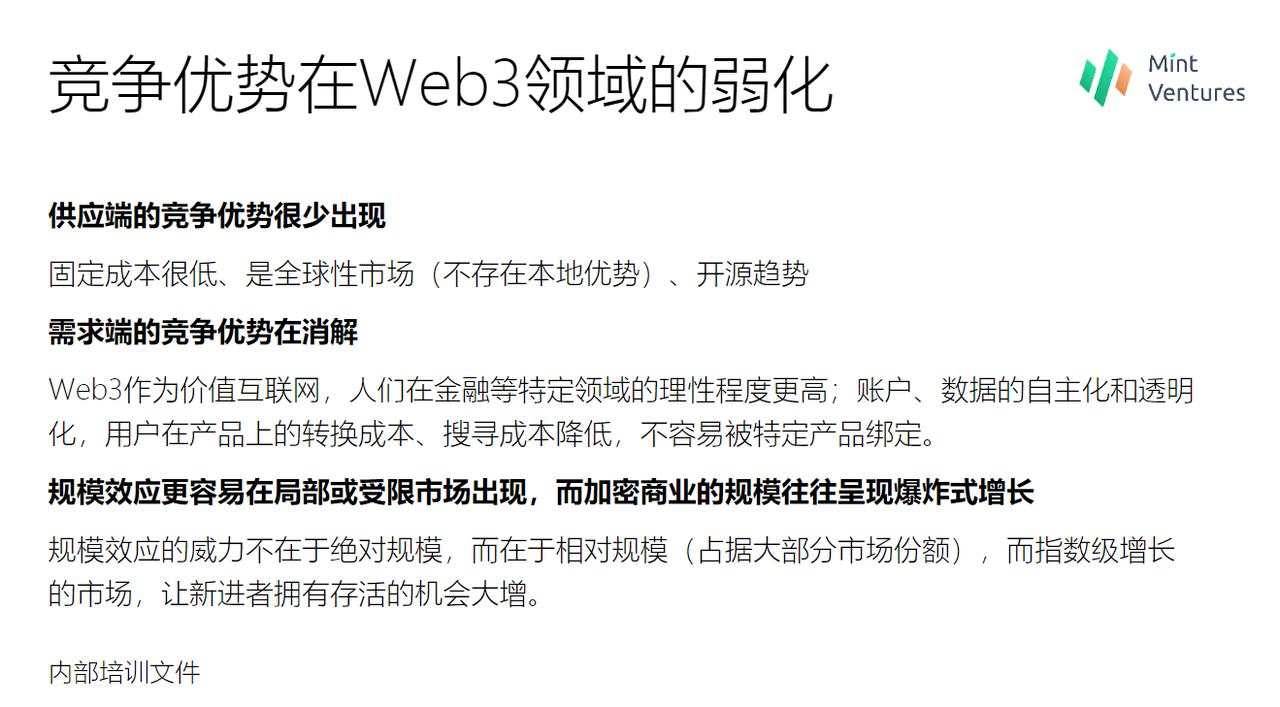
When there are no obvious barriers to competition in an industry, it is a nightmare for investors and entrepreneurs. It is more difficult to build a monopoly in the Web3 business field than in the Internet era, which may mean that it is very difficult to invest in the pursuit of absolute "long-term" and "barriers". More importantly, who can find innovation at the edge earlier, Who can achieve the ultimate efficiency (in a market without barriers, efficiency is the key to survival).
Economic model ≠ business model
The story of StepN tells us: economic model ≠ business model. Only Ponzi will push the economic model to the market as a product itself, otherwise the role of the economic model should be to coordinate and lubricate the multi-party relationship in the business model. Token economists attempt to use a set of economic models to solve various problems such as "product growth" (the actual purpose of X to earn), listing fundraising, and corporate governance. Is this a difficult move worth trying? Or a complete delusion, remains to be seen. But in any case, our concern about "what problem this project is trying to solve" should be placed before "how about its economic model".
The value created by Web3 is greater freedom and lower cost trust
What is the underlying value of Web3? This is a question that all those who invest in Web3 for entrepreneurship and investment should continue to think about. My answer at this stage is that it is permissionless and global, providing a free market with an unprecedented scale and borders, and the open source code and data verifiability provide this unprecedented free market with a lower cost of trust , Prosperity is born from this.
Therefore, projects that do not make good use of the core advantages of Web3 "freedom" and "trust" will face greater difficulties in business. ownership of assets). Projects in which native Web3 assets and business flows can all be chained have natural advantages and are worth our time to study.
Alex Xu's main areas of focus: DeFi and consumer-grade Web3 applications
Past articles by Alex Xu (2022):
Pocket Network: A Revolutionary in the Web3 Infrastructure Layer
Web3 Music Track: Market Background, Commercial Value, Explosion Path and Investment Opportunities
Behind the tens of millions of dollars in gambling: Is Luna a Ponzi scheme?
From currency protocol to DeFi matrix, analyze Frax.finance from multiple angles
The thunder of regulation has finally come, is the spring of decentralized stablecoins coming?
The underlying value of Web3, and how to make a good investment with it?
first level title@xuxiaopengmint
|Colin Li:Annual Impressions on Sentiment, Fundamentals and Innovation
Looking back on the development of the industry in the past year, three things first pop up in my mind:
The first thing is the "dropout All In Web3.0" in March this year, which is related to the popular sentiment
This slogan later evolved into other equally eye-catching slogans such as "Resignation All In Web3.0" and "Divorce All In Web3.0". Some DAOs, KOLs, and well-known organizations also joined the discussion. I remember opening Twitter at that time, and a space with these slogans appeared, and the discussion was very heated. Although I have seen similar slogans when reading books on various financial bubbles before, this is the first time I have truly experienced this process.
This incident gave me several thoughts: First, the longer the bubble lasts, the easier it is for investors involved to believe in an "eternal bull market." Secondly, compared with the traditional capital market, the crypto bubble is easier to get out of the circle. The "dropouts" are the student body, which has not been common in many past bubbles. Finally, it is not impossible to do "flesh stud", but it will test investors' ability to "choose the right time".
The second thing is the Luna crash, which is related to the fundamentals of the project
At the end of March this year, some people in the market estimated that the reserves of LFG (Terra’s ecological fund, which provides interest subsidies for the Anchor agreement) could only last for less than 2 months. At that time, some friends who saved money in Anchor came to ask me about Terra’s Although my suggestion to him was to withdraw the money as soon as possible before the reserve was reached, I did not expect Terra to collapse so quickly, nor did I expect that even many large institutions would be deeply involved in it.
Back to Terra itself, the early "Ponzi marketing" may not be right or wrong, but Terra's ecological development is still out of balance for more than a year after Luna took off, and the "Luna-Anchor" flywheel did not allow the ecology to prosper. This may be the root of Terra's ecological collapse.
In the short term, Luna’s panic stems from the de-anchoring and sniping of UST on the chain, which is precisely due to the shallow liquidity of Luna’s pool on the chain. I'm more inclined to view the UST unanchor as a snipe. There is no shortage of smart investors in the Crypto field. They can not only discover flawed projects, but also capture the window of the trend to overthrow the bubble, and make good use of the attribute of transparency on the chain to mobilize more investors who turn to themselves. Existing in the same ecology as such a shrewd hunter, for me, I need to understand the risk points of the project more than before. I don't want to be a hunter, but I want not to get hurt when hunting happens.
The third thing is Sudoswap’s NFT AMM, which is related to product innovation
secondary title
Looking ahead to the next bull market, here are 5 things to look forward to right now
The first is a decentralized stablecoin
From the birth of the concept of "stable currency" to the present, there have been three waves, especially the wave from 2020, which has made various innovations in the underlying assets, anchoring mechanism, etc., but after this year's After the baptism of the bear market, only fiat currency-collateralized stablecoins and other digital currency overcollateralized stablecoins survived. The innovation of stablecoins seems to have returned to the original point. "Decentralized stable currency" not only has the characteristics of "non-sovereign currency", but also realizes the actual use value connected with various activities in real life. As the world economy becomes more and more volatile today and in the future, we need more than the two types of decentralized stablecoins just mentioned. Therefore, I think that in the next round of bull market, "decentralized stable currency" will still be a track worthy of attention in the bull market, and it may appear in collateral, anchoring mechanism, and value capture ability, which will make people shine The project party can also have strong marketing capabilities, allowing this type of stable currency to circulate at a high speed in the crypto world.
The second is an unsecured loan
In my opinion, Vitalik's concept of "soul-bound tokens" formally indicates that blockchain technology has entered a stage where it can be used on a large scale. Only when users are deeply involved in activities on the chain and economic activities on the chain have a more diverse impact on real life, the "soul-bound token" token is meaningful. Just like WeChat/Twitter accounts, if lost will bring greater inconvenience to real life, then the identity of this kind of virtual world is of great value. And when the activities and identities on a person's chain can be marked with soul-bound tokens, the natural financial attributes of crypto will be combined with it. Under the numerous new financial businesses, I am more optimistic about the unsecured lending track. The current unsecured lending track is mainly aimed at institutions, and it is very difficult for individuals to use credit loans. In the next round of bull market, there may be a convenient unsecured lending business for individuals, and its business scale and growth rate may exceed our imagination.
The third is that the innovation of NFT’s underlying assets brings innovation in securitization
The leap brought about by non-homogeneous assets in the traditional financial field can be traced back to the wave of asset securitization in the 1970s. At that time, ABS, which used personal housing mortgage loans as the underlying asset, led to the development of a series of financial derivatives. Therefore, with the enrichment of the cash flow value and equity value of NFT itself, the corresponding securitization opportunities in the future will also flourish. Now PFP-based mortgage lending may only be a short moment for NFT-Fi.
The fourth is decentralized storage
One of the cornerstones of the "decentralized society" is decentralized storage, which is "disintermediation" at the data level. We have seen more and more NFTs choose decentralized storage services, and with the development of crypto in the future, the demand for this will also increase. One of the current problems is that the traditional business field has not yet seen the significant advantages brought by decentralized storage. Perhaps the outbreak of decentralized storage still needs to wait for the traditional business world to cause risks due to the thunderstorm of centralized storage.
The fifth is that with the intervention of supervision, crypto will become more and more compliant. In this case, it can successfully onboard the application of Web2.0 users
In the past 2 years, friends outside the crypto circle have come to ask me how to enter the Web3.0 world. However, concepts such as "mnemonic", "wallet", "deposit", and "network" dazzled them. Even though most of my friends completed the introduction with my assistance, they were quickly put aside. Therefore, how to lower the user entry threshold has become an important issue to be solved in Web3.0. In this regard, many wallets are making various attempts, and there are also project parties on other tracks making attempts, but so far, the "playability", "ease of use", "investment/ There are only a handful of projects that are well integrated with "smoothness of transaction" and "sustainability of fun". I don't think a separate "wallet" project is necessarily a necessary portal for future Web 3.0 users. Projects that can integrate several dimensions will become explosive models in the future. I don't know which segment this type of project will appear in, but I tend to think it will appear in a certain segment of NFT.
Colin Li's main areas of focus: Stablecoins, unsecured lending, decentralized storage, liquidity staking protocols
Colin Li's past articles (2022):
TrueFi in the CeFi Thunderbolt: Risks and Opportunities of Institutional Credit Lending Business
first level title@ly_wander
|Scarlett Wu:It is easy for popular content and applications to go to the platform, but it is difficult for the platform to incubate popular content
secondary title
The first one is Yuga Labs "redefining the seed round" at the beginning of the year
The $4 billion seed round was particularly impressive. It can be seen from the Yuga Labs Pitch Deck that was circulated that this company established in February 2021 not only has annual revenue of 137 million US dollars in 2021, but also has a net profit rate of more than 90%. Wheel" does seem reasonable.
secondary title
The second is the viral spread of StepN, and the inevitable fall after half a year in GMT
To what extent can X-to-Earn's dual-token model be inflated? StepN in April-May this year gave us the answer. Compared with the dual-token model + Axie, the originator of X-to-Earn, StepN's experience is more "lightweight" (not everyone can play games in front of the computer for a day, but everyone will walk with their mobile phones), wallet experience The interaction is smoother, and the initial experience is easier to use - the insights into market segments and the polishing of product details make StepN stand out from the imitators of Axie. The user scale (according to Forbes' report in May, MAU is up to 2.3 million) is almost the same as that of Axie, and its peak monthly income is more than 100 million US dollars.
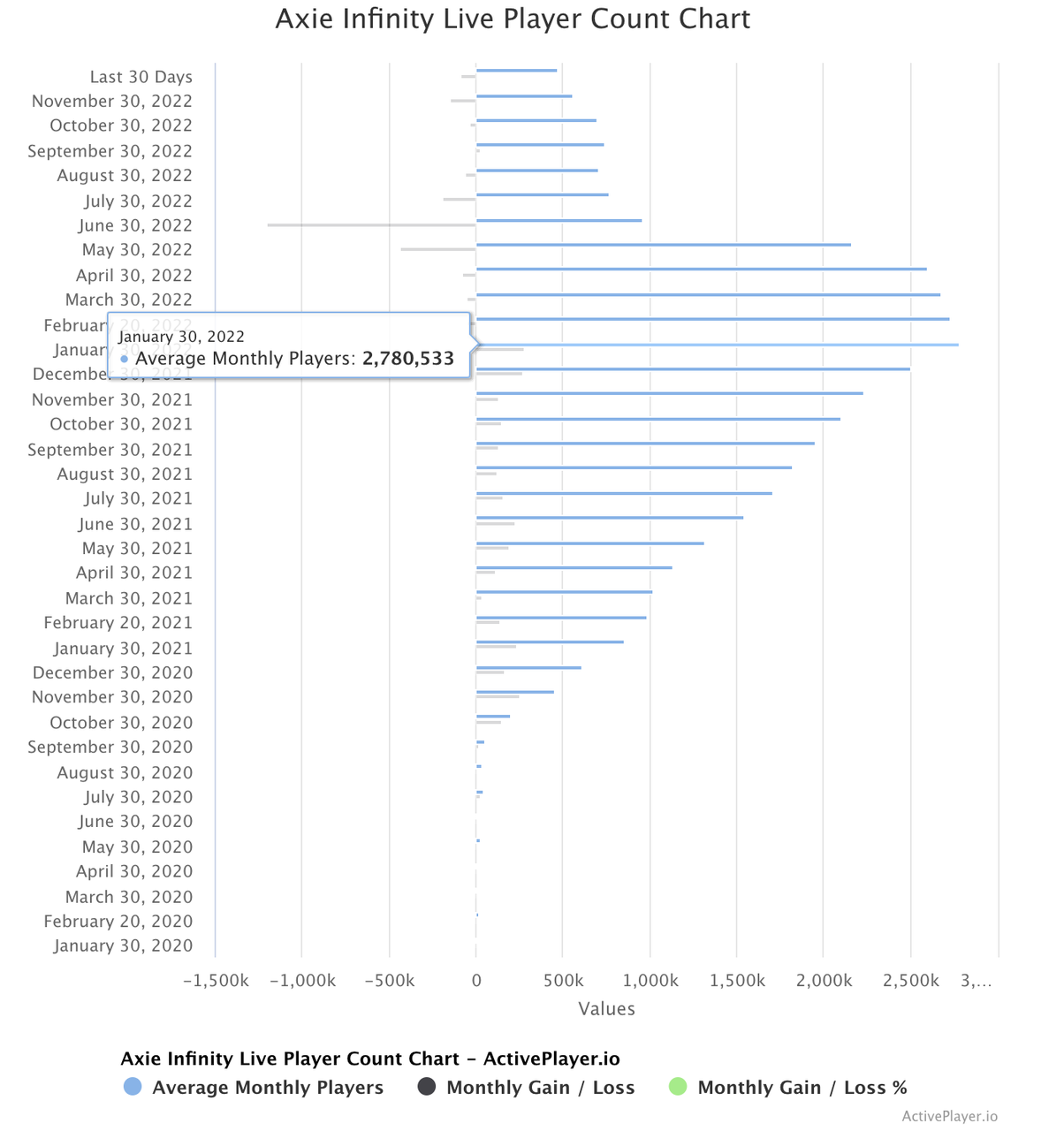
https://activeplayer.io/axie-infinity/
Despite StepN's low-friction virality, silky product experience, and extremely fine-grained token burn mechanism, the fragility of the dual-token model still manifests itself when user growth is sluggish. For VCs who invest in this project, the current price of GMT can still maintain a considerable profit (nearly a hundred times), but it is still unknown what range the price of GMT will enter when VC is unlocked. For the project side that uses X-to-Earn's dream to raise funds from VC, there are three problems that have to be faced:
Can the potential market size (TAM), the refinement of product details, and the governance capacity of the economic system surpass StepN?
If you can’t, you can only hope to give VC a shorter unlocking time in exchange for the possibility of an earlier exit-but Hype’s immediate departure after the end may also hurt VC’s brand. After all, the primary market is a brand that is more important than money industry.
What will be left of the product after the users who flock in due to the increase in the currency price or the potential to make money are gradually losing?
How will Hype affect the product? After Hype ends, will it bring users a better experience than before users enter?
secondary title
The third is the launch of Limit Break. Successful entrepreneurs in the traditional game industry entered Web3 and received a huge financing of 200 million US dollars to lead the industry trend.
Gabriel Leydon is the former CEO of the game manufacturer Machine Zone. He has experienced the arcade era of Atari, seized the trend of mobile games and Free-to-Play, and released many successful games. Such a "serial successful entrepreneur" entered Web3 Gaming is an inspiration to the entire industry. Starting a business in Web3 should not be a second-best option for "there is a lot of hot money in the industry, and it is difficult to obtain financing in other places", but an active choice of "seeing opportunities and taking drastic actions".
secondary title
Regarding the next bull market cycle, trends and investment opportunities worthy of attention
It may be clichéd - especially now that everyone is abandoning a single project to focus on infrastructure - but I still think the best opportunity is in the Killer App. What new users care about is not Ethereum, Polygon, Solana or Aptos, what they care about is what app is interesting, what app my friends are using.
The underlying blockchain, wallet, or various composable small components, although they have certain technical barriers, they are not real barriers compared to "having millions of highly sticky active users". The premise of Steam becoming a gaming platform is that Valve's "Half-Life" needs to be downloaded on it-content brings traffic, not traffic brings content. At present, most game platforms are hoping that the traffic will bring content, and the source of the traffic is the anticipation of airdrops and the lottery of re-likes and comments for business cooperation-such traffic is of low value and the barriers are also very weak.
Therefore, I still think that it is easy to go from content and app to platform/infrastructure, but it is more difficult to go from infrastructure/platform to content, especially when there are many giants. It is also a good example that the popularity of StepN at the beginning of the year caused Solana to go down. Most users may have never touched Solana, or never touched Web3, but this does not prevent them from having fun in StepN.
Regarding products and Tokenomics, I think the importance of Tokenomics in the current market has been overemphasized, while PMF (Product Market Fit) has been overemphasized.
PMF (Product Market Fit, that is, the fit between the product and the market demand, editor’s note) has been overly ignored. The flywheel of Tokenomics has turned the pseudo-demand. Going back to the first question, the three aspects of the X-to-Earn project Consideration is essentially thinking about "how to prolong the time of ecological prosperity" and "increasing the income of projects during the prosperous period", and then corresponding to the income of investors.Pseudo-demand can be driven by Ponzi, but once the bubble bursts and no new users enter the market, the cycle of prosperity will only get shorter and shorter.
Tokenomics is also very important. Good Tokenomics can promote growth and maintain long-term prosperity. At the same time, it should be combined with the mechanism and purpose of the product itself. Projects with below-average Tokenomics on the market are all making the same mistake: they only understand the potential growth brought about by the dual-token model, ignoring the problems that the product hopes to solve, when it needs to grow, and what kind of users it is facing. And correspondingly, how the economic model should assist growth demand. In fact, the real demand may also grow better because of Tokenomics, because the demand that can be solved can generate income (without investment return expectation), and Tokenomics highly securitizes assets, which greatly promotes the flywheel of early user acquisition .
Recently, I am re-understanding the history of Internet companies that appeared around 2000. The operation of raising valuations during the bubble in Silicon Valley back then is quite similar to the current Crypto circle: head VCs have invested in one or two listings such as Amazon and eBay The startup companies that invest in follow-up projects will have a good valuation support-even if they may not actually find a PMF, a great story may make the listed company pay for it, and the listed company will use the innovative concept of stock price to re-invest record high. In the era when PayPal was not yet popular, eBay, which was valued at tens of billions of dollars, was actually supported by a story that "need to send a check to buy second-hand dolls online", which seemed ridiculous. In such absurdity, the bubble burst, but a new generation of Internet giants grew up, and Amazon is the leader of the new generation of giants with a market value of nearly one trillion US dollars.
Comparing the stock price changes of eBay and Amazon, we can see something new: how a product that finds its own positioning and always maintains innovation will gradually stand out after going through cycles.
When eBay went public in 1998, its market value was US$700 million. At the peak of the Internet bubble in 2000, its market value reached US$14.4 billion. When the bubble burst in 2001, the market value returned to US$3.2 billion at its lowest. (Think about BTC ETH's cut in half and then cut in half...)
When Amazon went public in 1997, its market value was US$400 million. At the peak of the Internet bubble in 2000, the market value reached US$36 billion. When the bubble burst in 2001, the market value returned to US$2.1 billion at the lowest. (More ups and downs than altcoins...)
However, the subsequent direction of the two companies is quite different:
eBay reached US$33 billion in 2004, peaked at US$54.9 billion in the 21-year bubble, and is now returning to US$23 billion.
Amazon has been singing all the way, from 2.1 billion US dollars in 2001 to nearly 2 trillion US dollars in the bubble in 21 years. Although it has fallen back, its market value is still close to 1 trillion US dollars.
For investors who watched their stocks depreciate in various degrees in 2001, it may be difficult to imagine where they will go in the future. For crypto believers, the current Crypto market is like the messy scene where the .com bubble burst in 2001. Is the token in hand the next Amazon, or the next eBay? Or the countless nameless companies that went bankrupt in the dead of winter?
This is something we all need to keep thinking about.
Scarlett Wu's main areas of focus: Games, NFTs, AI, and other consumer Dapps
Past articles by Scarlett Wu (2022):
first level title@scarlettwu_eth
|snapp_ye:secondary title
What impressed me the most in 2022 is: the layout and competition of OP and ZK series for the L2 market
Let’s briefly review the important events in the L2 market this year. First, let’s talk about zk’s competition for the market:
The L2 war caused by Polygon
In July 2022, Polygon was the first to announce the achievement of ZKEVM equivalence. Within a month, the Polygon token price surged from $0.34 to $0.95. The surge of Polygon has caused unprecedented Layer 2 heat.
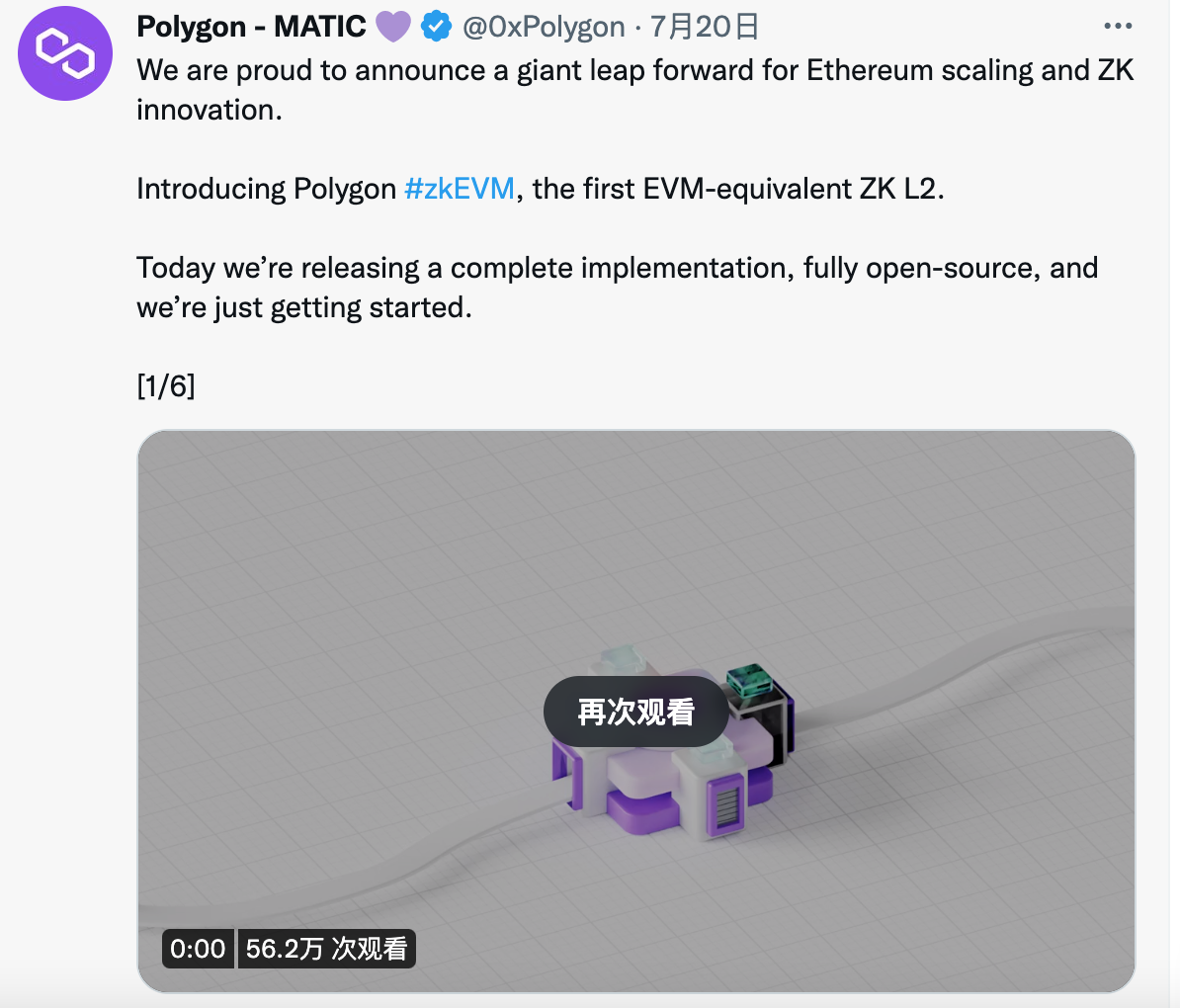
However, Polygon's publicity is completely hype. As Polygon released the ZKEVM code on July 21, the public found that the relevant programs were almost unusable, and then Polygon tokens fell rapidly. Many friends who are familiar with ZKEVM successfully shorted on the evening of July 20th and made a lot of money.
On October 11, 2022, Polygon will launch the public testnet, and the actual progress is much slower than the publicity.
zkSync's quick follow-up
As one of the leaders of ZK Rollup, zkSync responded quickly. In July 2022, zkSync officially released the 100-day ZKEVM mainnet countdown, and the ZKEVM mainnet is expected to be officially launched on October 28. In October 2022, ZKEVM once again attracted a lot of attention, but on October 28, zkSync launched the "Baby-Alpha" version of the mainnet, which cannot be opened to the public, nor can it be deployed by developers. The contract, in fact, can only be regarded as an internal test version at most. Subsequently, zkSync released several mainnet upgrade plans, which are expected to be launched in 2023.
As one of the leaders of ZK Rollup, zkSync responded quickly. In July 2022, zkSync officially released the 100-day ZKEVM mainnet countdown, and the ZKEVM mainnet is expected to be officially launched on October 28. In October 2022, ZKEVM once again attracted a lot of attention, but on October 28, zkSync launched the "Baby-Alpha" version of the mainnet, which cannot be opened to the public, nor can it be deployed by developers. The contract, in fact, can only be regarded as an internal test version at most. Subsequently, zkSync released several mainnet upgrade plans, which are expected to be launched in 2023.
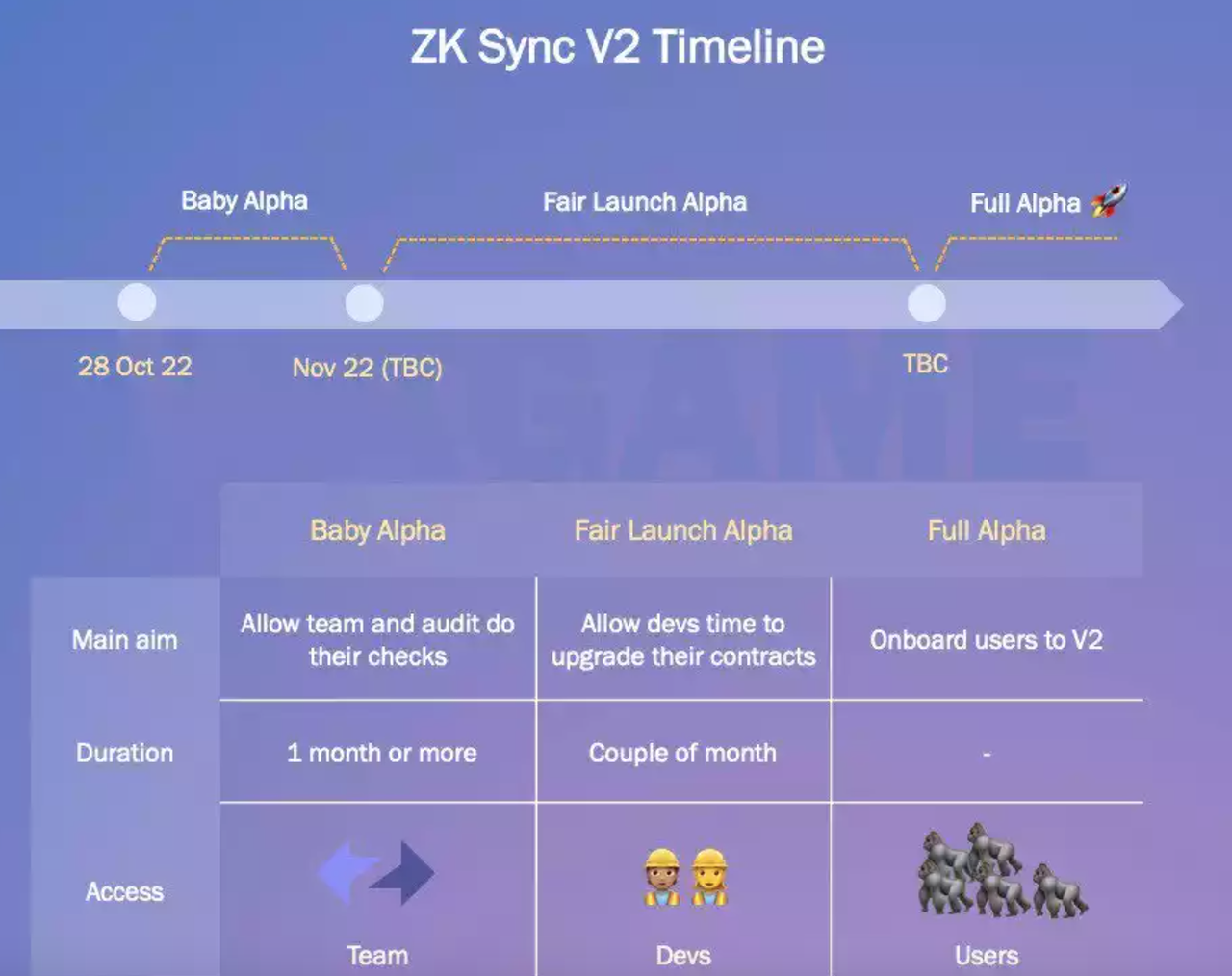
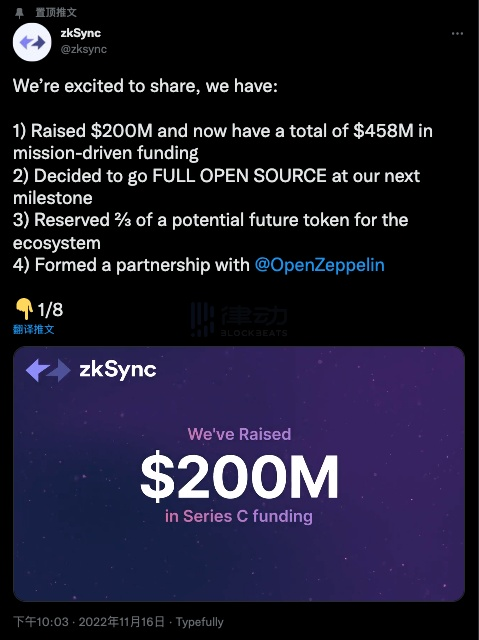
Due to the extremely high popularity of the ZKEVM market, the news of this "closed beta mainnet" did not affect the enthusiasm of investors at all. On November 16, 2022, zkSync development company Matter Labs completed a $200 million Series C round of financing.
Mistake of Scroll
On July 19, 2022, Scroll announced the launch of the Pre-Alpha version of the test network and opened applications for internal testing. Because the official announcement time of Polygon and zkSync happened to overlap, the jokes that the three major ZK Rollups suddenly realized the equivalent of ZKEVM at the same time flooded the entire network. However, the internal test version of Scroll basically meets the publicity expectations. The current test network quota is developed in an orderly manner, and the ecological construction is steadily advancing, showing the relatively pragmatic side of the Scroll project.
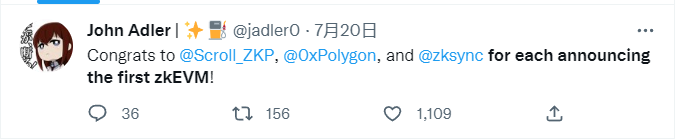
At the same time, Scroll's vision in decentralized parallel proof (commonly known as mining) and the choice of data availability solutions (rejection of zkPorter mode, etc.) all give people the feeling of Web 3-native.
Let’s look at the actions of the OP department:
The Vision of Optimism
In October 2022, when zkSync's "mainnet launch" triggered the ZKEVM trend, Optimsim was not to be outdone, and quickly announced the ambitious OP Stack.
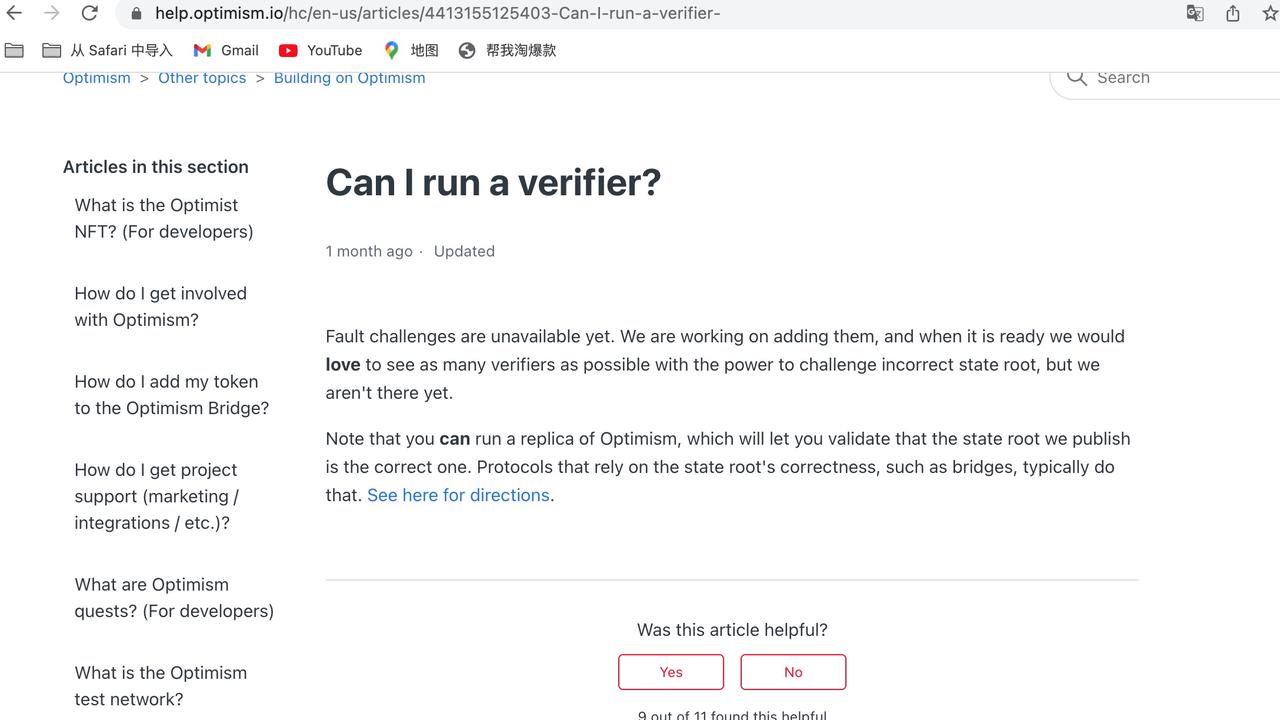
In Optimism's vision, Optimism, which inherits the security of Ethereum, can be used as the bottom layer of a large number of application chains. Various application chains rely on Optimism for all-round cross-chain interoperability, which is also called Cosmos on Ethereum.
However, since Optimism was upgraded in November 2021, there has been no fraud proof of normal operation for a long time, and the security of Optimism has also been questioned.
Arbitrum's Counterattack:
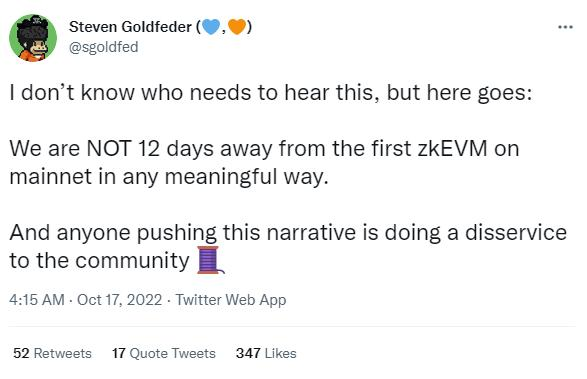
In July 2022, the CEO of the Arbitrum team called Polygon ZKEVM, thinking that the latter was almost unusable.
In October 2022, the CEO of Arbitrum stated again that now advocating ZKEVM is harming the entire community.
There are many reasons to pay attention to L2:
The long-term development space of Layer 2 is huge:On the one hand, the processing capacity of Ethereum is extremely limited, requiring a large number of Layer 2 to execute specific transactions to achieve expansion, so as to land in the real world on a large scale. On the other hand, with the rapid increase of application scenarios on the chain, the requirements of the application on the chain for the execution layer are also more diverse. A large number of Layer 2 with different characteristics interact through the Ethereum main chain, which is the future trend of the blockchain.
Layer 2 has more potential investment opportunities in the next 1-2 years:For example, the opportunity to issue coins for Layer 2 projects. Currently, the mainstream players of the OP series and ZK series, except Polygon, which is relatively special and has already issued coins, and Optimism, which issued coins in June this year, the rest of the mainstream projects will generally issue coins in the next 1-2 years:
Starkware
In July 2022, Starkware officially announced the issuance of the token Starknet, and announced that the Starknet token will become a gas fee payment token. On November 16, the token contract was officially deployed on the Ethereum mainnet, but it is not yet open for trading and use.
zkSync
In November 2022, the project party will allocate 2/3 of the tokens to the community after issuing the tokens (Note: Starknet allocates 1/2 to the community). Considering that projects such as zkPorter must ensure security through token pledges, and zkSync will basically be able to launch the mainnet in the next two years, zkSync tokens will basically go online in the next two years.
Scroll
Scroll is characterized by zero-knowledge proof mining. Since the current ZK Rollup is a package (Sequecer)-proof (Prover) operation mode, and zero-knowledge proof generation is much slower than transaction packaging, Scroll conceived a complete decentralized parallel In the proof mode, Scroll tokens are expected to be used as mining rewards to encourage miners to use better hardware to participate in proof generation.
The Scroll mainnet is also expected to be launched in the next 2 years, and due to the mining mechanism, Scroll tokens will inevitably be required when the mainnet goes online, and Scroll tokens have a certain value capture capability.
secondary title
Theoretical Optimal ZK Rollup
Since Ethereum can only process about 15 transactions per second, it is far below the actual demand. Therefore, expansion has become the only way for the blockchain to be implemented. The basic logic of Ethereum off-chain expansion is to allow Layer 2 to process multiple transactions, and then hand them over to the Ethereum main chain for verification and archiving. The previous off-chain expansion schemes basically could not allow transactions to be compressed and verified by the Ethereum main chain, but zero-knowledge proofs can compress dozens of transactions into verifiable proofs that are only the size of the original transaction, thereby improving blockchain performance. Substantially improved. Therefore, ZK Rollup has become the theoretically best expansion solution for Ethereum.
Why is it "long-term bullish on ZK"?
First of all, for the same math problem, the process of calculation and proof is almost completely reversed, which means that the proof will be a complete reconstruction of calculation. Secondly, for Ethereum, many early computing processes were very unfriendly to zero-knowledge proofs, which led to a long way to go for ZK Rollup to reproduce the Ethereum Virtual Machine (EVM).
Other thoughts:
About Layer 2:
In general, the concept of "short-term view of OP, long-term view of ZK" has been deeply rooted in the hearts of the people. ZK Rollup has made some progress in the past year, and has begun to lead the "Layer 2 Summer" trend. ZK Rollup's internal competition for online time has almost become fierce, while the OP department (especially Arbitrum) hopes that ZK Rollup will The landing is later, so as to obtain more development space.
The future is multi-chain, and it is likely to be a Cross-Rollup interaction with Ethereum as a shared security layer. Therefore, ZK Rollup with its own characteristics has more development opportunities.
Layer 2 investment opportunities:
Opportunities in the ZK mining track
Since ZK Rollup proves to be much slower than transaction packaging, and the more compatible it is with Ethereum, the slower the proof, then the speed of proof through hardware improvement will be the long-term development direction in the future. Considering that Scroll and other leading projects that have announced zero-knowledge proof mining, the layout opportunities of the original mining industry are also prominent.
Opportunities for investing in ZK tokens
The basic type of ZK Rollup revenue and expenditure is to charge users gas fees, which are used for project operating costs, certification fees for Layer 1, and release fees for Layer 1.
Taking the zkSync block numbered 90415 as an example, zkSync charges the user a gas fee of $9.92 in total, and spends a total of $19.91 in proof fees and $42.20 in release fees to Ethereum. At this time, zkSync is obviously in a serious balance of payments. This imbalance often needs to lubricate the entire business model through the issuance of tokens.
In the era of no currency issuance, zkSync often needs to pay $50 in cash to subsidize the production of a block, but in the basic model of currency issuance, the project party can choose to pay zkSync tokens for miners to subsidize. As the cost of zkSync gradually decreases, To achieve balance of payments and gain more market share, zkSync token holders are also expected to share the dividends of zkSync ecological development. This is a business model similar to traditional corporate option incentives.
It is through such an economic model that Bitcoin subversively realizes commercial development without capital and financing. The current IPFS storage cost is much higher than that of the storage center, but due to the Filecoin token subsidy, decentralized storage has still achieved good development.
In general, tokens are a financial innovation tool, allowing projects that are not yet mature and costly to come to the general public ahead of time.
Therefore, the ZK Rollup project party is very willing to use token tools to lubricate the business model. These tokens will bring us more investment opportunities.
snapp_ye's main focus areas: public chain, Layer 2, zero-knowledge proof
Past articles by snapp_ye (2022):
Aptos, Solana and the New Public Chain Periodic Law
first level title@snapp_yebit
|Feifei: Former employee of a major Internet company, now a Web3 investment worker, the first year of crossover
secondary title
First, is it a good time to join Web3?
After more than two decades of rapid development, the Internet has reached a bottleneck.
At the beginning of this year, I kept asking myself, what industries still have at least ten years of growth, and where are the opportunities for the next generation of Internet. After repeated discussions with many friends around me, the answer I found was Web3.
So what is the current status of Web3? I want to talk about one thing from the perspective of user needs that product managers (my professional background in the Internet) often say, NetEase and Blizzard broke up in November this year. The suspension of the game this time has once again pushed gamers' demands for "account/equipment ownership" to the public.
Where there is demand, there is opportunity. Web3 project development and user needs are mutually reinforcing. Whether it is the improvement of traditional finance by Defi, or the new gameplay created by new value media such as NFT for marketing, or Gamefi and Socialfi, which are still exploring business models. Due to the increasing maturity and growth of user needs, web3 natives are growing rapidly, and now Web3 is replicating the original golden age of the early Internet.
In addition, although the thunderstorms of Luna and FTX have brought more government regulatory actions and negative voices on Web3, the obvious change is that the policies of many countries have changed from resistance to regulation and coexistence in recent years.
Take Hong Kong as an example. At the Web3 conference at the end of October, the Financial Secretary of Hong Kong officially released the "Policy Declaration on the Development of Virtual Assets in Hong Kong". In the future, Hong Kong will speed up the improvement of the licensing system for virtual asset service providers, and will conduct public consultation on the appropriateness of retail investors to buy and sell virtual assets. It is also open to the introduction of virtual asset exchange-traded funds (ETFs) in Hong Kong. Major cities in China are also trying to explore Web3-related industries such as Metaverse and digital collections.
secondary title
Second, how to find opportunities in Web3?
In fact, the opportunity of Web3 is basically a reflection of Web2. You can choose to invest or do projects, start your own business or join a team. In terms of specific responsibilities, you can be responsible for development or community operations; in terms of direction, you can choose Gamefi or NFT track etc. All you need to do is to combine your own background, interests, abilities, and goals to make the best choice for you.
Perhaps many friends already know what kind of opportunities they are looking for, but they don't know how to find them. My suggestion is to "strengthen the initiative".
Different from Web2, as an employee of a large factory who passively waits for a headhunter to call and change jobs, in the budding development of Web3, everything requires you to play a subjective role.
If you want to find your favorite project team to join, go to the official website of high-quality projects by yourself, and write emails to actively apply for jobs. If you want to know a certain big cow, you will take the initiative to add his Twitter and write your own cognition and appeal. I joined Mint Ventures, and I also got the opportunity to write an email on my own initiative.
secondary title
Third, as a newcomer to Web3, how do you improve yourself?
No matter what direction you choose, no matter what background you have before, the core of entering Web3 and wanting to gain something in the end is "love and persist". As long as these two points are truly achieved, there will be a continuous internal driving force for learning and growth. I believe that half a year will be enough for you to become a senior person in a certain track/field.
Taking myself as an example, I went to work across cities just one month after giving birth. In the first few months, I kept reading and practicing various Web3 projects every day, except for sleeping time. My personal experience is that as long as you have read/operated the white papers of the top 100 projects and used their products, then your understanding of Web3 can exceed 90% of the people in the circle.
In addition, if possible, it is also recommended that you continue to output on social platforms to output counter-forced input. In order to keep myself from slacking off, after a few months in the industry, I also wrote a public account "Web3 100 days" with my friends to record our cognitive analysis of Web3 starting from 0.
Of course, in addition to these, if you can find a good platform for Web3 and have a group of like-minded friends, it will be even more powerful for your growth and development. Personally, Mint Ventures has really helped me grow. Finally, I wish you all the best in the Web3 field, where the sea is wide and the sky is high.
Feifei's main areas of focus: Defi, Socialfi, more secondary market
first level titleWeb3 100 days
|Jessica Shen:Still looking forward to more surprises from the NFT market
The events that impressed me in the past year include the collapse of the Luna empire, the exit of StepN products, and the entry of a large number of traditional Internet talents into Web3.
The collapse of the Luna empire had a huge negative impact on the industry, and the cryptocurrency world is still in aftershocks.Although I was not a major loser or beneficiary of the Luna crash, this incident allowed me to see the magic and charm of the cryptocurrency industry, and it also gave me a deeper understanding and awareness of the limitations of the industry. Contrary to many investors, the Luna debacle has strengthened my faith in the industry.
The cryptocurrency world is a Pandora's box. "These violent delights have violent ends." This is the advice that a friend gave me when I was new to cryptocurrency. In the days when the incident happened, I have been following the market changes and progress of the Luna incident, and heard the analysis of the impact of the incident on different Twitter Spaces and various podcasts. The currency and the overall ecology of Terra have changed from heaven to hell in a few days. In such an event, it is inevitable to hear "bad news" coming from afar. For a long period of time since then, aftershocks have affected many institutions including Three Arrows Capital. From well-known investment institutions to ordinary individual investors around them, they have all been negatively affected by the incident. I was deeply impressed by the swiftness of the crash and the intensity of its impact. A word from a friend becomes a prophecy. People who make a lot of money in the bull market are swimming naked when the bear market comes.
The disconnect between the cryptocurrency world and the real world is huge, especially in mainland China. While I was worrying and regretting the "Lehman" incident in the encrypted world, I was isolated at home in Shanghai in real life. The only "free" time I had every day was to go downstairs and line up with my neighbors to do nucleic acid. Looking at the singing of birds and flowers and laughter in the real world, it seems that nothing happened. In mainland China, the popularity of Web3 is still very low, but in Hong Kong, Singapore, the United States, Europe and other places, Web3, NFT and cryptocurrency have become popular topics. The penetration and impact of cryptocurrencies on everyone's life and work is slowly happening around the world. Undoubtedly, we will see more users and capital entering the industry in the future.
2022 is also the year when traditional Internet talents will enter Web3 in large numbers.image description
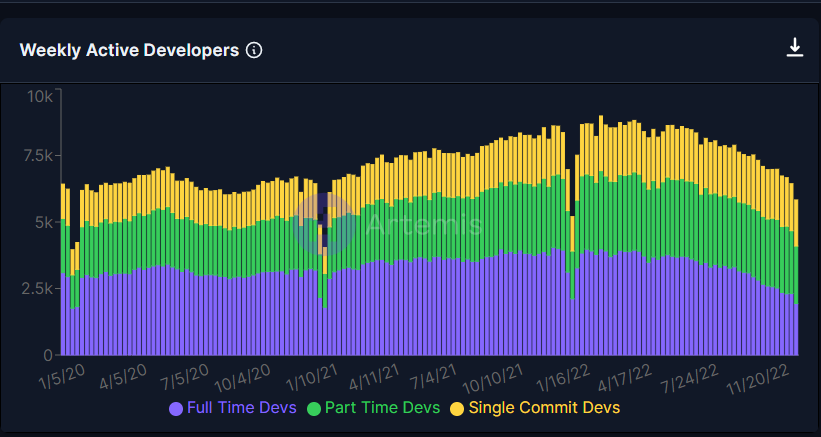
Image Source:GoKuStatsimage description
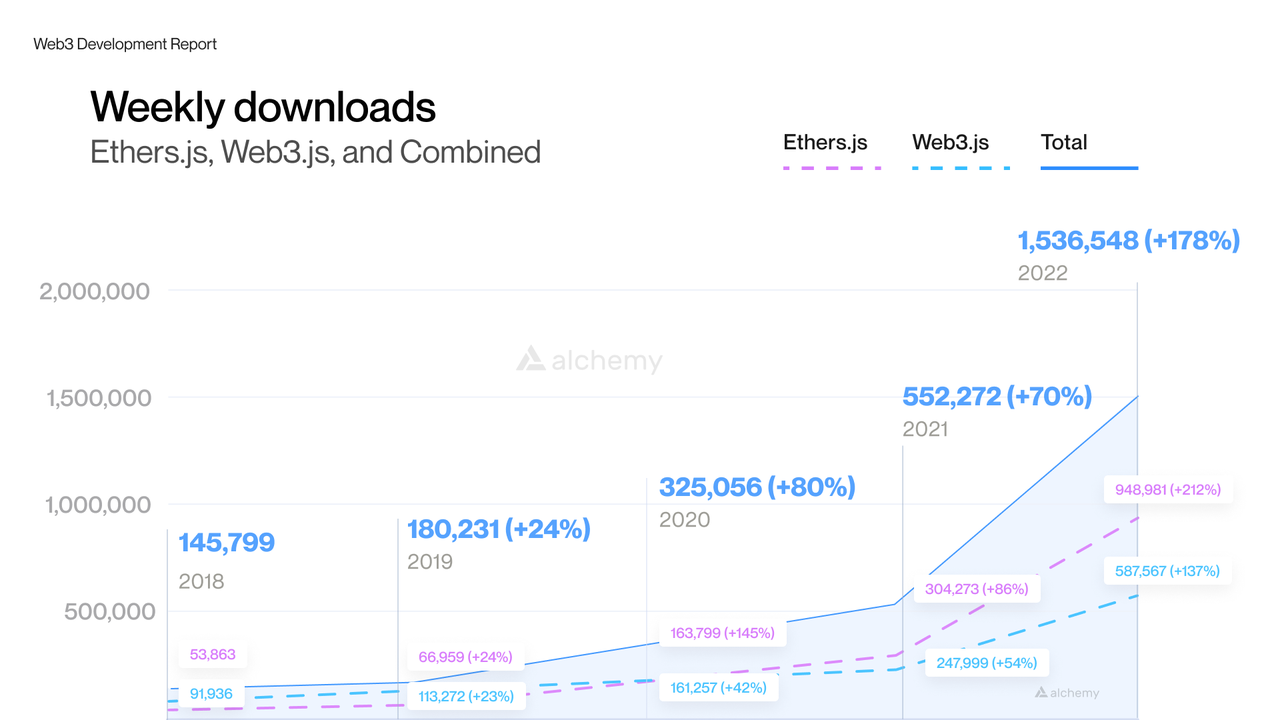
image descriptionWeb3 Developer Report (Q3 2022) by Alchemy
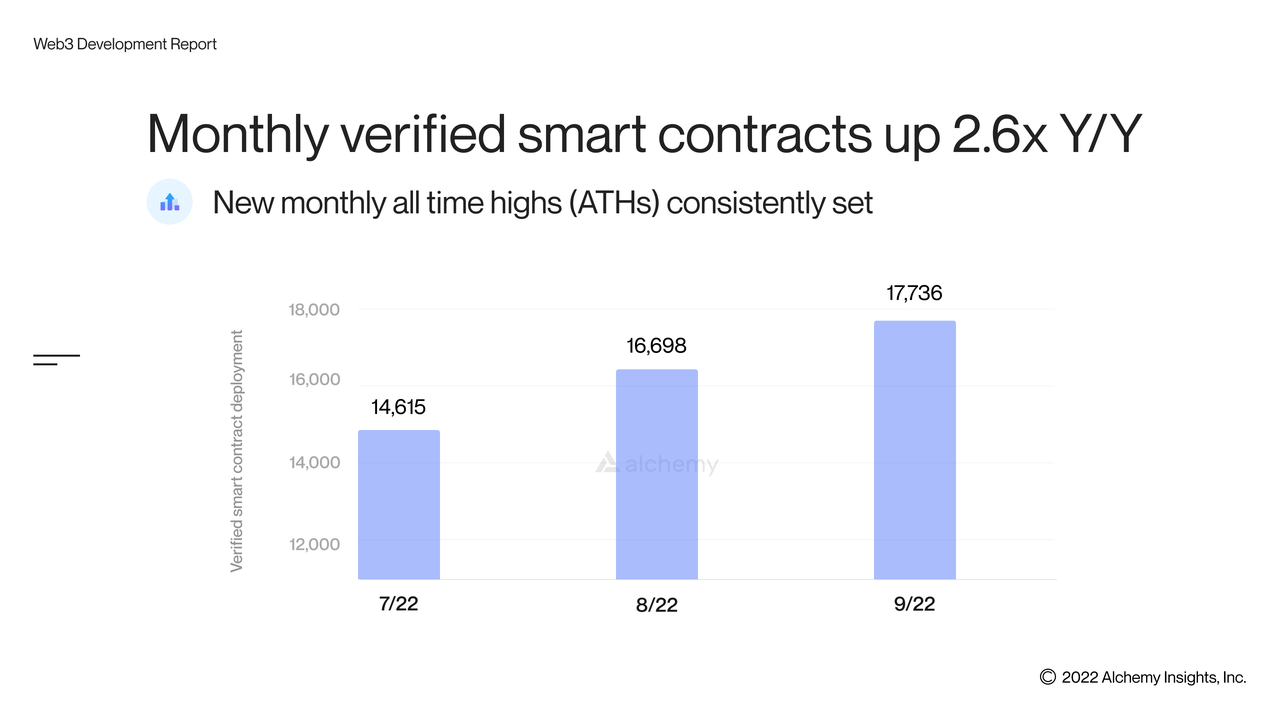
Image Source:Web3 Developer Report (Q3 2022) by Alchemy
image description
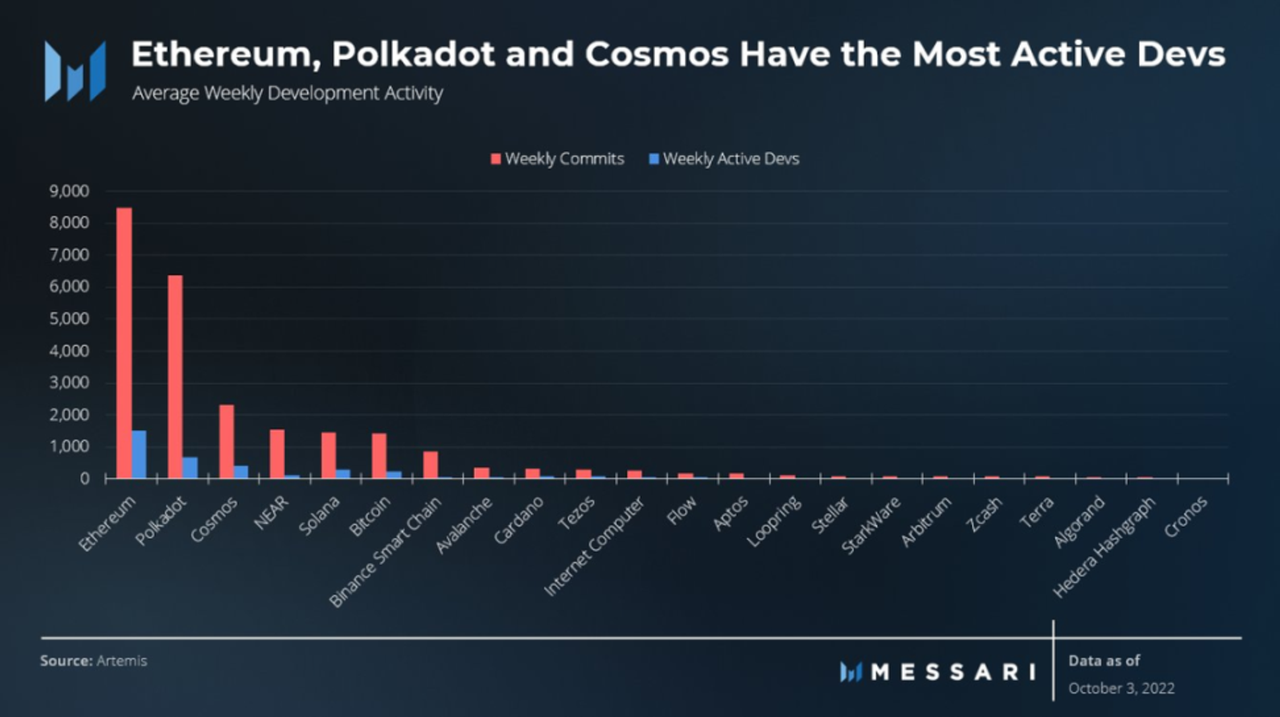
Image credit: Messari
The release of StepN products is also a hot event this year. The hottest project in the first half of the year, StepN, brought a large number of people who knew nothing about cryptocurrencies and Web3 into the world, although it was controversial in terms of team management, regulatory policies, and token models. My reflection on this incident is that people in the circle are expecting more participants to join, and if there is no product with excellent user experience or profit-driven products as a window, the cost of learning for outsiders is huge, from private keys to assets. Security, from the various abbreviations in the cryptocurrency world to the esoteric token model, between the two is the uncertainty of regulatory policies, and the frequent scandals in the circle have caused the lack of public confidence. Having said that, I have great expectations for the expansion of the cryptocurrency market, harmonization with regulation, technological advancement and stronger security.
In the field of cryptocurrency, the trends and tracks that I will pay more attention to in the future are:
The future of infrastructure around asset security is still the focus of industry development
secondary title
Let me talk about the infrastructure around asset security
There are many thieves in the bear market. We have seen too many hacking incidents in 2022. As more and more traditional capital interest ties are extended to the field of cryptocurrency, the degree of regulatory review is constantly under martial law. Regulatory escalation in preparation for what will appear to be more funds and users participating in cryptocurrency activities. At the same time, incidents of multiple centralized exchanges misappropriating user funds in violation of regulations were exposed in 2022, and the centralized custody mechanism once again lost the trust of Web3 users. For users and funds who are accustomed to the centralized trust mechanism model, protecting asset security will be the top priority when participating in "decentralized society" activities, and it is the same for native capital and new capital of cryptocurrency. However, due to the nature of decentralization and "weak" supervision, various infrastructures around asset security protection will be the "just needed" that has been continuously concerned in the cryptocurrency industry.
In this field, the wallet, as an important asset gathering place and user traffic entrance, has the role of "gatekeeper". There are various types of wallets. Since the birth of Bitcoin, the meaning of wallets has also extended from simple asset management, transfer and bookkeeping to asset management, on-chain applications, and social status symbols. According to equipment, there are hardware wallets and software wallets. According to custody methods, there are self-custody, co-custody (multi-signature) and centralized third-party custody. According to signature algorithms, there are single signature, multi-signature, and single private key. MPC


