






2023 Encryption Industry Theme Forecast: Layer1, Dapp, NFT, GameFi...


Compilation of the original text: The Way of DeFi
Compilation of the original text: The Way of DeFi
If you are reading this, you are probably a true believer, a very smart trader (who has lived through multiple cryptocurrency cycles), or someone who really thinks cryptocurrencies are here to stay. In addition to technological innovation, the encryption market will decline in almost every angle in 2022. Even so, innovation at the protocol and application level has me very excited about the future of the crypto industry in 2023 and beyond.
In this article, after a very brief discussion of price, I'll cover some relevant topics about blockchain, applications, and mainstream adoption. I hope you enjoyed these thought-provoking perspectives, and that you were diverse enough to provide some feedback.
This is what I believe will happen in 2023, enjoy it!
Price trend
The latest narrative is that crypto capitulation has happened and only true crypto believers still believe in the industry. I've also read about "time-based market capitulation," which basically boils down to investors getting bored or finding a more productive place to move their capital. For example, if the $ETH price hasn't moved in 6 months and you can earn 2.5% in your savings account, you might decide to move your funds.
Bitcoin is a difficult asset to hold on to for several reasons:
It is highly correlated with Nasdaq as the TradFi trading algorithm has been incorporated into the crypto industry
Mt. Gox compensation is expected to be distributed sometime in 2023. A supply of 150,000 BTC (worth $25 billion) is expected to be distributed to those affected by the hack.
Digital Currency Group suffered huge losses from its Genesis loan to FTX and Grayscale's GBTC product, which is now at a negative premium of 47.5%. Investors are concerned that Grayscale may need to liquidate some of their BTC to raise enough funds to keep DCG solvent.
I still subscribe to the idea that crypto will follow in TradFi's footsteps, however, crypto-native money will continue to flow out of BTC and into good layer 1 tokens + DApp tokens. This also means that Bitcoin dominance should continue to decline. My best hope is that as the recession and potential stagflation start to drive the stock market sideways, with earnings adjusted downwards, rate hikes continue until they reach an eventual rate above 5%.
The first layer (Layer 1)
Solidity has already won the race among smart contract languages (yes,I know there are new versions like Vyper...) so next year"
Neon and Nitro on Solana
Canto, Monad, and Berachain on Cosmos. Canto has a first mover advantage, but the hype surrounding Berachain's innovative liquid staking and delta neutral perps machine is intense.
After two years of VCs adopting predatory tactics at the height of cheap money, the retail industry has been slaughtered by predatory practices that allow locking and hedging early token allocation multiples via perps.
So I'm very bullish on organic, true builder-centric communities that aren't VC related. Specifically:
Ethereum and L2s (mainly Arbitrum and Optimism)
Fantom
Canto
Instead, until better token practices emerge, I am pessimistic about the following projects:
Aptos
Sui
Solana
Avalance
Near
I'm also bearish on Bitcoin, but it shouldn't even be called L1 due to its utter lack of utility and inflation hedge/store of value narrative failure. The only way $BTC will outperform $ETH in 2023 is if the following happens:
Some regulations are passed that harm smart contract platforms or PoS
Major currency failure or depreciation (EUR, JPY, USD)
The following are the blockchain ecosystems that I am preparing to try and think have potential:
Binance Smart Chain because of the Wombat ecosystem (incentivized stablecoin swaps), Thena (Solidly-style DEX) and Level (perpetual protocol). OpenSea also recently added support for BSCs, which may drive more NFT activity. CZ will support BSC's ecosystem at all costs, but centralization is dangerous, so I will always limit the funds I put on chain.
Osmosis has recently added new applications, namely stablecoin swaps and liquidity staking (Stride, Quicksilver). The Mars protocol is also on the way, which should significantly improve capital efficiency and become a part of the $OSMO token pool.
Synapse (Synchain) is a trusted bridge that has gone extensive and introduced $nUSD to transfer value across chains. Synchain is an Optimistic rollup expected to roll out soon with numerous partner protocols. Berachain is also interested in using Synapse as its canonical bridge, which could bring additional transaction volume. Synapse has a lot of questions to answer around specific progress on Synchain, token economics, and delivery for me to make a significant investment.
If only the Cosmos Hub could figure out the ATOM 2.0 token economics and clean up the governance/infighting. Unfortunately, "good tech, bad tokenology" only seems to benefit early insiders, while retail investors get hurt.
I'm also keeping a close eye on the other two Cosmos chains, which could become monsters if they deliver.
Sei has the shortest block time in Cosmos (0.6 second finality) and has figured out how to parallelize transactions to prevent MEV.
Ethereum
Ethereum
The next and final hard fork of Ethereum 2.0 is the Shanghai upgrade. This will unlock $ETH from the beacon chain, PoS, chain. The upgrade, scheduled for next March, should result in a massive increase in the staked supply, as it reassures investors that they can get their ETH back.
At the same time, we have seen Liquid Staking Derivatives (LSD) grow rapidly in 2022, and I predict they will grow faster than the new inflationary supply of ETH in 2023.
image description
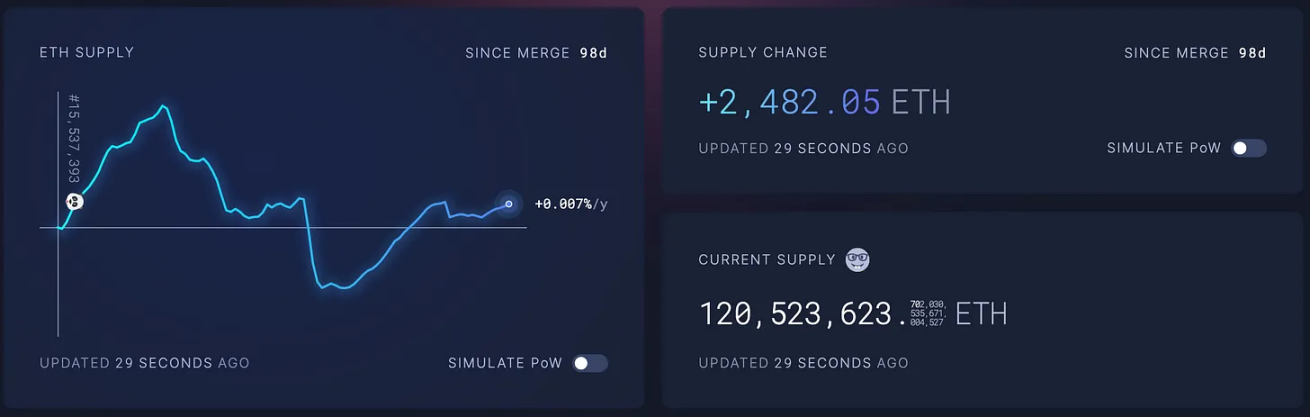
Source: ultrasound.money
Derivatives
Derivatives
On-chain perpetual markets explode in 2022 thanks to GMX (bear market darling - imagine transaction volume and fees in a bull market), Perpetual Protocol, and Gains Network. Arbitrum is becoming a liquidity hub as each protocol is deployed or migrated. I expect on-chain options to really improve in 2023. Dopex, Buffer and Premia run on Arbitrum, while Aevo is built on Ribbon. These will all double their TVL in 2023, despite lower liquidity.
Structured products and vaults will grow exponentially in 2023 as perpetuals and options combine.
Delta-neutral vaults like Rage Trade and Umami are likely to continue to attract crypto-native capital and eventually institutional capital due to their higher risk-adjusted yields.
decentralized exchange
By 2023, DEXs such as Velodrome ($VELO), Equalizer ($EQUAL), Thena ($THE) and Camelot ($GRAIL) will outperform Uni v2 type products (e.g. $SUSHI, $QUICK, $ BOO) and $UNI. Tokens with real yield, sustainable token release, and built-in bribery mechanisms should be less volatile and generate income in sideways markets.
borrow money
The undercollateralized lending track took a big step backwards after the FTX incident, but I believe it will still grow by 2023. Due to the over-collateralized nature of loans, DeFi is doing extremely well, and capital efficiency will be front and center for large capital pools.
crvUSD is just the beginning of DEX-centric stablecoins. Univ3 LPs (NFTs) are severely underutilized and other liquidity positions (e.g. Balancer BPTs) could lead to additional stablecoin liquidity and leverage.
Real World Assets (RWA) are the holy grail of leverage in DeFi, but I don't expect any progress in 2023. Regulatory clarity is an important requirement for this to happen.
Non-Fungible Token (NFT)
Admittedly, I'm not an NFT expert, but NFTFi is part of my theme for 2022, and I expect this to continue in 2023.
I recently participated in a protocol financing that used NFTs as a fundraising mechanism and thoroughly enjoyed the experience. This is unlike any other minting campaign I've bought a lottery ticket for a profile picture, as it has value backing the NFT received. I'd like to see other protocols replicate this mechanism.
NFT lending has been slow to start and has always revolved around higher-value blue-chip assets, but the addition of Llama Lend is very attractive for obtaining liquidity in long-tail assets. JPEG'd has the highest TVL and has been growing slower. One of the bigger risks of NFT lending is the liquidation engine. Lowering mortgage rates is one way to reduce the risk of an agreement, but finding a buyer for a liquidated loan is not always immediate and easy.
I'm excited about Sudoswap, the new NFT AMM being used as a price oracle and access to instant liquidity. Sudoswap LP tokens may also help leverage through lending or minting stablecoins. The $SUDO token should be one of the bigger launches in 2023.
I expect most mainstream crypto adoption to be in the NFT space by 2023 (more on that below).
GameFi
Gaming is the most obviously hyped vertical for blockchain and cryptocurrency disruption in the near future. Billions of dollars have been invested in game studios and companies, and the expectation is that once crypto incentives are added to games, the masses will flock to them.
In fact, I haven't seen a game that's good enough or has enough mainstream adoption (other than crypto speculators) for me to believe that claim. In a world where money isn't cheap and liquidity is thin, I need real results to make any large liquid investments in GameFi. Maybe by 2024-25, but not in 2023.
Social Finance (SocialFi)
The first exciting protocol in SocialFi is STFX. I've been a beta tester of it, playing with its UX, and eager to get more involved when it's fully rolled out in 2023. STFX will allow anyone to transparently demonstrate their trading acumen, raise money for a fund (directed trading), and leverage the power of community capital. STFX will also make GMX a bigger perpetual swap powerhouse and attract more CEX traders to DeFi.
Lens and Farcaster are decentralized social media with some crypto-native hype, but they need a better user experience and an experience on par with Twitter. Otherwise, they would never be available to crypto natives.
mass adoption
Credit card companies such as Visa have seen how blockchain can simplify the payment process. That's why Visa has been deeply exploring how to incorporate stablecoin payments.
Visa is at the front, but other payment processors will rank ahead of Fortune 100 companies like Amazon, Apple, and PayPal, all of which will benefit from the crypto payments orbit.
I expect big banks like JP Morgan, Goldman Sachs, BNY Melon to buy up crypto exchanges and assets of struggling companies, get into market making and custody, and integrate web3 wallets. Digitally native, purely online banks, such as SeriesFi, will cater to crypto-native companies.
Adoption of Polygon NFTs (Starbucks loyalty program, Nike, etc.) will continue. Their focus has been on business development, and their strategy has been to convince companies that it is a win-win when companies issue unique NFTs as part of a customer loyalty program. Whether the incorporation of NFTs will lead to behavioral changes or increased revenue remains to be seen, but it is definitely an interesting development that has the potential to help expand mass adoption.
Another much-needed development is to help cryptocurrency investors add fiat currency on-ramps directly to decentralized exchanges (DEXs) and bypass the risks of holding assets on custodial platforms. Moonpay has already had some success, and others will surely be eager to share the fees.
There has been and will continue to be a massive exodus of CEX → DEX usage and transactions. In order for CEXs to remain relevant, they must adapt their governance and transparency strategies. Coinbase and Binance are the biggest survivors. They all need a DeFi strategy, perhaps multi-signature authentication of asset transfers from customer wallets, or some other technical improvement, or they will not be able to develop due to public mistrust.
Supervision
With the congressional camp split, I don't think 2023 will bring about any sweeping regulatory changes. However, the influence of FTX and the general negative crypto sentiment will require us to be very active with organizations like Coincenter and support open-minded and well-informed MPs like Tom Emmer.


