






Nansen: 4D restores the whole process of FTX and Alameda's demise


Original source: Nansen

key points
The relationship between FTX and Alameda has had a close (on-chain) connection from the beginning.
FTX issued FTX Token (FTT), the token of their trading platform, which involved Alameda from day one. The two of them share most of the uncirculated FTT tokens.
The initial success of Alameda, FTX and the rapid rise of FTT will likely lead to an increase in the value of Alameda's balance sheet. This high balance sheet value of the FTT position was likely used by Alameda as collateral for borrowing. If the borrowed funds are used for illiquid investment, the FTT currency price will become the core vital gate of Alameda.
With the collapse of Terra/UST in May, a liquidity crunch ensued as many creditors started calling in their loans after the collapse of 3 AC and Celsius. Alameda needs liquidity from funds that are still willing to lend against its existing collateral.
Alameda deposited approximately $3 billion worth of FTT into the FTX exchange, and they have been kept in the FTX account.
Proof of the actual loan from FTX to Alameda is not directly visible on-chain, likely due to the inherent opacity of CEX, obfuscating clear on-chain traces.
A total of $4 billion in FTT flowed from Alameda to FTX in June and July, and these tokens may have been used as part of the collateral for secured loans (worth at least $4 billion) made in May-June, several people close to SBF said in a statement. This was revealed in an interview with Reuters.
While both Alameda and FTX are known to have been founded by SBF & Co., the Coindesk article exposed concerns about Alameda's balance sheet. The majority of the net worth of the Alameda business is comprised of FTX's own FTT tokens.
The Binance and FTX CEO clash had a ripple effect on market participants, with Binance having a large FTT token position.
FTX event origin
The FTX debacle can be viewed from CoinDeskarticle reportAt first, “Among FTX’s $8 billion in liabilities, there’s a massive amount of FTX tokens: $292 million in locked FTT tokens.” Next, Alameda Research CEO Caroline Ellison offered to spend $22 per FTT token Buy FTT in the hands of Binance at the price. What happened next was undoubtedly one of the craziest events in the cryptocurrency industry - the collapse of FTX and Alameda.
So how did this happen? Did the decoupling of UST, the failure of Luna, and the bankruptcy of 3 AC all lead to the failure of FTX and Alameda? Or has FTX itself mismanaged risk and misused client funds all along? Nansen, as a top industry chain data analysis platform, searches for data on the chain for you, and is now free to all usersopen registration。
Using on-chain data, Nansen wrote an in-depth analysis to piece together the falling dominoes of FTX and Alameda. Where possible, we want to provide an objective fact backed by on-chain evidence. Our research does not include potential off-chain events. This research leverages Nansen's wallet address tag heuristics to track known wallets of related entities and verify their on-chain behavior to understand what actually happened during the FTX-Alameda crash.
Research methods
In short, our on-chain analysis uses information from the blockchain ledger to determine the sequence of events and fund balances associated with the FTX and Alameda declines. Research analysts examine transaction data and crypto wallet activity for related entities, two primary data sources that are useful in piecing together what happened.
Using our previously proven methodologies for other on-chain analyses (TerraUSD decoupling, stETH decoupling), we structure our research using a grounded theory approach, where the list of wallet balances and transaction volumes processed through these wallets is at the core of this research . Through a review of gray literature such as social media, media reports, and podcasts, we narrowed our research to focus on transactional data for the following timeframes:
Back to May 2019: Early on-chain data shows: Alameda is deeply bound to FTX
August 2019 - January 2020: FTT as the "son" of FTX-Alameda
May 2022 - July 2022: Examining Alameda's response to the UST crash and its implications, and potential loans from FTX using FTT as collateral.
September 2022 - Now: Recent events and the downfall of FTX and Alameda
We also kept a close eye on a group of wallet addresses that we identify as those of FTX or Alameda, you can view the list of addresses and tags in the appendix section.
This report is divided into three distinct sections:
Part 1 serves as a preface, providing a study analyzing the relationship between FTX, Alameda, and its interaction with the FTX Token (FTT).
Part 2 details the interactions and entanglements between FTX and Alameda through some of the major events in the recent market cycle.
Finally, Part 3 focuses on on-chain data, primarily between November 2nd and November 9th. We attempted to measure the prevailing (online) narrative with variable on-chain footprints to understand FTX and Alameda's positions and holdings during this period.
Original Sin of FTX and Alameda
As we all know, both Alameda and FTX were founded by SBF (Sam Bankman-Fried, hereinafter referred to as SBF) and have maintained a cooperative relationship. However, it is rumored that FTX has only really started raising funds for Alameda, and the two have been colluding from the beginning. We use on-chain evidence to derive possible explanations.
May 2019: Early on-chain Alameda participation in FTX
Alameda is known to be one of, if not the original FTX liquidity providers. However, this raises the question of how involved these two entities are.
Visible to the naked eye: Alameda’s wallet interacted with FTX even before its launch in May 2019; it was the only clearly identifiable counterparty besides other CEX addresses.
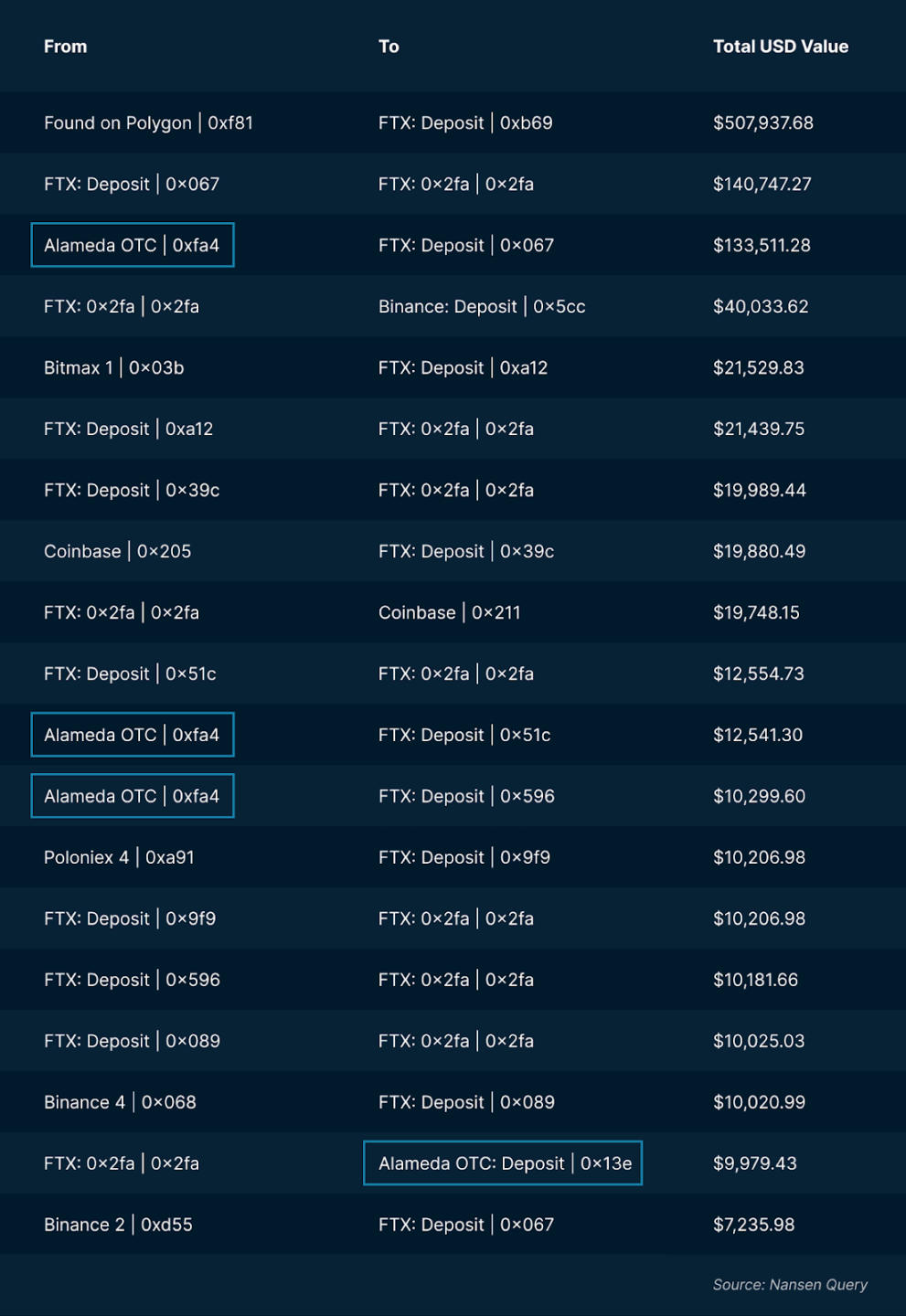
Although the transaction volume was relatively low (~$160,000), this strongly suggests that either Alameda was heavily involved in the founding of FTX, or that there was no clear distinction between Alameda and FTX at the time — and possibly neither.
July 2019 - January 2021: FTT token launch and early distribution
FTT is the utility token of the FTX platform, which does not entitle users to a portion of platform revenue or represent FTX's share. It has no backing nor control over governance decisions or FTX's funding. Given the relationship between Alameda and FTX, it's no surprise that Alameda entered FTT's seed round, but they weren't just ordinary investors.
Listing of FTT
Two days before their official listing on FTX on July 29, 2019, Alameda received 5 million FTT in three transactions, directly from FTX Deployer (minting FTT) to their FTX account. In addition, FTX Deployer deposited 20 million FTT into the FTX-related FTX deposit wallet on the day of listing. These were all the FTTs in circulation at the time.
image description
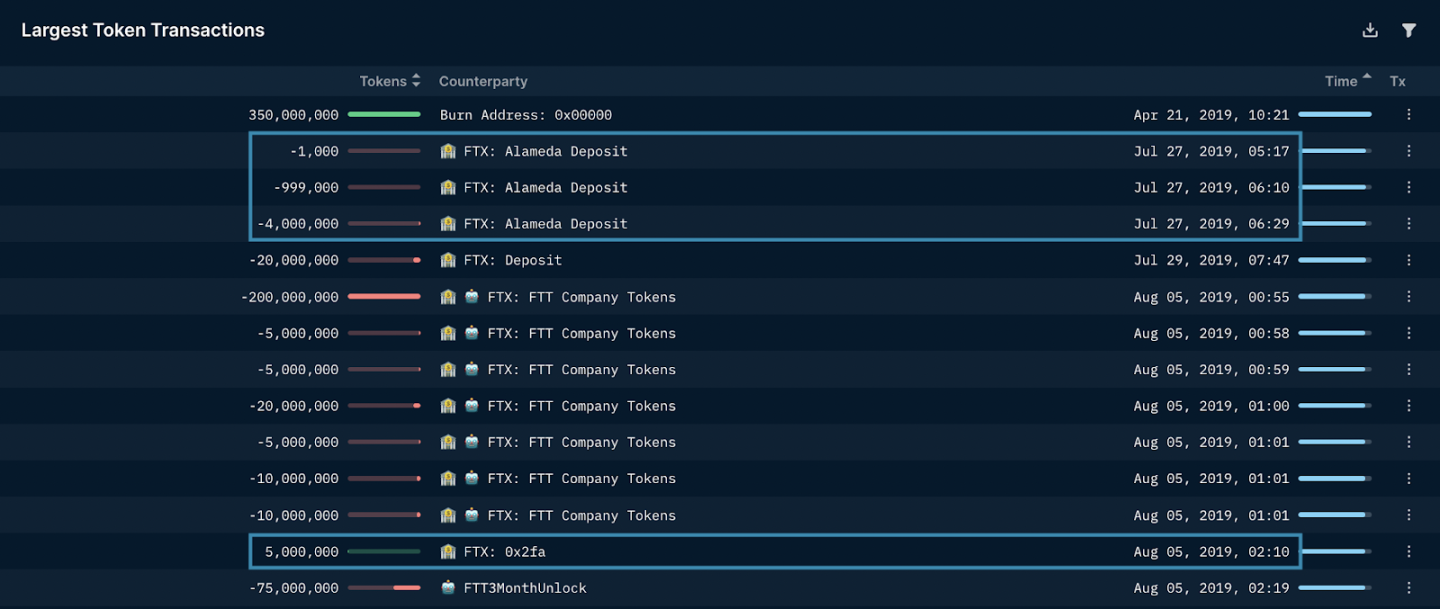
Source: Nansen, Wallet: FTX Deployer
The 5 million FTT sourced to FTX Deployer is likely the same as deposited into the Alameda FTX account
Amount exactly matched
It is extremely unlikely that any other party other than FTX itself owned that many tokens (25% of the circulating supply) at the time
As a seed investor, technically Alameda should not have fully transferable tokens in the first place
The optimistic explanation is that Alameda participates in the market making of FTT tokens. However, this theory doesn't explain why the funds were returned days later.
One dark explanation is that Alameda profited from ICO participants by selling tokens from other investors before their tokens were unlocked and buying them back later at a cheaper price to return to FTX.
Follow the FTT ICO trail
Using the official token distribution from the FTX documentation and comparing it to the on-chain movement from the first token movement after minting in late July 2019 to December 2020, it is possible to design an early distribution for FTT Possible scenarios:
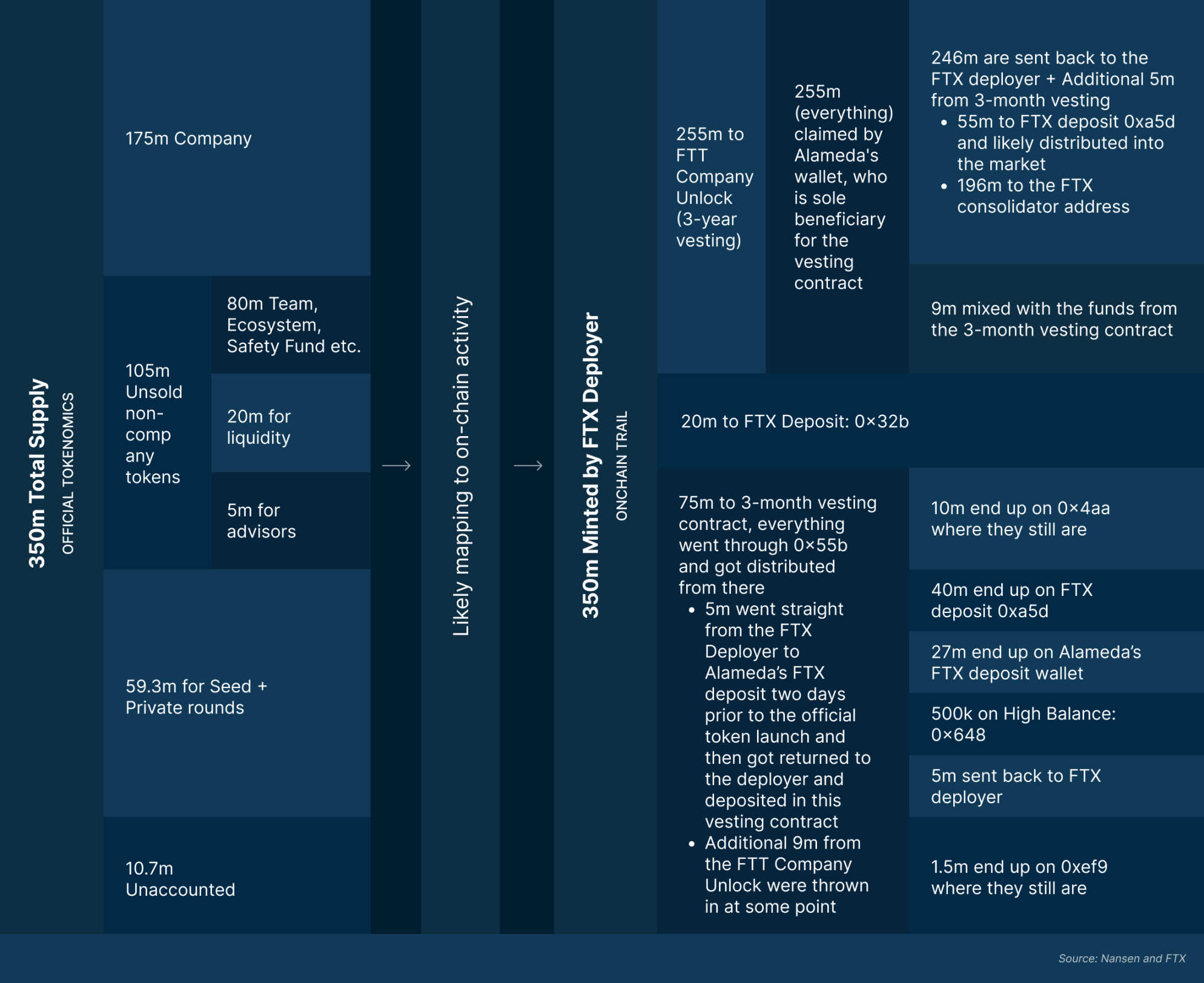
Looking at the above parameters, we notice some key observations:
Of the 350 million total supply of FTT, 280 million are controlled by FTX (approximately 80%).
Of the 59.3 million tokens used in the seed and private sale rounds, approximately 27 million (or approximately 46%) ended up in Alameda’s FTX deposit wallet (see appendix for details) within roughly a 3-month vesting contract, That's a pretty big concentration.
All Firm Tokens (FTT) and most unsold non-corporate tokens are deposited into a 3-year vesting contract with the Alameda address as sole beneficiary.
The whereabouts of 10 million FTT are unknown, and 10 million FTT remain unchanged at address 0x4 aa.
Our observations raise further questions: why does FTX need to have such a centralized token supply? Why would they choose a wallet (Alameda's) as the beneficiary of the FTT tokens instead of one directly controlled by FTX itself?
However, there are limitations to using on-chain data to answer these questions. So instead, we focus on questions that can be answered with on-chain data.
FTT’s early deal activity shows that:
Alameda has been involved with FTT from day one and may have even played a major role in its development
Since the Alameda address is the sole and immutable beneficiary of the company's token vesting contract, almost all FTT token supply must pass through Alameda's hands at some point - this does not mean that Alameda necessarily "owns" the tokens (2.55 100 million of which may be the currency of FTX company) but still very strange
Alameda may have received preferential treatment inside FTX
Alameda and FTX own the vast majority of the total FTT supply from day one, meaning:
1. Actual circulating supply (and liquidity depth) is low compared to total supply (i.e. low float)
2. Prices are susceptible to rising (or falling) by relatively small amounts compared to the resulting increase (or decrease) in valuation
3. Since Alameda and FTX hold most of the FTT supply, if one entity is forced to sell its holdings of FTT, the other entity could therefore take a huge hit to its balance sheet.
do good, do evil, help
January 2021-December 2021: Win-win for the bull market
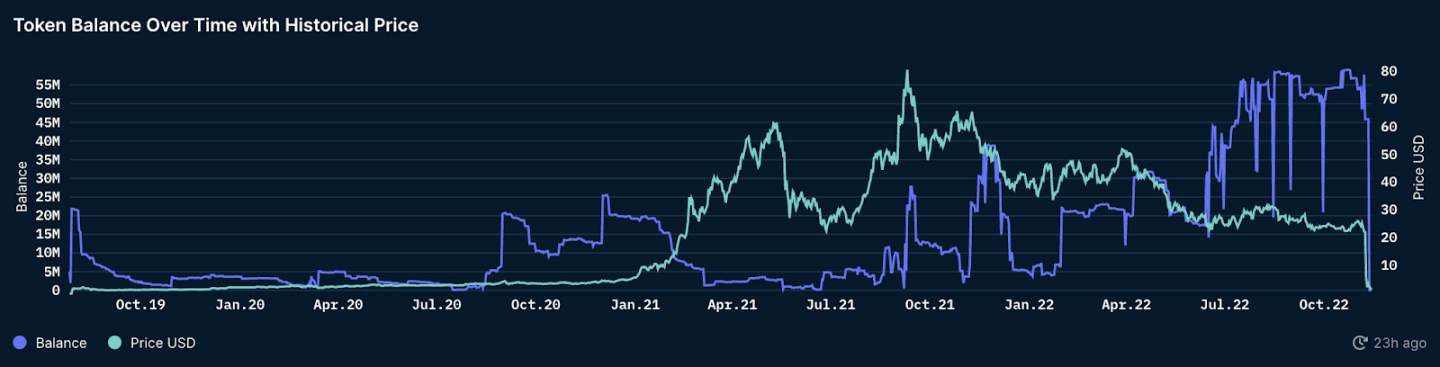
Fast forward to the bull market of 2021, and the FTT token is skyrocketing, rising roughly 800 times from its all-time high ATH of $0.10 in the summer of 2021 to a seed price of $84.
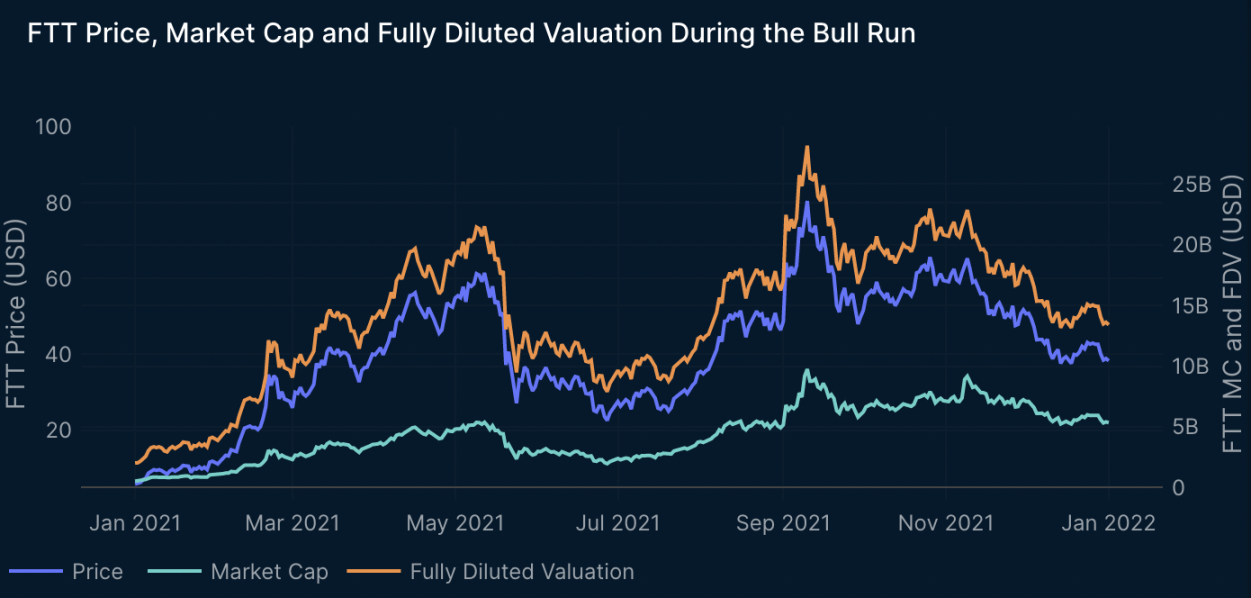
The rise in FTT's price has brought FTT's fully diluted valuation to an all-time high of nearly $30b - most of which is owned by Alameda and FTX.
Although these tokens are technically liquid, it is impossible for these quantities to be liquidated for Alameda on the open market. The sale of Alameda could lead to a significant downside in price, which in turn devalues their own and other holders' remaining positions, of which FTX is by far the largest. This poses a thorny issue for Alameda's FTT Holdings and creates further interdependence between Alameda and FTX.
Since Alameda cannot sell their FTT holdings in large quantities, and FTT cannot generate enough liquidity income, their potential options for using FTT to obtain liquidity are:
OTC: Sell FTT outside the market without affecting the price, by investing in FTT (eg in a venture deal or through an incubator) or selling FTT OTC (eg through a market maker like Genesis).
LP: Make money by providing liquidity for the FTT market or derivatives (such as FTX).
Borrow: Borrow it using FTT as collateral (eg on FTX or Genesis).
Note that many ways to access liquidity using FTT have been implemented by FTX from the beginning, with FTX users acting as counterparties.
While OTC sales and liquidity provision are relatively less risky, borrowing against FTT is considered risky due to the large negative impact that liquidation events can have on FTX and Alameda.
So the question remains, is Alameda borrowing funds at a book value that its FTT can't achieve?
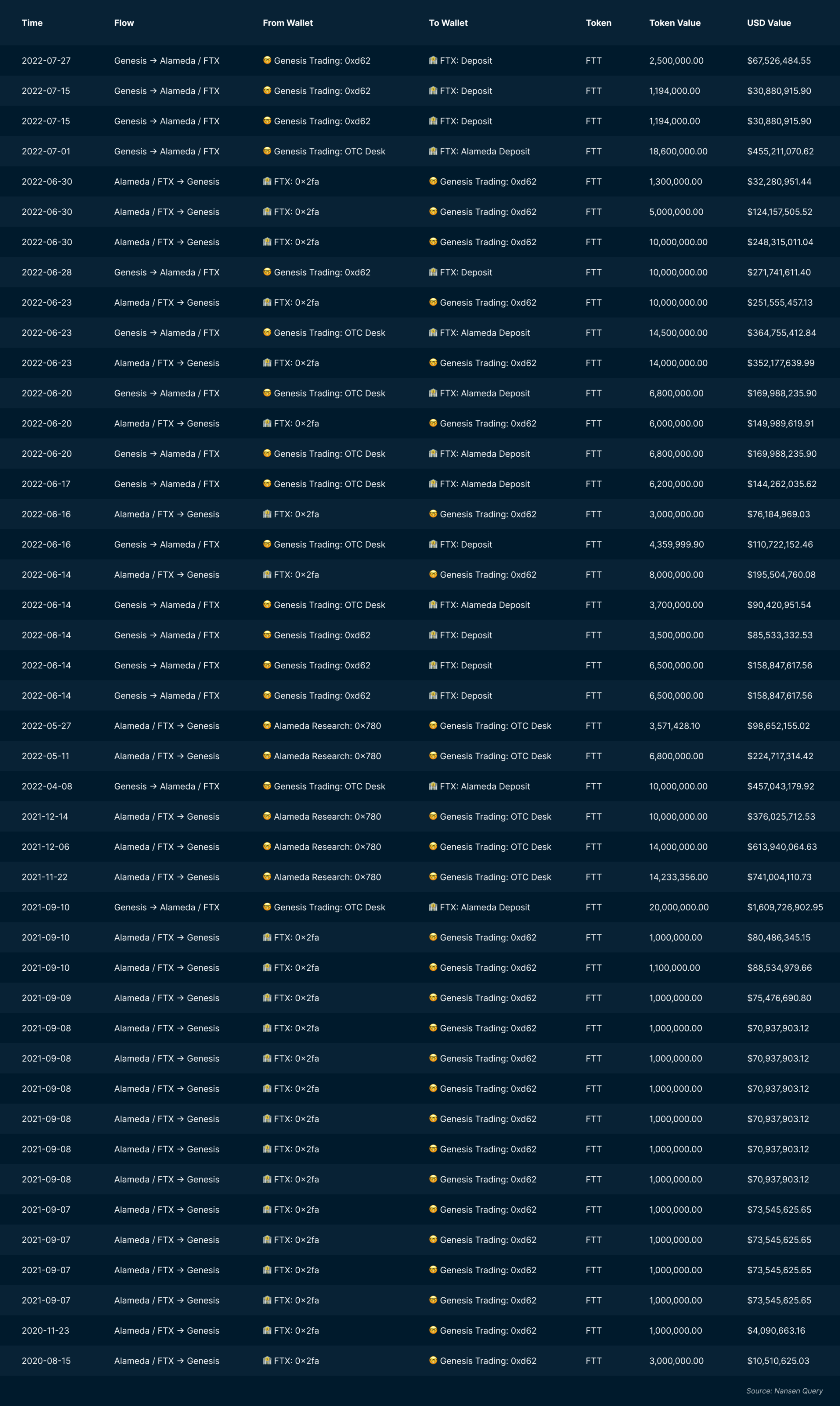
There are a lot of FTT transactions between FTX, Alameda and Genesis Trading:
In September 2021, FTX and Alameda regularly flowed into and out of Genesis Trading. First, we saw a massive increase in deposits from FTX to Genesis, followed by a large transfer of FTT tokens from Genesis to Alameda's FTX address.
It is possible that FTX sent the FTT to Genesis for the purpose of using the FTT as collateral for a loan to Alameda. However, if this assumption is correct, why did Genesis send 20 million FTT ($1.6) to Alameda instead of other more liquid tokens? This situation contradicts the logic of FTT being used as collateral due to low liquidity.
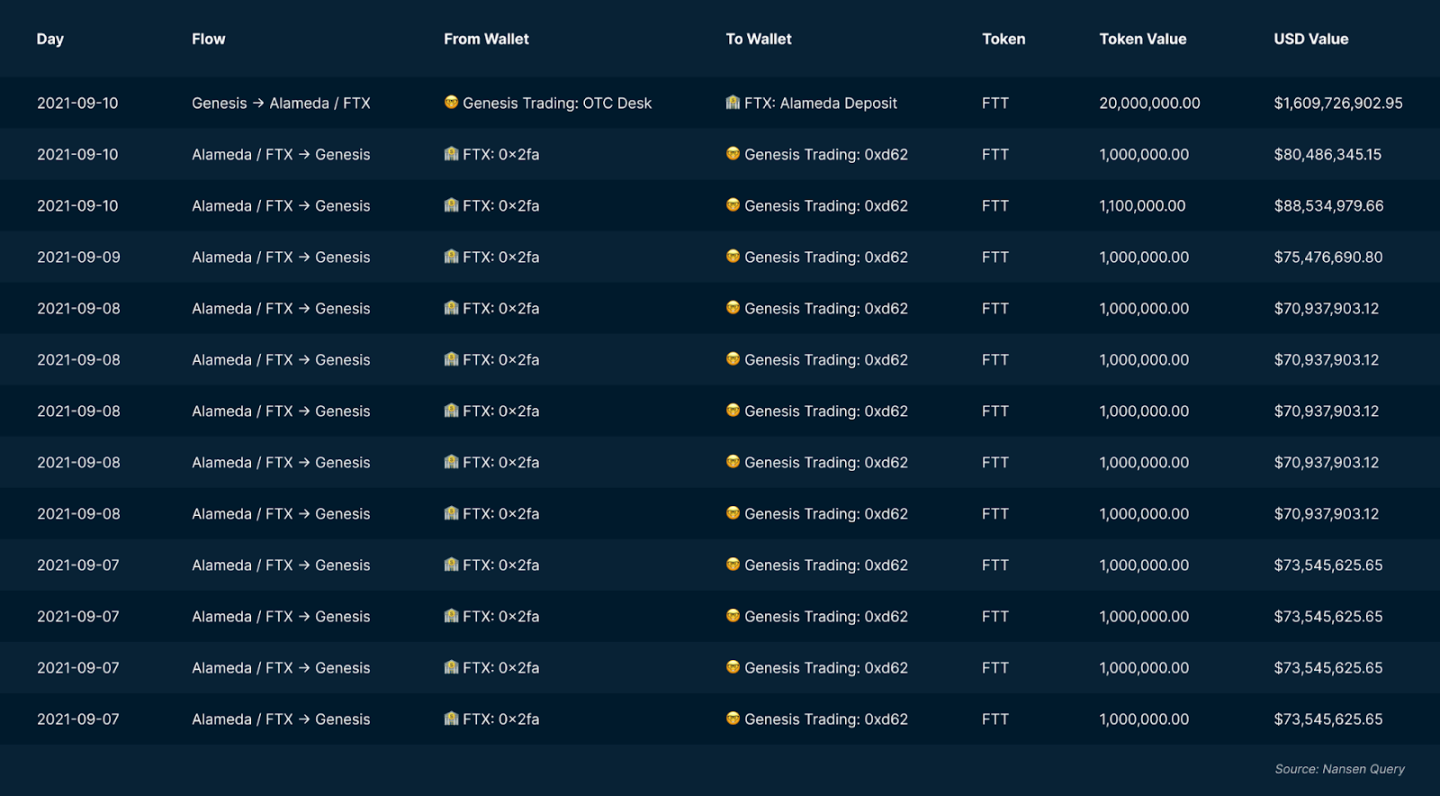
Then, in December 2021, Alameda sent a large FTT deposit to the Genesis Trading wallet, totaling approximately 38 million FTT or $170 million at the time:

Alameda could have tried to sell some of the FTT OTC to Genesis, or tried to use the transferred FTT as collateral for a loan from Genesis. However, since Genesis is a centralized platform, we cannot determine this primarily using our on-chain data sources.
In addition, it is difficult to trace on-chain the specific funds that have flowed out of centralized platforms such as Genesis, so it is difficult to pinpoint exactly how much funds Alameda may have borrowed.
Alameda has also been observed using FTT as collateral to borrow funds on DeFi platforms such as Abracadabra Money (MIM), although on a likely much smaller scale compared to their interactions with CeFi lenders such as Genesis.
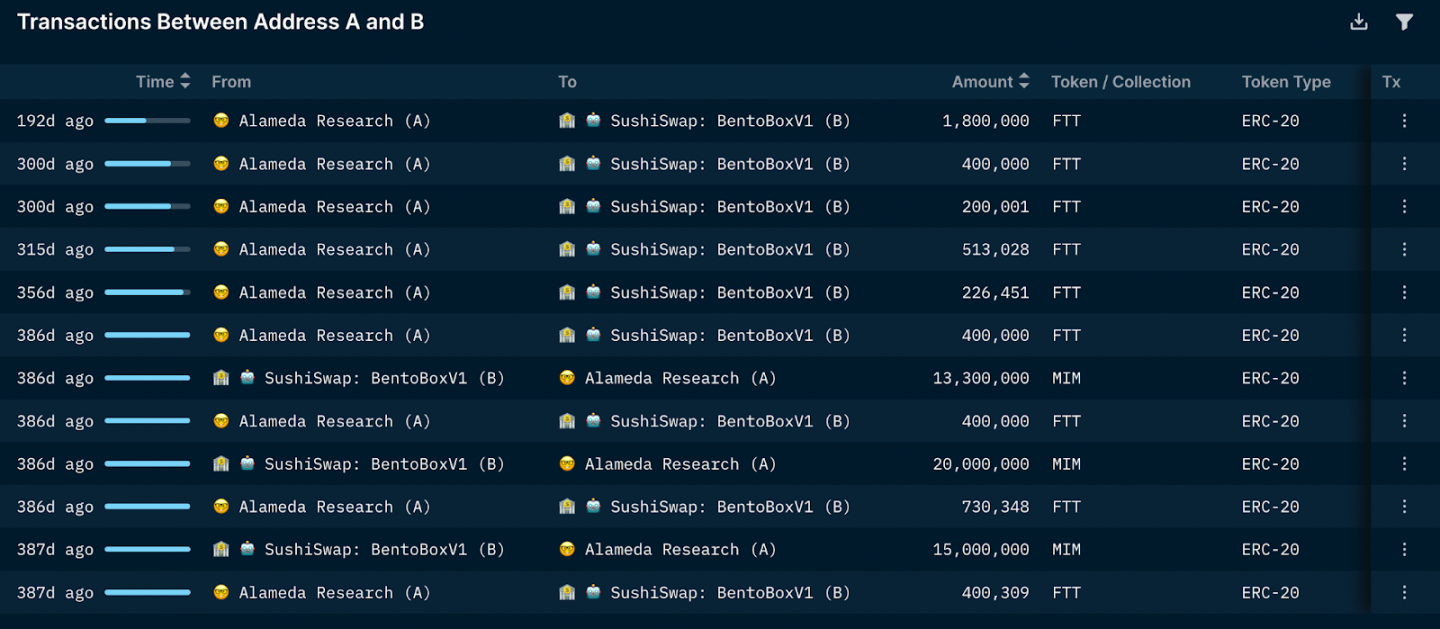
So far, FTT's on-chain data suggests the following strategy: control a large number of FTT tokens, deliberately raise the price of FTT by sitting on FTT, and then use the high price to realize mortgage lending.
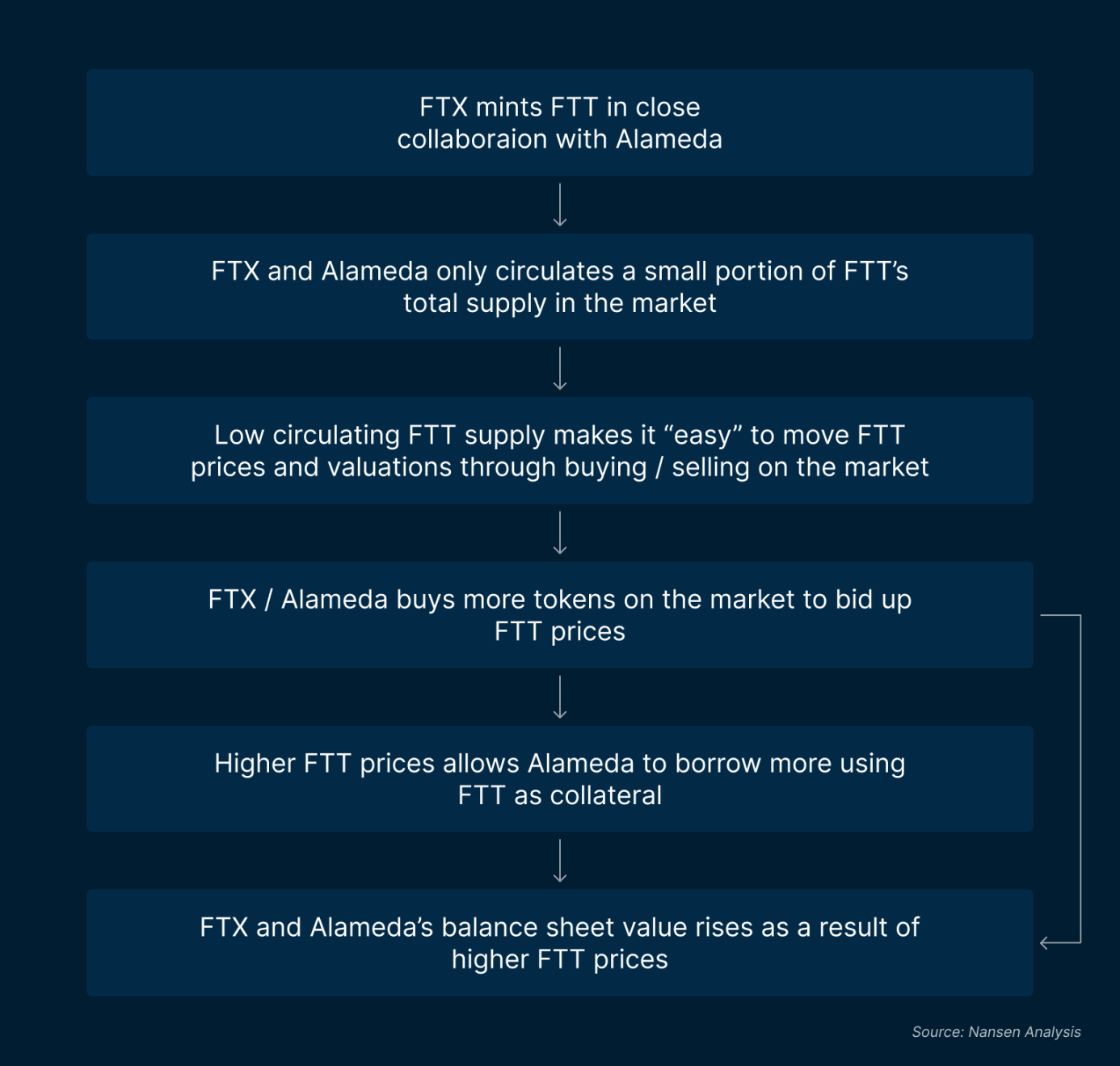
By utilizing this strategy - taking out loans against FTT and using the loans to invest further - would effectively place them in a leveraged long position.
The FTT token is the core lifeblood of Alameda and FTX, and a drop in price poses a very real threat. Quite thin liquidity compared to the total supply can make large market sales very dangerous (e.g. by liquidating Alameda's lending positions, companies with large FTTs go bankrupt, or get "dumped" by other large holders like Binance ).
May 2022 - June 2022: Potential Crisis
While this strategy may work well in a bull market in 2021, it could work even worse when the market starts moving against them, especially during the May-June 2022 crash:
OTC: Less need to buy OTC
LP: Buy-side demand drying up for volume, fees, and especially FTT
Borrowing: FTT mortgages are riskier as FTT prices fall. Additionally, borrowing liquidity is drying up, borrowing rates are rising (and margin calls), and creditors are calling in loans due to deteriorating general market conditions.
Given that a significant portion of Alameda's balance sheet consists of illiquid assets, Alameda could face serious liquidity challenges during May-June 2022.
With the decoupling of UST and the development of the situation, many entities were adversely affected at the time. Subsequent contagion brings down 3 AC and Celsius in mid-June 2022, which we have covered in this report; both are debtors of Genesis (based on on-chain interactions involving FTT tokens, they may have exposure to Alameda risks of).
So, is Alameda facing a liquidity crunch in June after the 3 AC and Celsius crashes? Has Alameda and its peers seen an increase in FTT token activity?
Breaking down the chain of events, here's a short summary of what we observed on-chain: Between June 9th and 23rd, Alameda received a large inflow of FTT tokens from five different entities: Fund: 0 xf 155, Huobi , Genesis Trading OTC, High Balance and Found on Avalanche.
June 9
High Balance received 2.7 million FTT ($78 million) from Celsius: Wallet, which was sent to the Alameda FTX deposit.
June 10
image description
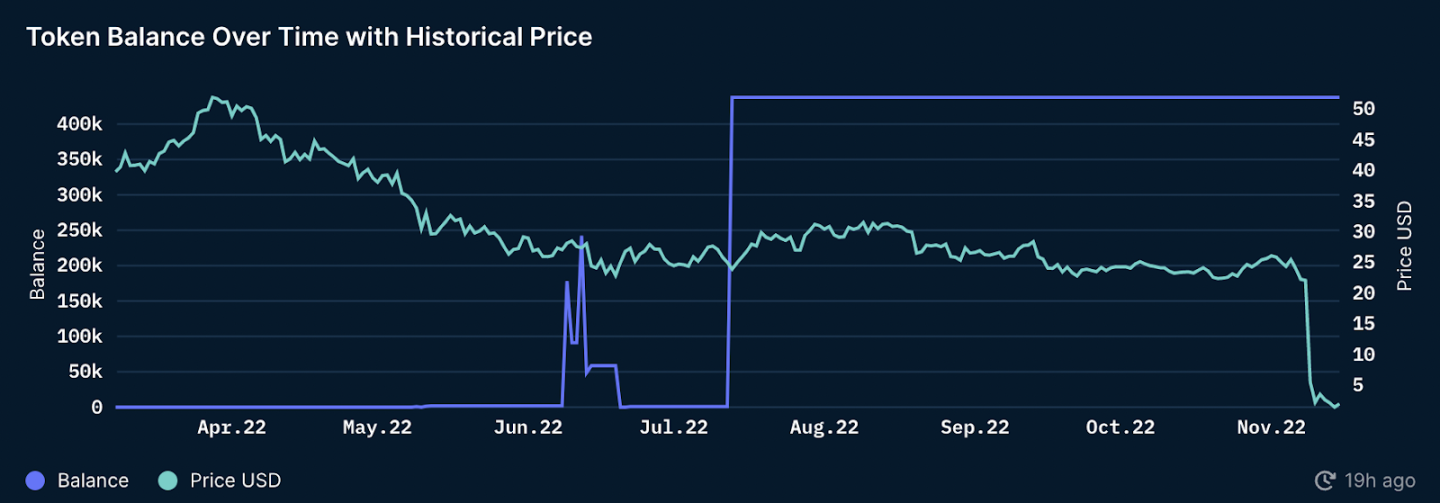
Source: Wallet Profiler for Token - High Balance (FTT)
June 13
High Balance received another 600,000 FTTs (worth $14.6 million), which were sent to the Alameda FTX deposit.
June 14
Fund: 0 xf 155 typically receive their FTT tokens from FTX and BlockFi, these tokens are sent to Alameda's wallet, which includes 27.5 million ($631 million) FTT from FTX, and then immediately sent back to FTX.
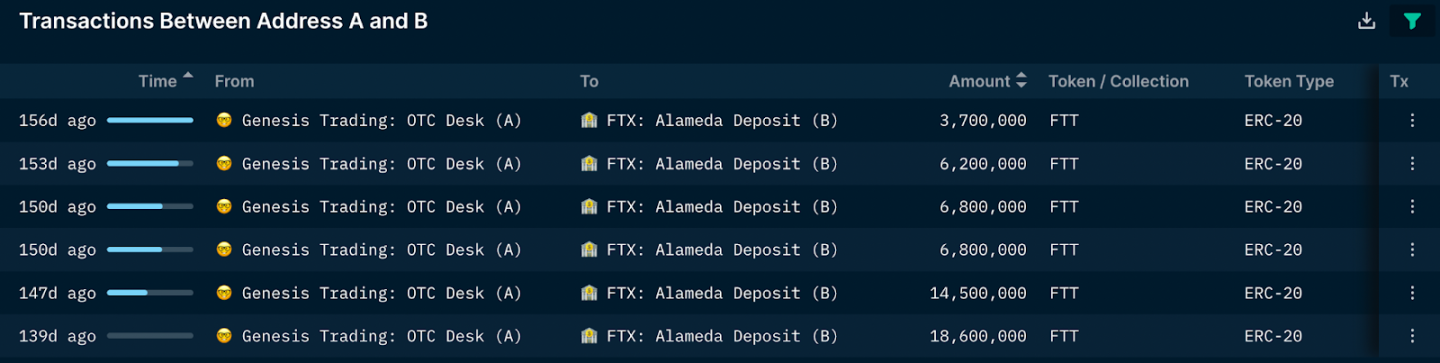
Genesis Trading: OTC sent 3.7 million FTT ($89 million) to Alameda FTX deposits.
June 15
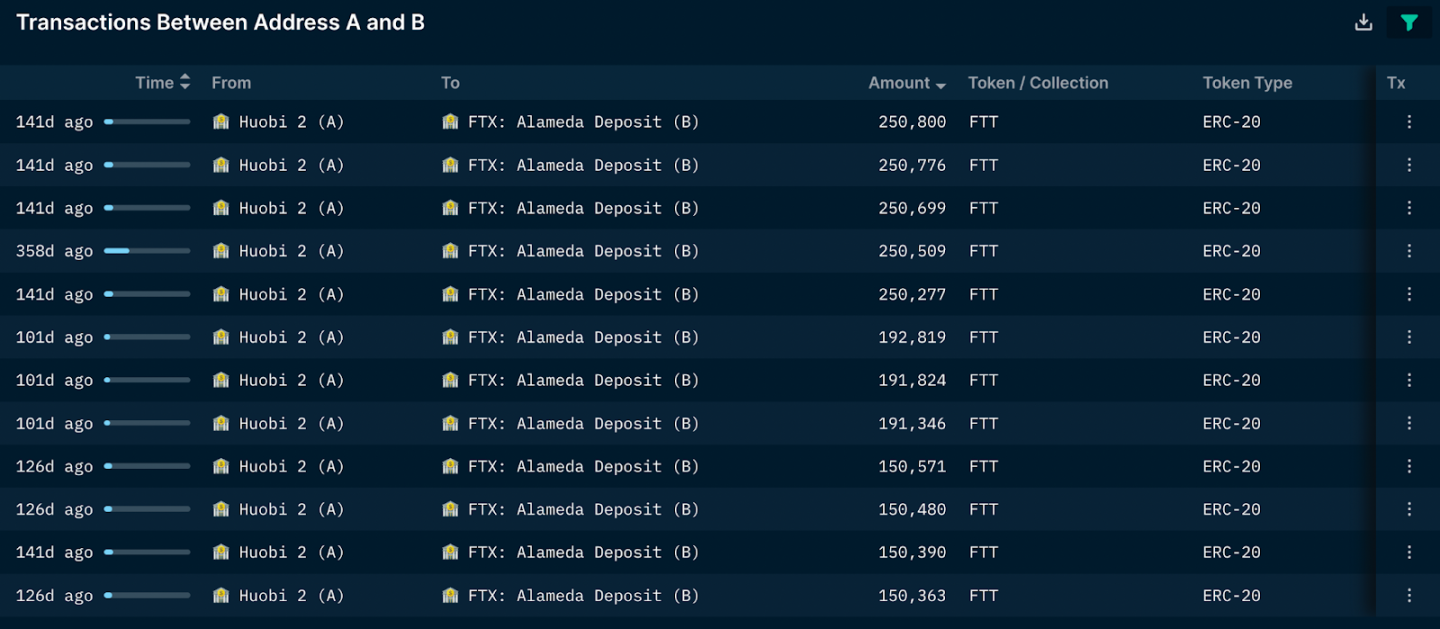
Huobi sent a total of 788k FTT ($18.9M) to Alameda FTX deposits.
June 16
Fund: 0 xf 155 received 14 million FTT ($326 million) and sent directly to the Alameda FTX deposit.
June 17
Alameda FTX deposits received 6.2 million FTT ($151 million) from Genesis Trading: OTC desk and 18 million FTT ($450 million) from fund: 0xf 155, which they received earlier in the day.
June 18
Fund: 0 xf 155 sent 27 million FTT ($631 million) to the Alameda FTX deposit.
June 20
Genesis Trading: OTC sent a total of 13.6 million FTT ($364 million) to Alameda FTX deposits.
June 21
Found on Avalanche sent 2.3 million FTT ($63 million) to Alameda FTX deposits.
June 22
Alameda FTX deposits earned 408k FTT ($11m) from High Balance and 249k FTT ($6m) from Found on Avalanche.
June 23
Genesis Trading: OTC sent 14.5M FTT ($381M) to Alameda FTX deposits.
image description
Source: Nansen
Huobi Sends Highest FTT to Alameda FTX Deposits since Terra/UST Crisis. A total of 18.4 million FTT ($47.2 million) was transferred.
image description
Source: Nansen
Between June 14 and July 1, Genesis sent a total of 56.6 million FTT ($1.4) to Alameda’s FTX deposits. The large on-chain transfer volume may indicate that Genesis may be Alameda's primary lender.
June 2022: Save Alameda with FTT-backed loans?
In fact, if Alameda had liquidity problems, they could be in a very tight position with limited options for an orderly liquidation of their assets to meet capital needs.
With lenders generally cautious after the 3 AC crisis, borrowing directly from FTX appears to be the only immediate lifeline to avoid bankruptcy:
Alameda and FTX are so closely related that the lines between organizational structures can be blurred
FTX has a significant stake in the survival of Alameda and must preserve it:
Alameda as a large market maker on its platform
Alameda's bankruptcy means the final liquidation of FTT and other token holdings, and the de facto death of FTX's FTT holdings (~$20 billion at peak)
FTX has access to a large reserve of liquid assets (i.e. user funds)
According to the latest New York Times report on how SBF’s cryptocurrency empire collapsed, Alameda’s CEO confirmed that “In recent months, Alameda has taken out loans and used the money for venture capital investments, among other expenses.” The Alameda CEO also confirmed, “In Around the time the crypto market crashed this spring, lenders started calling back on those loans, but the money Alameda spent was no longer readily available.” So Alameda used FTX’s client funds for the payments.
Did Alameda really get a FTT backed loan from FTX? We looked at FTT deposits from Alameda to FTX, which could have been used as collateral, and non-FTT outflows from FTX to Alameda.
Put FTT as collateral
A massive net FTT inflow from Alameda to FTX in mid-June, coinciding with the 3 AC collapse, totaled 163 million FTT, worth about $4 billion at the time.
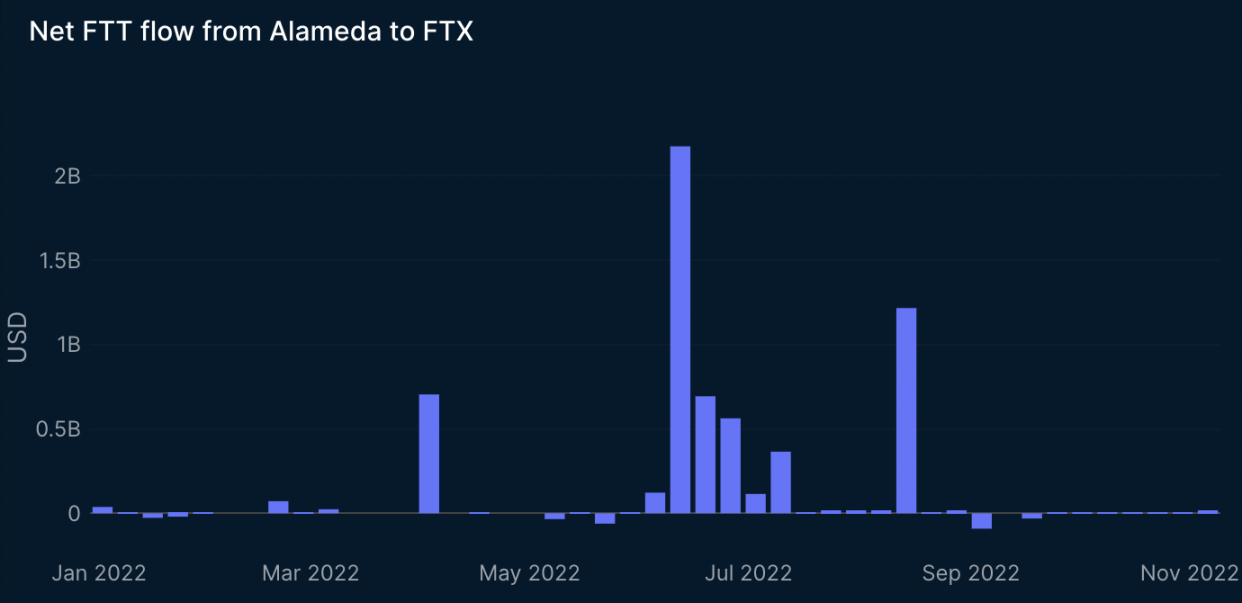
It is difficult to properly attribute funds outflows from centralized platforms to on-chain entities, and some of these funds may have made their way back to Alameda, either directly or through a third party, and then back to FTX again. Therefore, the net value shown in the chart may be higher than the actual net inflow.
image description
Source: Nansen
Alameda deposited ~$4b worth of FTT tokens (based on net inflows to the swap) on FTX between early June and July, peaking during the 3 AC crash during the week of June 12, 2022.
This is consistent with Reuters interviews with several people close to SBF that revealed a $4 billion loan from FTX to Alameda backed by FTT tokens, Robinhood stock and other assets.
Alameda gets loan from FTX
The question of whether FTX provided funds to Alameda cannot be concluded from on-chain data alone. FTX can send funds directly to any recipient, including creditors, in any token on (almost) any chain, and provide funds entirely off-chain. Also, looking at wallet balance changes is inconclusive.
As for FTX wallet balances, many people withdraw funds from the exchange during these turbulent times, causing the total balance to fluctuate wildly. Also, it's unclear what the actual funding balance should be, so identifying potential increments isn't an option.
Various token flows between FTX and Alameda can be seen, ranging in value from tens of thousands of dollars to tens of millions of dollars. While we did observe some unusually large transactions worth hundreds of millions of dollars, we did not have enough evidence to validate the measurements and consider these transactions "suspicious" or fully support the theory. Nansen Portfolio is currently open to all users who are interested in on-chain analysis for free. Welcome to use Nansen Portfolio to view the wallet address below.
But what the purpose of these large deals remains a mystery.
image description


Source: Nansen Portfolio
image description

Source: Nansen Portfolio
image description

Source: Nansen
All withdrawals from the FTT Company Token Vesting Contract must go through this Alameda wallet, as it has been declared as the sole beneficiary from the beginning (see appendix). Still, they made a bad impression by withdrawing all remaining tokens and sending them to FTX Deployer per the loan agreement.
Fall, Turmoil, and Failure: SBF's Cryptocurrency Empire Collapses
We summarize the events that led to the "death spiral" of FTX and Alameda:
September 28
image description

Source: Nansen
October 31 to November 1
An anomalous list of serial stablecoin transfers from FTX International and FTX US to Circle, Binance, and FTX wallets in Alameda was found. These stablecoins include USDC, BUSD, TUSD, PAX, TUSD, totaling $388 million.
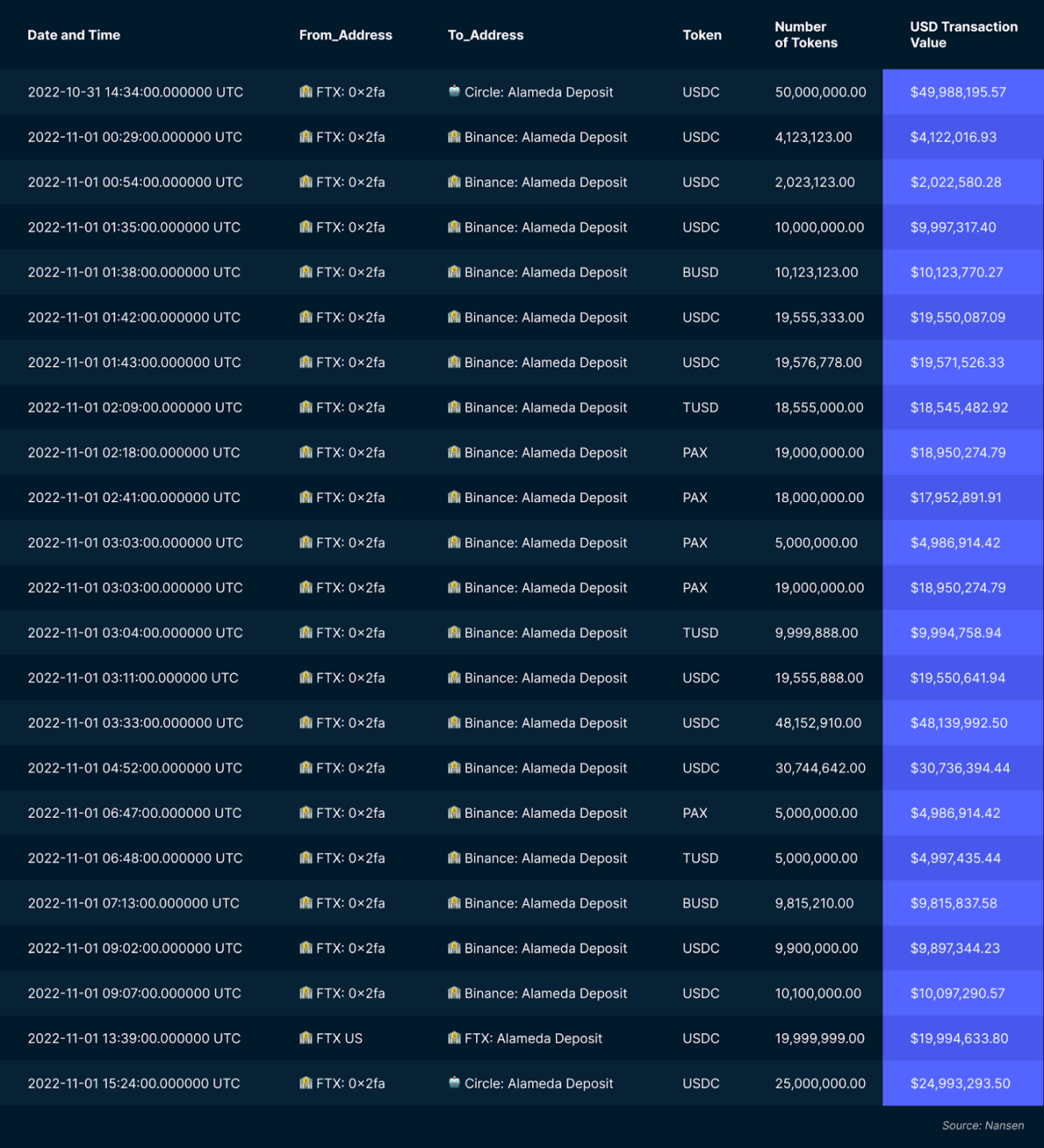
November 2
CoinDesk published a report on Alameda's balance sheet. According to reports, $5.8 billion of the $14.6 billion in assets on Alameda's balance sheet is FTT and other Solana ecosystem tokens. Most of the net worth of the Alameda business is actually FTX's own centralized control of the FTT token.
November 6
The Alameda CEO made a statement in Coindesk's balance sheet report and clarified that Alameda has assets in excess of $10b, which was not reflected in the report. She did not clarify liabilities not listed in the report. The tweet has since been deleted and we were unable to fully verify her claim on-chain.
Binance CEO Changpeng Zhao announced that they have decided to sell the remaining FTT on the books, which is worth approximately US$584 million.
The Alameda CEO offered to buy all of the FTT held by Binance OTC at $22 per token, leading to speculation that Alameda may have loans that would be waived if the price of FTT fell below $22. liquidation. This tweet has been deleted.
A review of identified Alameda wallets on the Ethereum chain indicates that, as of November 6, 2022, Alameda's assets held on the Ethereum chain are worth approximately $21 million (according to available Nansen data). A review of on-chain data shows that Alameda is highly unlikely to have the liquidity to purchase Binance FTT when Caroline publicly tweets on November 2, 2022. So, what was Caroline's motivation for making a public offer to buy Binance FTT?
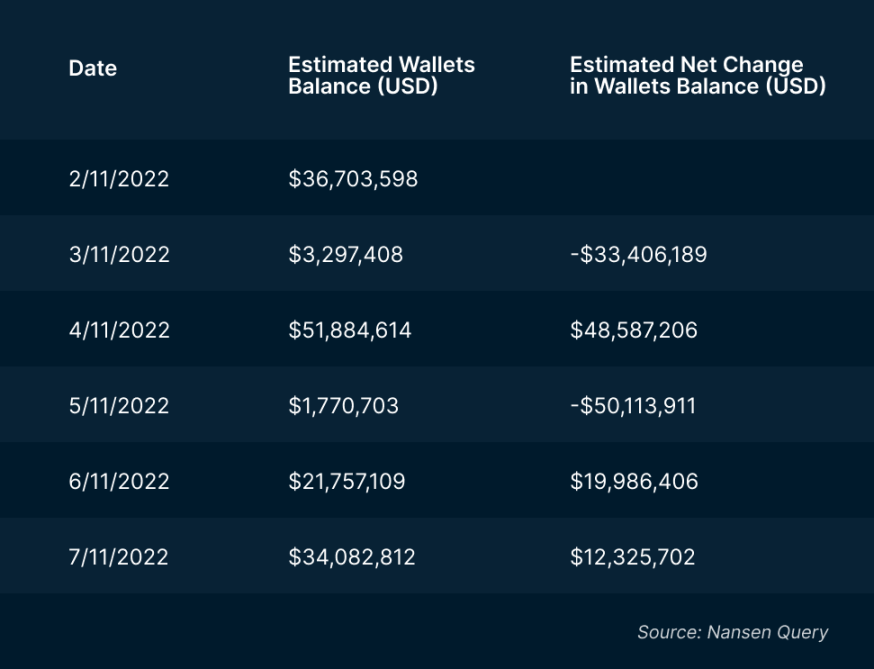
The obtained wallet balance is based on available Nansen data. Actual wallet balance may be higher (e.g. without taking into account LP tokens and/or Alameda's balance on CEX)
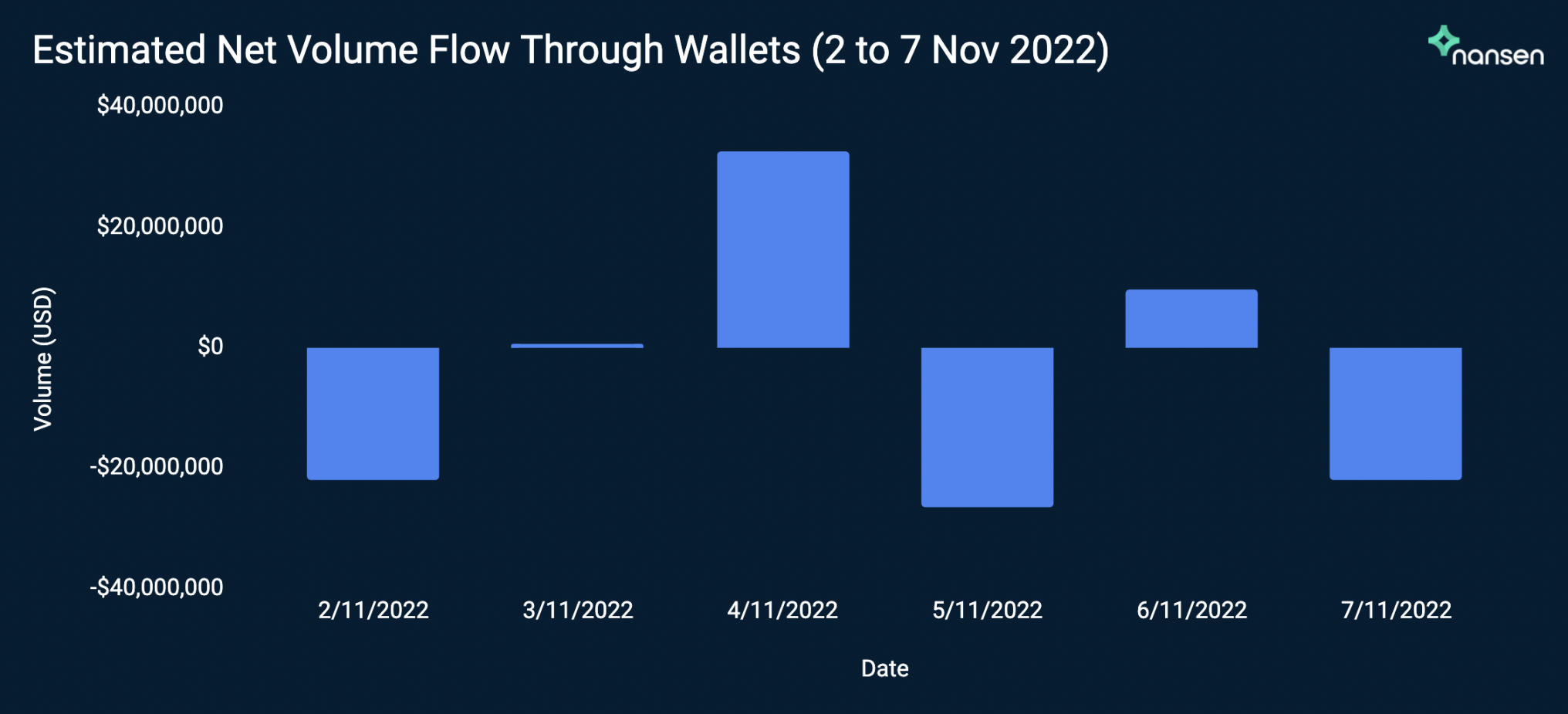
Binance CEO reinforced a statement about liquidating its FTT holdings. At the time of the statement, there was no on-chain activity to support the move.
The FTX CEO responded by clarifying that FTX is solvent and stated that "FTX is fine and assets are fine." The tweet has now been deleted.
November 7
The market resorted to panic mode. Nansen’s tracking of seven-day stablecoin flows shows a net inflow of $411.5 million into Binance deposits and a net outflow of $451.1 million in withdrawals from FTX during the period.
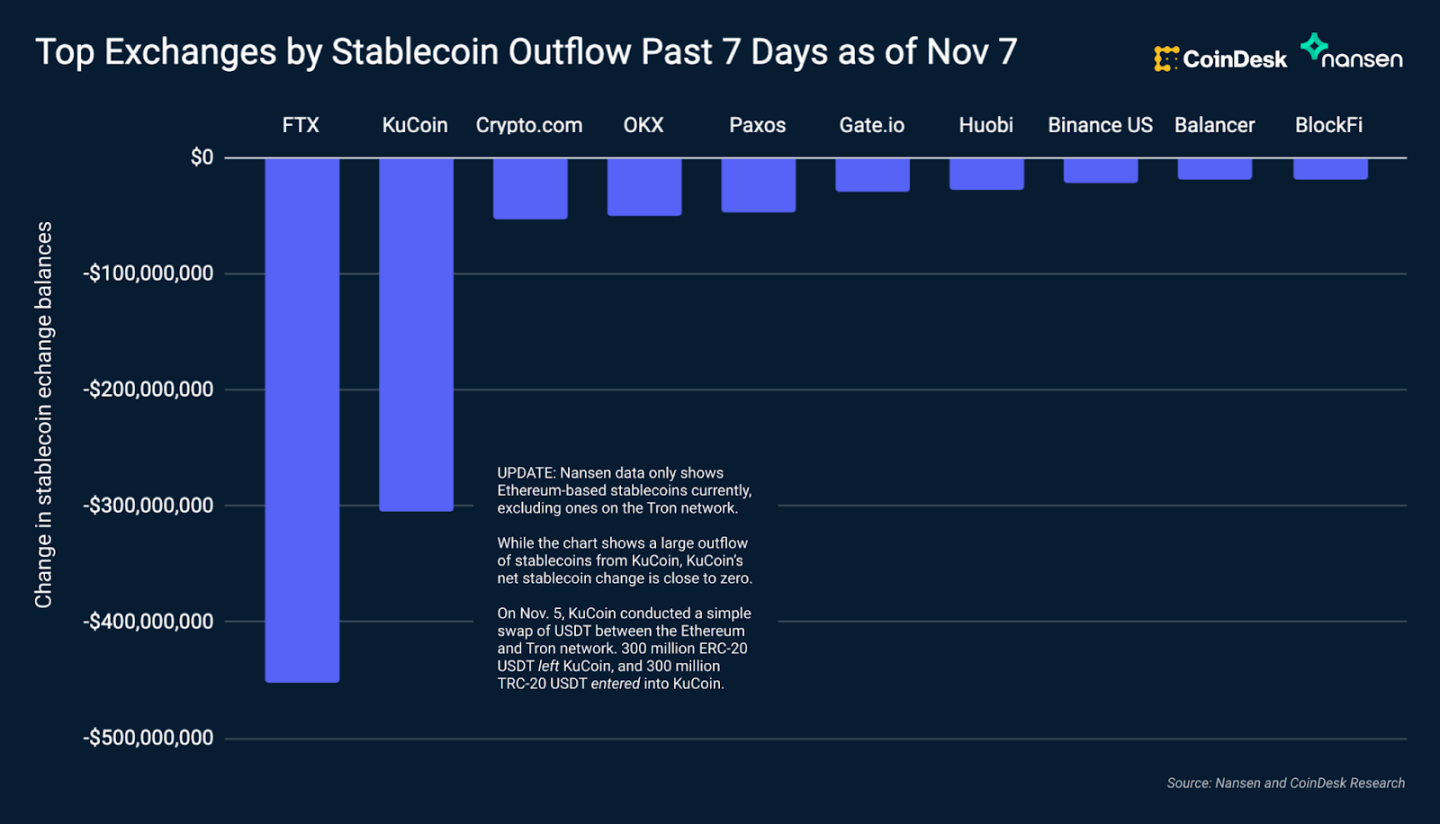
Additionally, our on-chain checks have drawn attention to a series of (unusual) large withdrawals prior to the FTX crash. Entities who made withdrawals 24 hours before FTX stopped withdrawals:
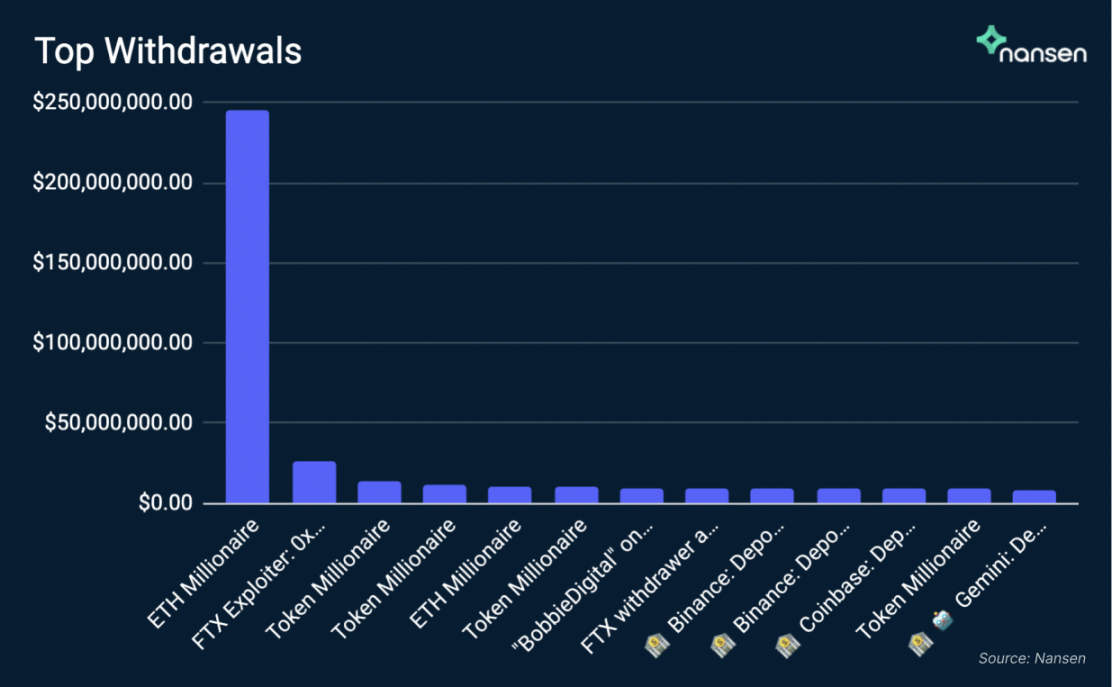
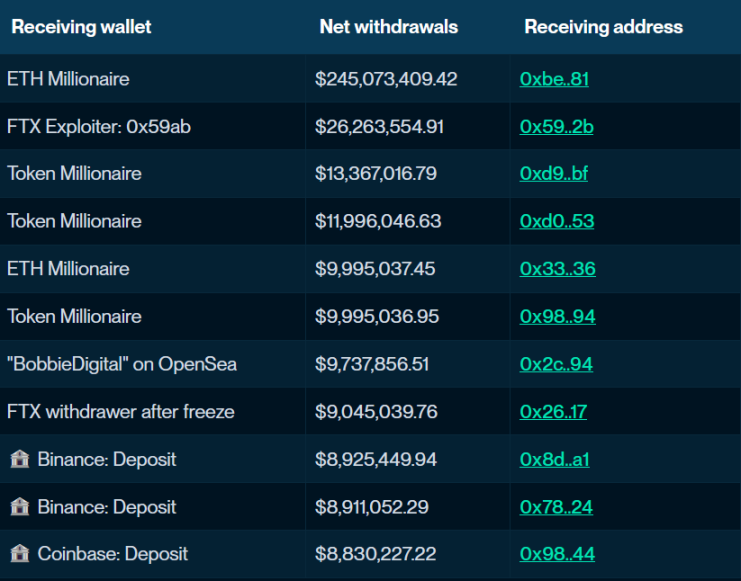
The massive selling pressure on FTT means that the FTTFinally fell below the currency price of 22 US dollars。
November 8
FTX appears to have suspended withdrawals, The Block reported. During this period, FTX sent 92 million USD ($37 million) in BIT tokens to 🤓 Alameda Research: 0 x 84 d.
The FTX CEO stated that Binance will reach a strategic transaction with FTX, in which the Binance CEO announced a non-binding letter of intent to fully acquire FTX and help solve its liquidity crunch.
Binance appears leaning towards canceling FTX rescue takeover. At this point, FTX US has sent $10 million USDT to Alameda. Alameda Research then sent 130k FTT (~$715k) to 🏦 Binance: Alameda deposits. In the end, FTX US sent 2,262 WBTC ($41 million) to 🤓 Alameda Research: WBTC and subsequently to WBTC: Controller. Interestingly, while FTX International has stopped withdrawals, FTX US still managed to transfer a significant amount of WBTC to Alameda. The Alameda CEO also hinted that only the FTX International entity is facing liquidity issues, while FTX US is not affected.
November 9
The Wall Street Journal reported that Binance had dropped the deal with FTX.
November 11
in conclusion
in conclusion
According to an unconfirmed internal source leaked on Twitter as of Nov. 16, “Caroline sees the Alameda and FTX liquidation as a possible event, not a tail event.” Additionally, FTX’s native token, FTT, is also in the spotlight. FTX's low circulation and ongoing buying pressure suggest that the only thing that could trigger a drop in FTT's price is massive selling pressure on the token. While Coindesk’s report first drew public attention to the relationship between Alameda and FTX, FTX’s “bank run” also coincided with Binance announcing its intention to liquidate the remaining FTT tokens on its books.
Piecing together the pieces of our on-chain investigation, it's clear that the Luna/Terra debacle revealed deep flaws in the chaotic relationship between Alameda and FTX. In the case of Terra-Luna/3 AC, there is a large amount of FTT outflow from Alameda to FTX. A total of $4 billion in FTT that flowed from Alameda to FTX in June and July may have been the provision of collateral to secure loans worth at least $4 billion in May-June, according to the data, several firms said in interviews with Reuters. persons close to SBF at the time.
We also observed a slightly unusual outflow of stablecoin tokens from FTX to Alameda’s wallets during this period. Given the knock-on effects of the Luna debacle, many firms like 3 AC were liquidated, causing contagion across the crypto lending market. While our on-chain investigations did not directly confirm that user funds were being moved from FTX to Alameda in an attempt to “save” them from liquidation, FTX’s unusually large FTT inflows after Luna/3 AC suggest a plausible case.
Since then, the complex relationship between Alameda and FTX has gotten trickier, as client funds were also in the mix. Alameda is at a stage where survival is a priority, and if one entity collapses, more trouble could start brewing for FTX. Given how intertwined the way these entities operate, and the over-leveraged collateral, our post-mortem on-chain analysis suggests that the eventual collapse of Alameda (and the resulting impact on FTX) may have been inevitable.
The sudden impact of FTX has sparked growing fear among cryptocurrency market participants — investors and traders alike. If anything, this situation only reinforces the need for greater transparency in cryptocurrencies. Our team at Nansen Portfolio compiled a data panel showing proof of reserves for major cryptocurrency exchanges. While the list of asset holdings is not exhaustive, it is a first step towards making cryptocurrency participants more accountable. Proof of Reserve links for each of Nansen's entities can be found here.
CEX exchange name and asset reserve data page on the Portfolio chain
Conclusion: Entities and wallet addresses worthy of attention
During our investigation, we noticed a group of wallets that may or may not be Alameda/FTX addresses. Observations of on-chain activity and interactions suggest that these wallets likely had indirect contact with Alameda. For those interested in exploring these wallets, we provide a brief description of the activities involved.
1.High Balance High Net Worth Address:
Throughout our analysis, we found that High Balance obtains all of its FTT tokens primarily from Celsius Trading: Wallet. A large number of transfers are sent to FTX: Alameda Deposit. High Balance may be an intermediary address that helps facilitate transfers between Celsius Trading: Wallet and FTX: Alameda Deposit.
On May 11, 2022, High Balance received 6.8 million FTT ($255 million) from Celsius: Wallet, which was sent to the Alameda FTX deposit.
On May 12, 2022, High Balance received 881k FTT ($25 million) from Celsius: Wallet, which was sent to the Alameda FTX deposit.
From May 27 to July 13 (during the LUNA/UST contagion), High Balance sent a total of 6.8 million FTT ($190.3 million) to FTX Alameda deposits.
2.Fund: 0 xf 155 Fund address:
Fund: 0 xf 155 A total of 88 million FTT were sent to FTX:Alameda deposits from June 14th to July 13th, 2022. Fund: The relationship between 0xf 155 is opaque.
According to on-chain evidence, the address received $403 million worth of FTT tokens and sent the same amount of accumulated value. It is possible that this wallet is used for intermediary transactions, since most transactions to and from the Alameda wallet are traded out.
Tracing their previous transactions, FTX often sends FTT tokens to the fund: 0xf 155 , then to Alameda Research: 0x84d and transferred to another Alameda wallet, possibly to obfuscate their tracks or for other unknown Purpose. FTT eventually returns to FTX. In addition to receiving FTT from FTX, Fund: 0 xf 155 also received 2.54 million FTT from Medium Dex Trader (sourced from BlockFi).
3.Found on BSC Binance Chain User Address:
The "found on BSC" address only had one interaction with Alameda on June 27, 2022, and Alameda sent 3.2 million FTT ($87 million) to FTX: Alameda Deposit.
This address interacted with several FTX-related wallets. All token transactions of "Found on BSC" are funded by FTX. Digging into the interaction between FTX and Found on BSC and which tokens are sent to the Found on BSC wallet, FTT and SRM stand out.
4.ETH Millionaire ETH millionaireWallet address:
From June 14th to November 7th, 2022, ETH Millionaire transferred a total of 1 million FTT ($24.4 million) to the FTX Alameda wallet.
The FTT tokens transferred by ETH Millionaire come from Bitgo Forwarder, which also receives FTT tokens from Genesis Trading OTC Desk.
5.Huobi Huobi address
On June 15th alone, Huobi sent 788k FTT to the FTX Alameda wallet.
While such FTT flows between Huobi and FTX:Alameda are not uncommon, the amount of FTT transferred on June 15 was higher than the daily average of 278.4 k FTT tokens transferred since May 2022.
On June 29, 2022, Huobi sent the largest amount of FTT to FTX: Alameda since the Luna and UST crashes. A total of 1.84 million FTT tokens ($47.2 million) were transferred.
Huobi also received a large amount of FTT tokens from FTX, which may be used for market-making activities. From May 1 to August 17, FTX sent a total of 4.98 million FTT tokens worth $139 million to Huobi.
6.Genesis Trading: OTC market-making address
Between June 14 and August 16, Genesis Trading: OTC sent a total of 95.4 million FTT ($2.5) to FTX Alameda. Such numbers may indicate a close relationship between Genesis and Alameda.
appendix
The movement process of the official FTT token distribution to the address on the chain
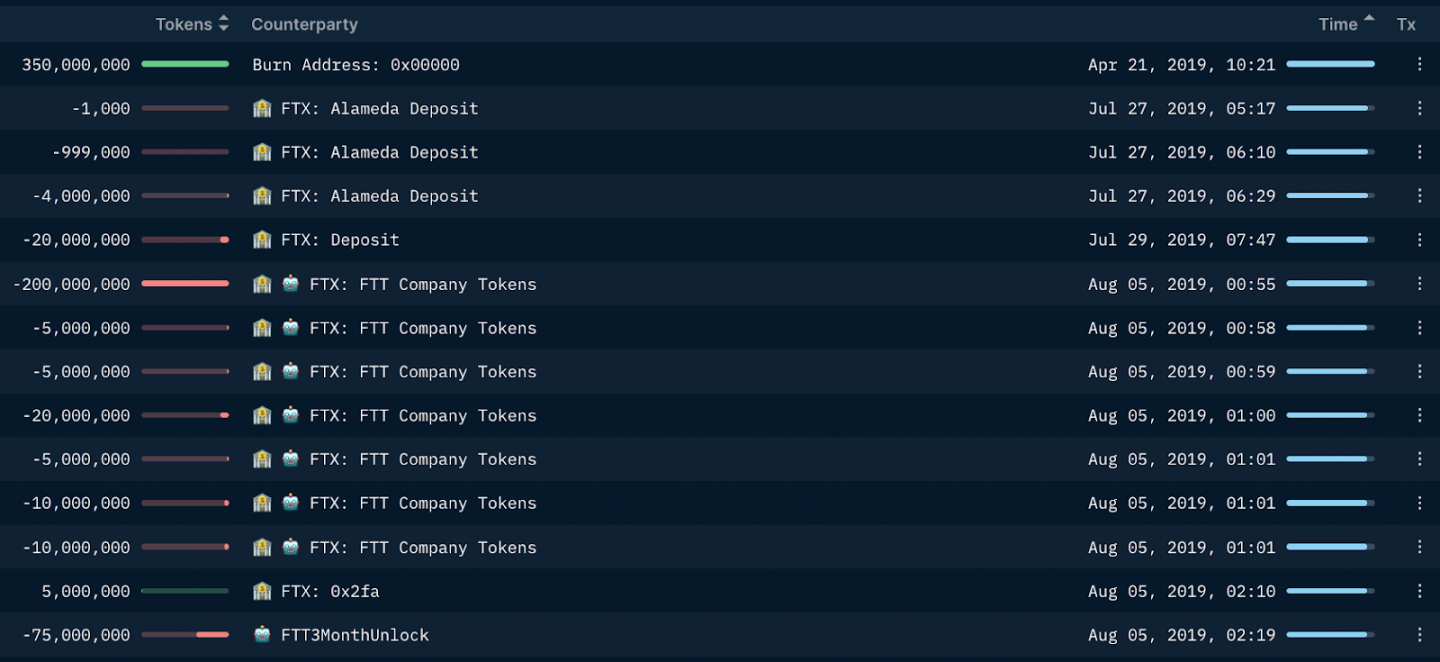
Deployer, the FTT minter, minted and distributed a total of 350 million in late July 2019. Let me check which addresses these initial FTT tokens were sent to:
1. Before FTX tokens are listed on FTX, 5 million tokens will go directly to the FTX deposit address in Alameda, and 5 million tokens will be returned from FTX shortly after listing.
image description
Source: Nansen
5 million returned from FTX: 0 x 2 fa 6 days after listing. Possibly the same token from Alameda as no one else should have this size at this point and there is no reason for FTX to withdraw tokens. These trades add up to a net 0 and the tokens end up going back to the FTX deployer and then into a 3 month vesting contract.
2. 20 million pieces transferred to FTX deposit: 0 x 23 b , probably originally designed for liquidity supply
3. 255 million FTT tokens allocated to FTT Company to unlock smart contracts
175 million FTT to FTX (almost certain) + 105 million FTT transferred to other entities and not sold (almost certain) - 20 million FTT as initial liquidity (almost certain) - 5 million FTT to advisors = 255 million
It is linearly unlocked but must be claimed. If it remains unchanged, the "receivable amount" will only increase until it is claimed (see smart contract)
image description
Source: Nansen, Alameda wallet profiler for FTT
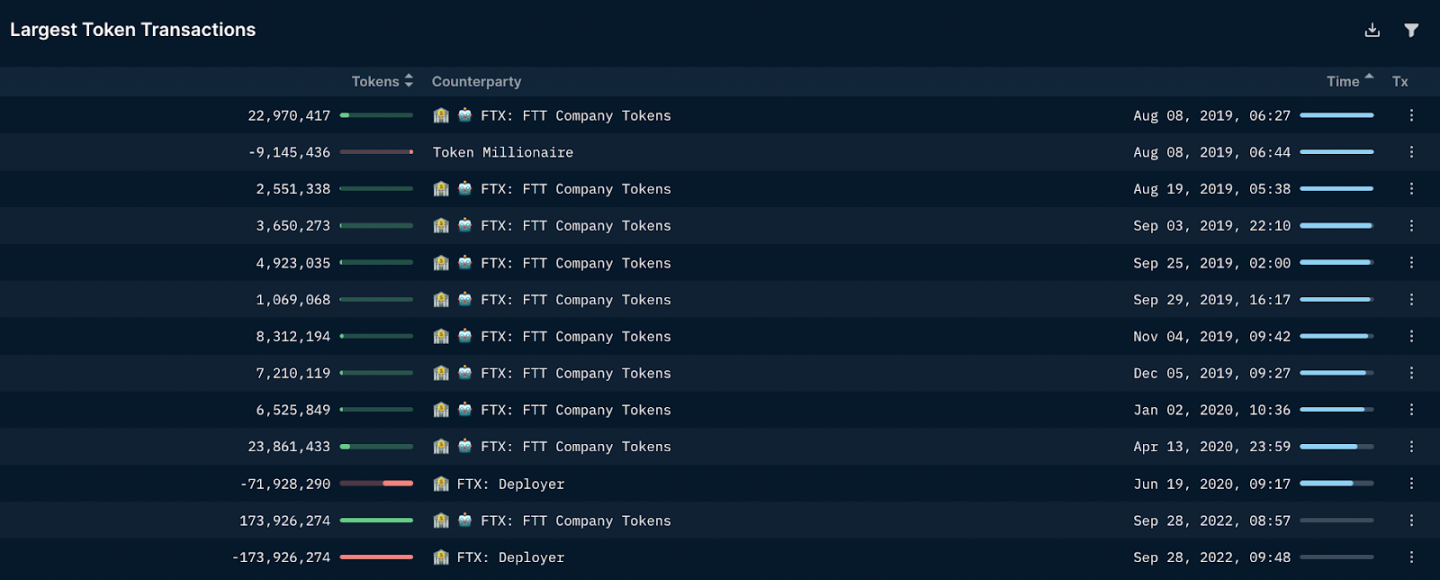
72 million has been withdrawn as of mid-April 2020 and sent to the Alameda wallet and then to the FTX deployer who put most of it on FTX - unknown what happens after that.
173 m was withdrawn immediately on September 28, 2022, then sent to the FTX Deployer, and then to the FTX Withdrawer After Freeze with the rest of the remaining FTT
Judging by the volume, these are almost certainly FTX Corporation and FTX Corporation managed tokens. The Alameda address was the sole beneficiary of the vesting contract, suggesting a strong connection between the two companies. If the Alameda wallet received FTT from the contract, they likely actually belong to FTX. They usually retweet them at some point without doing anything with them.
4.75 million FTT transferred to 3-month unlock contract contract
$59.3m for investor round (almost certain) + $5m for advisors (likely) + $10.7m for token economics design (likely)
image description

Source: Nansen
10 million to Token Millionaire: 0 x 4 aa (held until today)
20 million deposits to FTX: 0 xa 5 d (same as deposited by FTX Deployer, may be affiliated with FTX and/or Alameda), tokens may be distributed to FTT early investors, distributed through the FTX platform.
40 million to token Millionaire: 0 xef 9 , who also received 9 million from Alameda around the same time.
15 million still in wallet
20 million to FTX deposit: 0 xa 5 d (same location as March unlocked and FTX deployer to send funds), further distributed to early FTT investors (possibly) 27.5 million to EIP 1559 users: from 0 x 209 address send.
13.5 million to EIP 1559: 0xf 27 sent 13m to FTX: Alameda deposit and 500k to high balance: 0x648 and it's still there.
14 million sent to FTX: Alameda Deposit.
Alameda as a seed investor will likely receive at least 27 million FTT at the time of the initial distribution, representing approximately 8% of the total supply and 46% of the tokens sold during the launch.
Overall, at least 307 million tokens (86%) of all FTT’s 355 million tokens may have been initially controlled by Alameda or FTX. That percentage could be as high as 90% as another 12 million tokens have not been distributed and have sat undisturbed for years in wallets with unknown owners.
Alameda / FTX and Genesis Trading's FTT token exchange
Nansen wallet tags and addresses



