






PoPW (Proof of Physical Workload): Creating a Global Collaborative Economic Network


This article comes from MediumThis article comes from

, original author: Mohamed Fouda & Qiao Wang, compiled by Odaily translator Katie Koo.
In this article, we’ll dive into the characteristics of a successful PoPW network and what ideas could make it easier to scale and achieve product-market fit.
secondary title
Definition and Benefits of PoPW
The PoPW network is a collaborative network where network participants create a decentralized two-sided market. One party contributes workload to the network and service buyers, and the other party benefits from the services provided by the network by paying.At best, these networks should resemble decentralized exchanges, where service requests are automatically matched with service provider offers. The network only needs to charge a transaction fee, which is used to reward the infrastructure nodes that run the network. This may be the long-term goal of current PoPW networks such as Helium.
However, in the initial stages, a centralized entity is needed to develop the system and guide the growth of the system through partnerships and marketing. The entity also needs to develop a sound token economy, bootstrap the supply side of the network, and create a network that is attractive to customers.Similar to Amazon, the goal of the PoPW network is to create a global marketplace. The market is initially at a loss as it builds the business infrastructure and bootstraps the supply side. Market economies turn profitable when the supply side grows and the market succeeds in delivering high-quality services to buyers.
The advantages of a PoPW network also include the cost-effectiveness of reducing reliance on intermediaries and the ability to scale infrastructure faster.
secondary title
Five Standards to Realize PoPW Network
Regarding how the PoPW network can produce similar effects to centralized solutions, and the cost-effectiveness of PoPW will be expanded from the following five basic characteristics of the PoPW network.
1. Contributors "get started quickly"
For a PoPW network operating on a global scale, service provider contribution should be as easy as possible to expand the pool of potential contributors and achieve faster scalability goals. Some current PoPW networks require complex operations and multiple layers of planning and coordination, which can significantly limit their user base.
Decentralized mobile networks are one example.
Operating a mobile network is much more complex than deploying "tiny" base stations. The nature of mobile coverage requirements is dynamic, and the structure of a decentralized network cannot quickly adapt to changes in requirements. In addition, mobile networks require a lot of technical work in terms of planning, deploying infrastructure, servicing and maintenance, which is difficult for decentralized players to complete. XNET, a decentralized mobile network project, estimates that for every $1 in network revenue, $0.60 will be used to support complex backend operations and $0.40 will be used to reward cell tower deployments. This complexity dictates the need for a centralized entity to coordinate these activities, and a decentralized PoPW would be more difficult to achieve.
2. Contribution standardization
Spexigon's contribution was more precise, with the system's software controlling the drone's movement to create standardized aerial images. Standardization also guarantees fairness and neutrality among service providers. Service providers can be rewarded differently based on metrics related to network goals, such as coverage, recency, or customer demand.
3. "Reliable" oracle machine (Oracle)In a PoPW network, off-chain contributions of network participants need to be proven on-chain. These proofs allow contributions to be rewarded using the network's native token. Before submitting these contributions to the chain, the oracle needs to prove the authenticity of the contribution. This oracle problem is one of the toughest challenges for PoPW networks. Malicious actors have an incentive to manipulate oracles to extract maximum value from the network. likeMalicious behavior of some actors in the Helium network.
Since the network rewards them with a proof-of-coverage mechanism, there has been malicious activity of faking hotspots or spoofing their locations. Cyber actors have taken steps to crack down, including creating blacklists and using hotspots to challenge the system. Still, proving the authenticity of Helium hotspot locations remains a challenge.
Other PoPW platforms such as Hivemapper combat oracle operations by relying on hardware authentication. Hivemapper dash cams use GPS positioning and connection to Helium hotspots as part of the Proof of Location protocol for proving the correctness of mapping contributions. Additionally, Hivemapper adds a human-operated quality assurance layer that checks the authenticity of submitted images. While human review works, the process becomes complex and can create opportunities for malicious coordination between contributors and reviewers.
Effective PoPW oracles remain an open problem and a potential area of innovation. Currently, there is no general solution to this problem. Hardware authentication can provide some protection for specific use cases, since hardware is generally more difficult to manipulate. However, this also requires a more resilient and general-purpose Oracle to support a wider range of use cases.
4. Avoid monopoly
To be successful, a decentralized PoPW network needs to avoid single points of failure. Points of failure include dependencies on proprietary technology or specific software or hardware vendors. Instead, the network should adopt a contributing standard that can be supported by multiple vendors and applied to any hardware or software required for the network. Make the network more secure and reliable by eliminating any chance of centralization and monopoly. Helium, for example, has more than 20 vendors producing the LoRaWan hotspots needed for the network.
5. Conservative and flexible token design
A major factor in the success of a PoPW network is token design, which can attract network contributors, balance supply and demand, and prevent malicious extraction of value from the network.
Balanced Token Design Principles:
The PoPW development entity should change the token design based on the actual data of the project's main network. It is best to provide conservative incentives on the supply side from the beginning and roll it out as an initial product. As network usage increases, token design can be changed to improve network economics.
secondary title
PoPW development status
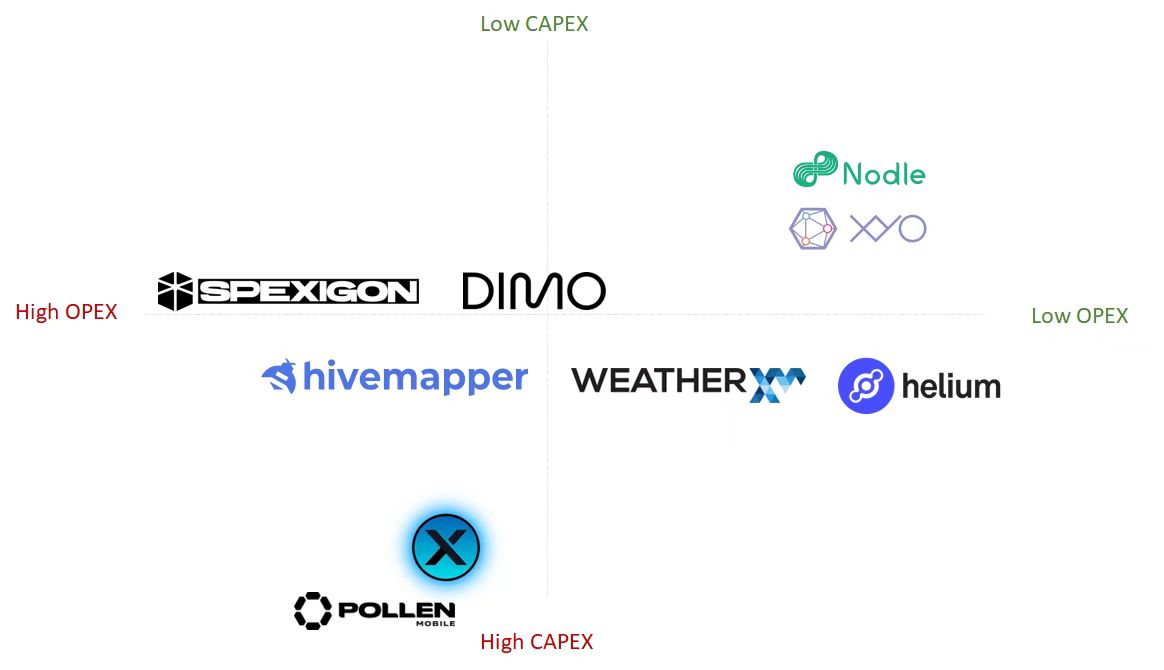
A common requirement of PoPW networks is the need to scale quickly to compete with centralized solutions. The main limiting factor in acquiring participants is the cost of participating in the network. A network with low participation costs can quickly attract more users, achieve better supply quality, expand decentralization, and test product-market fit faster. PoPW participation costs are usually divided into upfront investment costs and ongoing participation costs. PoPW projects are categorized below according to these participation costs.
Entry costs (capex)
"Cost of entry" is the upfront cost a user must pay to become part of the network. Such as the cost of a Helium hotspot or the cost of a Spexigon protocol drone, also known as capital expenditure. The higher the capital expenditure, the harder it is to acquire network users. The high "cost of entry" is often related to the specialized equipment required to participate in the network. In addition to cost, specialized equipment also takes longer to manufacture and distribute to network participants, which slows down adoption. PoPW networks that require simple or common devices such as mobile phones are more likely to attract users.
This is an ongoing operating cost that users pay to actively participate in the network. For example, the energy cost and time required to map an area using Hivemapper or Spexigon, we call it operational cost. High operating costs mean that participants need to get paid for their contributions faster and more frequently. This also means that participants will need to sell a portion of their earned token rewards to cover their operating costs, creating continued selling pressure on token prices. This pressure needs to be balanced by demand, that is, the buying pressure of native tokens, in order to protect the price of native tokens from entering a downward trend, thereby stabilizing participants’ confidence in the network. Networks that require high operating costs can often benefit from an incremental growth strategy that balances supply and demand.
secondary title
PoPW Entrepreneurial Direction
1. Infrastructure and tools of PoPW network
Examples of addressing infrastructure needs include innovative manipulation-resistant oracle solutions that can be hardware-based or crypto-native, ensuring the authenticity of contributions and eliminating fraud.
Another tool is an SDK that can launch a modular PoPW network as an L2 or application chain with a custom token economic model. PoPW networks generally do not need to be launched as L1 as they are now. These SDKs need to focus on modularity by creating separate modules, such as token utilities, reward mechanisms, oracle solutions, and storage solutions (in the case of data-related PoPW). This modularity allows PoPW developers to independently tune each module for optimal customization for specific use cases. The availability of such SDKs can greatly simplify the work required to launch a PoPW network.
2. Health data sharing
A major challenge for public health researchers is the lack of sufficient data sets to test their research hypotheses. The solution to this problem is to decentralize the health data that individuals provide for research and drug development. For example, DNA data is shared by individuals, and participants are rewarded for sharing their DNA data and related health information. Universities, hospitals, and pharmaceutical companies can access this data through a decentralized marketplace and use it for research and commercial applications. Another example is sharing physical activity data, heart rate, sleep data and other types of data collected by wearable devices. Health-conscious businesses can use this data to improve their products. In these applications, user contributions are simple and standardized, making them ideal candidates for conversion to PoPW networks. Additionally, health data use cases can benefit from privacy-enhancing techniques such as zero-knowledge proofs.
3. Decentralized VoIP International Calls
Voice over Internet Protocol (VoIP) technology is able to route calls over the Internet, greatly reducing the cost of international calls. With decentralization, the cost of international calls can be reduced by another 10x. The PoPW network, made up of users who connect their local phone lines to the Internet, creates a global phone network where local calls cost the same as international calls.
4. Balance the distribution of renewable energy
Sustainability and clean energy have received increasing attention in recent years. The use of solar cells and other renewable energy sources can be improved by creating efficient distribution networks that balance generation and consumption. Decentralized energy contributions could also be integrated with the public energy network, supporting the network during periods of high demand and reducing the need to use fossil fuels during these periods. An example of this is React web.
Sustainability and clean energy have been in the spotlight in recent years. The use of solar cells and other renewable energy sources can be improved by creating efficient distribution networks that balance generation and consumption. Decentralized energy contributions can also be integrated with the public energy network, supporting the network during periods of high demand and reducing the need to use fossil fuels during these periods. An example project in this area is React Web.
5. MTurk on decentralized chain
Amazon MTurk is a platform that allows the outsourcing of tasks requiring artificial intelligence to distributed job seekers. The current MTurk model is not suitable as a PoPW network due to the diversity of tasks. However, with the development of technical tools, MTurk can grow into an on-demand small PoPW network.
In this model, requesting entities create sub-PoPW networks on demand and submit worker contributions to the sub-networks according to their rules. All subnetworks share the same native token, creating a contributor-owned platform that is flexible enough to serve different niche use cases. In addition to the benefits of reducing costs through lower intermediary fees, MTurk on the decentralized chain has several other advantages, including:
Employers and employers are not required to share PII as Amazon MTurk currently requires;
The history and achievements of both parties are transparently displayed on the chain for review by counterparties;
SBTs issued by third-party identity providers can attest to a particular job applicant's qualifications;
Earned on-chain reputation can be transferred to other user-facing clients;
Payments can be settled faster through encrypted rails.
6. AI dataset creation
Training advanced AI models requires large and complex datasets. A lot of human input is required when creating datasets. For example, to create a dataset to train an autonomous driving model, the first step is to capture photos of actual traffic conditions at different times and in different scenarios. Then, the second part is to correctly label/annotate these images to train the computer vision model. Both steps require a lot of human involvement. A PoPW network can be built to aggregate human contributions to create large datasets for AI and other use cases. These datasets will be used by companies developing and training large AI models. As the complexity of the AI model increases, the PoPW network can continuously modify and expand the dataset to achieve better performance.
secondary title
Summarize
We believe that the PoPW network can create a large-scale economic network and realize the potential of decentralization. Compared to Web3's financial use cases (mainly speculation), PoPW networks facilitate services that touch our daily lives. In several cases, PoPW can challenge and compete with monopolies by offering better services at lower costs. We are particularly excited about decentralized data sharing applications and end-user services, and look forward to seeing more Builders in the PoPW network field join the build army.
secondary title


