






Innovation or monopoly? Reth launched by Paradigm was exposed to plagiarize Artem code


Top crypto VCs are stepping down to do Ethereum node clients. Previously, a16z launched an Ethereum light clientHelios, and later Paradigm built the Ethereum execution layer Reth. With their own powerful resources and strong financial advantages, these two projects have attracted much attention since their debut. However, as soon as Reth was made public, it fell into a whirlpool of public opinion due to code plagiarism and use of the database of a company sanctioned by the United States.
As we all know, Ethereum nodes run on top of the client, and the client is the software application that the node interacts with the Ethereum blockchain and the blocks based on the Ethereum smart contract. Without clients, nodes would not be able to broadcast and verify transactions, execute smart contracts, or reach consensus on the state of the blockchain. Ethereum has multiple interoperable clients, using various programming languages (such as Go, Rust, JavaScript, Typescript and Python, etc.), and independently developed and maintained by different teams. This diversity also makes Ethereum The Ethereum network is more resilient to attacks and errors, especially after the Ethereum merger.
Both Helios and Reth are written in the Rust language. The difference is that the former focuses on light node clients, which can convert data from untrusted centralized RPC providers into secure and verifiable local RPCs (remote calls). According to Paradigm CTO Georgios Konstantopoulos, this is a new Apache/MIT open source licensed full-node client, not a fork or rewrite of any other client implementation, but Built on top of clients including Geth, Erigon, and Akula, core goals are modularity, open source friendliness, and performance.
tweetstweetsHe pointed out that Paradigm created Reth for three reasons: to build high-performance nodes for advanced users; to contribute to the stability of Ethereum by improving client diversity; to give back to Ethereum by contributing to the roadmap. Paradigm is currently building Reth to adapt to a wider user base, including stakeholders, enthusiasts, RPC node operators, Bridge, MEV searchers, Layer 2 (such as Optimism/Arbitrum) or other Ethereum adjacent projects (such as Polygon, BSC, Avalanche and Fantom, etc.). Through Reth, Paradigm will work side by side with the Ethereum ecosystem and core developers, and hopes to be at the forefront with new research, code, and architecture, and contribute to important upcoming milestones in the Ethereum roadmap.
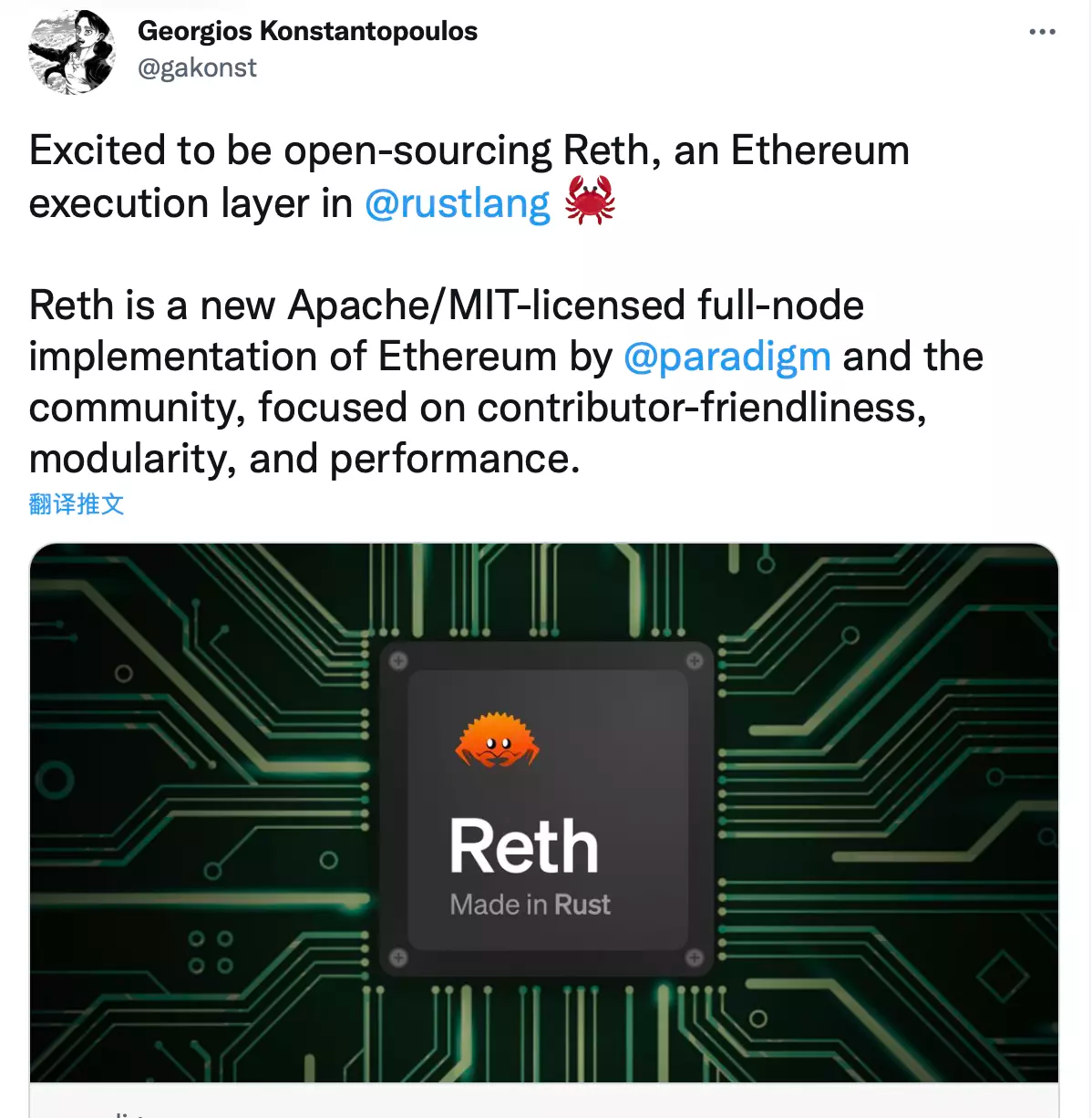
At the same time, Konstantopoulos also said that Reth is still under construction and is striving to become a node and framework for building EVM infrastructure. At the same time, the team expects that Reth will support synchronous Sync+RPC early in the first quarter of 2023. Although the code has not been audited and should not be open for use, anyone can use it under the Apache/MIT license without any additional conditions. At the same time, out of consistency with Ethereum’s transparency and values, Reth will publish the Reth Book, sharing the knowledge the team has learned about how the Ethereum protocol works and how nodes should be built during the process of developing nodes, as an introduction for node developers Educational Resources. Additionally, Konstantopoulos encouraged the community to fork Reth.
And Konstantopoulos' tweet appears to be a response to his copying of Akula's code. Not long ago, Akula founder Artem Vorotnikov posted, "Unfortunately, we can't compete with the venture capital company that copied and pasted the Akula architecture and code, open source, right?"
Konstantopoulos said that Reth is not a copy or rewrite of any client implementation, nor does it contain any existing client code, but stands on the shoulders of giants such as Geth, Erigon, and Akula. At the same time, he also said that Paradigm sponsored this project (Reth) for the diversity of clients, so it is a pity to see any other projects stop development, which is a loss for this field.
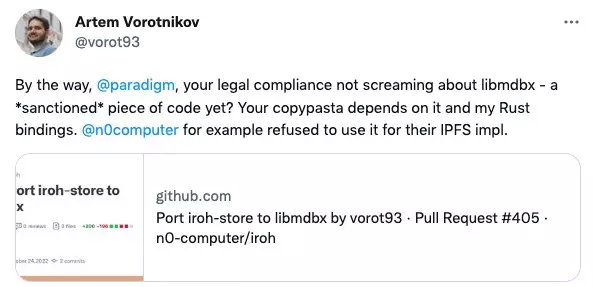
At the same time, Artem forwarded the screenshot of Konstantopoulos' tweet insisting that the company did not fork Akula, and said that "some people want to be named and shamed", bluntly saying that Paradigm copied the "Rust package libmdbx" code, Paradigm relied on it and copied it Pasted, but rejected for IPFS implementation by developer @n 0 computer.
Akula is also a high-performance Ethereum client written in Rust. It adopts the design idea of the Ethereum client Erigon and is officially supported by the project. It was started in June 2021 by Artem Vorotnikov, a core developer of Ethereum, with a small Group developers build. Prior to developing Akula, Artem Vorotnikov was lead software developer at GnosisDAO who took over and maintained the legacy codebase of Parity, an Ethereum client implemented in the Rust programming language.
However, the launch of Reth forced the Akula developers to announce that they would no longer maintain or run the project as they could not compete with a rival project Reth with similar functionality, but the Akula code is still available because it is open source.
Although Konstantopoulos has repeatedly denied it, the Akula developer revealed that the CTO had asked a lot of technical details about the project, and the team responded unreservedly, and believed that Konstantopoulos might intend to participate in Akula's open source contributions.
In addition to questions about code plagiarism, Erigon's withdrawal of support for Akula further exacerbated community discontent. On November 23, the Erigon team stated that it has recently noticed a Rust-based implementation of the Ethereum execution layer, which has almost the same scope as Akula, and has some similar building blocks, and will soon open source. After discussion, the team believes that the new project will be better supported after open source, and will soon match and surpass Akula in terms of functionality, so it has decided to cancel Akula's technical, management and financial support, and is gradually ending the project. Management and technology transfer.
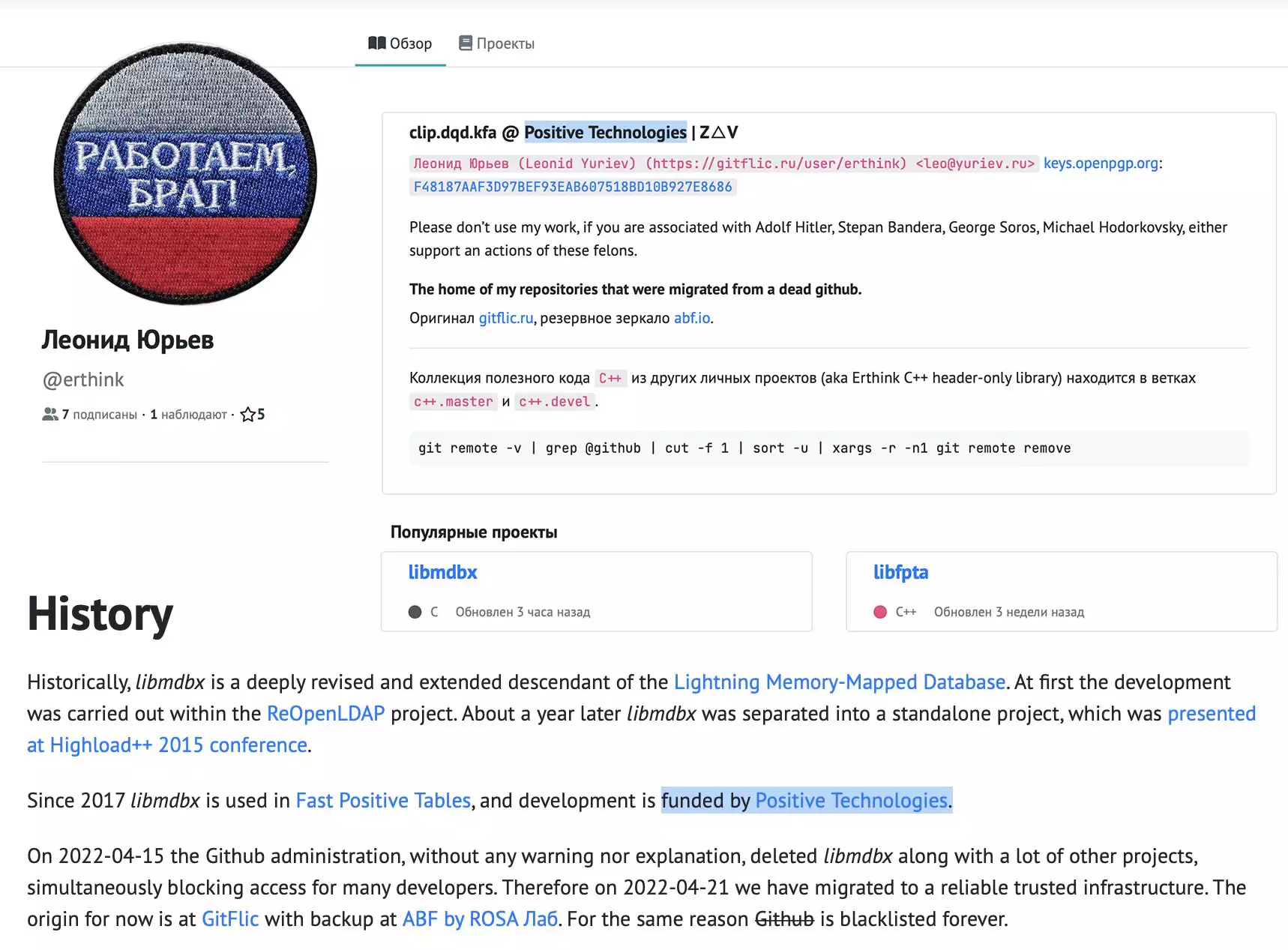
So how did Erigon discover projects that were not yet open source? Is there another secret behind it? In addition, Reth was also pointed out by the community that the libmdbx database it used was funded and developed in 2017 by Positive Technologies, a Russian cybersecurity company sanctioned by the United States.
"While Reth borrowed heavily from Akula, and copied Erigon's uniquely groundbreaking architecture, Paradigm never supported the developers behind these clients, and instead 'dumped' them under false pretenses, instead of partnering with and paying for Erigon's Consulting fees. Paradigm is one of the few VCs who can write code, but that is not an excuse for its predatory behavior, especially with a non-hostile product, which not only damages the spirit of open source, but also damages its own reputation." Yearn core developer Banteg tweeted.
In the Web2 era, monopoly was once the top wealth code. If Erigon really gave up support for Akula because of Paradigm’s capital monopoly, then this is undoubtedly the strangulation of early innovation projects. This kind of behavior of taking other people’s excellent products/ideas by virtue of its own advantages is really disgraceful. Monopoly This behavior will undoubtedly make developers lose the motivation to open source, and the monopoly behavior similar to the Web2 oligarchs is also contrary to the decentralized characteristics of the blockchain.


