Re-interpretation of Layerzero: a protocol layer product that is often mistaken for a cross-chain bridge



In the past two-year bull market, the market not only witnessed the rapid rise of the multi-chain ecology, but also directly witnessed the rapid explosion of many cross-chain bridge products.
However, after repeated hacking incidents and various defects in the experience of cross-chain bridges, people began to doubt whether cross-chain bridge products that only solve asset cross-chain problems are in the wrong direction? What should the underlying protocol that can carry native cross-chain applications look like in the future?
first level title
Why can't Layerzero be simply understood as a cross-chain bridge?
When seeing the introduction article about Layerzero, the first reaction of many readers may be: "Isn't this another cross-chain bridge product?"
Indeed, the current application of cross-chain technology in the market still basically stays in asset cross-chain. However, asset cross-chain is actually only a small subset of the entire cross-chain technology. It can even be said that the many cross-chain bridge products we used before are just developed by the project team in order to cope with the sudden emergence of multi-chain ecology. A transitional product for the most basic needs of users at that time.
And if we want to enter a truly mature multi-chain ecology, so that users can smoothly interact with all mainstream public chains through only one application, and do not need to frequently switch wallets, then we must have a lower-level, capable A protocol-level cross-chain product that realizes information cross-chain rather than simple asset cross-chain.
Just like the meaning implied in the name of Layerzero, Layerzero did not simply position itself as an ordinary asset cross-chain bridge from the beginning, but hoped that it could become a lower-level infrastructure-level protocol than the Layer1 public chain, and then in In the future, it will completely solve the deep-seated problems such as liquidity fragmentation among many public chains and the need to frequently switch wallets when using applications.
first level title
secondary title
1. Value capture logic
Yes, in the Web3 industry, the most important difference between protocol layer and product layer projects may be the fundamental difference in value capture logic.
According to the famous "fat protocol" theory, the underlying protocol-level projects in the Web3 ecosystem can often capture the most value in the industry by providing security guarantees for upper-layer applications. However, application layer projects built on the protocol layer often need to rely on the traditional method of obtaining income through handling fees or service fees, and then converting them into profits to capture value.
Therefore, before deciding to deeply participate in a Web3 project, it is a very critical issue to distinguish whether it is an application layer product or an underlying Web3 protocol that can carry upper-layer applications.
secondary title
2. What matters is ecology, not just product functions
The way to evaluate a protocol layer project is also very different from an application layer project.
Among many smart contract public chains, the reason why Ethereum can maintain the highest market value for a long time is not because of its faster transaction speed, but because Ethereum has the most prosperous chain ecology and developer group.
Therefore, when we are investigating a protocol layer project like Layerzero, the focus should not be on simply evaluating which public chains it supports and how many more cross-chain currencies it supports, as we do with other cross-chain bridge products. level of improvement. Instead, we should pay more attention to the innovations brought about by various ecological projects based on it.
At present, the more representative products based on Layerzero already include Stargate and Sushiswap, etc. In the future, as the ecology continues to develop, it is expected that more native cross-chain products based on Layerzero will be born.
first level title
What are the advantages of Layerzero over other cross-chain protocols?
secondary title
1. Greater versatility
The IBC protocol, born in the Cosmos ecosystem, is also committed to achieving cross-chain protocol layers. However, in order to achieve compatibility with IBC, light nodes of other public chains must be deployed on the public chain. The high gas cost makes it difficult for many EVM-compatible chains, especially Ethereum, to support the IBC protocol, which greatly limits the versatility of the IBC protocol. Therefore, it can only run among relatively small Cosmos ecological chains.
Similar to the IBC protocol, the Polkadot ecosystem, which once focused on the cross-chain concept, has also developed the XCMP cross-chain protocol. However, because it can only realize the cross-chain interaction requirements between Polkadot parachains, it can still only become a cross-chain protocol among relatively closed small circles.
secondary title
2. The balance between safety and efficiency
Of course, Layerzero has not been the only player on the track of integrating all mainstream EVM public chains and becoming its underlying cross-chain protocol. One of the more influential competitors is Wormhole. But if we mention Wormhole again today, the first reaction of many readers may have been the hacking incident that caused hundreds of millions of dollars.
This actually throws us a more important question, that is, how can Layerzero achieve a better balance between efficiency and security? This is the technical architecture of the "ultra-light node" that helps Layerzero realize cross-chain communication.
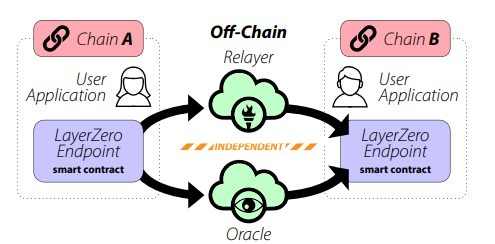
Layerzero's "ultra-light node" still adopts a verification mode similar to IBC light nodes, but it is different from the slightly cumbersome solution where light nodes save all the block headers of the other party. Obtain the required block header and verify the transaction, thereby greatly reducing the cost of verification under the premise of ensuring security.
This leads to the fact that the current Layerzero has an advantage over Wormhole, which also has ambitions to become the underlying cross-chain protocol of the EVM chain, in terms of safety record and efficiency.
After all, if a developer chooses an insufficiently secure underlying protocol to build an application, once its security assumption is broken, it is likely to lead to complete failure of the application and damage to user assets. Therefore, in the future, Wormhole may continue to exist as a cross-chain bridge product, but I am afraid that it will be difficult to have the opportunity to develop a prosperous protocol ecosystem and compete with Layerzero.
Therefore, at this stage, Layerzero can be said to have found a blue ocean market that is relatively suitable for itself. As long as the project team can work silently during the bear market and do its best to build its own protocol ecology, then when the next bull market comes, Layerzero will hopefully become the seed player of the next cycle. (Remember Chainlink, the first protocol layer project that broke out in the early days of DeFi Summer, although it was difficult to understand?)
A bear market is often a critical stage that breeds innovation at the protocol layer. This article briefly outlines the essential differences between Layerzero and many cross-chain bridge projects in the previous bull market stage, as well as its underlying logic that can breed the next wave of native cross-chain applications. I hope that readers will not give up their continuous attention to protocol layer products during the somewhat boring bear market cycle.
After all, the progress of the protocol layer is the strongest driving force for the industry to move forward.