Talking about why Ethereum is most likely to become the base layer of CBDC


Original title: "Ethereum is most likely to become the base layer of CBDC"
Original compilation: Block unicorn
Original compilation: Block unicorn
Outside of China, no major country is ready
Imagine if you were willing to have persistent double digit inflation, skyrocketing energy costs, shortages causing blackouts across Europe, uncontrolled surges in bond yields, supply chains grinding to a halt, and sovereign debt crises erupting around the world. … ..
Then, on a long weekend after the markets closed on a Friday, there was an urgent news that the President, the Chairman of the Federal Reserve and the Speaker of the House of Representatives appeared on national television to announce that under the statutory bail provisions of the 2010 Dodd-Frank Act, There will be a bank holiday in the coming week. During the holiday period, certain bank liabilities will be converted into Federal Reserve Coin (FED), an ERC-20 token on the Ethereum blockchain, at an exchange rate of 10 FED per $1.
Each depositor will have an NFT of their Social Security number issued to them — which will allow them to access their FedCoins via the Ethereum login protocol. Depositors must “stake” their Ethereum to receive the “full benefits” of FedCoin, however, any bad social behavior, such as falling behind on current vaccinations, or turning the air conditioner on too cold, can result in “penalties.” ”—part of their pledged assets are “burned/destroyed”.
Similar announcements have been made elsewhere: Canadian Prime Minister Freeland and her Finance Minister Steven Gilbert announced the creation of LOONCoin, citing the Bank Recapitalization (Bailout) Conversion Regulations of 2018, while in Australia they referred to Financial Sector Legislative Amendments (Crisis Resolution Powers and Other Measures) Bill 2017. Across the G20, every leader has called their national initiative part of a grand reshuffle...
We have entered the endgame of the late phase of globalism, and things are moving fast. Decades of increasingly centralized, fiat-based looting has now reached its peak, and the system is rapidly unraveling:
Due to the energy shortage caused by ESG (Environmental, Social Responsibility and Corporate Governance), the cost of energy has risen sharply.
Inflation rates have surpassed the stagflation rates of the 1970s and in some regions (Turkey, Argentina, Sri Lanka, Lebanon) are approaching severe inflation.
Bond markets around the world could unravel at any moment as beleaguered central banks try to engineer rate hikes into a global recession.
Geopolitical tensions (even among NATO allies) recall the months leading up to 1914, when the world "sleepwalked" into the first global war on an industrial scale.
The world's political and cultural elites have never been more dysfunctional and out of touch with reality.
Many commentators have floated a monetary endgame scenario in which the Fed and other central banks do lose control of bond markets, $150-$300 trillion (depending on what you include) global debt implodes, and the financial system itself enters The collapse that has been postponed since the bankruptcy of Internet companies...
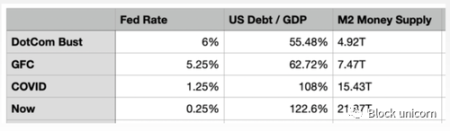
Two Decades of Effort: Fed Rates, Debt/GDP, and M2 Money Supply Caused the Last Four Financial Crisis…
The small metaphor in the opening paragraphs outlines what many of us who are skeptical of the current system expect: the inevitable move towards a Central Bank Digital Currency (CBDC), seen as a fiat-based financial A way of ten-year lifespan while presenting an irresistible mechanism for asserting Chinese-style control in a way that former authoritarians could only dream of.
A plethora of government white papers have been released (we discuss these seriously in Letters to Crypto-Capitalists), which unanimously outline CBDC aspirations:
The effective date for Cash.
Negative interest rates on savings.
Programmability of where, when, with whom and why money is spent.
Reporting, tracking and taxation at the transaction level.
Quotas, Limits and Restrictions.
The ability for central authorities to add or remove funds remotely.
Outside of China, no country or central bank can truly complete the deployment of CBDC.
For a while, it seemed like Facebook's Diem would be at least a temporary FedCoin, until Facebook dropped the project (they had sold the intellectual property to Silvergate Bank).
But in reality, no one is ready. Countries that have deployed home-grown CBDCs such as Nigeria and Venezuela have failed, and even China’s digital yuan debuted during the Olympics to mediocre response (no one uses it).
It is impossible for a country's CBDC to develop secretly and then suddenly appear in the crowd. The orbit of a globally interconnected CBDC will leave a footprint, and a huge one at that. People who follow Bitcoin, cryptocurrencies, digital assets, and blockchain closely will hear about it and see its future, while any development known to be unready, such as Canada's CBDC Jasper project, has stalled.
However, now that the financial system is rapidly unraveling, there may not be time to develop a national CBDC from scratch, at least for the G20 advanced economies.
The solution might be to take an existing cryptocurrency that has already been deployed, already has a market share and a brand, and shows more or less buy-in to the concept.
Enter Ethereum: Central Banks' (and WEF's) Cryptocurrency of Choice
The advent of Bitcoin was a blow to all central banks and fiat currencies. For example, we see people's gut reaction to threats posed in various Bank of Canada documents (obtained via ATIA request):
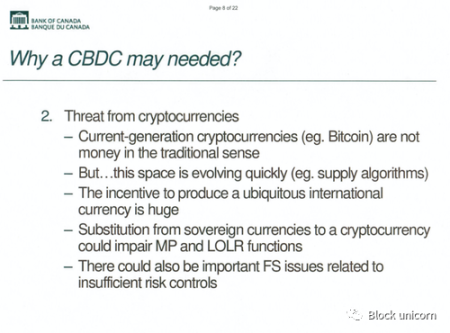
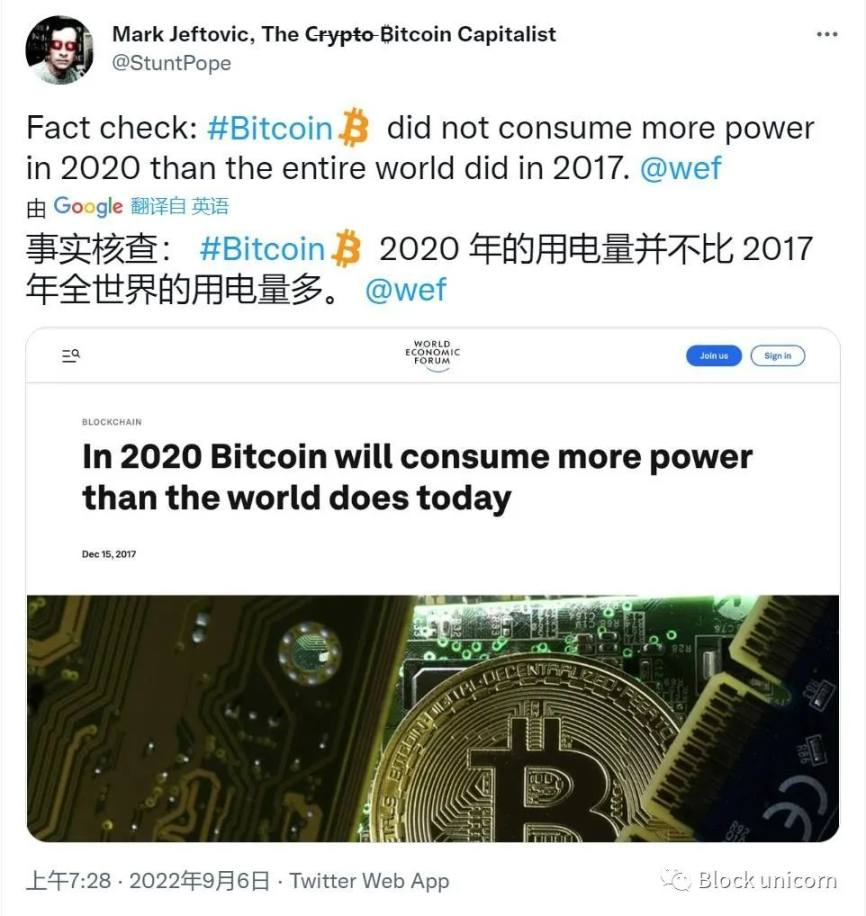
At the supranational and NGO level, everyone from the World Bank to the IMF to the World Economic Forum harbors some degree of hostility toward Bitcoin. World Economic Forum articles on Bitcoin usually end with Bitcoin-related "problems" and alternative currency solutions, even claiming in 2017 that "Bitcoin will consume more electricity than the entire world" by 2020.
So, one cryptocurrency to note that these international institutions and central banks have not been openly hostile to is Ethereum.
The main thrust of Canadian CBDC development is (so far) "Project Jasper", a collaboration between the Bank of Canada, Canadian Payments, R3 and the big banks, note that Phase 1 is built on top of Ethereum:
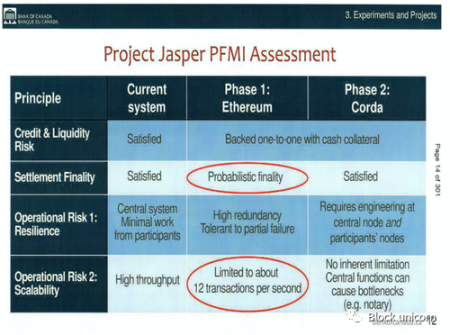
So far, Norway and Israel have started CBDC development using Ethereum. In 2021, a Chinese banking official made the case for deploying a CBDC on Ethereum, and at a World Economic Forum meeting in 2020, Joseph Lubin, co-founder of Ethereum and CEO of Consensys, A white paper was submitted stating that Ethereum is an orbital for a CBDC.
“As the World Economic Forum gathers in Davos for the 50th time, it is taking place against a backdrop of dramatic changes in monetary regimes.
Below we provide an overview of CBDC and provide a concrete example of how a CBDC could be implemented on the Ethereum blockchain. We believe that Ethereum is the most suitable blockchain network for the most secure, global-scale, interoperable settlement platform that a CBDC requires. But we are well aware that there are many other possibilities. "
To be clear, I'm not one of those people who thinks the World Economic Forum is some kind of omnipotent "controlling everything" cabal, because the reality is that the world is inherently uncontrollable on a macro level (we live in In a world out of control, the prospect is, for many, scarier than dystopia).
But what happens in Davos doesn't stay in Davos. The WEF agendas do wield enormous influence (at least for now), and they do set the prevailing tone for technocrats, authoritarians, and Malthusians of all sorts that infiltrate elite circles.
Ethereum (or "CBDETH") is well suited for global cbdc use cases: different ERC-20 tokens can be used for multiple purposes: stablecoins, UBI (Universal Basic Income allocation), food stamps, carbon quotas, social credits ——All of these are supported by Ethereum at the bottom. A country with a good track record is willing to change monetary policy at any time without fear of the hardships and dangers that come with changing.
For advancing digital IDs, ERC-721 style NFTs are a good fit. Not only does your boring ape show how cool you are, it acts as a form of identity, and if your COVID health code is up to date, it's on the blockchain for all to see.
Looking at it now, this runs counter to what I’ve been saying in The Crypto Capitalist for over a year now. My theory is that, in the future, the way you can differentiate between decentralized anonymous digital assets and CBDCs is the possibility of self-custodial private keys. Maybe I'm wrong because anyone can hold their own wallet for Ethereum.
However, we should expect that civilians will be incentivized to keep their private keys (“secure and efficient”) with their banking partners in the CBDETH system. There might even be incentives for doing so, like an extra meat allowance, or being allowed to take an extra flight a year.
The Ethereum ecosystem has signaled its willingness to comply with central state directives: embracing OFAC compliance, making helpless attempts at transaction review at the protocol level, rather than arguing too much. The upcoming PoS action is ESG inspired (this is not the place to argue about PoW energy policy, just to say that the scare surrounding it is based on pure ignorance and fear; but I would at least recommend Alex Gladstein's The Hidden Cost of Petrodollars and Nic Carter's "The Last Word on Bitcoin's Energy Consumption").
After the merger (aka Ethereum's Great Leap Forward), if we can envision a scenario where the majority of ETH is locked up in centrally operated validators, a large chunk of the system has enacted protocol-level transaction censorship , which would be perfect. On the surface, it can be built as a decentralized, inclusive digital currency, while in reality it is highly centralized and censored at the transaction level.
Just as the WEF boasted that they had “infiltrated many of the world’s governments,” the upper echelons of the WEF and the Ethereum Foundation have intersected in a few places. In addition to the aforementioned speech by Ethereum co-founder Joseph Lubin, the executive director of the Ethereum Foundation is an “agenda contributor” at the World Economic Forum.
The Enterprise Ethereum Alliance is made up of Big Tech, Wall Street, and corporate bigwigs, including JPMorgan Chase, Microsoft, Accenture, BNY Mellon, Ernst & Young, and even FedEx Enterprise Services.
Comparison of Ethereum and Bitcoin
With EIP 1559, Ethereum ostensibly adopted a "super-sound" monetary policy, and the supply of ETH would actually plateau and then start to decline as more ETH was "burned" than minted. Yet even such an update, coupled with the looming switch from Proof-of-Work to PoS, shows that Ethereum's core developers have nothing wrong with fundamentally adjusting its fundamentals to suit the wind. and environmental changes.
From the original ICO to insiders, to launching an infinite supply, to saving itself after the DAO hack, Ethereum has a "whatever it takes" approach, the exact opposite of an immutable hard asset like Bitcoin with a limited supply .
They can change the system again if a situation arises where they want or need an infinitely expanding money supply.
Compared with Bitcoin, Ethereum is truly decentralized and has an immutable hard upper limit. If there are dissenting factions, such as in a block size competition, it can be resolved through a hard fork, and users can choose for themselves what works for them, and the market will justify that force.
At this point, Bitcoin even has a Proof-of-Stake version.
So, if we really value democracy over coercion, and if Proof-of-Work is clearly superior to Bitcoin Core's Proof-of-Work, then we should see "Bitcoin" in due course. Coin-2” to replace Bitcoin (similarly, this is also my main opinion on The Merge, a more democratic way is for users to choose a hard fork, and then it is up to the user to choose which chain to stay in).
in conclusion
in conclusion
In The Manifesto for Cryptocapitalism, I propose a theory of an impending two-tiered society, building on previous work around the "Great Fork". In my opinion, UBI will be inevitable, and Orbit will be a CBDC as a Chinese-style social credit system. Everything that has happened since has reinforced that belief.
What I may not have foreseen is that the orbit of CBDC is likely to be Ethereum, or a cooperative version of it. The Beacon Chain (the merged chain) may be this version.
It is too early to say how to view this issue. I've always had a soft spot for Ethereum and admired what they've done with ENS for decentralized naming. My main business has been involved in this work for a while. I guess it's a bit confusing to watch it position itself for mainstream/corporate/government acceptance.
However, the long-term existence of Bitcoin has broken the criticism of being considered a honeypot, and Ethereum has realized its infinite possibilities through practical applications.
(Perhaps it’s a good thing that the last iteration of state-sponsored money in the fiat currency era will have to build on something they absolutely cannot control—another sign of the decentralized revolution?)
This is not to say that wearing our investor hat, even if it goes on like this, there will not be huge gains within the Ethereum ecosystem. If Ethereum becomes orbital for a global CBDC (CBDETH), owning its infrastructure components (oracles, validators, exchanges, DApps, naming platforms) will be akin to owning a fraction of the Federal Reserve, or the global ACH payment system.
Original link