DID: Refactoring the Web3 social model


first level title
1. The core of DID
exist"DID: Improvements to on-chain credit business and DAO identity", we pointed out thatThree properties of DID: low consensus cost, composability and native globalization, is the main difference between it and the real social identity system, and this is one of the elements that it can bring about a qualitative change in Web 3.DID changes the definition of "identity" in the traditional sense. In the physical world, proving that "I" is "I" relies on official government documents. The government with a collective consensus has endorsed the credit and provided the authenticity and reliability of the identity certificate, and human beings have been able to derive a code of conduct applicable to society. But in the world of the Internet, the definition of an individual has changed. As David Phelps writes in "You Are What You Ownargues that we can own our data online as individuals and be rewarded for sharing, collectivizing, and reorganizing it in new public social structures that we have not yet fully conceived.
In other words, "I" is the sum total of my current behavioral patterns, and human behavioral patterns determine an individual's identity. The social platform of Web 2 is broken, and the social profiles of each medium cannot communicate with each other; but Web 3 gives the answer. DID strings together traceable behaviors on the chain, pointing to a unique identifier stored in the blockchain. Human preferences, property, experience, reputation, etc. enrich the identity and can communicate with any DApp.
《Decentralized Society: Finding Web3's Soul"The article expounds a vision of the Web3.0 ecosystem, called "DeSoc", a decentralized society. And the basis of all this is around DID, because the proof of relationship on the chain can be realized, and the core of proving that "you" is "you" is DID. The data on the chain is transparent, and DID breaks the barriers of centralized servers. It is like a "plug-in" that packages and integrates human behavior in various scenarios for flow, and also gives more possibilities to the needs of upper-level applications.
In a broad sense, social interaction is a collection of human behaviors. In modern society, all interactions between people can be considered social, including financial services. But does the DID in the current mode change the social behavior in Web 3, and how does it build another type of paradigm social relationship in Web 3? Next, we will use the project as an example,first level title
2. DID as a "plug-in"
It is precisely because of DID's "plug-in" feature that DID track projects. Among the projects introduced below, there are DApps at the data layer, protocol layer, and application layer. It is very incorrect to simply define them as DID projects due to the composability of DID. Compared with the summary of DID ecology from a technical point of view,This article will start from the perspective of users, that is, how applications define and apply DID, and outline the adaptability and changeability of DID to human social behavior on the chain.secondary title
a. Rely on off-chain authentication
BrightIDThe core idea is to verify the authenticity of users through social relationships, which solves the problem of unique account identities. Users do not need to submit identification documents, but only need to participate in the verification session of multilingual selection (verification party) and complete the initial level of identification to obtain a verification badge. After establishing social connections with friends, such as adding friends, creating groups, etc., you can get corresponding points and upgrade your identity verification level.
The authentication session setup for the initial level is, in fact, more likeSimplified off-chain KYC certification process. The offline identity verification behavior is compared with personal offline entities and identity documents. BrightID does not collect personal data, that is, omits the step of identification documents, and uses human face-to-face social behaviors as "initial identification documents" to generate trust, and then use social behaviors to improve the trustworthiness of identities. This type of model is highly dependent on the good interaction of social relationships, and cannot avoid malicious behaviors that contain fraud. On the other hand, in the BrightID introduction, they argue that "the ability of humans to identify someone using all available information (including recognizing their face/look). The ability of real people to recognize others far exceeds the ability of artificial intelligence", butSuch a mechanism, under the criticism of artificial intelligence's uncertainty and possibility of doing evil, finally returns to the digital identity environment that relies on big data as the underlying support.
Same as BrightID, if linked to Github account registrationGitcoin Dao, select projects such as off-chain identification, start with the social relationship in the physical world, and build a social network on the chain.secondary title
b. On-chain authentication
As the name implies, on-chain identity authentication completes the work of digital identity verification by aggregating and identifying a series of behaviors on the chain. From the user's point of view, project logic can be roughly divided into two categories. class ofData collection does not depend on the generation and birth of social relationships, but mainly captures the traces of individual autonomous behavior; and the other class is similar to BrightID,Encourage users to gain attention/trust value through social networking; then guide users to participate in the marketing activities of partners and obtain certification such as NFT medals/labels.This type of project has stronger composability, and rich application modes have attracted more attention。
1)capture of personal behavior
From an application perspective, the most widely applicable/user-scale on-chain behavior authentication is financial transaction behavior. For users, this type of project has the characteristics of the lowest threshold and the most convenient utility. The objective data comes from the public and transparent wallet history captured on the chain. Personal identity is linked to individual financial behaviors, such as transactions, NFT The simplest information such as holding positions or other encrypted assets.
The most typical on-chain trading tools are products like Metamask and Etherscan.MetamaskThe wallet has a built-in transfer function between accounts,EtherscanImage Source:
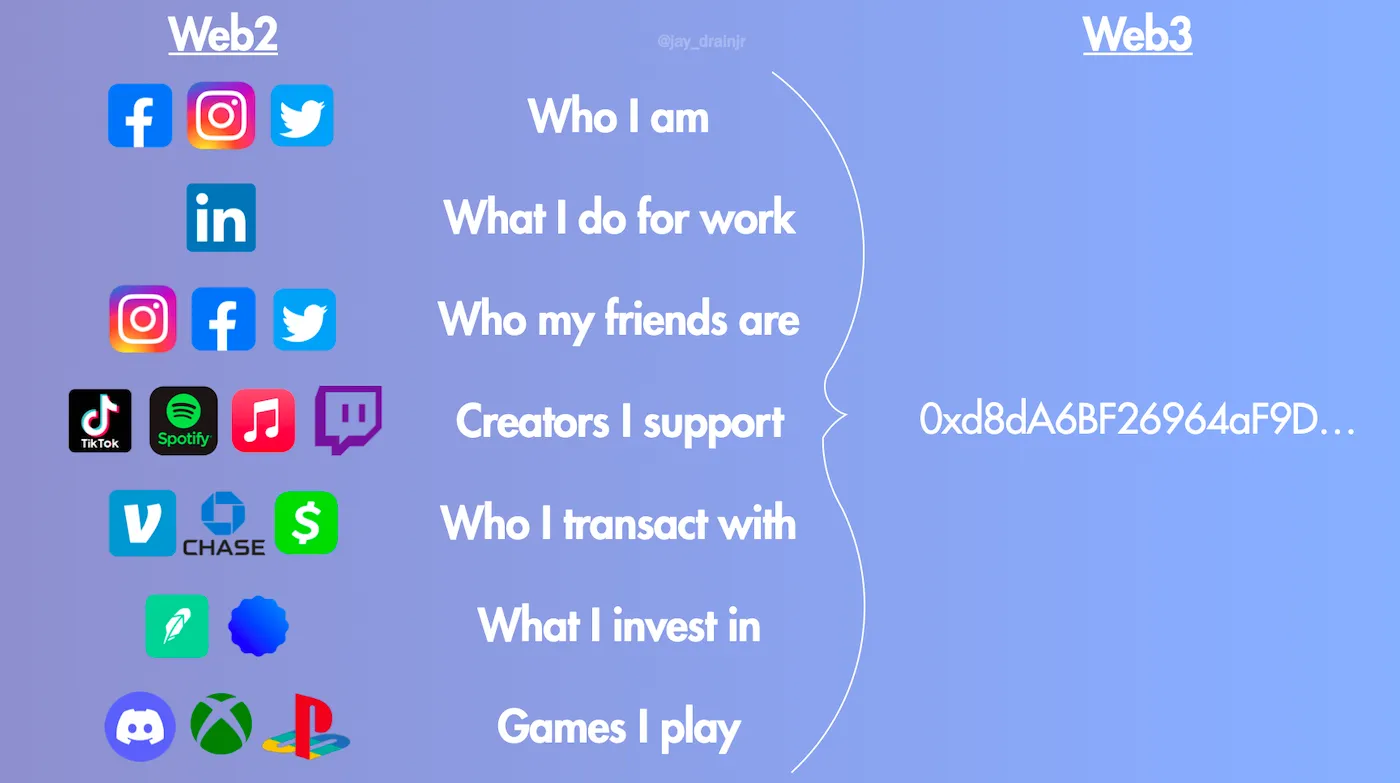
Image Source:The Crypto Wallet: Unlocking Digital Identity
On the other hand, domain names, reputation systems, such as ENS, DAS, etc., play similar roles to wallets.ENSIt is a decentralized phone book that converts readable domain names into on-chain resources and user identity tags. In simple terms, a .eth URL can be regarded as an identity, and users can use it to complete a series of social activities on the chain, such as inputting domain name transfers, conducting transactions on Opensea, and so on. Decentralized account system on Nervos .bitexpressexpress, more than 38,000 independent addresses have registered more than 110,000 .bit accounts, and about 100 wallets and DApps have integrated with .bit.
2)On-chain social square
The capture of personal behavior on the chain meets the need for transparent sharing of identities on the chain. Wallet addresses can be shared between DApps, and users can conduct token transactions on Uniswap to complete financial social networking; they can link Metamask registration accounts on Mirror to complete basic social account registration. However, users cannot use it to perform higher-level and simple social service behaviors, such as chatting, reputation scoring, and personal achievement display.
exist
existProject Galaxyimage description
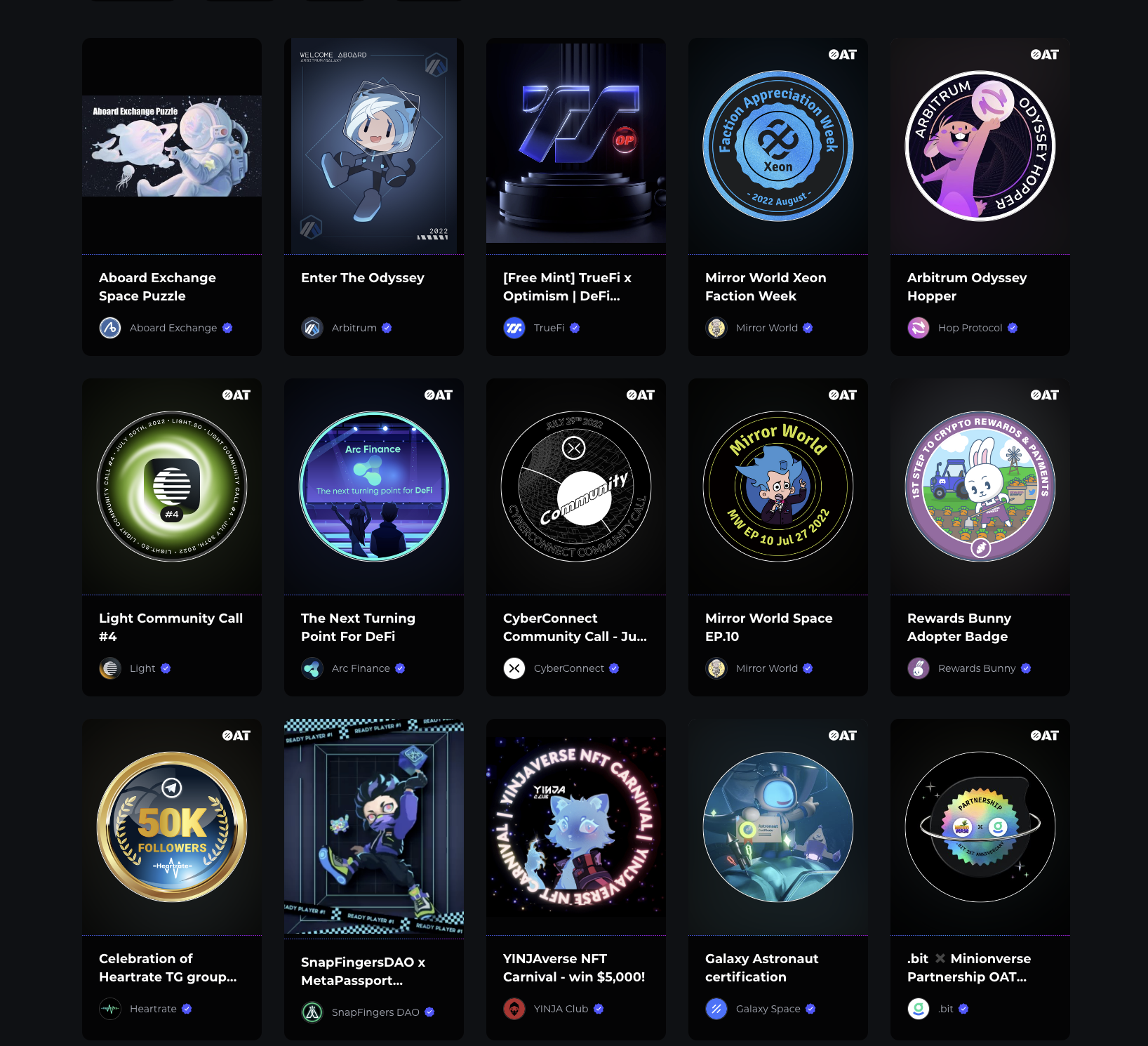
Activities supported by Project Galaxy
first level title
3. Dilemma
Although DID solves the information gap of Web2 centralization, it still faces some pain points:
1)Information islands on the chain
The goal of DID is to realize the unified identification on and off the chain. However, there is a natural gap between on-chain and off-chain identities; that is, how on-chain identities project off-chain behaviors is also one of the issues that needs to be resolved. also,The fragmentation of the public chain makes it impossible to obtain information on the chain with a global view, the "unique" identity built on each chain or each application is still disconnected from a macro perspective. Ethereum has an absolute advantage in terms of capital and user volume, which makes a large number of applications converge on Ethereum. It is difficult to integrate and label user behavior on other chains. Identity aggregation based on other chains Apps are difficult for users to use.
Take the aggregation management protocol UniPass as an example. Through the key management mechanism, it is the only passport for users to enter the Metaverse. The user's Unipass ID can connect to their own social platforms on Web2 and Web3, including multi-chain addresses, mailboxes, and Twitter. Its vision is beautiful, but UniPass, which uses Nervos as the bottom layer, is still out of the circle, and its popularity, user usage and acceptance are not very high.
2)Choices for Privacy and Transparency
One of the main reasons why Web 2 identity has been criticized is its centralization and lack of privacy security. But can Web 3 identity really completely solve this drawback? At present, it seems that it is not possible. One side of the balance points to the ownership and management of Web 3 identities by users, but on the other hand, all data is transparent, open, and traceable. To a certain extent, it is difficult for users to "conceal" their own behavior path, unless they choose to disappear completely from the Internet. And these behavioral paths will eventually be quantified into "credentials" one by one, and "credentials" become indicators for quantifying individual value, which seems to be another kind of exploitation of individual consciousness.
3)The value incentive of "identity"
The current user's identity and account number on the chain can be a wallet, but the wallet itself is only a financial tool, and the user's transaction behavior cannot generate intrinsic value. But in the real world, most human behaviors are aimed at obtaining incentives, such incentives can be monetary rewards, a sense of recognition, or a sense of satisfaction. However, the current project's solution to DID is to quantify user behavior and give "credentials" as recognition. But only if there is enough community consensus, the "certificate" can have recognized value; otherwise, the "identity" given to the "certificate" is just a display of the user's behavior on the chain. The project party can obtain a large number of transparent user portraits and accurately locate its own customer base. The value incentive of user behavior depends on the recognition of the "certificate" itself. For example, the "credentials" obtained by users from high-traffic projects on high-consensus public chains are much more valuable than those obtained from low-traffic projects on low-consensus public chains. In other words, the goal of the project party to motivate users is the high utility value incentive of "identity". In the current state of multi-chain fragmentation, some behaviors on the chain may not be collected as "credentials", and "identity" is more likely to be just another face of the wallet logo.
In summary, DID draws a wider application and narrative space for the behavioral scene on the chain. From the user's perspective, it provides a simpler and faster application mode, such as not needing to display one's past history and achievements on various platforms. With the accumulation of data and reputation on our chain, DID identities began to have rights and value, which converted non-financial behaviors into "reputation" and quantified financial behaviors into "credit" values. As we have done in theDID: Improvements to on-chain credit business and DAO identitydisclaimer
Reference
https://brightid.gitbook.io/brightid-zh/
https://mp.weixin.qq.com/s/WDx-cqImZYCDuC_Q4_lcgw
https://medium.com/amber-group/decentralized-identity-passport-to-web3-d3373479268a
https://mirror.xyz/shreyjain.eth/TyBzMOegl3rMNxpAFoJ36MjE0pGfdLcrVCBgy-x3qS8
https://davidphelps.substack.com/p/you-are-what-you-own
https://jaydrainjr.substack.com/p/crypto-wallet
https://medium.com/unipass/unipass-your-universal-crypto-identity-in-metaverse-b8b932f9313f
disclaimer
More information
Copyright Notice
Without the authorization of DODO Research Institute, no one may use without authorization (including but not limited to copy, disseminate, display, mirror, upload, download, reprint, excerpt, etc.) or allow others to use the above intellectual property rights. If the work has been authorized to be used, it shall be used within the scope of authorization, and the source of the author shall be indicated. Otherwise, its legal responsibility will be investigated according to law.
about Us
"DODO Research Institute" led by the dean "Dr.DODO" led a group of DODO researchers to dive into the Web 3.0 world, doing reliable and in-depth research, aiming at decoding the encrypted world, outputting clear opinions, and discovering the future value of the encrypted world. "DODO" is a decentralized trading platform driven by the Proactive Market Maker (PMM) algorithm, which aims to provide efficient on-chain liquidity for Web3 assets, allowing everyone to issue and trade easily.
More information
Official Website: https://dodoex.io/
GitHub: https://github.com/DODOEX
Telegram: t.me/dodoex_official
Discord: https://discord.gg/tyKReUK
Twitter: https://twitter.com/DodoResearch
Notion: https://dodotopia.notion.site/Dr-DODO-is-Researching-6c18bbca8ea0465ab94a61ff5d2d7682
Mirror:https://mirror.xyz/0x70562F91075eea0f87728733b4bbe00F7e779788