W&M Report (4): Strategic Analysis of Web3 Guiding Music Fans to Join


Original Author: Water & Music
secondary title
This article is from The SeeDAO.
Related Reading:
W&M Report (3): Current Status of Web3 Tools for Musicians
W&M Report (2): Defining the Ownership of Music NFT
W&M Report (3): Current Status of Web3 Tools for Musicians
Too long to see the version:Too long to see the version:
While the headlines are often about huge sales cases for artists in Web3 and the huge possibilities ahead, a close examination of fan tactics reveals that there are many obstacles before this possibility becomes a reality. As narrative and technical friction weigh on the Web2 fanbase, artists are finding support in niche Web3-native communities and in strategies that may be counterintuitive and unscalable.
In the past two months, the Water & Music community has completed a series of research reports on "The Status Quo of Music and Web3 Fields". The report consists of five parts, and this article is the fourth part. We list at the end of the article the contributors (ordered by role) who provided leads for our study of the problem of Web3 fan-guidance practice. You can also visit stream.waterandmusic.com to see the current status of our report publications, as well as a full list of member contributors.
A basic assumption in many music industry circles is that for a Web3 project to be successful, it must scale to the same level as a Web2 project, which requires engaging Web2 fans of all artists. It's easy to fantasize about combining the hype behind recent NFT headlines with the artist's mainstream user base behind hundreds of millions of Spotify and Apple Music listeners. However, we compare two groups, one is the top artists in the Web2 music industry, but the NFTs released are not successful; the other is the unknown grassroots artists in Web2, but they have become stars under the spotlight of Web3. Clearly, a huge Web2 fan base doesn't necessarily translate to Web3 success.
Back in 2013, investor Paul Graham offered the following evergreen advice to pioneer entrepreneurs at Y Combinator: "Do things that don't scale." The manual work of recruiting, onboarding, and delighting users has a compounding impact on future growth.
Fast-forward eight years later, and we've seen this kind of direct, micro-level outreach strategy—daily Twitter space, one-on-one Zoom calls, Discord AMAs—used time and time again by many of Web3's greatest artists Use to develop their loyal fans and collectors. This is in stark contrast to the one-off, one-and-done approach we've seen from many celebrities, whose NFTs may have landed in the media, but little has been changed in terms of adaptation, leaving collectors and fans with nothing to worry about. A token of value and a sour taste.
secondary title
method
the interview
We conducted 11 one-on-one interviews with artists and representatives from Web3 startups that have or are about to launch music NFT projects. Respondents included Black Dave, The Disco Biscuits, Dyl, Fifi Rong, Haleek Maul, Ibn Inglor, Iman Europe, Latashá, Rome Fortune, Vérité, and the team from music NFT platform KLKTN. Most of the artists interviewed were independent or unsigned; this is intentional, as we believe the independent sector is setting the standard for effective community leadership, facilitation and communication practices in music and Web3.
secondary title
We created and distributed a short online survey to gather fans' general views on music, Web3 and onboarding experiences. Since the survey is primarily distributed across the Water & Music research community and extended member network (including Anjunabeats, Dutch In Sound, and Metaverse Music Fest), the sources of fan data included are primarily electronic music genres, indie music communities, analog-first communities, and other music Professionals in the industry. In total, the survey received 157 unique responses.
secondary title
definition
definition
secondary title
In this article, a "fan" refers to any potential buyer of an artist's work. Throughout the report, we will discuss the nuances and trends of fans in the Web2 and Web3 communities, based on the results of our fan experience/guidance survey.
secondary title
guide
We distinguished two types of artists in our research: the first type is those who directly issued one-off NFTs without any investment or experience background in Web3 construction; the second type is those who spend more time learning technology, and other Artists who communicate with developers and build channels for fans to communicate their clear ideas around their plans for using the technology in the future. The former is marketing and the latter is guidance.
Web3
secondary title
In this post, we strive to bring fans into a public, decentralized network that fosters an active developer community and democratizes user access and token distribution. A core tenet of decentralized networks, especially when it comes to buying or trading digital assets, is the certainty that one's assets are "on-chain"—meaning they are permanently stored in a secure blockchain, And only submit to what is explicitly programmed. (You can view a more in-depth discussion of the importance of the web in the music/Web3 space in the tools section of our collaborative report.)
first level title
Part 1: Fan Types
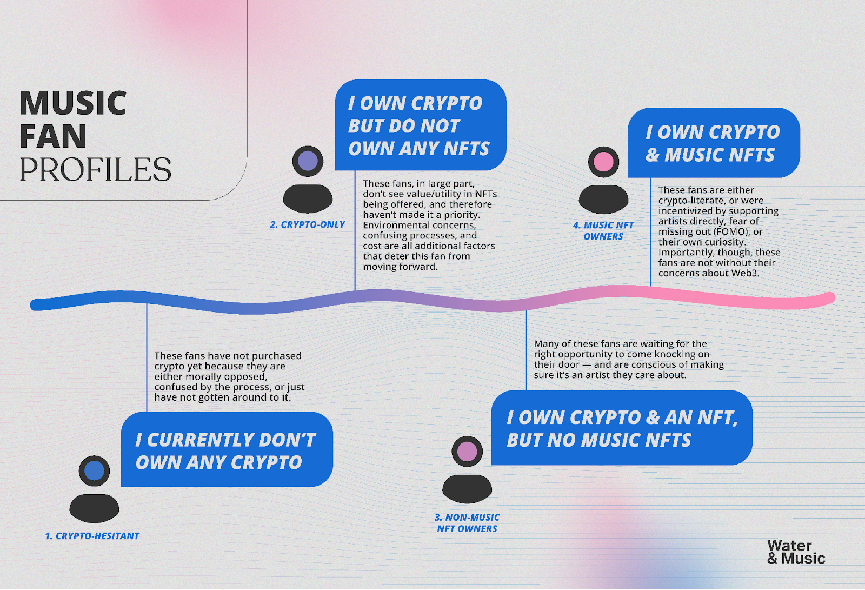
Based on the survey results, we developed a set of classifications for four types of fans involved in the Web3 world - from novices who have not participated in Web3 at all, to those who have mastered multiple technologies.
secondary title
Fan Type 1: Hesitant Group
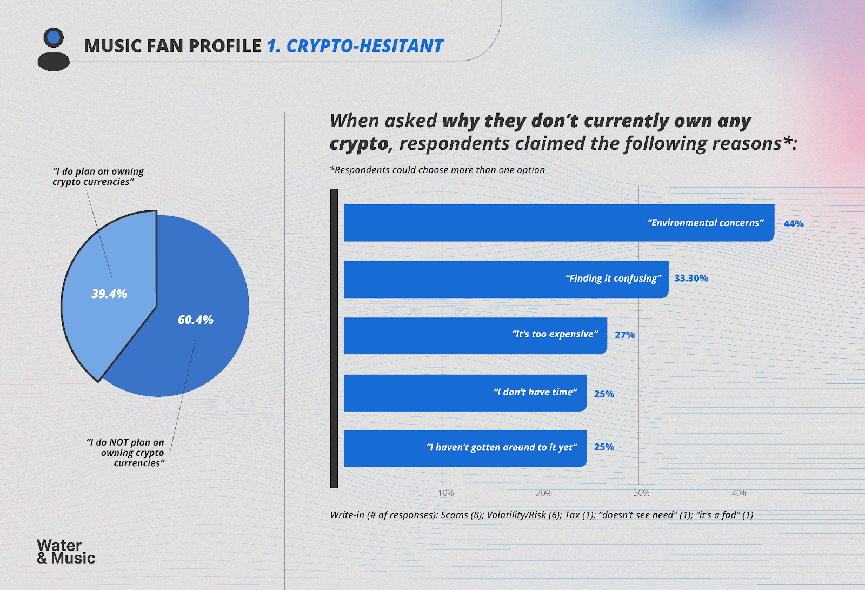
These fans choose not to buy cryptocurrencies because they are morally opposed to certain aspects of cryptocurrencies (e.g. environmental costs, capitalist nature), they are confused in the process, or simply do not understand it. Notably, 60.4% of Crypto-Hesitant respondents said they do not intend to hold cryptocurrencies.
secondary title
Fan Type 2: Groups who only hold cryptocurrencies
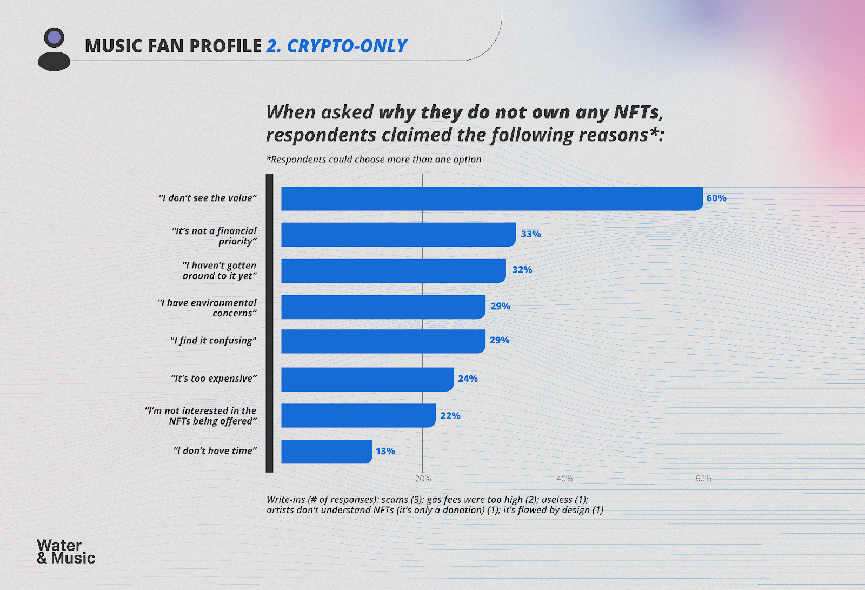
While these fans range from novices to experts, many respondents said they did not buy NFTs because they did not see any value or utility, which made NFTs a low priority, prevented them from moving forward, and ultimately Other factors in buying NFTs also include environmental concerns, as well as confusing buying processes and costs.
secondary title
Fan Type 3: Non-Music NFT Holders
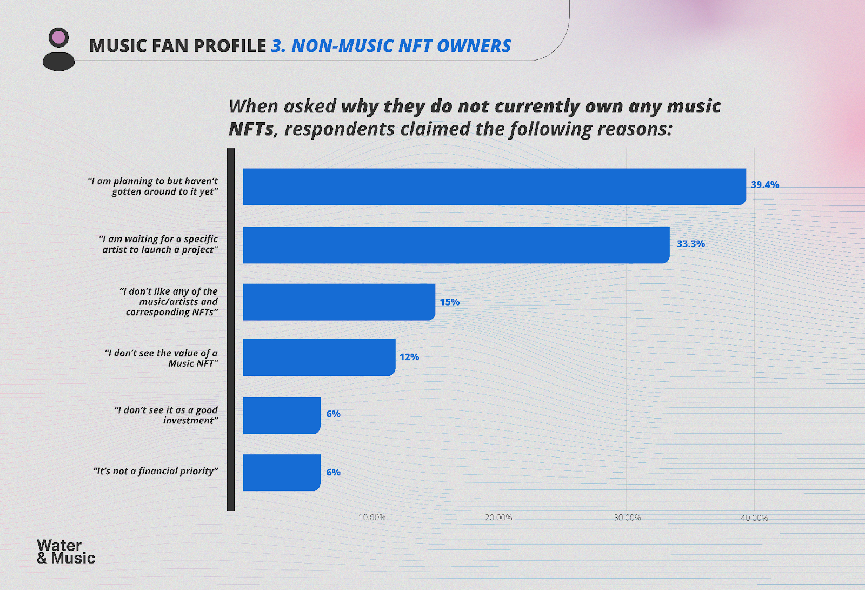
There are many fans who have purchased NFTs other than music. When asked why they don't currently have any music NFTs, these fans always say they're waiting for the right music NFTs to come along before they join, and they want to make sure they're for the artists they care about.
secondary title
Fan Type 4: Music NFT holders
Response: "I hold cryptocurrencies and music NFTs" (19% of respondents)
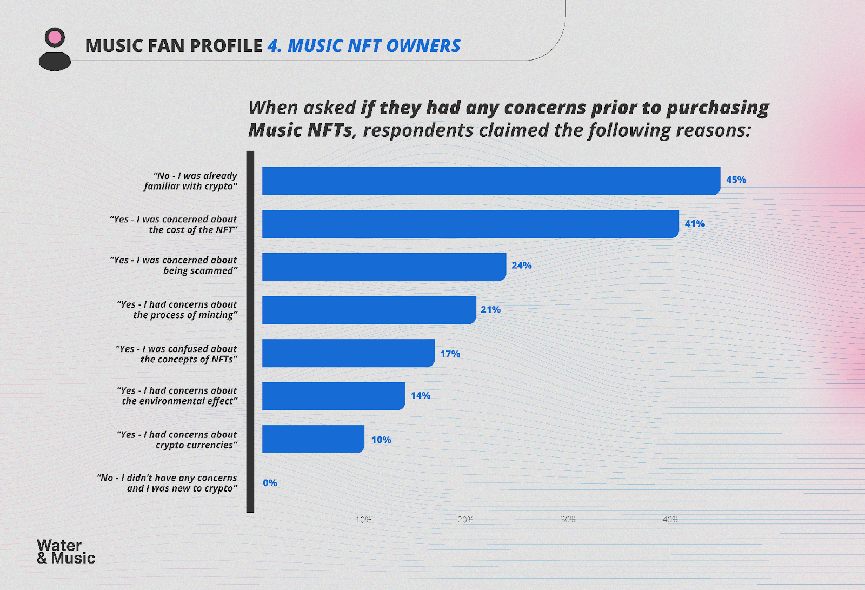
Many of these fans were self-proclaimed cryptocurrency intellectuals before buying their first music NFT. However, many people are driven to join Web3, either because they want to directly support artists, to alleviate their own FOMO (fear of missing out), or purely to satisfy their own curiosity. Importantly, 0% of these respondents were crypto newbies and had no concerns despite their having joined music NFTs, which highlights an opportunity for artists to solve their problems before getting new fans on board.
For fans who are concerned but still buy music NFTs, here's their reasoning as to what alleviated their concerns, or moved them forward:
1. Support an Artist
"Support a friend."
"My relationship with the artists, eager to support them, because it would be cool to tell my friends."
"Community support and openness."
"I want to support the artist and see what happens. However, I don't think there's a way to spend that much on a future solo track."
2. Fear of missing out (FOMO)
"Want to participate! FOMO!"
“The crazy money that was being created. I realized that digital ownership was a revolution. Building real communities online and how I started using the internet as a way to connect, not just consume.”
3. Curiosity
"Curiosity about new technologies"
"I just decided to bite the bullet because I wanted to start experimenting in this area."
4. Other
"I know the system does what it can, and I'm happy with the price points."
"I trust the artist behind the NFT"
"Layer 2; eco-friendly public chain"
"If you haven't been scammed, you're probably new to crypto and NFTs."
Our fan survey provides a framework for thinking about fans and their concerns when critically evaluating the different strategies employed by artists and platforms to incorporate their fans into Web3.
Part Two: Fan Focus
secondary title
What is the biggest factor influencing a fan's decision to participate in the world of music NFTs or stay away from it?
Based on the above survey data, we identified four main issues that influence fans' decision to participate in NFTs. These issues include environmental concerns, costs as a barrier to entry, lack of education on the basics of encryption, and confusion about the actual utility value of NFTs.
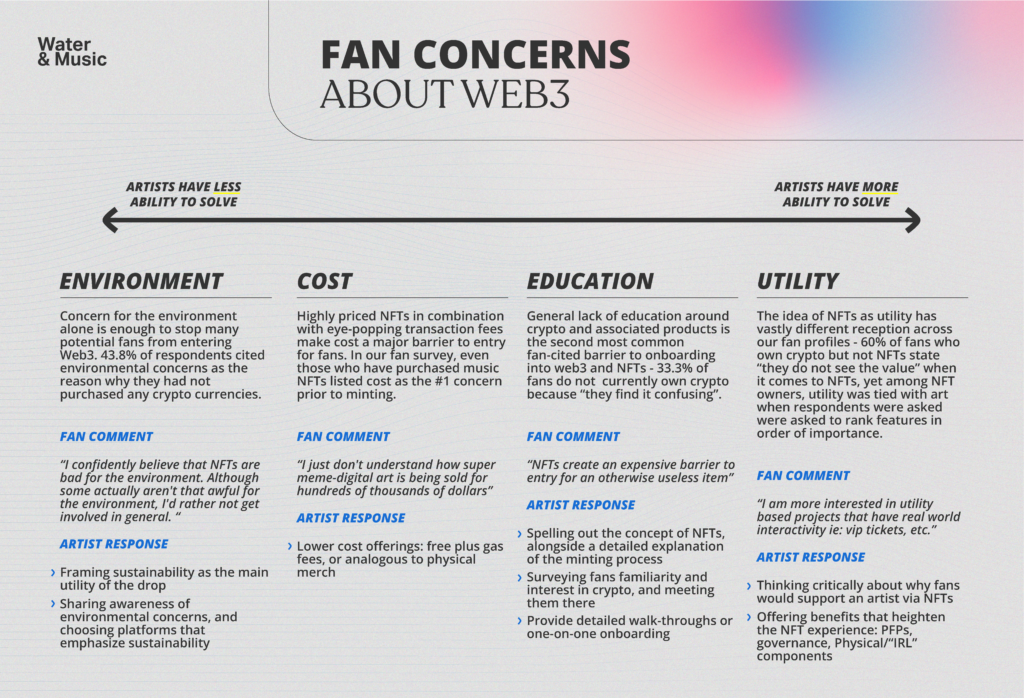
Below, we discuss each of these questions one by one—from those that artists are least equipped to solve on their own, to those that artists are best able to respond to directly through their channeling methods. Where applicable, we've also provided examples of concrete solutions we've seen artists use to address fans' concerns when devising their own approaches to Web3 onboarding strategies.
1. Environment
A clear theme of fan responses to our survey was the strong belief that NFTs are harmful to the environment. That alone is enough to stop many fans from getting interested in the idea of Web3. For fans in the hesitant group (subgroup 1), the environment is the top reason why they have not purchased any cryptocurrency yet, with more than 43.8% of such respondents citing this concern. Even among survey respondents who purchased NFTs, 13.3% said they had reservations about the environmental impact of NFTs before proceeding with the purchase. Fans have also been very emotional about these concerns, with responses often linking environmental concerns to broader social issues. As one fan put it: “The simple act of minting NFTs results in staggering amounts of carbon and costs a lot of money. They are inherently unfair and permanent system pains that are best dismantled.”
text
How do artists address environmental issues?
Both artists and platforms are acutely aware of this harmful narrative — and they work with each other to minimize it. Many announced projects are proactively addressing this issue by emphasizing in press releases that they carefully select environmentally conscious partners. For example, the first line of Doja Cat's NFT launch press release categorizes her platform partner OneOf.Com as a "green NFT platform designed for music artists and fans." When DistroKid’s NFT debuted, it also pointed out how their specific process was carbon neutral — but even that particular tweet was later deleted following a barrage of relentlessly negative comments.
Beyond press releases, environmental concerns are actually influencing tech startups' decisions about which networks to build. For example, Jeff Miyahara, co-founder and chief creative officer of NFT platform KLKTN, told us in an interview that he sees "environmental impact" as the first improvement he would like to see across music/Web3 tools: it's "constantly emerging "The problem"...that's why we chose Flow." (Flow is Dapper Labs' blockchain that uses a less energy-intensive Proof-of-Stake rather than Proof-of-Work consensus mechanism to verify transactions, ultimately reducing minting's impact on the environment Influence.)
Artists also took care to share their own personal environmental issues and awareness of blockchain minting issues. The press release for the NFT collaboration between the band Intelpol and artist David Lynch states that mitigating environmental and social concerns is a prerequisite for entering the ecosystem:
“As important as the quality of the art is to all parties, execution is taken seriously. ‘We’re excited to join Aerial in entering the NFT space as ethically as possible,’ Banks continued, noting that the platform is used to offset carbon The tools of the footprint were key to the decision to use the project.”
While environmental messages from major artist NFT projects provide a signal to fans that artists do consider climate-related issues, in practice, the promotion of these projects often fails to shed light on the realities surrounding NFTs in any meaningful way. Environmental influences can even be misleading. Some of the climate-conscious NFT press releases we analyzed highlighted their use of Ethereum’s alternative chains (e.g. Polygon, Tezos), emphasizing the lower environmental costs associated with minting transactions. While this information is accurate, it ignores other environmental costs that NFT buyers add. For example, many people will buy ETH on the main Ethereum network and bridge it to the secondary chain to buy NFTs.
While there is little that individual artists can do today to address the environmental issues inherent in blockchain technology (other than waiting for Web3 technology to improve and reduce energy usage intensity), artists can consciously choose environmentally conscious partners to tackle the problem head-on, especially if Their fan base is mainly hesitant group or only cryptocurrency holding group. Imminent changes in the blockchain ecosystem, including Ethereum's move to a greener proof-of-stake consensus mechanism, will have a significant impact on the total energy usage surrounding NFTs. But until that changes, environmental issues will continue to play a huge role in fan decision-making for the foreseeable future, and it may be more realistic for artists to focus on addressing issues for which they have more agency.
2. High costs and fees
High prices of NFT and transaction fees, these costs are the main barriers to the entry of the public who are curious about Web3 and even the fans of Web3, even the most loyal fans cannot accept such a high cost at all. Continued media coverage of the NFT market is also fueling the unusually expensive prices of NFTs, with many mainstream media headlines focusing heavily on jaw-dropping auction bids and projects raising millions of dollars themselves.
Cost was cited as the third most common reason for respondents in the hesitant group that they have not yet purchased cryptocurrency. Likewise, 25% of respondents in the cryptocurrency-only group (Section 2) said they found NFTs too expensive to spend their time investing (as one fan put it, “NFTs set an expensive barrier to entry for otherwise useless projects).” barrier"). Even music NFT owners (group 4) – the closest to Web3 among our fan survey respondents – listed cost as the number one concern ahead of minting music NFTs. In conclusion, our fan survey results show that regardless of one's direct involvement or interest in Web3, cost remains a barrier across the ecosystem.
How do artists solve the problem of cost?
Many of the press releases we analyzed highlighted how NFTs would provide artists themselves with a fairer distribution of revenue—but for fans interested in purchasing NFTs, the high costs and financial hurdles are often only recognized on the surface.
On the face of it, more and more artists are now waking up to the idea of putting out projects at more reasonable price points for fans who can't make it to high-priced auctions. To that end, multiple press releases include short paragraphs explaining the democratizing power of NFTs and the seemingly cheap sticker price to buy their tokens. But at the same time, they also failed to fully explain to potential buyers all the costs associated with purchasing NFTs, such as gas fees and transaction fees.
For example, a recent Doja Cat OneOf NFT press release touted their project as "designed for fans with no financial or technical background" and "starting at just $5." However, once you consider the time that new crypto users will face and financial cost, the language becomes hollow. This includes the cost of moving cryptocurrencies from exchanges like Coinbase to crypto wallets, as well as the gas fees and transaction fees associated with minting or buying NFT assets on the secondary market, not to mention the time it takes to learn how to do all of this.
Artists don't have much leverage to help with transaction costs, which is a by-product and limitation of current technology. Independent avant-garde artist Fifi Rong recently released 2 NFTs for "free+gas", bearing transaction costs. Ping Lam, head of marketing at KLKTN, told us that their company intends to counter the broader trend of NFT companies “focusing on the appeal of scarcity and high-priced items” by accepting fiat currencies on their platform and listing NFTs by price point, This is similar to physical goods ($10-$500 each). (At a platform level, a significant impact of transaction costs is that many music/Web3 startups still choose to operate on more centralized payment systems to reduce perceived financial costs for fans, rather than fully adopting decentralized infrastructure. )
To sum up, entertainers currently don't have many options in terms of NFT to allay fans' concerns about cost. In addition to consciously providing low-priced goods, directly subsidizing fans to buy NFT (Fifi Rong) or transforming the platform to make the overall cost more transparent to consumers, the reality is that artists need to wait for the further development of Web3 technology to really reduce the cost associated with NFT. costs and change fans’ perceptions of fees.
3. Education
Education is a key part of the Web3 onboarding process. Not only is there a steep learning curve to navigate this complex, novel technology — requiring ultimate personal responsibility for financial assets — but there are also many public misconceptions to debunk.
The second most common barrier for fans getting into Web3 and NFTs is a general lack of education about cryptocurrencies and related products. 33.3% of Fan Survey respondents indicated that they currently do not own any cryptocurrency simply because they find it confusing. As one fan put it, “Education around NFTs remains the biggest hurdle to making them ubiquitous.” Several survey respondents also elaborated on this concern in their responses, citing a lack of time (“It takes time to get it right. to understand and study it in the same way”; “I don’t have the time”) are the main barriers to entry into the crypto world. In short, the lack of easy onboarding educational resources, combined with the lack of time available for learning, creates an environment that is not hospitable to newcomers.
How do artists solve educational problems?
Our analysis of project press releases shows that many mainstream artists promoting NFT projects fail to communicate even the most basic information needed to enable fans to enter the ecosystem. For example, of the ten press releases highlighted in our report, only four mentioned crypto wallets — basic necessities for participating in crypto as a whole, let alone acquiring and holding NFTs. Even so, none of these mentions explain what a crypto wallet is, nor do they provide clear guidance on how potential buyers can purchase an NFT. For example, Doja Cat’s NFT project press release guarantees that NFT owners will have access to a closed Discord community and “the chance to win luxury rewards, airdrops, and other merchandise” — without elaborating on what the airdrops, companion airdrops, or Discord servers are.
This is in stark contrast to the time-consuming and personal approach many indie artists take to educating their fans — a call to YC’s “do things that don’t scale” approach.
In our analysis of the launch of Wobblebug, the latest NFT project from music producer Wuki and digital artist Florian Tappeser, we noted that overcommunication was one of the most important aspects of its launch. Including questions that other artists can use to guide their own ways of thinking, we have grouped their guiding strategies into the following three categories:
A. Before Casting: Focus Group or Survey
What are your fans interested in?
What is the scope of their knowledge?
What are their concerns?
What actual features are they interested in?
This helps tailor not only a specific product, but also relevant educational content and attention that fans may need. One day we may see this type of focus group become obsolete as Web3 technologies are adopted, but for now it remains a key part of the process - building trust with fans early on and protecting them helps To ensure that they persist in the long run.
B. During casting: omnipresent support team
Monitor Twitter and Discord for potential scams
During minting, projects typically experience the most attacks and scams. Many attacks take the form of social phishing, or phishing — a method by which scammers manipulate potential victims into handing over private keys and seed phrase information for their crypto wallets, often by impersonating official support staff on crypto-oriented Discord servers. Scarcity is one of the driving factors behind the value proposition of NFTs, and it has very serious psychological effects, with people often frantically clicking between website tabs and social apps in a scramble to mint. In this environment, there have been countless projects that have had their casting stopped or delayed due to having had a lot of fans scammed in the process.
C. Post-Cast: Passionate Collectors as Untapped Advisors
Collectors are asked for their opinion on specific NFT purchases and the music NFT ecosystem as a whole
Keep up with popular expectations for NFT functionality and educate current and future NFT holders ahead of time
The post-minting stage is when artists may realize that their NFT buyers are not only supporters and fans, but may possess knowledge, or experts themselves, that can add long-term value to the artist's wider community and development strategy. For example, given that Wobblebug is a producer-focused community, one could imagine any number of follow-on airdrops or community engagement opportunities to encourage interaction among token holders, from sample packs to production tutorials and collaboration/remixing Chance.
Several other artists we spoke to are taking a similar fieldwork approach, teaching their fans the basics of Web3 on a weekly or even daily basis. For example, Fifi Rong holds daily two-hour guided calls for beginners on Twitter Spaces, in addition to monthly private Zoom calls with her supporters. Hip-hop artist Latashá, one of the most high-profile and well-known artists in the music NFT space, still takes time to host a weekly Twitter space aimed at providing a safe place for people in tech and culture to learn about NFTs basic knowledge. The NFT platform KLKTN set up regular Instagram live meetings to educate their artists and partners Kevin Woo and MIYAVI about NFT knowledge, teach fans how to use encrypted wallets, and more.
Philadelphia-based improv band The Disco Biscuits used QR codes at their Las Vegas live show to help Web2 ticket buyers claim an exclusive NFT, which gave holders access to broadcast-quality live warehouse recordings. While the overall adoption rate was well below 10% of participants (240 followers out of 6,000 tickets sold), they considered each token activation a success, with separate customer support calls and video chats two weeks after first offering , to help fans set up crypto wallets in preparation for future airdrops. This hands-on approach set the stage for a successful second NFT launch, which sold out within days. Additionally, only 25 of their 791 NFTs were listed for sale on the secondary market, a strong sign of a healthy long-term community.
4. Lack of utility — and plenty of scams
With so many free or low-cost ways to consume music, many fans are wondering: what's the point of buying music NFTs? Consumer sentiment towards the lack of utility of NFTs is putting pressure on many artists and platforms to innovate.
Looking at the survey responses, we found that over 60% of Crypto-Only respondents largely "didn't see the value in NFTs." Even 12% of non-music NFT owners in our survey said they didn't buy music NFTs because they didn't see the value. Here are some examples:
“These are essentially just virtual, purposeless baseball cards for artists or songs I like, and I don’t want to own them.”
"I'm not waiting on a particular artist, I'm mostly looking to see something meaningful to fans (in terms of privilege, community, and value) without such a high barrier to entry."
“I saw an NFT that claimed exclusive access to download the mix, but you could actually just download it directly from the preview site.”
"I didn't buy music NFTs because none of them made sense to me."
The lack of perceived utility for NFT buyers is also directly related to another common theme mentioned in our survey responses: the fear of being scammed.
Essentially, a scam is a failure to deliver on a promise. In Web3, the risk of making a commitment is much higher than in Web2. While blockchain technology allows individuals to control their assets in unprecedented ways, it is also a dangerous place where personal responsibility is paramount and falling prey to the bad guys can have dire consequences; You can't find anyone to help when things go wrong.
Even among those survey respondents categorized as music NFT owners, 23% responded that they were concerned about being scammed before buying their music NFT. In our fan survey, we had dozens of respondents go out of their way to express their strong feelings about the fraudulent nature of NFTs — namely “Ponzi schemes,” “shit,” “money laundering,” and “idiots.”
Negative perceptions of potential NFT-related scams are also a product of the language used in NFT press releases — specifically related to describing NFT projects as “investment opportunities,” regardless of whether the agreement actually legally constitutes an investment or financial opportunity. Kings of Leon’s NFT Yourself press release last March made this inflation clear, declaring that “all these NFTs are expected to increase in value over time” — a statement that is agnostic and in A lot depends on things outside of the control of the creator of the project.
While some NFT purchases may eventually turn into valuable investment assets, a lack of clear education or explanation about the full cost of investing (transaction fees plus item value) may prevent fans from fully understanding the financial risk they are taking when purchasing NFTs . Looking back at our previous definition of scam as “failure to deliver on a promise,” we can see that a contingent claim of future value associated with an NFT, if not realized over time, will be viewed by fans as a scam.
How do artists solve the utility/scam problem?
Unsurprisingly, none of the press releases we analyzed explicitly mentioned fraud, or the issue of NFTs with unsavory business practices. However, that doesn't mean that well-crafted generalizations don't need to be learned in this regard.
An important takeaway from our analysis is that the choice of language is critical in guiding fans' initial perceptions of a project, and ultimately affects whether individuals are likely to view a particular project as a scam, let alone the concept of NFTs as a whole.
Emerging projects are understandably excited to occupy new territories, as reflected in the repeated claims of Web3 "firsts" in the press releases we analyzed. For example, when Async's blog introduced their interactive music NFT project in cooperation with multimedia artist Mighty33, it claimed that this was "the first time on the blockchain" and "one of the earliest programmable music works in the NFT field." In addition, Doja Cat claims that her project partner OneOf is "the first ecological and fan-friendly NFT platform." A press release from Method Man’s Tical Universe NFT project boasts that “Tical Universe NFT is the first-ever NFT offering that is not a money grab,” hinting at concerns about scams.
While using exaggerated qualifiers to sell a product is not a problem per se, when claims of novelty are combined with corporate PR language and lack clear details about the mid- to long-term utility of owning NFTs, projects can be questioned by fans because of these Fans have dismissed the entire cryptocurrency world as a potential scam. To that end, Verite, an indie artist with a ton of NFT sales and a huge Web2 fan base supporting her for nearly a decade, didn't even go out of her way to market her NFT to her Web2 fans. “I’m not going to tell fans to go buy ETH and get involved,” she told us, because the view from those fans is that the proposal is “too risky.” Instead, she maintains a realistic view that privileges such as exclusive content, social influence and artist access are only available to a relatively small subset of fans and “collectors.”
Because of the many value propositions that can be provided by using Web3 technologies, artists have to wrestle with the question of why fans would support Web3 products in the first place. What do they "get" from this purchase?
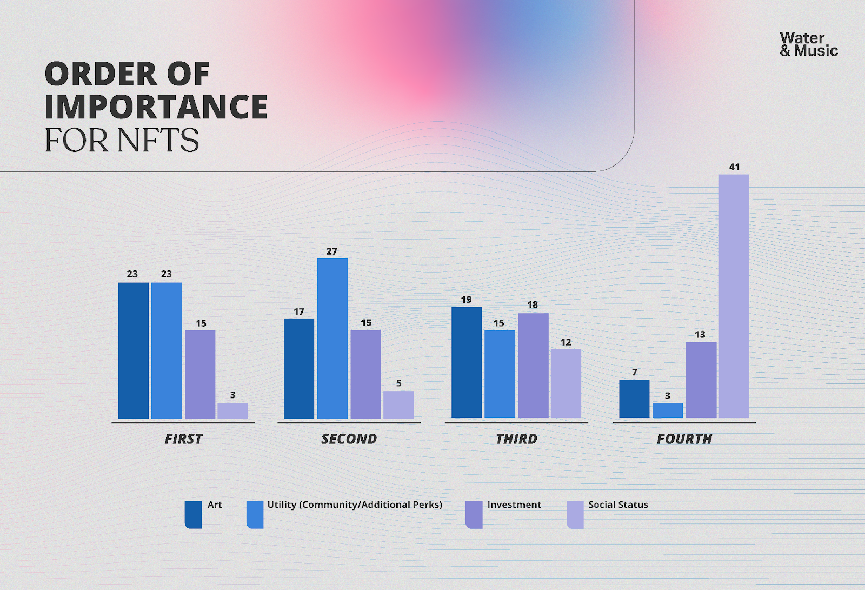
While fans in the hesitant group (group 1) and the crypto-only group (group 2) cited lack of utility as the main reason holding them back from buying NFTs, many with NFTs did the opposite, citing utility as the least of their priorities part. When asked to rank by importance, NFT owners (group 3 + group 4) voted "Utility" tied for first place with "Art" - ahead of "Investment" and "Social Status". In the second graph, "practical" received 10 more votes than "art" (see graph above).
Parallel to our fan persona, emerging utility forms of music NFTs also fall within the realm of Web2 with more Web3-native target audiences. Below are some examples of the most common value propositions and use cases for music NFTs, as provided by the artists in our dataset and highlighted by fans in our survey. Of course, this is not an exhaustive list, as Web3 technologies continue to evolve and more and more Web3 users are creating and implementing new use cases every day. (We also outline emerging forms of platforms other than artist-focused utilities in our Music/Web3 Tools Market Map.)
first level title
Web2-Centric Utilities: Community Conversation and Co-creation
Fan survey quote:
“[What prompted me to buy NFTs was] the real community that was built online and how I started using the internet as a means of connecting, not just consuming.”
“I also saw another music NFT that I really like — it’s Songcamp’s Elektra. I’m fascinated by the storytelling and collaborative nature of NFTs.”
“Great to have conversations with artists during auction and after purchasing 1/1 NFT.”
Additionally, through creative perks, such as access to royalty-free samples used to remix Wobblebug songs, owners of these Wobblebug NFTs also gain permission to continue the co-creation process long after the sale ends. A community-driven talent search is also a natural by-product of such perks.
first level title
Web2-Centric Utilities: Physical/Offline/Live Experiences
Fan survey quote:
"I'm more interested in utility projects with real-world interactivity, eg: vip tickets, etc"
"My favorite is Mattia Cuttini, if you send him your physical address, he will send you a postcard of his NFT, Crypto into the real world"
Bridging from online to offline has been a core part of the artist-fan relationship over the past few decades. Now, with the advent of NFTs, many Web3-ready artists are focusing in the opposite direction, offering fans physical, offline perks to motivate them to join Web3. In fact, many of the high-profile mainstream press releases we analyzed around major artists highlighted physical or offline benefits, such as free tickets (Lil Pump, King of Leon) and collector's edition vinyl (Kings of Leon ).
When it is not "offline", live broadcast can also be used as an entry point to further introduce Web2 fans into Web3. For example, the improv band Umphrey's McGee held a concert in the Decentraland metaverse, and the only requirement for entry was a MetaMask wallet — no purchase required. Eventually, more than 1,000 fans downloaded MetaMask to participate. Summoning followers is relatively easy to understand and execute, and takes significantly less time than Disco Biscuits token claiming. In fact, Disco Biscuits bassist Marc Brownstein candidly called Umphrey's McGee's approach "true bootstrapping" since the latter use their platform to motivate bootstrapping not for profit but to foster collective education, so it might be A great model for artists to signal to their fans that they are interested in the long-term mutual benefits that Web3 technologies can offer.
first level title
Web3-Centric Utility: Creative Marketing Around the Technology Itself
Fan survey quote:
"This appears to be a new and innovative experiment around sponsoring musicians."
"The casting experience from Creature is absolutely incredible. It's a real video game."
“Interested from a systems standpoint with the latest deadmau5 launch as they use a non-ETH blockchain to let consumers mint $2 NFTs.”
The beauty of marketing to the Web3-native community, while doing the very important and detailed onboarding work for those fans in the hesitant group, is that most of these fans have effectively entered the crypto space - the process of wallet setup and basic education. Early friction is alleviated. Still, those fans need to be joined somewhere*. *The basics are covered, and artists can more freely transfer limited resources from basic education to more creative products.
In particular, the barriers to entry of the Web3 ecosystem make creative marketing around the technology itself a powerful strategy for attracting crypto-savvy fans. As we discussed in the music/Web3 tools chapter of the collaborative report, crypto experiences in this case have good reason to emphasize the complexity of blockchain at the application layer, rather than abstracting this complexity away . By embracing complexity, even as part of a Web3-native marketing plan, artists can help certain fan groups understand more directly the benefits of interacting with the internet.
Multidisciplinary hip-hop artist Domino took this approach in his latest NFT project. He issued NFT during the period of soaring gas fees in early 2021. His pitch is simple: "Get 7 NFTs. Only pay 1 gas fee." The marketing focus around the drop introduces how to work with the new EIP1155 standard Using to bundle the technical details of multiple different token types, how it differs from other token types such as ERC20 (fungible token) and ERC721 (NFT), and the EIP1155 format can ultimately minimize transaction costs for fans. In the end, the sale exceeded 26 ETH.
first level title
Web3-Centric Utilities: Governance
One of the major advances offered by blockchain technology is the ability to provide governance benefits to individual token or NFT holders - thus allowing artists to share their project governance with their fan communities in novel ways, facilitating multi-directional Not just one-way interactions and relationships.
Black Dave is an artist exploring the possibility of a new governance structure around song—especially the "support-earning" relationship with his fans.
“Social tokens with monetary value are the opposite of what social tokens are. Social tokens can only be earned through engagement, support, and community investment, non-financial ways are the only way I think social tokens can be earned. Imagine I could With that said, whoever retweets me can give you social tokens. ok thanks, that's 5. oh btw, if you have 30, I have t-shirts that sell for 30 tokens, ok Yes, here's one for you."
Of course, this type of interaction isn't for everyone; many fans may just want to enjoy the music of their favorite artists, not act as "investors" or creative advisors. But for tech-savvy superfans who do want meaningful interactions with their favorite artists, explaining what NFT holders can do to help advance an artist's career is a way to fuel enthusiasm and creativity. way of marketing.
first level title
Web3-Centric Practicality: Cross-Promotion Across Web3-Native Communities
Another approach is YC's reapplication of "doing things that don't scale" and may require additional work from the artist, as it often requires meaningful involvement with other projects to understand exactly why they are successful and convince their fans to invest more time and resources to support new projects. That said, as we saw in the example above about directly engaging fans with lead education, this extra effort of communicating directly with potential new audiences can pay off enormously.
first level title
Conclusion: Balancing the two extremes of "WHY"
Our overall goal with this piece is to provide artists and their teams with a framework for how to consider the various concerns of fans, and then develop a channeling strategy that works for both parties. The above discussion also shows the value of starting small, and the clear contrast between specific issues where artists have less interest in the agent of change (such as transaction fees and environmental impact for a particular blockchain network) and other levers they can more easily design their own Distinction (such as clear education about encryption, and clear communication and enforcement of utilities).
We want to stress that before thinking about how to get fans on board Web3, it's important to think very critically about why, as an artist, you're going to go on this extremely difficult and complex journey of introducing your fans to cryptocurrencies.
Besides financial freedom and opportunity for artists - both of which are obviously valid parts of the equation - why would a Web3 infrastructure make the fan experience better? Drawing on frameworks such as Human-Centered Design, the first step to getting fans on board with Web3 is understanding who they are, what they value, and what their main focus is. Only from there can artists and their teams have a clear understanding of whether Web3 makes sense for their fanbase, and how a Web3-native solution can meet their unique needs. "How many of my fans want to come?" is a prerequisite for "How can I get those fans here?", and then a prerequisite for "How can I make money?" (Or, as Fifi Rong puts it: "Why, then what, then how.")