W&M Report (2): Defining the Ownership of Music NFT
Original Author: Water & Music
Recommended reading:
This article is from The SeeDAO.
Recommended reading:
W&M Report (1): Will music NFTs have their PFP moment?

first level title
Too long not to read the version
This year, the music NFT space has been awash with sky-high sales headlines...but what exactly is being sold? After annotating music NFT contracts and consulting with lawyers, we found that there are very few descriptions of "what NFT ownership really is", and there are even many conflicting opinions, not to mention that artists and platforms simply cannot honor their buyers. promise. Artists hope that the use agreement of their works is simple, but the ecosystem of global music copyright is complex, and this fundamental contradiction creates a gap between education and communication.
The Water & Music community has completed a series of research reports on "The Status Quo of Music and Web3 Fields" in the past two months. The report consists of five parts, and this article is the second part. We end the paper with a list of contributors (ordered by role) who provided clues to our research on music NFT legal issues, as well as a list of contracts annotated during the research, music/Web3 standards related references.
The first part of this report examines Emerging Markets for Generative Music NFTs, and you can view all reports completed so far, as well as a full list of community members and contributors, by visiting our website.
Music NFT raised more than $80 million in the primary market last year, driving an unprecedented wave of development and experimentation in the blockchain music industry. Proponents of music NFTs tout the advantages of a decentralized infrastructure, arguing that it can eliminate entrenched industry middlemen and replace the outdated functions of record labels, insiders, and other stakeholders. And, the decentralized infrastructure makes much of the labor of a new generation of musicians and creators visible.
However, behind the explosive financing growth and hype, people do not have a clear understanding and awareness of what they are really buying when they buy music NFTs. Nor is it known whether, on a legal level, the technology actually "solves" the fundamental disputes behind complex music copyright ownership.
Although the space has been developed and funded for over five years, with enthusiasts and investors contributing hundreds of pages of white papers on blockchain music industry solutions, nothing has yet begun. As early as 2015, artists and developers have been trying to use the blockchain to solve the music industry's biggest problems - the pace of innovation limited by obscure legal agreements and complex copyright laws, the dilemma of clear creator attribution, the timely payment of royalties Payments have also been difficult (not to mention the shrinking market pie for available royalties).
Early on, it was believed that blockchain would be the B2B panacea for the music industry, providing a decentralized ledger to record music copyright and ownership metadata in a more transparent way, as well as "smart contracts" to enable royalties Validate and automate transfers. During 2015-2018, many startups and projects began to emerge, such as Ujo Music under ConsenSys, JAAK, and the Open Music Initiative jointly established by Berklee College of Music/MIT. Centralized permission and payment infrastructure.
But it turns out that it is not easy to change the inherent political rules of the industry and persuade competitors to open source copyright databases. The vision of these projects was too big, and under the huge pressure of the industry, they gradually collapsed. In a recent twitter space hosted by Water & Music, Jack Spallone, director of encryption at HIFI Labs and former project director at Ujo Music, mentioned: "We try to work with industry giants to modernize their systems. But if you think this means you can register It would be a little naive to take all the music catalogs in the world and license them through an automated process.”Five years later, some projects in the blockchain music industry have learned their lessons, especially NFT-related projects. Most of the changes around music NFTs are not just happening at the micro level, not just involving a single artist and a few or 100 buyers, and not just trying to transfer tens of thousands or millions of songs to the chain;
People are starting to focus on how to create a new economic model around music from scratch, rather than just bringing the traditional legal framework onto the Web3 track.
Based on this emerging paradigm, there are currently two different ideas on how to apply blockchain to the music industry on a large scale:
Introducing traditional music industry structures into Web3;
Let go of the past and create a new system.
In this binary choice, choosing the first excludes the other, and vice versa. But both philosophies will require massive, unified adoption to have real impact. Therefore, which ideology to choose is a key issue for all practitioners in the ecosystem. What should those active in the Web3 space be doing right now? What legal issues should be paid attention to?
Disclaimer: This article was not written by an attorney and the content contained herein is for general information only and does not provide legal advice or opinions of any kind. The content of this article should not be relied upon as legal advice in any particular situation, nor does it represent the latest legal developments. To the fullest extent permitted by law, no person should take any action in reliance on the information in this article. Water & Music does not accept or accept any liability for the consequences of any person's actions or inaction based on the information herein. Regarding specific legal questions, an attorney should be contacted for advice.
first level title
Copyright 101 - What the hell are we talking about when we talk about "ownership"?
From a legal perspective, ownership is a simple concept that refers to an individual's specific rights to specific property, including intellectual ownership and other rights. However, ownership of music is not simply defined.
Generally speaking, intellectual property rights are to coordinate the benefits of open IP to society and to stimulate inventors and creators. The interest relationship established in the form of money or commodities) to promote social progress.
Common types of intellectual property include trademarks, copyrights, patents, and trade secrets, among many others. Name rights, likeness rights, and publicity rights are sometimes discussed together when public figures are involved. Although for some recent NFT projects, trademark rights and publicity rights are also quite important; but in terms of this article, understanding the basics of copyright may be the most helpful.
Copyright is an exclusive right that gives the copyright owner the exclusive right to reproduce and distribute a creative work. Music can be a unique type of copyright because there are multiple copyrights contained in each sound recording: rights to the underlying composition of the music (such as musical scores); right (the right to publicly perform a work or play a particular version of a sound recording).
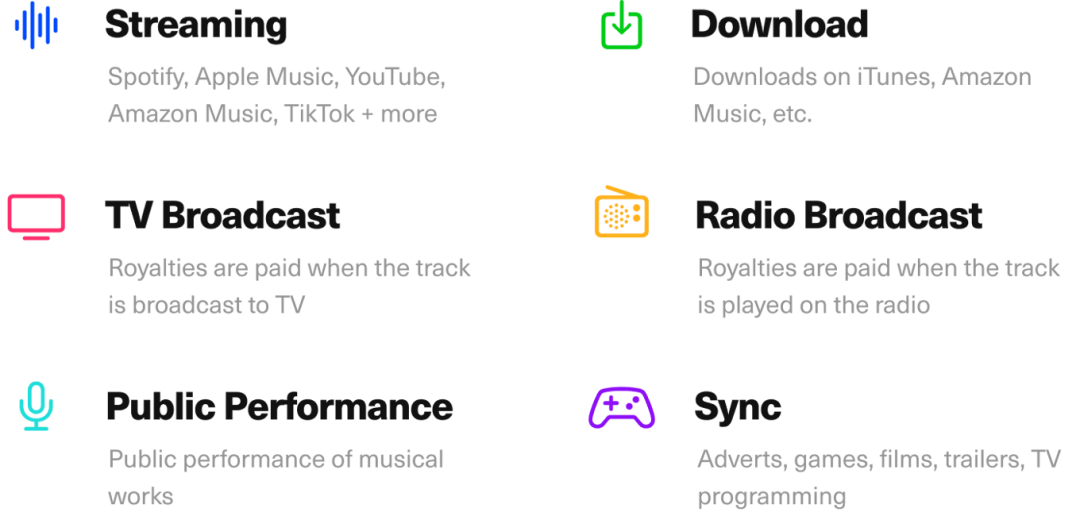
Accordingly, different and/or multiple permissions may be required in different situations, including: 1) playing recordings, 2) copying songs, 3) distributing or broadcasting songs, 4) playing songs in timed combination with any visual content (such as in Netflix shows songs used), usually provided by entities that hold copyrights in different categories.
Ownership of music rights has had a complicated history: Michael Jackson's purchase of the Beatles rights and ensuing strife, Taylor Swift's attempts to wrest control of her recordings from former labels and investors; The Litzer Prize-winning journalist went fishing to become the songwriter of hundreds of titles. Most major changes in music rights have been met with some degree of controversy, illustrating the flaws in the system of multiple parties competing for multiple rights in a single work.Can NFT essentially fix these flaws? While this technology will bring certain benefits to artists, and while blockchain does help create more transparent attribution mechanisms (assuming the data entered is accurate),
But the technology itself doesn't "solve" the problem of ownership complexity in the music industry.
Sophie Goossens, a partner at Reed Smith LLP, expressed her views on this issue: NFT is a form of alternative ownership, that is, ownership established by contract. There is no legal property in a digital file, and therefore no legal title to digital property, but both parties recognize this form of ownership nonetheless.
Therefore, Goossens believes that NFT is the third layer concept of intellectual property rights-alternative digital ownership, while before it was tangible items and related intellectual property rights. This structure looks like this:
Creators own intellectual property.
Buyers in the physical world own physical objects.
NFT owners on the blockchain have alternative ownership created by contracts.

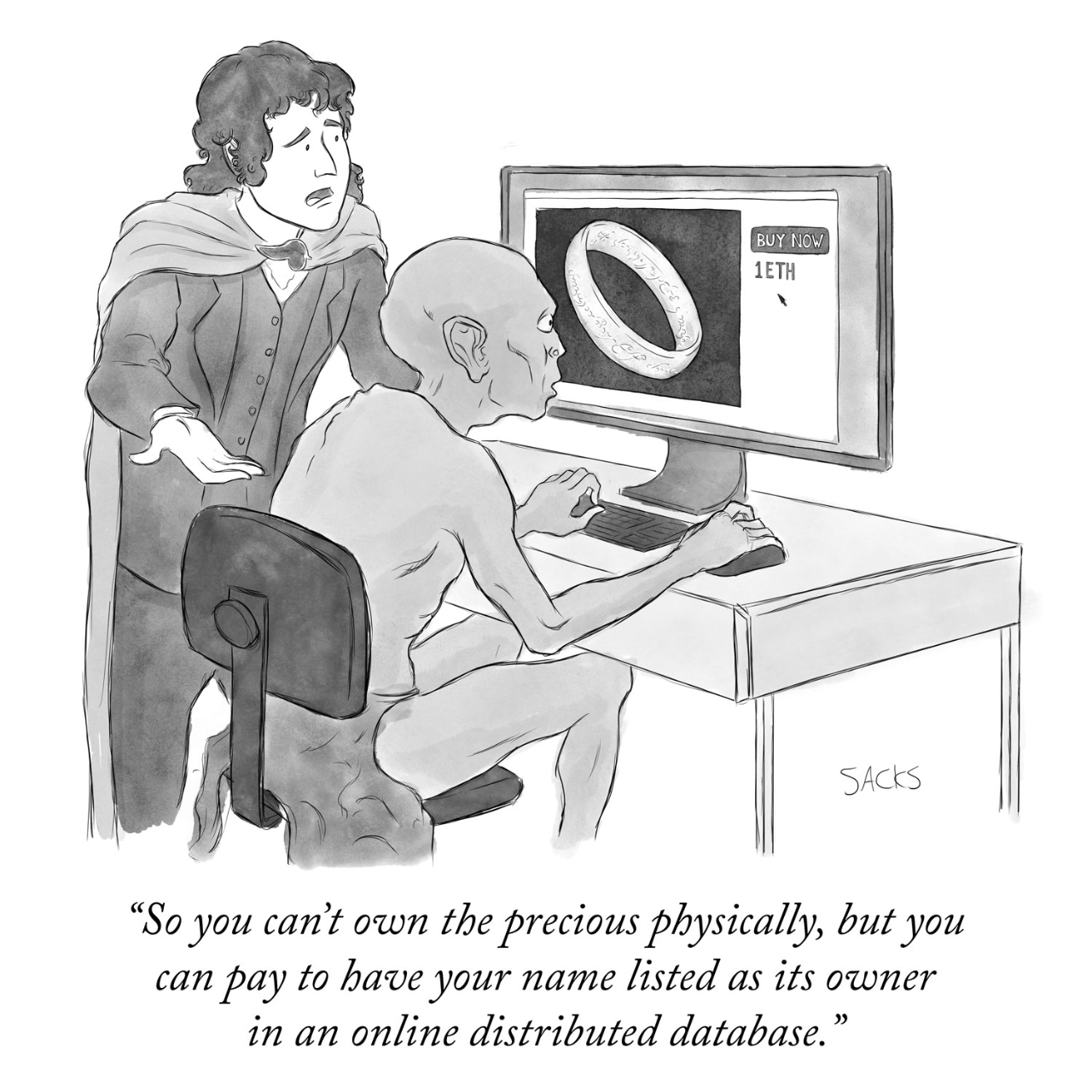
This comic, rejected by The New Yorker, accurately depicts the structure (Lord of the Rings fans hope Sauron still owns the intellectual property rights to the work, despite being sold to Frodo).
While one cannot own these precious entities, one can pay to have one's name recorded as the owner in a distributed database.
While NFTs add a new layer of meaning to ownership, recording a work on the blockchain does not alter ownership of the original work. This change still needs to be legally verified in the "physical world". This is especially true when purchasing a music NFT comes with vesting of the associated intellectual property, and/or future royalties associated with said intellectual property. Optimizing the terms of the contract and eliminating cumbersome legal provisions for ordinary fans, musicians such as 3LAU, Lil Pump, Lyrah, Vérité, Jacques Greene, and Daniel Allan have tried to share the income of streaming media royalties as part of the NFT they sell and crowdfund. Main "utility".However, after analyzing the "details" of the subsidiary basic agreement of NFT for rights transfer or royalty sharing, we found that,
There is a large gap between legal ownership of music copyrights and ownership of blockchain records.In all the music NFT contracts we analyzed, there was very little description of "what exactly is NFT ownership".Mistakes like this are understandable if it’s a one-off experiment; but if the music industry wants to adopt blockchain infrastructure at scale, these conceptual confusions could have major downsides.
first level title
Problem 1: Things are not as simple as imagined
In many modern music NFT contracts, artists hope to use blockchain technology to simplify the process, especially how to more properly consider the interests of the original author of the work, or more transparently distribute royalty income among multiple stakeholders. However, when it comes to talking to lawyers about how this process should be practiced, it comes at the expense of an accurate description of intellectual property ownership and control. Generally speaking, simplifying the process is indeed a goal, but in a music industry environment, especially when an artist wants to perform a specific musical work at a high level in multiple media, simplified contracts can be very problematic.

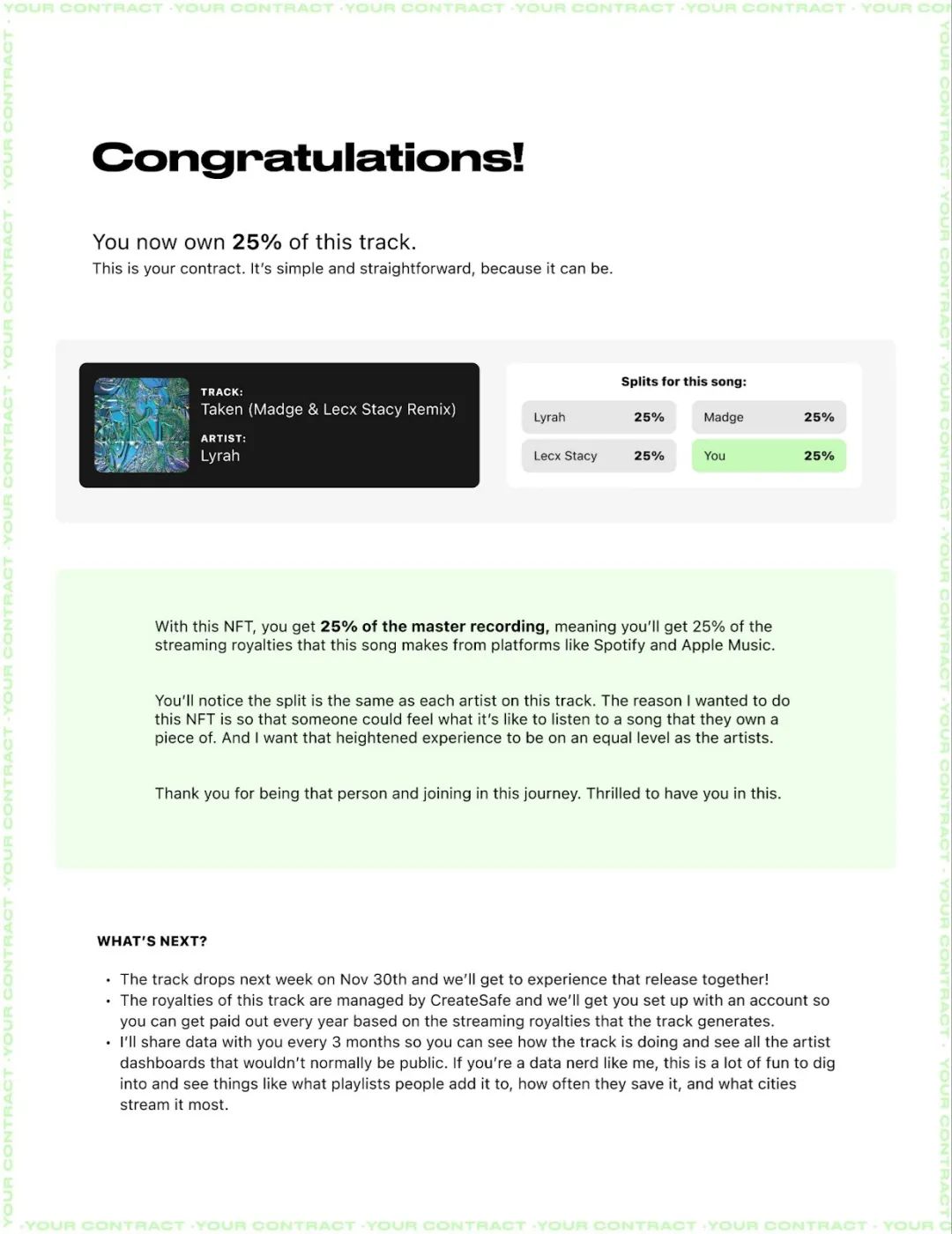
Take Lyrah’s NFT work “Taken” contract as an example, which was generated with the help of the CreateOS platform:The first sentence in the green box reads: "Owning this NFT, you can get 25% of the ownership of this master tape, which also means that you can get 25% of the royalty income of this song on streaming media platforms such as Spotify and Apple Music." 25%."
But this sentence is wrong!
If you own 25% of a master tape, it doesn't mean you own 25% of the streaming royalties; as shown above, the song has different copyright owners, and they all get a share of the royalties. This is a fairly obvious mistake, and highlights a problem: these simple agreements require trust between the parties. Compared to artists who are signed to large companies with different publishers and separate sync agreements; for emerging artists, whose copyrights have not yet been dispersed among different entities, in small operations, the relationship between artist and fans Trust is manageable and the royalty process is much simpler.
Examples abound of artists openly (intentionally or not) conflating different types of music ownership or copyright. In early 2021, Jacques Greene sold an NFT that included the publishing rights to the associated track (that is, the copyright to the underlying work). However, this is not a true transfer of ownership, it is simply a right to share royalties on terms agreed off-chain between Jacques Greene and the NFT purchaser.
Similarly, Eugy's NFT work "Your Touch" on Serenade allows buyers to record a verse in the Remix version of Eugy's released song "My Touch". When "My Touch" reaches 15 million views on all platforms, NFT owners can get 25% of the streaming royalty income of the Remix version. However, the terms of purchase associated with the Eugy NFT make it clear that these rights do not represent a true transfer of intellectual property ownership in the physical world.Regarding the different types of copyrights involved in songs, even many music NFT platforms themselves lack basic knowledge of science.

For example, on the landing page of the Republic / Lil Pump NFT release event, the investor-oriented statement was carried over by a simple sentence: "You will receive a share of the potential profits generated by the master tape", and the page began to display other content, as shown in the figure below Show:
Water&Music community member Jonathan Larr also annotated the release's contracts and found a "worrisome" issue: Many of these contracts also yield songwriting royalties, not just mastering royalties. He mentioned: “Interactive streaming generates recording royalties and song royalties. Downloading songs generates publishing royalties, and publishing royalties belong to song royalties. A sync agreement pays both mastering royalties and/or song royalties, depending on It depends on the content used. I was worried from the beginning that the use of terminology by these platforms is not correct.”
Again, these nuances may not matter as much when it comes to individual 1/1 NFTs and/or individual artists. But imagine if 1,000+ people bought a royalty share of the same song, if those song NFTs had multiple authors, if artists on major labels (which actually had exclusive ownership of the master tapes) tried to create them Own music NFTs, what if NFTs representing those royalties shares are sold on the secondary market, what if an artist (like Taylor Swift) records an updated version of the master tape? What's more, copyright laws and the concept of "ownership" vary from country to country.
In addition, if an artist is sued for infringing an artist's work, do you, as the NFT owner, also bear the 25% loss? If you bought an NFT and thought you "owned" it, would you be content with just getting royalties? Maybe you want to own the rights to create derivative works, remix or control the work yourself?
Specific to the Republic/Lil Pump example: as an NFT investor, you don’t think you’re getting your fair share of royalties, so you want to sue the artist, but the court can’t even determine Republic/Lil Pump if the information provided initially was inaccurate What kind of royalties should be paid. If courts can't determine what royalties they can get (for example, whether mastering and songwriting royalties should really be involved), then, in the best-case scenario, there will be complex litigation over the intent of the contract drafters; courts can easily decide whether they are entitled to both types of royalties.
It’s worth noting that in these cases, the relationship between NFT creators and NFT buyers/investors is similar to that between traditional record labels and musicians. But that's not to negate the similarity, as investing in artists can certainly help boost their careers. Perhaps the solution is not necessarily to change the rights that creators attach to NFT sales, but to ensure that buyers clearly understand what rights they are buying and how exactly they benefit from them.
first level title
Problem 2: Lack of Financial Regulation and Accountability Mechanisms
A smart contract refers to a transaction agreement that is automatically executed when certain predetermined conditions are met, or it can be simply understood as a set of if-then functions, that is, to digitally establish an NFT-related transaction on a public and decentralized ledger. man-made property rights. However, as mentioned above, such ownership is not automatically enforceable in the physical world, and at least in the music industry, none of these contracts are actually "smart".
So, what guarantees the reliability of all the promises in today's many music NFT releases? In particular, how are the benefits of ownership or investment guaranteed? Outside of trust relationships, how can we ensure that artists deliver on these promises (i.e. make sure their NFT offerings don't become a scam)?
The MODA DAO community has developed a Web3 tool that helps artists retain full control over their music. Dan Tauhore, head of growth at the MODA DAO community, told us in an interview: "We need to track the interaction between artists and fans, and track whether they are actually rewarded. .”
In other words, whether the NFT achieves digital or physical benefits will become a key indicator of the success of the artist's NFT distribution.
In traditional contracts, one party usually delivers some product or gives something in return to the other party; however, most of the contracts we annotated have surprisingly little even the most basic information.
For example, with regard to how owners of large-scale copyright investment NFTs can realistically and fairly receive their share of revenue, most contracts have few details of these mechanisms;
For example, which cryptocurrency or stablecoin to pay for, how often to pay, whether rewards are airdropped to the collector’s wallet instead of being claimed via a link, who will bear the gas costs for these transactions, etc.
This could be because the whole process is hard to explain and/or there are no tools to have a silky-smooth payment experience; but these are still very important details and should not be glossed over.
Copyright law does not fully apply to blockchain-related technologies, nor can rights be clarified through digital files. Founders, lawyers, and regulators have raised many questions about whether NFTs, or “tokens” in a broad sense, should be classified as securities.
The "Howey Test" in a 1946 Supreme Court case is the standard courts use to determine whether something qualifies as an "investment contract" and is therefore subject to securities law.
It has not yet been determined whether or how this test applies to blockchain-related applications, so creators should always seek legal counsel based on the facts of their specific actions. There are two questions respectively:
What rights does the certificate specifically include? Is it a transfer of title or other rights?
Is the token advertised or marketed as an investment that relies on the efforts of a third party to earn income?
Will the recent release of music NFTs provide answers to these questions? Let's take a look at the NFT released by composer Junkie XL on AmplifyX in June 2021.
The "winners" of the NFT auction will create the soundtrack of their lives with Junkie XL, who will create a 20-minute soundtrack based on input from NFT owners. While AmplifyX motto clearly states that buyers (or "winners" in their terminology) make an "investment" in the artist, the real contractual terms associated with the NFT talk about licensing rights and do not include the transfer of ownership.
Although Article 7 of the contract terms clearly states that if the winning bid exceeds US$250,000, ownership may be transferred, even so, what the winning bidder can and cannot do with the work is like the buyer with a commodity (such as a DVD) rights.
Although this is a case of NFT (digital goods) ownership, what is owned is only the license rights to the work "Original Music in the Winner's Life". There are problems with the terminology used by the contract, and under the framework of the Howey test, true NFTs probably should not be classified as securities.
On the other hand, the S-NFT created by Opulous and Republic appears to be a specific investment vehicle. Their announcement (emphasis added) reads:
NFTs as securities tools create new opportunities for artists; securities NFTs are designed to increase efficiency and distribute investors' royalties shares directly into their encrypted wallets.
However, when we looked at the real content of the first S-NFT protocol, the version before the collaboration with rapper Lil Pump, we found the following (emphasis added):
Neither the offering nor the securities have been registered under federal or state securities laws, i.e., no specific regulatory policies apply to the Company.
Should Opulous apply to the SEC to register S-NFT? As with other regulatory issues facing cryptocurrencies, there is a lack of consensus.
Generally speaking, the SEC's role is to protect investors through the regulation of securities; so Goossens and other lawyers argue that what matters is not whether something is sold on a blockchain; It is a fungible and passive financial asset.
By definition, NFTs are non-fungible, although other types of tokens and protocols (such as social tokens) are.
While there are currently no existing laws to draw upon, it seems inevitable that regulators will step in at some point. As for whether it will be in five years or ten years, it all depends on the speed of NFT's development, and of course it depends on whether the number of related private lawsuits will increase.
A general lack of education about the music royalty distribution process has, in many cases, completely disconnected retail investors from the economic reality of the rights they are buying.
Take 3LAU’s contract for Worst Case at Royal, for example, in which the artist distributes 333 “buy-in shares” of on-demand streaming royalties to collectors for free, meaning each share ends up getting only this The first song is a mere 0.15% of the cake in the streaming media market.
However, most of these 333 NFTs now have a floor price of 3.25 ETH on OpenSea (approximately $14,000 as of this writing). Just the "worst case" royalty fee would make it a worthwhile investment at 3.25 ETH, then streaming downloads would have to be astronomical; so NFTs are considered short-term speculative assets rather than long-term production sex assets.
Does the ability to instantly resell royalty-bearing NFTs on secondary markets put retail investors at risk? Additional concerns arise if the artist retains an interest (royalties) in subsequent sales, which is also customary for NFT sales.
In contrast, the "S-NFT" issued by Republic and Lil Pump directly stated that they complied with Section 144 of the US Securities and Exchange Commission. This provision is an exemption from the regular SEC filing requirements and is typically used for seed funding and employee/officer stock benefits. However, according to this requirement, investors need to hold S-NFT for at least 12 months, but in the era of cryptocurrency, 12 months may be equivalent to several years.
There have been several lawsuits over the intellectual property ownership of NFT sales. Roc-A-Fella Records argued that when Damon Dash released an NFT for Jay Z's Reasonable Doubt, he had no right to sell something he didn't own. In their court filing, the company said that while Dash owns one-third of the company, that doesn't mean he can sell company assets.
NFT may be just a digital project, but when NFT involves copyright transfer, it directly collides with the legal boundary of the physical world.
In terms of music intellectual property, with the multitude of copyright categories and copyright holders for even a single song, the uncertainty of this exploitation of rights is only exacerbated, and even without Web3 this uncertainty can be exposed. These early “Qaeda experiments” are the tip of the iceberg as regulators will adopt or adjust laws to account for new forms of ownership under physical world policy.
Much of the current focus in the music and Web3 space is on small-scale solutions for artists and their fans, which require only simple documentation to help people navigate new modes of support and interaction. If an artist can make enough money from NFT sales to support himself and his artwork, that's a win.
However, the complex structure of music IP does not provide a framework for simple solutions. This tension between the simplicity artists crave and the complex structures their art resides in leads us to two dangerous phenomena in the modern music NFT space:
Simple language replaces the accurate and comprehensive description of rights that NFT contracts should contain.
So, what tangible improvements can we make to music NFT contracts today?
First, it's about education and communication. Many artists and fans are unaware of the complexities of copyright. Musicians and creators need to be open about what they are promising and how they plan to deliver on it. And fans need to understand that investing in their favorite artists through NFTs may not bring any potential benefits, and, despite some exaggerated press releases suggesting benefits, there is really no simple scheme to get rich here.
Beyond communication, clear mechanisms need to be established that allow fans to hold musicians and creators accountable for the utility contained in their NFTs. This requires a clear definition of what utilities are and how they can be claimed. If it includes any form of future income, we need to communicate again clearly - about the exact source of income, whether it is passive income, or whether it includes the active participation of buyers inside the NFT, and what will happen when the rights to these future income change hands again What.
A blockchain-based solution can make all of the above problems seem simple, because any utility contained in the NFT can be solved through an if-then structure when triggering any utility contained in the NFT, but the essence of the problem is the attribution of ownership and the recognition of ownership. Thus, Web3 music hit an inevitable roadblock.
On the one hand, there are indeed people with high risk appetite who are keen to try and trade emerging technologies and business models. For example, MODA DAO mentioned earlier, the organization launched their pass last month, and they didn’t even have a clear development goal at that time.
On the other hand, there are those who want to transfer the entire traditional music industry to the blockchain and are keen to establish broad standards for Web3 applications. The problem is, as new use cases for buying and selling music NFTs keep popping up, it's hard to imagine what those standards would be. George Howard, a music/Web3 veteran who worked on The Song that Owns Itself, told us in an interview: "There has to be a deal before there is a standard... What gives these guys the courage to boast of insight How does it change the way consumers search for and use assets, and in a whole new dimension?"
There are some differences as to who bears the responsibility for setting standards. For example, the responsibilities of MODA or Royal in the field of music NFT are definitely different from the responsibilities of individual independent artists in NFT distribution.