






Pantera Capital: Encrypted assets will reshape the global macro trade pattern


Written by: Pantera Capital
first level title
A leader in global macro trade
Blockchain is the cornerstone of enabling global macro trade.
Taking the USD/JPY exchange rate in the traditional financial market as an example, it has always fluctuated within the range of 120 ± 20 in the past 35 years. A researcher with 35 years of trading experience walked on thin ice in the ups and downs of the exchange rate, but was surprised to find that today's exchange rate has returned to the position when he first entered the industry in 1987 - 128.38. Years of efforts by USD/JPY traders appear to be in vain as the rate turns and returns again.
In contrast, the blockchain is changing the pattern of global macro trade—if everyone with a smartphone uses the blockchain within ten years, the number of users on the chain will increase to 3.5 billion. This also means that we will no longer be able to buy Bitcoin at the "cheap" price of $38342 / BTC.
This is why most “repeated” macro traders prefer Bitcoin or blockchain. Although it is the same as the concept of traditional field research, in fact, the emergence of blockchain is to optimize the operation of the whole world in a higher dimension.
Now, blockchain venture trading even opens up a global macro perspective. For example, being long on Circle stock is a good way to hedge against rising interest rates. Circle earns float on the USDC stablecoin. Rising interest rates lead to rising income, which is a good counter-cyclical investment method.
first level title
Institutional Transition
Institutional investors are in a dilemma - a few years ago, investing in the blockchain meant facing a huge career risk, and a few years later, not investing will be a huge fiduciary risk.
There's no point in trying to figure out which deal is going to have the last laugh, and many investors spend most of their meetings trying to sort out just such issues.
Nobody picks a stock manager and asks him to explain which firm will end up taking over the business in question around the world. Investors just choose a manager with excellent performance, entrust them to build an investment portfolio, and change the composition of the portfolio according to time, and finally win profits. The investment process in the blockchain field should also be consistent with the traditional financial market.
The beauty of blockchain is that the choice is the investor's right - they can buy Ethereum and Solana at the same time; they can buy Polkadot, Terra and 20 to 30 other tokens at the same time.
The stalemate of blockchain investment is gradually being broken - in the past 12 years, more and more investment institutions have begun to enter the market. They generally invest about 0.2% of their funds in the blockchain industry. Once investment starts, the proportion of this exposure will only increase, and the proportion of institutional investment will rise to about 8.0% in the next 5-10 years. These funds that are being injected into blockchain assets will drive up prices.
Since the beginning of 2021, several blockchain industry funds represented by Pantera have raised US$2 billion in funds and will invest in the next year or two.
In the next few years, institutional investment in the blockchain field will increase by an order of magnitude, and the rapid rise in market popularity seems inevitable.
Another dilemma is that traders today still believe that blockchain trading should be correlated with most other risky assets. However, the market should soon realize that blockchain transactions are completely different from traditional markets as there are no cash flows to discount. Cryptocurrencies are priced purely based on supply and demand and are not affected by rising interest rates. Assuming that the number of people using cryptocurrency will increase by 10 times every two years, as long as there is a fixed amount of currency and 10 times the number of people want to hold the currency, its price will rise.
In a world where most risky assets are doing poorly, investors will give it a go — expecting better performance from fresher investments like blockchain.
first level title
Pantera Select Funds
The blockchain transaction market is maturing as the industry expands to over $2 trillion in value.
When we started investing, the target projects were basically in the seed round and A round stage. However, with the development of the industry, about 27% of the current investment targets have passed the A-round stage.
Many portfolio companies are now valued in the tens of billions. Pantera has spent nearly a decade helping companies like Ripple, Circle, Alchemy, Starkware, Coinbase, Amber, and FTX. For example, Pantera is the only VC that has invested in every round Alchemy has made.
Pantera will continue to support the best companies in the industry and is exiting a fully growth-stage fund. The Pantera Select Fund is designed to capitalize on opportunities in the industry's transition to more growth stages.
With a record deal network, Pantera has a long history of providing growth class financing opportunities to syndicated venture capital vehicles.
For the first time in the past nine years, Pantera has targeted three high-profile, growth-stage financing companies simultaneously and provided them with a special fund to facilitate financing. Meanwhile, Pantera said it will close another seven to nine deals over the next year.
The fund expects to initially invest in three companies:
Amber: A leading cryptocurrency financial service provider for individual and institutional investors, as a digital asset gateway, providing institutional-grade tools and investment products.
CoinDCX: One of the largest and safest cryptocurrency exchanges in India, known for its top-notch cryptocurrency financial services. It provides users with a friendly experience to securely access different digital assets and provides insurance and security to its users.
[Company Name Confidential]: The number one provider of NFT domain names on the blockchain; by building blockchain-based domain names, allowing users to replace cryptocurrency addresses with human-readable names, hosting decentralized websites, and simplifying Cryptocurrency payments, bringing the world to the decentralized web.
These growth financing opportunities will form the overall structure of Pantera's Select Fund, with a target of $200 million, expected to close in May with what may be the only funding round.
first level title
Two years under the shadow of the epidemic policy
It has been nearly two years since policymakers began printing money to offset the impact of the invisible virus.
In April 2020, the letter marking the advent of the post-pandemic era reads:
"This is a very distressing and confusing time because 99% of what happens next is up in the air. However, I firmly believe that this will have a positive impact on cryptocurrency prices"
"The way kids count to 100 is, one, two, skip a few, one hundred. It feels like we're doing that with quantitative easing. QE1, QE2, skip a few stages, QE100"
As QE approaches "infinite easing," it must fundamentally have an impact on those things that cannot be eased in quantity.
“When the government increases the amount of paper money, more paper money is needed to buy things that have a fixed amount, such as stocks and real estate. No matter how the amount of money increases, the total amount of these assets will not be affected”
“…Like water pressure, the influx of new money drives up the price of assets with fixed volumes like gold, bitcoin, and other cryptocurrencies”
Since this prediction, the “tsunami” of paper money has brought unprecedented rises in all boats, especially for cryptocurrencies. The following figure shows the performance of various types of total fixed assets since the increase in money printing:
first level title
Inflation, the aftermath of the new crown
In an interview published by the Wall Street Journal on April 12 this year, Congressman Mark Pocan pointed out, "As they work to determine their November campaign strategy, Democrats say they need to do a better job of promoting Mr. Biden's leadership to the public. Victory, mostly COVID stimulus and infrastructure spending, while making it clear that they're going to try to bring down price levels. We've done a lot of that. But the hangover from COVID and inflation makes it harder for us to talk about the really big ones."
first level title
Yu Gong moved mountains? please wake up
Inflation is as high as 854 bps, while austerity is only 25 bps, it is obviously not feasible.
Fed Chair Jerome Powell is behaving as if he's really going to make a big splash and maybe raise rates by 50bps at some point in the future. Inflation has increased by as much as 17 times. Six months ago, the inflation level was about 500bps to burst the real estate bubble created by the Federal Reserve.
One investor told Pantera that he does just one thing in the regular market -- buy as many homes as possible and take out 30-year mortgages on them.
Pantera responded that the housing market nationwide is running at 19.8%, while the Fed is still manipulating mortgage rates down to 5.0%, the Fed is basically making home buying a last resort.
If the Fed still doesn't hold any mortgages like they did in the first 95 years, free market mortgage rates will be ridiculously high, directly creating the housing bubble mentioned above.
Over the next few years, the Fed will have to deal with stagflation in its inflated boom-or-bust scenario.
first level title
This is the so-called 70s
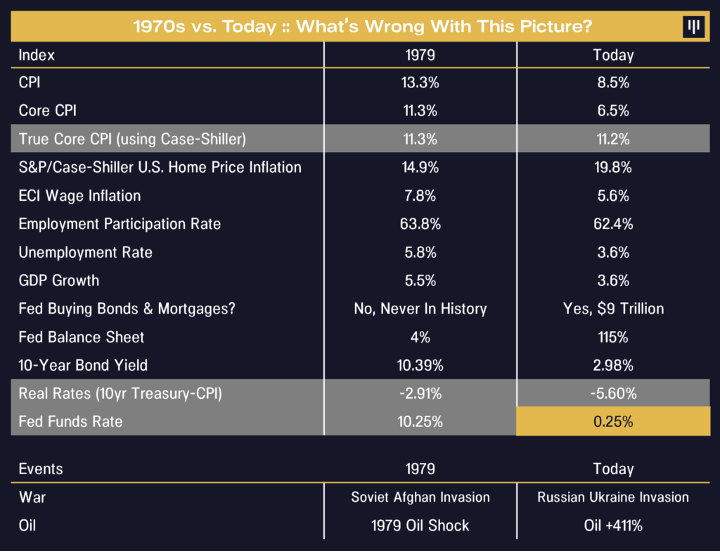
Want to play a game of spot the difference?
 the fed
Fed Vice Chairman Lael Brainard said in a public speech on April 12, "I don't want to be too rigid in how I think about the appropriate course of policy for the rest of this year and next year. ... The move quickly to a more neutral stance gives the Committee a sense of responsibility. Choice in one direction.”
This statement is startling, and a slow move toward neutrality must not help when everything is out of control.
The Fed's dual mandate is price stability and full employment.
For them, price stability means devaluing paper money "only" by 2.0% per year. Real core CPI (using the more realistic Case-Shiller housing prices) is double digits and five times the Fed's target inflation rate. Obviously, this mission has failed.
From an employment perspective, the U.S. is now clearly well past any optimal level of employment. The number of people applying for unemployment benefits as a percentage of the civilian labor force is lower than at any point in history.
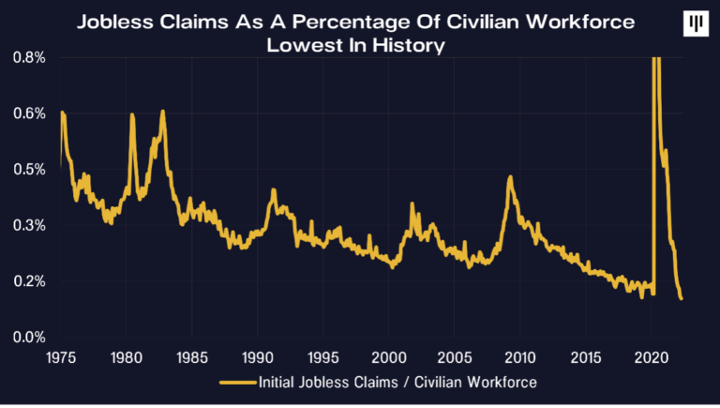
Only one in a thousand loses their job, an unemployment rate roughly equal to the probability of being hit by a falling coconut while walking down the road.
Even the chairman of the Federal Reserve admits that squeezing labor when it is in short supply is unreasonable.
Federal Reserve Chairman Powell said in the minutes of the Fed's March meeting, "If you look at the labor market today, what you can see is that there are more than 1.7 jobs for every unemployed person. So I would say this is a very tight one." The labor market is abnormally tight."
1.8 jobs per unemployed person is unprecedented, and even usually, the ratio is reversed.
So why did this slow, small increase end up being neutral?
Because interest rates are supposed to be restrictive.
Eric Rosengren, former president of the Federal Reserve Bank of Boston, pointed out, "The Fed is definitely behind the curve. Inflation indicators such as PCE and CPI are well above 2%. Unemployment is 4%, below the CBO's estimate of full employment. In this environment Rates should be slightly above neutral. We're nowhere near that, so the Fed has a lot of room to catch up. If anything, it's not pivoting earlier."
first level title
Unprecedented "relaxation"
"When I entered this industry in October 1981, the yield on government bonds was 14%. By 2020, interest rates in all developed countries had reached the lowest point in 5,000 years. With inflation, with geopolitical uncertainty, this This bull market is finally over. Bond yields are rising rapidly on the 10-year, and I expect that to continue."
- Bill Miller, Founder, Miller Value Partners, Pantera Blockchain Summit, April 5, 2022
Since the 2008 financial crisis, the vast majority of sovereign debt has been purchased by price-insensitive government buyers. It’s a combination of domestic central banks such as the Fed monetizing their own debt, and countries trying to keep current account surpluses offshore, thereby depressing the value of their currencies by selling them and buying dollars (needing to invest in Treasuries).
QE created a rare investment world - bonds and stocks rebounded at the same time. (In a free market world, their prices are usually negatively correlated).
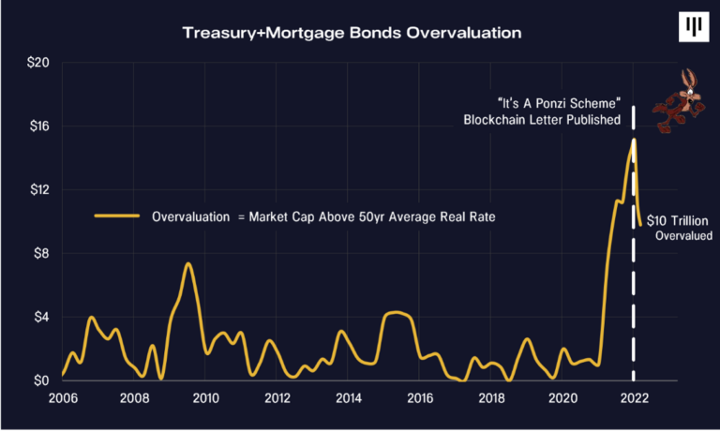 Quantitative tightening (QT) will send bonds and stocks down at the same time.
first level title
The Macro Trade in Stagflation: A Summary of Key Points from the Bankless Podcast
Ryan Sean Adams: That's the highest inflation rate in 40 years, 8.5% CPI. Can you tell us what happened?
Dan Morehead: I've been in this business for 35 years, so I've seen a lot of cycles, and this one is the craziest. The Fed inflated a bubble on bonds, which is outrageous. The bond market is the fuel for the mortgage industry, with record numbers of Americans taking out mortgages and buying homes last year. A 19% rise in the house was no surprise. That's a good thing if you're a homeowner, but 35% of Americans aren't, so I think it's a terrible thing.
About a year ago, the Fed chair said it was a transitional blip in inflation. It's not transitional, it's a huge problem. New record highs have been printed every month since Powell said it was transitional. We're literally back to the craziest 70s.
Uber’s costs have doubled, which to me is a huge sign of a tight labor market. Used cars are more expensive now than when they were brand new. This is super crazy. This has never happened before in history. Basically everything is on fire and more expensive.
David Hoffman: Why is there a bubble in the bond market?
Dan Morehead: The first is that Congress essentially approved $9 trillion worth of spending.
The U.S. deficit for the past two years is simply larger than it was in any year during World War II. We were fighting fascism in World War II. That's a big deal. Here, the money spent fighting this invisible virus is staggering and ineffective. In the US, it costs $50,000 per family. I mean, it's a huge amount of money. Of course, there are policies that need to happen, and there are some people who really need help. But most people who got stimulus checks saved them. Savings rates rise in a recession, something that has never happened before in history.
Thus, nine trillion new paper money was printed and distributed to everyone. Again, a handful of them really need help, and probably more. But most people don't need to. So what did they do with the money? They use it to buy things.
They bought stocks. Stocks are at all-time highs. They bought gold, they bought bonds. So people invest all that free newly printed money.
If you print 9 trillion new paper money, more paper money is needed to buy a car in 2021, or a median home in the US, or a share of the S&P 500. It really is that simple. Paper money is losing value.
In my 35 years of trading, I have never seen anything so extreme and so huge. I've seen some weird deals in small corners of the world, and strange things are happening in some emerging markets. But what the Fed did was a nine trillion -- I mean, that's the biggest bubble.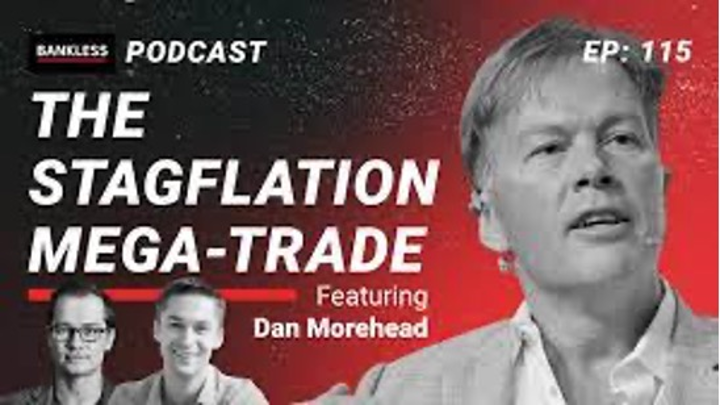
David Hoffman: Can you tell us a little bit about what you think is going to happen next with all this?
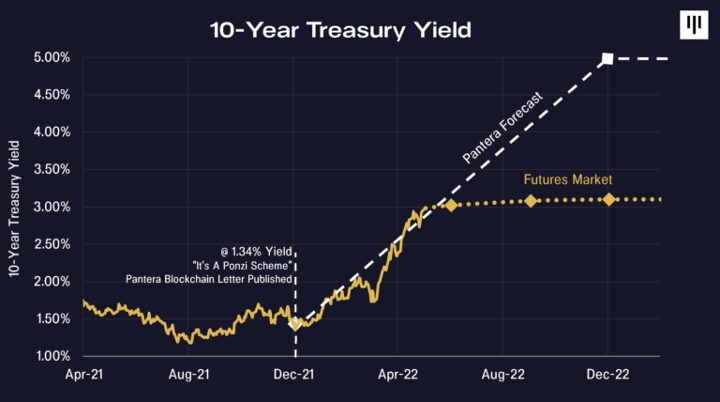
Dan Morehead: I think in about two months, the Fed will realize that this thing is really getting out of hand. They're going to have to start selling bonds instead of just waiting until the holding period for those bonds ends (which will take a long time since most of their bonds are due in 20 years). When you go from the Fed buying billions a month in bonds to now selling tens of billions of bonds, bonds are going to get crushed.
I said in our letter that this is the first non-blockchain transaction I've done in eight years because it's so asymmetric. I think there's a 90% chance that rates will go up.
The point is, you probably don't want to own a ton of national debt.
When I was growing up, I had a normal asset allocation mix of 60/40: 60% stocks, 40% bonds. I'm sure there are some pension plans and insurance companies that still have a fair amount of traditional portfolios in bonds, but if you look at all the facts that we can see today as a normal free market investor, it's just hard to say,' At 2.7% over the next 10 years, the nominal inflation rate is 8.5%, but it's actually 10.7%, and I'm going to buy a 2.7% 10-year bond. I really can't imagine how anyone could do that.
I think money is losing value, but very slowly. No working-age American is investing in a rising interest rate environment. That's very important to us -- I'm 56, and when I got into Wall Street, it was a bull market for six years -- the 10-year note was 10%, so it could easily be 5% or 10% again . But most people your age never actually get close to a 10% 10-year note.
For 40 years, everything has been going up because interest rates have been going down, down, down. In July last year, the 10-year rate hit 54 basis points. That marked the end of the bull market. Interest rates certainly don't get lower than that.
I think we're in a five-year bond bear market and we all have to figure that out. I'm still trying to figure out what this means for our portfolio.
David: How do you think the cryptocurrency market is digesting all this macro news?
Dan Morehead: Basically, there's almost nowhere to hide this kind of macro news, right? That’s why we call it the “Great Unbundling,” and I think everything else will be affected except cryptocurrencies.
If we're even partially right, bond yields will rise to 5% or more, which will obviously crush bond prices, but it also has to affect stocks and real estate and anything else that has discounted cash flow.
I still believe that blockchain can have a low correlation with everything else because most people don't own any blockchain, right? Most institutional investors really don't own a lot of crypto assets. Some of the largest endowments maybe have one or two or 3% blockchain. There are plenty of people who still don't, and neither do most major insurance companies.
So that's how they can remain irrelevant, I think in the future, let's say, five years. If we're right, and blockchain is a very important thing, by the time it becomes an asset class, I think everyone will have around 8% of blockchain in their portfolio. In 10 years, blockchain will be as relevant to the S&P as anything else, commodities or bonds or whatever. But for now, I really think it can be irrelevant.
Ryan: Can you talk about the investment portfolio construction in the blockchain field?
Dan Morehead: Unfortunately, it's not as easy as it used to be, and if we want a quick answer, it's almost impossible.
Obviously, Bitcoin was everything for a long time, and it was good. I used to tell people, buy some bitcoins. And then for a long time, I thought, buy half bitcoin, half ethereum, and you'll be fine. The world today is much more complicated than that.
That theoretical answer, aka diversifying your portfolio, is obviously not super practical for all of your audience. We have maybe 200 different things invested in all our funds. The reality is that there are probably 10 or so Layer 1 blockchains that really matter. All the others are really just companies that basically build on top of other protocols.
The chairman of the SEC said something about five months ago that we don't need 5,000 new private currencies. I think he and many others are misunderstood. There are no 5000 Layer 1 blockchains, right? Just not. There are 10 or so that are important. The rest are almost all protocol applications built on other people's protocols. There are 4,500 public companies in the US, so I'm fine with 4,500 tokens, right. We are not there yet. There are not 4500 real tokens yet, but in 10 years there will be.
A well-performing portfolio should contain many assets, not just one or two. The theoretical answer is that due to the rapid changes in external information, we should try our best to diversify our investment. For example, last year, Bitcoin was up 70%, and our Liquid Token Fund was up 325%. There are many things that are quietly changing, and Bitcoin is one of them, but there are also 30 important assets in terms of liquidity.
first level title
Mortgage inflation rate - 38%
A year ago, the median mortgage payment cost for an American home was $1,223 (monthly payments after a 20% down payment), according to calculations by Realtor.com economist George Ratiu.
first level title
A short story about the Pantera brand
Finally, end with a short story.
One day, I (Dan) was having lunch at an outdoor restaurant, and a guy named Mark Ross came up and introduced himself. He said he was an LP of our fund and asked how I named the company. I replied that it was named after my wife Devon. When I talked about this with Devon, Devon gave the reason for naming, "I used to work in Tiger Management, and all the funds I came into contact with were named after big cats, and pantera means leopard in Spanish and Italian. Pantera was originally a global macro fund, pan terra also happens to mean across the earth in Latin, and oh, and it was the name of a famous heavy metal band in the 80s.”
And that's why the man asked the question, Mark was an A&R at Atlantic Records, and he discovered and signed that famous band, the Black Panthers.





