How will Layer 2 develop in 2022? See what industry leaders are saying



Original source:Original source:
ConsenSys Blog
This article is from The Way of Defi, reprinted and published by Odaily with authorization.
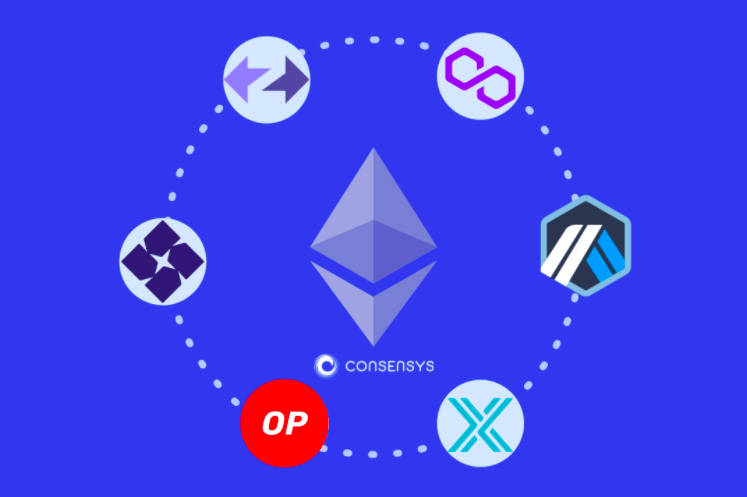
As blockchains like Ethereum continue to scale, Layer 2 (or L2) solutions open up opportunities for millions of new users.
The options available today are countless. The most promising L2 solutions are so-called Rollups, such as Arbitrum, Optimism, StarkNet, and zkSync to name a few. These vertical "mini-blockchains" have very similar security properties extending from the Ethereum mainnet. What they have in common are:
Cheaper transaction fees (low gas)
faster throughput
Trustless Proof Mechanism
Rollups execute transactions in a new environment (i.e. off-chain) and bundle them together, then send updated state and transaction data back to Ethereum. They use proofs for security — some solutions use proofs of mathematical validity, applying techniques from zero-knowledge cryptography, while others use game theory and staked values for fraud proofs. In other words, Rollup is a bridge to the off-chain state machine. The updated state performed on the Rollup is then published to Layer 1 (or L1) and verified using a validity or anti-fraud scheme in the verification contract.
In this post, we expand on the four main questions we ask industry leaders who are building, researching, and developing L2.
What are the key trends in blockchain scaling in 2022?
Will L2 surpass total value locked (TVL) of sidechains/alternative L1 in 2022?
Which plan will come out of the shell in 2022? Which won't?
As a new developer, should I choose to learn Optimistic or ZK rollups? Why?
Please note that these responses are their personal views and do not necessarily reflect the views of their entire organization.
How does Optimistic Rollup work?
In Optimistic Rollup, the operator submits state transitions to L1 and batches all transaction data together with state transitions. Assume state transitions are correct unless proven incorrect. With given data, anyone can examine it. If someone can prove the operator's fraudulent behavior, the operator's deposit will be slashed, and the prover will be rewarded. After a predefined period of time, if no one is willing or able to do a fraud proof, the state transition is accepted on L1 and considered final. This fraud window defines the withdrawal delay before anyone withdraws assets from the Rollup.
Two major players in Optimistic Rollup include Arbitrum and Optimism, which have a 7-day waiting period for withdrawals.
Effectiveness How does Rollup work?
In a Validity Rollup or ZK Rollup, the operator submits a zero-knowledge proof of state transitions to L1 along with some transaction data. Zero-knowledge proofs of state transitions — which are difficult to create but relatively easy to verify — can be verified in L1’s verification contract. The proof shows that the state transition is correct. Different zero-knowledge schemes are used - SNARKS and STARKS - which have slightly different properties and gas usage. Validity Rollup has almost no withdrawal delays because state transitions are mathematically proven correct, so the current state is always valid.
Two notable teams using proofs of validity include Matter Labs (building zkSync) and StarkWare (powering dYdX, Immutable X, etc.).
Dive into L222
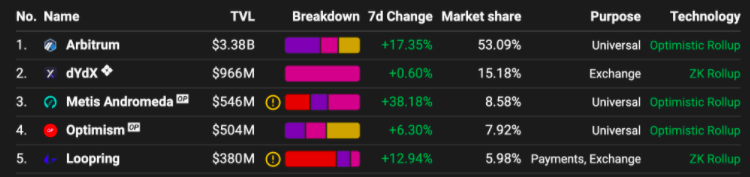
While industry buzzwords are dynamic in the crypto environment, some of them are here to stay. While these L2 scaling ecosystems are young and there is still a lot of work to be done, 2022 will be the L222 year for the Ethereum ecosystem as these various networks take off and gain traction. The high gas of Ethereum will continue to promote the development of L2. As these teams continue to work on gas optimization, user experience, developer tools, and network constraints, they will start to attract a lot of attention from developers, which will strengthen the entire Ethereum ecosystem.
Figures and statistics provide a snapshot of the current state and potential market for L2 solutions. Time will tell if the market will value the more expensive security measures.
Currently, the five largest Rollups have a TVL of $5.51 billion, and these tokens can be used in these systems. This is a relatively small amount compared to the value locked in alternative L1s like Polygon PoS (>$5 billion) or BSC (>$13 billion). Also in terms of usage (e.g. measured by the number of daily transactions), the most commonly used L2 dYdX has ~200,000 transactions, which is one-tenth of Polygon PoS's ~3 million transactions.
However, we believe it is easier to achieve high value locked or daily transaction usage than Ethereum-like security. So even today, L2 seems to be used by only a small group of users, as the technology improves, we will see more and more usage and value growth of L2. Perhaps to put it another way: the difference between L1 and L2 is that in L2 you pay a premium for the privilege of a completely trustless off-chain system. We don't know if users will pay extra to remove this trust.
The best way to learn about L222 is to connect with those who are in it. We gathered insights from research experts, founders of the L2 team, and blockchain engineers on four key points.
1) The main trend of expansion in 2022
In terms of expansion, we have identified four main themes for 2022.There is no denying that 2022 will be the Year of the Bridge.
This could mean two things, since Rollup is essentially a bridge that protects user funds in a specific way. On the other hand, there are bridge protocols that allow interoperability between different Rollups.
“We’re going to get really good at moving ERC20 assets between these chains, and we’ll start to see the development of universal messaging and other non-simple ERC20 application-specific bridges,” predicts Optimism chief scientist Ben Jones.
also,also,The Merger of Ethereum and Proof-of-Stake (PoS) Will Happen
“The narrative of mainnet for determinism and L2 for computation will continue to build,” said Faina Shalts of the Truffle Suite. The merge itself won't have much impact on the rollup as it only changes the L1 consensus layer. However, the next thing to look at is likely to be danksharding, which will have a huge impact, although most likely not in 2022. As Polynya puts it, “Danksharding turns Ethereum into a unified settlement and data availability layer”.Another major trend we will see iscost reduction
. Specialized zk rollups are generally cheaper than optimistic rollups by far. (It's unclear how expensive a per-transaction generalized zk rollup is). Peter Robinson of ConsenSys asked: "Can Optimistic Rollup reduce costs?" There are some ways to reduce costs, and their team is working hard to optimize the compression technology.
Recall that Angela Lu from Matter Labs mentioned, “Ironically, [last year] Optimistic Rollup’s schedule was too optimistic, building an EVM-compatible sidechain is much simpler and has an order of magnitude lower fees, thus satisfies the market."
The final trend the experts found was aboutDeveloperDeveloper
of. As a trend, Faina Shalts sees developers writing L2 native protocols instead of just porting from existing L1 Solidity code. A professional L2 smart contract developer might code in Cairo or Zink. More specifically, Angela Lu believes that with the rise of L2 native applications and blockchain use cases (which cannot be built under the constraints of the Ethereum mainnet), there will be vertical innovation [Rollup technology innovation].
2) Will L2 surpass the TVL of sidechains/replace L1 in 2022?
Overtaking all sidechains and replacing L1 in 2022 seems unlikely.
"Ethereum's security and decentralization are attractive to developers and those who have been in the field for a long time, but at least some L1s will continue to take the lead," said Faina Shalts.
"This is the year to adopt Optimistic Rollup," says Ankit Maity, though he doesn't believe they're ready for the next billion users.
According to Ben Jones, multiple factors will have an upward impact on L2 in terms of TVL and transaction volume:
The gas cost is further optimized and cheaper
people aware of safety issues
Common users gain trust in these L2 systems, which are inherently harder to build due to their various proof mechanisms
While we may see an increase in TVL on L2 in 2022, we also need to see easy-to-use, accessible, and cheap cross-chain bridges for capital to move away from alternative L1.
As far as she's concerned, it's important to remember that these L2s are early technology and therefore not safe to use. L2Beat has a detailed risk summary for each Rollup, you can view:
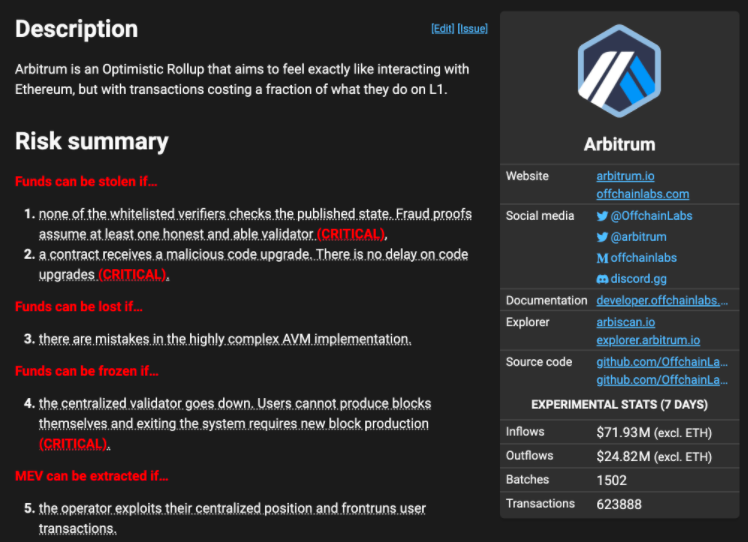
image description
L2Beat's Arbitrum Risk Summary
All in all, the complete homogeneity of the blockchain does not seem realistic. Many alternatives to L1 such as Solana and Binance Smart Chain are cheaper, but less secure - accounting for significant market cap. Some transactions don't need to be as secure as others, and some might not even care about decentralization, just cheaper fees and faster transactions.
Large-scale malicious attacks on these networks could alert people to security risks and prompt migration. Remember Solana's Wormhole cross-chain bridge incident last week?
Though perhaps we should heed Patrick McCorry's stance not to worry about L2 taking over sidechains, but to see if L2 can flip the TVL held by a centralized exchange like Coinbase.
3) Which plan will break the game in 2022? Which won't?
When it comes to the unsolved puzzles of 2022, almost all experts are talking about EVM equivalence.
For Optimistic rollups, we will see them gain traction in terms of usage and tooling, as they are nearly equivalent to EVM. “We’re seeing a ton of people deploying their projects because they realize it’s actually as easy as changing the chainID and running the exact same script that you do on mainnet,” Ben Jones observed. However, as different EVM-compatible scaling solutions enter production, users and developers will become more aware of the nuances of compatibility and the costs associated with them.
However, with zk rollup, the expectation for it falls on continuity. Some experts conservatively predict that we'll see good workarounds for converting code to the EVM. Some believe that a zkEVM proof of concept is feasible in 2022. Some even think we'll see efficient zkEVM provers on mainnet.
What we won't see in 2022 is trustless and seamless interoperability between L2s - which is essentially bridging. There are protocols, and some teams build on top of them. Most bridge projects to date are indeed trusted and centralized.
4) As a new developer, should I choose to learn Optimistic Rollup or zkRollups? Why?
If you are a new developer, don't worry. The consensus here is to learn Solidity and EVM.
"Solidity is a smart contract language with the richest developer tutorials, most mature developer tools, and largest developer community to support one's smart contract development journey," said Angela Lu.
As a new developer, you probably want to be able to do things quickly and develop intuition. The developer experience on Ethereum has improved significantly over the past three years, and by learning Ethereum you will have the foundation you need to build EVM-compatible Optimistic Rollups, which doesn't apply to zk rollups.
“zk Rollup currently requires knowledge of a different language optimized for the computation required to make it work. For example, to really reap the benefits Starknet promises, you need to know Cairo. This year is definitely the best time to learn it , because the language is so new that junior developers can quickly develop expertise. We will no doubt see both the "Cairo Smart Contract Developer" role and the "Zinc Smart Contract Developer" role soon. Focusing on one of these is Risky, as both major zk Rollups are expected to eventually be EVM compatible, but I think learning one of them is a good reward/risk calculation!
Warning - there are not as many resources for learning Cairo or Zinc as there are for learning Solidity, so they will be harder to learn for a while," says Faina Shalts.
As a new developer, you might want to avoid jumping into an esoteric programming language right now, as that could be prone to extreme changes and possible bugs, since that would be a more challenging route. However, the team at StarkWare encourages developers to familiarize themselves with the idea that "every marginal transaction reduces the unit transaction cost, removes the gas limit that exists on L1, and opens up a world of new features."
Depending on your level of experience, you might want to explore zk rollup for deploying L2 native applications. According to Angela Lu of Matter Labs, this allows for greater design space because:<>fast L1
L2 Asynchronous Messaging Enables Hybrid Applications Leveraging L1 Applications and Liquidity
Volition is designed to enable disparate classes of users and applications across the entire security/cost spectrum to compose and interoperate in one system that spans many data availability solutions
The ability to publish only state differences to calldata will provide significant cost savings over Optimistic rollup.
Nicolas Liochon, head of R&D at ConsenSys, emphasized that as a new project and developer, "a reasonable plan would be to evaluate the properties of zk Rollup and Optimistic Rollup anyway, to see if Optimistic Rollup is good enough, at least in the short term, and then wait to let The zk-evm debate is settled."
Developer resources available to you today:The Ultimate Hackathon Survival Guide
– Learn Web3 (basic, intermediate and advanced resources)Professor Patrick McCorry's
ConsenSys AcademyCryptocurrency Lessons for 2022
Blockchain Developer BootcampSmart Contract Engineer
Learn Solidity and Vyperfor your comprehensive developer kit
Infura platform
The blockchain trilemma refers to the widely held view that decentralized networks can only provide two of three benefits in terms of decentralization, security, and scalability at any given time.
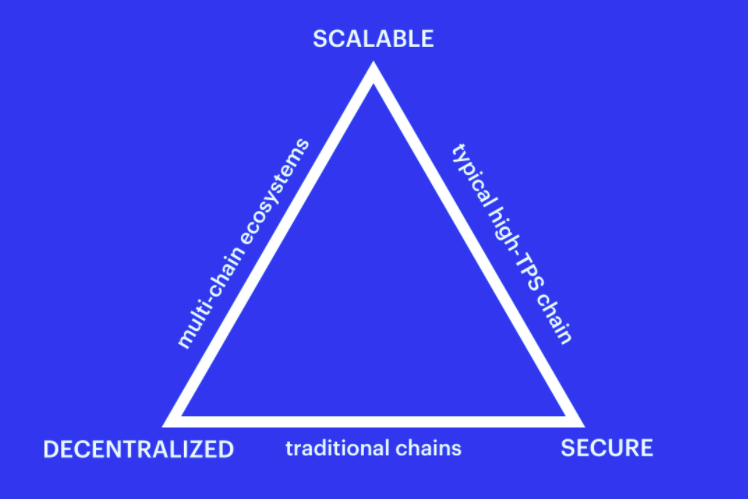
image description
Rollup is a modular implementation designed to solve the trilemma. By creating a transaction execution environment separate from Ethereum, they are relieved of responsibility for consensus and data availability. This allows Rollup to benefit from high scalability, security, and decentralization without compromising any of them.
final thoughts
final thoughts
All in all, the main trends we will see scaling in 2022 include bridges, fee reductions, consolidation, and developer migration. Although there will be significant progress in EVM compatibility and EVM equivalence this year, we won't see L2 surpassing L1 in TVL anytime soon. Trustless and seamless bridging will take more time to mature as it is a challenging puzzle. If you're a developer looking to break into the field, start by learning Solidity!
Ideally, new users don't even need to know they're on L2. It will be a seamless experience where they don't need to go back to mainnet while still inheriting its security. The popularity of bridges, mature L2 infrastructure, and fiat currency on-ramps will help with developer attention and user traction.
Hopefully soon, most people will be using this technology without knowing what L2 or EVM means. Until then, we try to stay on top of the ecosystem and keep up with developments built and researched by many skilled and interesting people.
Maurelian, Optimism
Ben Jones, Optimism
Ankit Maity, Polygon
Angela Lu, Matter Labs
Tyler Perkins, Matter Labs
Liron Hayman, Starkware
Fred Lacs, Arbitrum (Offchain Labs)
Faina Shalts, ConsenSys
Patrick McCorry, ConsenSys
Nicolas Liochon, ConsenSys
Peter Robinson, ConsenSys
David Killen, ConsenSys