






The Web 3 Opinion Debate: Who Moved My JPEGs?


Original Source: Tao of the Metaverse
Original Source: Tao of the Metaverse
Last weekend, Moxie Marlinspike, the founder of the well-known encrypted communication application Signal, published an article entitled "My First Impressions on Web3" (Chinese version by Chain Catcher), which aroused heated discussions in the encryption circle. It is reported that Moxie conducted in-depth research after developing two decentralized applications and creating NFT works but was deleted by Opensea. He found that Metamask didn't actually show the contents of his account on the Ethereum blockchain. Instead, the wallet app relies on the Opensea API to check which NFTs are associated with which blockchain account.
In this regard, Vitalik Buterin, the founder of Ethereum, Aditya Agarwal, a Facebook engineer and CTO of Dropbox, and Dror Poleg, a columnist in the Wall Street Journal and the New York Times, expressed their views. The following is a compilation of relevant content.
text
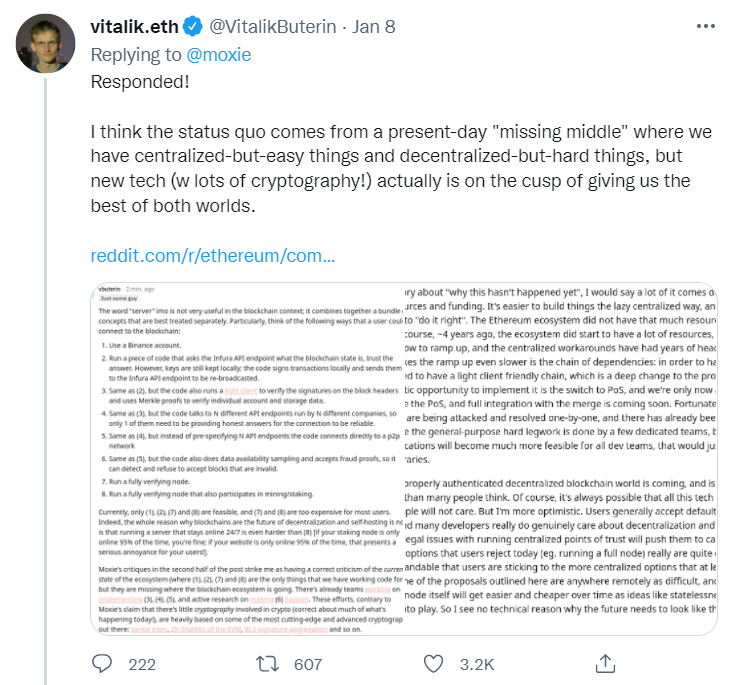
text
In the context of blockchain, the word "server" is not very useful; it combines concepts that are best treated separately. In particular, consider that users can connect to the blockchain in the following ways:
Use a Binance account.
Run a piece of code that asks an Infura API endpoint what the blockchain state is, and trust the answer. However, the keys are still kept locally; the code signs the transaction locally and sends it to the Infura API endpoint for rebroadcasting.
Same as 2, but the code also runs a light client to verify signatures of block headers and uses Merkle proofs to verify individual accounts and store data.
Same as 3, but the code talks to N different API endpoints run by N different companies, so only one of them needs to provide an honest answer for the connection to be reliable.
Same as 4, but instead of pre-specifying N API endpoints, the code connects directly to a P2P network.
Same as 5, but the code also samples data availability and accepts fraud proofs, so it can detect and reject invalid blocks.
Run a fully validating node.
Run a fully validating node while participating in mining/staking.
Currently, only 1, 2, 7 and 8 are viable, and 7 and 8 are too expensive for most users. In fact, the whole reason blockchain is the future of decentralization and self-hosting isn't is that running a server that's online 24/7 is even harder than 8 [if your staked nodes are only online 95% of the time, fine; if Your website is only online 95% of the time, then this is causing serious annoyance to your users!
Moxie's criticism in the second half of the post makes me think that the criticisms of the state of the ecosystem are valid (1, 2, 7 and 8 of which are the only things we have working code for), but they miss the development of the blockchain ecosystem direction. There are already teams working on implementing 3, 4, 5, and actively researching how to implement 6. These efforts, contrary to Moxie's claim that cryptography is rarely involved (which is true for most of what's happening today!), are largely based on some cutting-edge and advanced cryptography. Verkle trees, ZK-SNARKs for the EVM, BLS signature aggregation, and more.
As such, I think the world of properly certified decentralized blockchains is on the horizon, and closer to it than many imagine. Of course, there's always the possibility that all of this technology will be built and many people won't care. But I am more optimistic. Users generally accept the defaults given by developers, and many developers do genuinely care about decentralization and trustless issues (and the growing legal issues of running centralized trustpoints will drive them to care even more). Decentralized options that users reject today (e.g., running a full node) are indeed quite difficult today, so it's understandable for users to insist on more centralized options, at least they can use them easily. None of the suggestions listed here are that difficult, and even running a full node itself will become easier and cheaper over time as ideas like statelessness and history expiration come into play. So I see no technical reason why the future needs to look like the status quo today.
secondary title
Facebook Engineer: Don't Focus On Trying To Predict, It's Much More Fun To Build
and"protocol"and"platform"Relationship. In short, protocols are difficult and slow to develop. This is not in dispute, but I also think that everyone is"protocol"protocol
The mental models are current protocols, such as HTTP, SMTP, etc. All of these protocols are *stateless*. This has long been an accepted (and generally correct) protocol design pattern.
Such"protocol"protocol
There haven't been many examples yet, which is why it's no surprise that we're all unsure how it compares to traditional models."More broadly, I think there is a lot to web3"technological determinism
oriented comments. For example, web3 leads to some points of centralization (examples: Alchemy, OpenSea), so it doesn't satisfy utopian goals of complete decentralization, etc.
I find this comment somewhat naive because it ignores how technology is ultimately woven into the next generation of products. Most things don't appear cleanly in one world or the other. It will be confusing. Things will feel like they cross ideological boundaries.
The future is here, but it's not evenly distributed, only a part of it is captured. More likely, the future will be intertwined with the past for a long time to come. It's basically the same conversation we're seeing around autonomy, artificial intelligence, SaaS, et cetera.
Don't focus on trying to predict. Building is much more fun.
secondary title

"Wall Street Journal" columnist Dror Poleg: I don't believe that web3 will be more just and free
Crypto is interesting because of the freedom it enables, not the freedom users currently care about. (Response to Moxie)
The Hungarian Sausage Story
"Jews, Germans and oil are our best exports," dictator Nicolae Ceaușescu boasted in the 1970s. He was talking about my grandmother, my father and my uncle.
Some people like living in the Romanian Socialist Republic, my grandmother didn't. After surviving Auschwitz, she wanted to give her children something better than anti-Semitism. But she couldn't just pack up and leave. Someone has to buy her.
From 1945, Romania collected more than $100 million in cash and other goods in exchange for Jews. As Zahra Tara recounts in The Great Departure:
"The exchange of Romanian Jews for money and agricultural products began covertly after the Second World War. A Jewish businessman in London named Henry Jacober acted as an intermediary between Western privates and the Romanian Secret Service. Jacober used cash laden briefcase, usually $4,000 to $6,000 per immigrant (depending on the individual's age and education status), in exchange for an exit permit to the West."。
When Israeli intelligence officials learned of the deals, they decided to join the scheme, with Prime Minister David Ben-Gurion's approval. At Khrushchev's insistence, Romanians began demanding agricultural products instead of cash. Soon, Romanian Jews were being bartered for everything from cows and pigs to chicken farms and cornflake factories... Prices to leave the country depended on the immigrant's age, education, occupation, family status and political importance can reach $50,000
In 1962, my grandmother, father and uncle managed to get exit visas and board a plane to Rome. They are only allowed to bring clothes, sheets and food for the trip. Everything else -- property, electrical appliances, jewelry, books, even photos -- had to stay in Romania.
To jump-start the family fortune in the New World, my father and uncle brought some Hungarian sausages. They heard a rumor that Italians were generous with this rare delicacy. But this rumor is wrong. After days of running the streets of Naples without finding generous customers, my father and uncle threw the sausages away and boarded a boat to Israel.
Most of the time, being able to pack up and leave is not important to most people. But when it happens, it matters.
A recent discussion about the promises and limitations of cryptocurrencies/Web3 got me thinking about those Hungarian sausages. Our current predicament seems comical in light of the tragedies of history. But they could end up having a big impact.
In 2022, the smartest minds in the world are arguing about digital tokens, monkey JPEGs, and Super Bowl commercials. Last week, the Financial Times quoted my review of a shoddy ad starring Matt Damon, while The Guardian ran an article on why the Boring Ape NFT is actually worthless.
A more substantive contribution to the debate about the future of the Internet comes from Moxie Marlinspike, founder of the private messaging app Signal. Moxie shared his "first impressions of web3" in a blog post.
Bottleneck of decentralization
The vision of web3 is admirable. But Moxie set out to see how decentralized "sausage" is made in practice. However, this did not impress him.
Moxie’s first concern is that Web3 is not as decentralized as it claims to be. In this case, access to the underlying infrastructure of web3 (the Ethereum blockchain) ends up going through several popular API providers. So even though the blockchain itself is decentralized, most applications that rely on it are still bottlenecked by centralization and run by private, for-profit entities.
As an analogy, say a person bought a piece of gold and deposited it in a keyed vault down the mountain maintained by a Swiss bank. When the person logs into the bank's app to check his gold balance, the app doesn't send someone into the vault to check how much gold is there or if someone has tampered with the key to the vault. Instead, it simply displays data from a third-party database that records bullion inflows and outflows across the mountain. So the client gets the latest information, but it doesn't get the straight, indisputable truth.
Banks do this because it's much easier to maintain a central database of all deposits and remittances made on the Hill than to send someone in person every time a customer logs into the app. Ethereum-based applications use API providers for the same reason: it's easier and simpler for them to do so than to validate each query itself on the blockchain.
This choice of expediency over decentralization is bad in some use cases and harmless in others. The problems Moxie raises are well known, Ethereum developers have spoken and written about them publicly, and are working on ways to mitigate them. And I've also written about how each wave of decentralization simultaneously spawned a wave of centralization.
Still, Moxie ignores (or fails to mention) an essential difference between these problems and what's happening now in Web 2.0. We'll discuss that in a minute. But first, let's look at Moxie's second concern.
no benefit
After trying to build a decentralized application and encountering a centralized API, Moxie created an NFT and listed it on OpenSea, the most popular NFT marketplace."NFTs are a prime example of web3's promise to free users from powerful platforms. Even though NFTs can be created and listed on platforms like OpenSea, they are not stored on those platforms. When you create or buy an NFT, that action is recorded on the blockchain itself. This means you can buy an NFT on one platform and then"take it with you
to a different platform, or sell it to someone else without their permission. You can use a cryptocurrency wallet like Metamask or Rainbow to access all your funds and assets on the blockchain without having to log into any specific platform.
This may sound like nonsense. Why would anyone want to buy or sell tokens that give ownership of digital goods? But when you consider that in 2021 humans will spend over $60 billion on games, or $13 billion on digital music streaming, or $22 billion on digital artwork -- you start to see a The value of digitally native ownership systems.
In Web 2.0, you could buy a movie on Amazon Prime or a song on Apple Music, but if you decide to leave the platform (or get kicked), you lose access to those assets. The goal of NFTs is to enable users to directly own their stuff, take it with them, and move the power away from platforms and companies.
But that's not the Moxie experience.
Who moved my JPEG?
Moxie created an NFT on OpenSea and intentionally programmed the manifest to look different on different platforms (by loading different images, depending on the IP of the requesting website). Initially, he could see the NFT in his cryptocurrency wallet, meaning his ownership of it was recorded on the Ethereum blockchain. However, a few days later, OpenSea decided to remove his NFT from their marketplace, claiming that Moxie violated their terms of service (due to the code changing what users see).
Technically, the fact that OpenSea decided to remove NFTs from their marketplace shouldn't be a problem. Moxie still owns it, and this ownership is independent of OpenSea, recorded on the blockchain itself. But when Moxie checked his cryptocurrency wallet app, he found that the NFT had disappeared. How is this possible?
Moxie dug deeper and found that the wallet app he was using (Metamask) didn't actually show the contents of his account on the Ethereum blockchain. Instead, his wallet app relies on an API to check which NFTs are associated with which blockchain account, and that API is none other than the OpenSea API! Since Moxie's NFT has been removed from OpenSea, the API says it no longer exists.
It feels like a Web 2.0 comeback. A powerful platform successfully confiscated/deleted data and assets from a user's account without his consent.
But there's one fundamental difference between what happened to Moxie and what happens when a Web 2.0 platform decides to delete a user's file or list.
If Moxie used a different app to check the status of his NFT directly on the blockchain, he could see that the NFT still exists. In fact, you can also see that NFT on OpenSea competitor Rarible. Going back to our earlier analogy, the bullion is still inside the vault, inside the mountain, even though the bank's app doesn't show it."Of course, popular wallet apps not showing what's in people's accounts (although those things are still there) is a problem. But the good news is that while OpenSea removed Moxie's NFT, that NFT"down, still in its place. I'm pretty sure Moxie ended up making a lot of money when someone bought it as a memento of the whole event. And I've already bid.
postscript
postscript
Unlike my dad, if I needed to move, I could take most of my assets and cash-generating businesses with me. If the US decides to kick me out (or sell me back to Romania!), as long as I can use my Twitter, Gmail, Maven and Stripe accounts, I can keep making money. The biggest threat to my livelihood is not losing my citizenship; it's losing access to my accounts on multiple platforms.
Crypto and web3 promise to increase my freedom to switch between the platforms I rely on, and my likelihood of surviving hostilities on one of them. This promise is only partially fulfilled so far, and may never be fully realized.
Unlike some, I don't believe web3 will be more just or equitable, or even more liberal by default. But I do believe it offers the possibility of increasing our freedom and agency. And, on the basis of general and personal history, this possibility was enough to pique my curiosity and gain my support.
The freedom to pack and move your digital assets and identity is not important to most users. But one day it might matter, and when it does, it will matter a lot.


