






Cardano ecological leader, World Mobile is laying a decentralized network in Africa


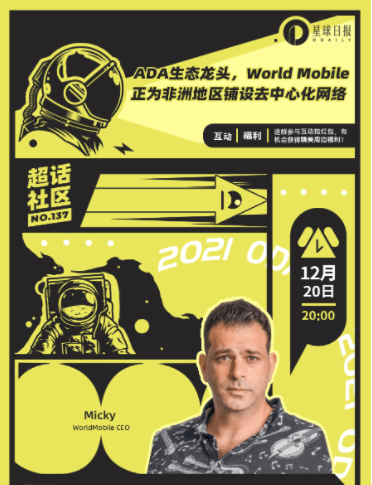
With the activation of the smart contract function, the ecological construction of Cardano has officially started, but at the current stage, most users may not know much about the specific projects in the Cardano ecosystem. To this end, the Odaily Community Super Talk No. 137 specially invited World Mobile, a leading Cardano ecological project. As a project directly invested by the Cardano development team IOHK, what World Mobile is doing is different from most projects currently on the market. . Specifically, Micky, CEO of World Mobile, personally gave the answer in the AMA.
In order to make it easier for friends who missed the live broadcast last night to tutor Micky’s shared content, we have organized the main content of last night’s AMA in text, as follows:
Q1: Could you give us a brief introduction to World Mobile?
A1: World Mobile aims to incentivize the deployment of telecommunications infrastructure in places where there is currently no telecommunication infrastructure. Word Mobile is the first sharing economy project in the multi-trillion dollar telecommunications market.
Q2: Why do you want to build a decentralized mobile network? In World Mobile's view, what are the disadvantages of existing mobile networks?
A2: In order to realize the free choice of the economy and the self-governance of the data, and realize non-tamperable, transparent and distributed ownership, this is why we build a decentralized network. It is difficult to achieve "credibility" without decentralization.
Q3: What role can blockchain technology play in the design of World Mobile?
A3: Blockchain is part of our technology stack and has many applications, such as:
Trust: Verification "on-chain" cannot be changed arbitrarily in the future.
Efficiency: Smart contracts can replace many layers of bureaucracy and administration, increasing the efficiency of the solution.
Digital ID: Empowering millions of users to bridge the digital divide and achieve economic freedom.
Sharing economy: Node owners and operators are automatically rewarded through the token economy of the blockchain, enabling the network to grow rapidly.
Own data governance: Give users privacy and control over their own data.
Community: Supports distributed ownership of infrastructure, allowing scalable, continuous funding.
Q4: How does World Mobile's network service quality compare to traditional mobile networks?
A4: This question is also very good! Our average speed was around 17 Mbps with a latency of 100 ms. The network is stable on both WiFi and GSM, and compared to other options in the area, the experience is basically the same, or even better.
Q5: Let’s talk about token content. How can we obtain World Mobile tokens?
A5: I know that the WMT team recently released some news about the online exchange. Please pay attention to our WeChat, Telegram, Twitter and other social media, where you will find all relevant information about CEX and DEXs, and we will announce some announcements worth looking forward to before the end of the year.
Q6: According to the economic model, the tokens of World Mobile will be released after twenty years. At that time, there will be no token incentives for operating nodes. Will this affect the sustainable operation of World Mobile?
A6: There are still more than 3.5 billion people who do not have access to the Internet! The number of people using the network will almost never stop growing, so node operators will continue to have positive revenue while running their nodes. Our token economy was written in collaboration with the best minds in the blockchain industry. The founders of Delphi Digital, Zero1, and IOHK all participated in the creation of the economic model. Many of these teams have participated in the operation of the top 100 projects.
Q7: From the perspective of vision, what World Mobile wants to do is a very grand thing. Such a grand undertaking obviously needs sufficient financial support. Can you introduce the current financing situation of World Mobile?
A7: World Mobile is a new economic model in which the telecommunications infrastructure is distributed. The industry has trillions of dollars, and this is the first sharing economy project in the telecom industry. The smart contract rewards any user running the World Mobile sharing economy and incentivizes further deployment of the hardware. We believe there will be explosive growth when the community has the option to own the hardware, participate in the sharing economy, and earn rewards without having to raise money in the typical centralized fashion from VCs and foundations etc.
Q8: At present, is there any actual landing case of World Mobile's solution?
A8: Of course, share a story that moved me.
A few years ago, we established a POC in East Africa. We installed two aerial nodes in a remote coastal village. Air nodes can provide nighttime lighting, internet connectivity and a charging station powered by solar power and backup batteries. Our purpose is to analyze the impact that two air nodes will have on a fishing community of about 200 people, but suddenly the epidemic broke out and many places were blocked. So we didn't go back to that village for almost 9 months, but we were shocked when we finally managed to travel again.
The village has doubled in size to nearly 400 people, and now has 3 new pubs. A store is also open. Fishermen can make 5x more money from their fisheries than before because they can talk directly to merchants and communicate with customers about stock information in real time. For me, that's where the motivation lies.
Q9: Currently there are other projects on the market that are doing something similar to World Mobile, such as Helium, can I ask what is the difference between you? Are the two projects in direct competition?
A9: Helium uses proprietary hardware, and we use various combinations of off-the-shelf devices to create connections. We are using different combinations of equipment as needed. In some cases we use HAPS/Helikites/Balloons for networking. To provide ultra-fast connections, we use free-space optics or run fiber optics and push coverage through the mesh. Our network offers both cellular and Wi-Fi, or just Wi-Fi. We have deployed deployment teams throughout the East Africa region. What we do is create the network and the software that runs it. The last mile is built by villages or towns, we build the backbone of the network and they provide the rest of the last mile.
They don't provide Internet access solutions like ours, nor do they provide mobile networks, our sim cards allow roaming in more than 52 countries on the Mesh network. They're more focused on the US and areas that already have coverage, we're building a network in areas that don't have coverage.


