ENS founder: How do you view the long-term vision of ENS and the story of Web3.0?


After 2019, the concept of Web3.0 was mentioned again and spread rapidly. Just a few days ago, Internet KOL Pan Luan hosted a discussion about Web2.0 and Web3.0, the highest traffic was close to 200,000 . Obviously, Web3.0 is no longer only focused on the blockchain industry, but has begun to tell new stories in the global Internet technology industry.
Ethereum Name Service (ENS) is one of the important infrastructures of the Ethereum network, and of course an important infrastructure of the Web3.0 network. In the Ethereum ecosystem, more and more protocols are beginning to support ENS. Using ENS as a name, using NFT as an avatar, using mirror to record life, and using AR to store content is already a standard configuration for Web3.0 people, and it is also a standard for many Web3. .0 foundation for social applications.
How does the founder of ENS see the vision of ENS and the story of Web3.0? A few days ago, he was a guest at The Defiant and chatted with the host about his story and original intention of doing ENS, as well as the future of ENS. Rhythm BlockBeats translated the full text as follows:
Camila Russo (Moderator): Nick is the founder and main developer of Ethereum Name Service (ENS), which is Ethereum's version of domain names, and he will also talk about all the specifics in a later interview. ENS allows Ethereum users to link human-readable domain names to their Ethereum addresses, making it easier to send and receive Crypto. However, this is only the starting point for the ENS roadmap and future goals. Basically, any domain name with .eth that you see on Crypto Twitter comes from ENS. So, before we get into the story and goals of ENS, I want to know what made you start ENS in the first place?
Nick Johnson:I remember back in 2016, when I was still working at Google as a software engineer, a well-known financial services company contacted me and said, "Do you want to find a job on Ethereum?" I replied, " Not really, but Ethereum sounds like fun." I wrote some code and then created a couple of libraries. Then I got a call from the Ethereum Foundation and they asked me, "Would you like to work on Go Ethereum or Swarm?" It sounded more exciting because I had neither done remote work nor contracted work, so this will be a complete challenge for me, but I chose this job resolutely.
I just started working on Swarm, and one of the projects required a name service to provide domain names for decentralized content like the ones you see on Swarm and IPFS. So I started what is now ENS just as a side hustle, but it quickly evolved from a small side hustle to what I am now a full-time job at the Foundation. Then we separated it, established our own organization, and created today's ENS.
CR: Can you tell us about Swarm?
NJ:secondary title
Ethereum Foundation provides funding for ENS
CR: Was ENS originally funded and guided by the Ethereum Foundation?
NJ:Yes, it started out as a licensed side project of mine at the Ethereum Foundation (EF). However, as it continued to grow and develop, I could no longer do all the work alone, so the foundation suggested that instead of forming a team in the foundation to be responsible for the ENS business, I should set up my own team, and they also gave A small sum of money was allocated to us. We used this money to recruit the first people who were willing to work with me and who did some voluntary or paid work for us while ENS was still part of the foundation. After that, we developed step by step, and now we have a stable registration income.
CR: Is it common for foundations to spin off an internal project into their own company?
NJ:I think they want to encourage this, but we haven't really had something like this happen before, because sometimes, it's not realistic to do it, such as core infrastructure like Go Ethereum, if it is independent, it doesn't seem to be Doesn't do any good. It's hard to see how they would benefit from a completely separate organization. But in other cases it makes a lot of sense, like for us, the initial funding that the foundation gave us got us on our feet and things got off the ground and we made significant progress in the first two years .
image description
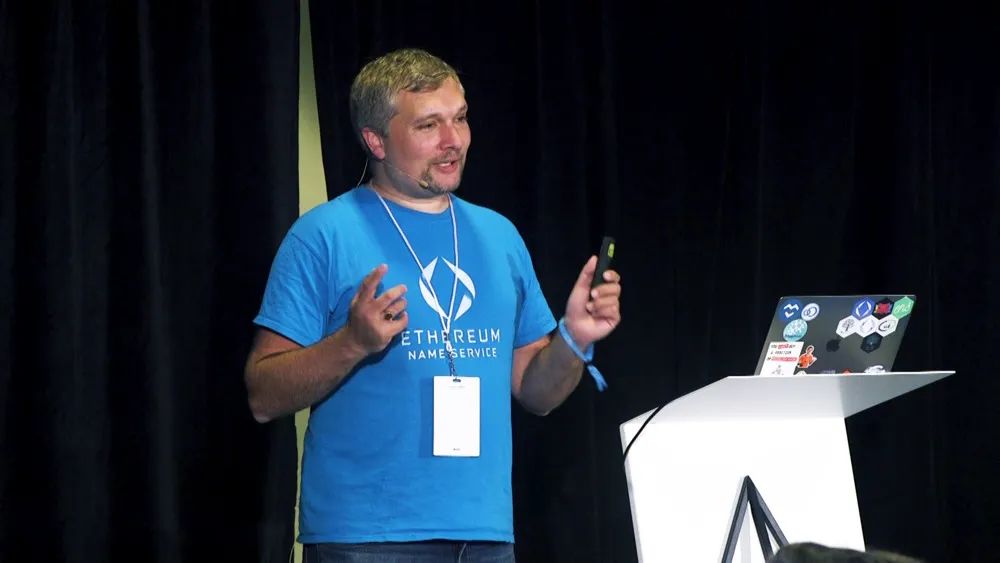
Nick Johnson
CR: Sounds very interesting, I would like to ask how much money the foundation gave you?
NJ:They gave us a million dollars. It was like this, they asked me to draw up a grant letter, and I thought about how many people I need to hire, how much I should pay them, what else do I need, and so on. In the end, I calculated that the operating expenses for the first year needed to be $500,000, but the final decision was still in Vitalik's hands. He said: "It's not enough, give them a million dollars."
I'm really thankful that they gave us so much grant money that got us through tough times and got us on our feet. Without this grant, we might not be where we are today. They later gave us a special grant, which meant a lot to us as well.
CR: So does the Foundation own shares in ENS now?
NJ:secondary title
How ENS works
CR: Can you talk a little bit about your business model and the revenue that registration brings? You mentioned before that when you separated ENS, you didn't consider the issue of income, but your company does have stable income, so what is your vision for the future? Are you trying to turn it into a for-profit business? Can you talk about your current actual income?
NJ:I've always wanted to make ENS a public good, not a for-profit business, or to make money from it, because I want people to use the domain name system. But the first thing you need to figure out when building a domain name system is how to make sure that names that people find interesting or useful aren't immediately snatched up by speculators and resold on the secondary market.
When you're building a neutral system, there's no way you can completely eliminate this, but what you can do is set some costs that make name grabbing not cost-effective, and force speculators to focus more on those they considered the most valuable. Systems like Namecoin have been compromised by speculators to the point that it's very illiquid - it's hard to find a domain you like on it because speculators have already resold them at extreme premiums, and the secondary market Also very inefficient. Therefore, we want to avoid this situation as much as possible, and at the same time, it must not affect ordinary users.
In the first version of ENS there was an auction-based system, and if you won the auction, you couldn't get your deposit back as long as you held the domain. Of course, this approach is not for profit, it is just the cost you should pay for using the domain name, which will have a positive effect in theory.
But the problem is that squatters and speculators know they're going to sell the name and get their deposit back. But any long-term project investor tacitly cannot get back the deposit, because it is not realistic for them to give up the domain name, which further aggravates the phenomenon of squatting. Therefore, we decided to go with an annual registration fee model, which is also a nominal fee. For domain names longer than 5 characters, the annual registration fee is $5 - and transaction fees on Ethereum are now several times higher. That being said, this model does limit speculation somewhat, with unused domains being fed back into the registration pool, and it also provides us with higher revenue than expected.
At today's price of ether, ENS has about $40 million worth of assets in multisig and soon the DAO, of which 20 million is the funds we have already earned. Because for example, someone registered a domain name for two years a year ago, and now the first year has passed, we have already received half of the money, and the other half of the money will be recognized in the future. When DAO goes online in the future, it will also have its own Token, which will be used to reward people for participating in governance, or completing some projects that conform to the development ideas of ENS.
CR: So the 40 million is pure registration fee income, and this income is separate from the ENS Token vault?
NJ:The road to decentralization
The road to decentralization
CR: Can you talk about your vision or goals for creating a DAO?
NJ:From day one, our goal has been to build a decentralized system, which means we need to get rid of human control as much as possible, and I firmly believe that this is the most feasible way to build a decentralized system. At the same time, we want to minimize the number of systems that require trusted parties to execute. To do this, we have built a system that is managed cryptographically with the help of certificates, and gradually removed some permissions that are no longer used. Therefore, even ENS root keyholders who use ENS for administrative work cannot affect existing registrations because they no longer have this permission. Even if we end up with a DAO, they can't do that.
The second thing we're going to do is move from our original 70-holder governance model to a more decentralized model where the future DAO will take control of the overall development. We've raised enough money so far that we'll be taking enough money beyond our operating expenses to fund other good causes and other causes in the Ethereum ecosystem. Secondly, we will also make continuous upgrades and adjustments to ENS to ensure its normal operation.
The DAO was new when we started, and I don't think it's mature enough, so I'm not too keen on handing over ENS to a nascent DAO. But since then, even in the past six months to a year, the ecosystem has matured, not only has a lot of tools been built, but also a wealth of practical operations, and a smart contract system , such as the OpenZeppelin component we're using (which is a DAO-based composite model), plus we've successfully removed the manipulation from the administrative functions, we're confident we'll be giving control back to the community.
CR: For a founder, it is very interesting to have the confidence to entrust the organization that you have built over the years to a group of decentralized token holders. You just mentioned that management no longer has administrative authority, and I think that sounds a bit disturbing, because it means that no one has control over how ENS works. How do you deal with these risks, and why do you think decentralization is the right decision?
NJ:Part of the reason is that ENS has been that way since day one. We've had seven keyholders since launch, which certainly isn't decentralized enough, but it's better than me having the power all by myself. Moreover, we are not a group of several people from the same company, but several of us are from the entire Ethereum community, and it is a group worthy of trust and respect.
We hope that if someone (not necessarily me) proposes to upgrade or change the ENS, they will look at it with a critical eye and assess whether it is a good idea or not. Not only does this mechanism prevent someone's key from being compromised, it's also a way of self-regulation. This committee or board will be responsible for reviewing any proposals and ensuring they have the best interests of the Ethereum community at heart.
So, in a way, the handover of ENS to the DAO is just another step in that direction. I'm out of control of where things are going, and I have to convince other people that it's a good idea. However, as more players continue to join, we may not be able to avoid some serious mistakes. But at the same time, there are many DAOs that are currently developing very well and have achieved success in decentralized governance. In the process of learning from them, we have also regained confidence, allowing us to be sure that we have not put ENS in the middle. in danger.
In my opinion, the worst situation we can encounter is misallocation and misuse of funds, but this is not as important as ensuring the safety of ENS users and the normal use of domain names and not being misappropriated.
CR: Can you talk about how you designed the distribution of ENS Token? And why is it designed like this?
NJ:The design of the Token distribution mechanism is also crucial to the realization of our long-term goals. As the first public welfare product serving the community, our goal is to provide users with the most effective and convenient services. In terms of how Token is allocated, we mainly look at the number of domain names registered by users or the registration period. However, there will also be a problem with this distribution. Some people who want to seek personal gain through the system will obtain a large number of governance tokens, which is not conducive to the development of the system, and those who have been using the system will not get much reward.
Therefore, we want to set a set of parameters to identify those who have been using the system and distribute the airdrop to those who do use the system. Not only that, but these parameters have to be hard to forge.
So we split the airdrop in half, and one half is based on the number of days the account has owned a domain in the past. So if you own the domain from day one, you get the biggest airdrop. But if you signed up the day before Snapshot, you won't get any money. This number of days is difficult to forge. You have to start thinking about airdrops on the day ENS was launched four years ago, so that it is possible to forge successfully, so this is a very good distribution plan.
But this model ignores those who just joined ENS with enthusiasm, so the other half of the airdrop will be distributed according to how long your last name registration is about to expire. We think this is a good indicator, because if you don't think ENS can achieve long-term development, you probably won't sign up for ten or eight years, at most one or two years. Therefore, if you are willing to register for a long time, it means that you believe in ENS and that this domain name can be valid for a long time. But the registration time can’t be as long as you want, up to eight years, because if someone wants to register for thousands of years, then we have to hand over the entire DAO to him.
The last point is whether you have set your domain name as the main DNS domain name. If this domain name appears when you log in to your Apple account or vote, it means that you are really using this domain name. We will double the amount of the other two parts of the airdrop.
CR: Of the total token supply, how much is allocated to users and how much is allocated to ENS domain name holders?
NJ:25% were allocated to domain name holders through airdrops, and 50% remained in the DAO treasury and managed by Token holders.
CR: What is the Token economy of ENS? How does the value of Token accumulate?
NJ:The token is designed as a governance token, and DAO can add additional functions to it, but our main goal is to involve those who have helped ENS succeed in governance and ensure that they can help manage the entire system. Therefore, its function is that if you get the Token of ENS, you can delegate your voting rights to others, and then this person can vote on proposals such as how to use treasury funds to fund other public welfare undertakings, or vote on the system Vote on how changes should be made.
CR: How will the tokens in the vault be allocated in the next step? Is there an inflation mechanism in place? What is your plan?
NJ:The 5 million Tokens in the vault can be withdrawn at any time, while the remaining 45 million tokens have a four-year redemption period in case all 50 million Tokens in the vault are transferred away one day in the future. Token has a 2% inflation rate, which means that DAO can start voting in November next year and allocate 2% of the total Token to an address, and this behavior can be done once a year.
CR: So you have a built-in 2% annual inflation rate?
NJ:Yes, and up to 2%, they can also choose to exercise or not exercise.
ENS airdrop
NJ:Yes.
ENS airdrop
CR: Has the airdrop been going on for a month?
NJ:We announced the airdrop on November 1st, the actual airdrop was on November 8th, and today is November 24th, so it has been about three weeks since we announced it.
CR: What interesting governance proposals have you received during this time?
NJ:I'm really, really happy to see that things are starting to work out. As we expected, some of the discussion prior to the launch of the "Article Zero" charter basically explained the charter and why the ENS DAO can be placed outside the rules system. While this is only a draft proposal, I'm glad to see the community actively participating. We would also like to see a proposal to move the treasury from multisig to the DAO, and that would be a formal petition proposal for multisig keyholders.
But there are some that we didn't think of, for example, we encountered a subtle problem when calculating the airdrop multiplier. If the account receiving the airdrop has a primary ENS domain set, then the account will be able to get the airdrop multiplier, but it has been pointed out that some people's accounts have ENS domains that are likely to be someone else's domain. I know a lot of people do this for security reasons, but those accounts still don't get the airdrop multiplier, even though they also use ENS.
Therefore, there is currently a very popular proposal under discussion where we plan to send additional airdrops to these users with approximately $200,000 worth of DAO Tokens—out of the 137,000 users who received airdrops, approximately 2,000 users received additional airdrops. Received this additional airdrop.
In the next step, I will think about how to establish a working group and give them a certain budget, so that they don't need to seek the approval of the entire DAO for 5 ETH funds, because if this is the case, the management of the DAO will be difficult conduct.
CR: That sounds interesting, so what's your role in it?
NJ:I also run True Names, the development company that builds most of the ENS infrastructure. From time to time, we will also apply to the DAO for a budget to continue operations. Not only that, but I also participated in governance to ensure the smooth progress of the work, so that people's proposals can be truly valued and finally implemented through voting.
CR: Do you think your development company will be the only organization building ENS in the future? Or now that it has become a DAO, will other development companies compete with your company or ENS?
NJ:I certainly hope we won't be the only company, but I think if we do well enough, then we can collaborate with other companies instead of competing with each other, which will be more productive. But if we're not doing well, then I hope someone else will step up. And I hope that no matter what, I hope that someone will come forward and say, "If you give us a part of the budget, then we can definitely do a lot of things."
CR: I am very interested in these emerging business models that have evolved from DAOs. I know it’s only been three weeks since the airdrop, but I would like to ask you what lessons or preliminary gains you have learned in the process of adding tokens to ENS?
NJ:What our head of operations Brantley tweeted has become an internet meme. He said, "You are not simply airdropped Token, you are airdropped a responsibility." I thought it was hilarious, and of course it struck a chord with people right away. I jokingly say that this tweet has done more to help people understand ENS DAO than all our previous efforts combined.
Many people now choose to delegate their Token-related matters to others, so we have established a corresponding claims process to encourage people to delegate. It remains to be seen how token delegation will develop in the future, because it depends on what functions DAO wants to give tokens other than governance.
CR: I used to post on Twitter and ask people to ask me questions, and one of the questions was, "Will this token need to be pledged?" Is it too early to think about this?
NJ:secondary title
ENS as digital identity
CR: What is the long-term vision for ENS?
NJ:Our long-term vision is that we want to be the domain name system for all digital resources in the world. We are improving on DNS technology to make it more decentralized and more convenient. So what we want to do is not only the Ethereum domain name service, but also want the domain name to become part of your decentralized identity, such as the Sign-In With Ethereum service we have launched, which allows you to use your Ethereum on the website The account acts as a personal identity and displays your name and profile picture, thus integrating nicely with ENS.
CR: So you want to provide domain names for all blockchain addresses, not just Ethereum addresses?
NJ:Yes, we already support over 100 popular blockchains.
CR: You guys are working on making ENS a digital identity and want it to replace Google or Facebook for logins, so will you log in with your own blockchain address in the future?
NJ:It is, and unlike those systems, you can use your own encryption keys to manage your identity without relying on a third-party service provider.
CR: How do you see this UX improvement? Do you think people will have their own digital profile with all your assets, NFTs, and history of interactions with different DApps? What would a blockchain user profile look like?
NJ:We posted some images of the redesigned manager a while back that has a lot of that in it and it's pretty much like you said it manages the user's profile and makes updates, but it doesn't generate history yet, But this is something we will build in the future.
CR: I think the avatar is the NFT in the user's wallet, right?
NJ:Yes, but you can use any image you like, but we are more interested in NFT, we will make it easier to set NFT as avatar.
CR: Do you think this new user profile will be integrated with Web 2.0 in the future? Can I log into Twitter with ENS and my profile picture be my profile picture? Can such an integration go smoothly?
NJ:This is exactly what we want to see and what Sign-In With Ethereum is working towards. We're building an OAuth gateway that's essentially the same authentication provider used by Google, Facebook, and GitHub logins, which means you can just deploy any one of those, and then update your existing Web 2.0 applications to use this particular gateway to Just log in and integrate with all existing protocols that use it.
CR: This sounds interesting, so will it have any impact? Continuing with the Twitter example, maybe it's possible to send encrypted prompts to other Twitter users?
NJ:Yes, the idea is that you have one unified profile across all services, so you only have to set up your profile once and it's there across all services, so people who want to follow you can see it which services you are using. Twitter has the option to automatically provide profiles to their users, so your existing Twitter login can be used as an ENS profile, the domain is your username plus .twitter.com, and you can use it with any other service , and it automatically fetches your Twitter avatar and profile.
CR: I am looking forward to this very much. Once we start using DeFi and Web 3.0, and use MetaMask or Ethereum wallet to log in to different DApps, then the Web 2.0 login method will completely pale in comparison. Because in that way, we have to give away our email and personal information, not only that, but also have to memorize the password repeatedly, but if we can all use Ethereum wallet or blockchain wallet to log in, everything becomes easier too much.
NJ:secondary title
Integrating ENS with Web 2.0
CR: How will ENS integrate with Internet domain names and website names?
NJ:I think there are two aspects to this. One is that with today's ENS, you can host a website on IPFS or other content storage and link to your ENS domain name. For example, if you are using a browser with MetaMask, you can just enter the .eth domain name followed by a slash after the ENS domain name and it will load in your web browser just like any other DNS domain name Same. If you don't use this browser, or you want to link these words to other places, you can add .link or .lambo to the end of the ENS domain name, and then it will be done by the gateway service that can be used by people all over the world parse.
Conversely, ENS incorporates all DNS namespaces. So, in the twitter.com example I mentioned earlier, Twitter could claim the twitter.com domain in ENS, so they could use twitter.com as the ENS name instead of twitter.eth. So they can set it up with a wallet address, but more interestingly, they can host a website on it so they can create subdomains for all their users.
Thus, each user can have their twitter.com address, or any other domain name they want to use. So, we're integrating all of these existing DNS namespaces into ENS because we believe that improving existing domain name services is the starting point for effectively building future systems.
CR: So now, any Web 2.0 domain name owner can set up their .com, .org or any other domain extension on ENS and link their existing domain name to the blockchain account?
NJ:Yes, most of them are like this. However, some top-level domain names, especially those with country codes, cannot be set yet, but the remaining 97% to 98% of domain names can be freely set and linked.
CR: So I can use TheDefiant.io and search for it in ENS and link to my account? I think I already have an email address for TheDefiant.eth.
NJ:Yes, then you can already do anything.
CR: That's great, so what can I do with it after I link it to my account?
NJ:Basically, everything that can be done with a native .eth domain name is basically possible. You can link them to IPFS content or a personal wallet, and you can use a contract to issue subdomains so you can distribute subdomains to users, or you can manually issue domains for yourself for other uses.
If you want to hand out subdomains of TheDefiant.eth to people, then people will be able to keep the domain name forever, so they can get a certain sense of security. This is not guaranteed for a DNS domain name, as its ownership rests with the external DNS registrar and the actual owner of the DNS domain name. However, you can also create a profile on TheDefiant.io when using other ENS apps. This way, when you log in, the profile will show up.
CR: So, if I could give all of The Defiant's users their specific ENS URL name, that name would exist as a profile on TheDefiant.io?
NJ:Yes, that's right.
CR: So can they keep the domain name permanently? It is also said that the functions and attributes of different profile pages are different. For example, paid users will get special domain names, allowing them to access paid content, and the website will be able to recognize these names and give them access rights?
NJ:Yes of course.
CR: Brantley Milligan, director of operations at ENS, once posted a tweet that attracted a lot of people's attention. He said: "I hope everyone understands that most of these encrypted domain name suffixes do not recognize the global namespace, and in the future will be in DNS and ENS can be used by different people. .ETH has been occupied, so it can no longer be used by people, but its .sol, .crypto and other domain names can be used by everyone.” Can you explain this tweet?
NJ:So, when we think of domain names with suffixes, we mostly think about the existing DNS namespaces -- .com, .net, .org, but over a thousand new top-level domains have also appeared. These are issued and managed by ICANN (Internet Corporation for Assigned Names and Numbers). The domains that exist today exist because a few years ago the agency held an auction where bidders could bid to register a new top-level domain, and the agency would release the domains to the winning bidders. And it is almost certain that they will hold another auction like this in the next few years.
These domains are recognized in every browser and application in the United States. Therefore, other blockchain domain name systems are also launching dozens of different top-level domain names, and sometimes there will be many top-level domain names in one system. This raises the problem that two identical domain names link to different sources. Crypto is very hot these days, and .crypto domain names will also be very popular in auctions, so it is still unclear who will win the domain name among the many decentralized domain name systems.
The .eth suffix is not so lucky, because the three letters ETH is still the country code of Ethiopia, but we do not intend to give up this domain name. We're also working hard to keep up with the web community and reassure them, "We need our own namespace, but we're not going to compromise the global namespace. Instead, we're integrating with it to give people more functionality, and I think we're doing a pretty good job of that.
CR: Well, it's kind of confusing though. So, while you can integrate all existing Web 2.0 domain names on ENS, link it with your address, and link regular DNS domain names with blockchain addresses, existing Web 3.0 domain names such as .sol and .crypto, can this still be done? While they exist on Web 3.0, can they be on Web 2.0? Will there be another auction? And not sure, if you own a .crypto domain on ENS, do you really own it?
NJ:So ENS is committed to only issuing .eth names, so if I could issue a .crypto to someone, then that would be a TLD inside ENS and managed by that person, not someone claiming to own a .crypto blockchain naming system.
CR: Okay, so what does this mean for .crypto owners today?
NJ:secondary title
a lucky coincidence
CR: So how do you plan to deal with the coincidence of .eth?
NJ:It is indeed a coincidence, because eth is still a country code, and the country codes currently used in many countries have only two letters, such as .uk, .ch, .nz, etc., so although this country code is preserved, it is impossible was issued. We hope to work with Ethiopia to agree on what to do with .eth.
CR: It's really interesting.
NJ:Yes, that's right. I think that for any naming system, these collisions should be minimized. And I don't think we can issue top-level domains with buzzwords in them, because that's going to cause the Internet giants to clash.
CR: You mentioned in the conversation just now that Ethereum’s gas fee is many times the actual registration fee of ENS. How do you plan to solve this situation, will you consider using Layer 2?
NJ:Yes, we do have that in mind, we've discussed it in some meetings, we've taken Vitalik's advice, and we've built on that. Our basic idea is that we want people to choose the Layer 2 protocol they want to host, rather than having to use the Layer 2 protocol of ENS uniformly. It could be a second-level domain like TheDefiant.eth, or it could be Optimism, Arbitrum, or whatever network you see fit.
In the longer term, we will look at how to move the registration of new second-level domains like .eth to L2. But in the short term, we will focus on how to let L2 participate in the management and create sub-domains. We expect that many users will obtain sub-domains provided by wallet providers or third parties through L2, instead of registering their own second-level domain names.
CR: So what's next for ENS? What kind of products are you developing recently? What kind of products do you expect to be launched in the near future?
NJ:We hope to launch the just mentioned L2 project in the near future, at least for private deployments, and then maybe first on Optimism. We've made great improvements to the manager, effectively improving the user experience and providing some new features. At the same time, we have also improved a large set of smart contracts, which will allow Name Wrapper to more easily publish subdomains with limited permissions. We've also made improvements to some core contracts, improving their usability and reducing gas fees. These improvements effectively improve the user experience of registering and managing domain names with ENS.
CR: When do you think Web 3.0 logins will become commonplace?
NJ:I think we will see the first signs in the next two or three months, because Sign-In With Ethereum is rapidly maturing, and many websites will start using this program. I've also heard that some of the big Web 2.0 companies are going to start adopting and deploying it and bringing us more talent. Like ENS and anything else, Web 3.0 login adoption and acceptance by all will never happen overnight, but we've made a good start and I hope it will have a somewhat snowball effect so that Achieve more efficient and rapid development.
CR: This reminds me of a tweet from the Discord COO, where he hinted that people would be able to log in with Ethereum in the future, but this also met with resistance, I would love to hear your thoughts on this.
NJ:I think the emergence of Sign-In With Ethereum is really exciting, so I am very disappointed by the resistance of some people. I've found that some people already take pleasure in hating Crypto, they're indiscriminate and hostile to all Crypto developments. Admittedly, the Crypto community and Crypto itself still have a lot of problems to be solved, but it also brings us a lot of convenience, so I really don't want people to be in an infinite loop - if they don't like something, they think it's Everything is sinful and pointless.
CR: I also agree with you that this is really disappointing and I wish more people could see Ethereum login as an empowering tool to manage our digital identities. I have another question, what is the most misunderstood or underrated thing in ENS?
NJ:I think the most misunderstood thing about ENS is that people think ENS only has a .eth domain, when in fact ENS also has a DNS domain. Also, people think that ENS can only be used to provide domain names for wallets, when in fact you can use it for IPFS content, but also for profile information, user discovery and digital identity, etc.
CR: This talk is very exciting. You make us look forward to the future of Web 3.0 and ENS, and hope that more people are willing to learn about ENS.
NJ:It's my pleasure, thank you.