One article to understand the O3 Swap protocol


O3 Swap
1 Introduction
1 Introduction
1.1 Overview
O3 swap is a proprietary cross-chain aggregation protocol built by O3 Labs. Consumers can exchange or 'swap' various digital assets within the O3 Wallet. The platform also provides “cross-chain” swaps for exchange settlement without the limitations of typical isolated blockchain networks. The O3 Swap protocol, in cooperation with its associated decentralized wallet software, provides a one-stop aggregation and exchange platform for consumers and provides developers with access to an open, distributed, limitless and secure trading environment.
1.2 Background
O3 Labs was founded in Tokyo in 2017. Currently, our team members come from almost every continent. O3 Labs is committed to providing professional digital asset management tools and services to 100,000 users in more than 40 countries around the world, and has an O3 community of more than 20,000 people in Japan, Europe, the United States, Russia, South Korea and China.
1.3 Mission
The innovation of DeFi has brought many practical applications to the industry and promoted the development of open finance. Decentralized exchanges have gradually been recognized by the market. The total value of locked assets in Ethereum DeFi projects exceeds $60 billion (DeBank data). However, network congestion and poor scalability have resulted in unprecedentedly high network transaction fees. The problem is urgent and has caused severe financial loss to many. The problem lacks a community-consensus-verified solution. With the emergence of various Layer 2 solutions and the efforts of certain sidechains such as BSC and HECO, retail investors now have other options. However, transaction barriers between blockchains will continue to limit the use of assets, and the O3 exchange helps to overcome these limitations.
In order to provide a more efficient and easier method of trading, we compared different exchanges on leading chains to find the most cost-effective exchange rates for our users. In addition, we have implemented a cross-chain protocol to connect different blockchain networks and allow users to freely exchange assets without considering the network isolation situation.
1.4 Features
1. Permission-free, anti-censorship: In any environment, anyone can access O3 Swap without permission and KYC review.
2. Liquidity aggregation: Users can exchange assets at the lowest rates and most efficient trading routes - this is achieved by connecting their own decentralized wallets.
3. Cross-chain exchange: We use the aggregation protocol to implement all mature and possible cross-chain solutions to the market. In this way, we can realize cross-chain transactions. Users can freely exchange multi-chain assets with one click.
4. Community-driven: Based on the issuance and economic model of O3 exchange tokens, decentralized governance and community-driven development will be realized.
2. Function
1. Structure
O3 swap uses a four-tier structure to ensure the integrity and symmetry of information in the liquid market, providing consumers with a safe and effective trading environment.
(1) Network layer: As the basis of the O3 exchange cross-chain protocol, we will integrate high-quality public chains and ecological chain systems in the market. This includes Ethereum, Binance Smart Chain, Neo, Huobi ECO Chain and reputable layer 2 projects to provide cross-chain transactions.
(2) Market liquidity: The aggregation of different liquidity sources of O3 Swap enables the platform to identify and recommend the best exchange quotes for users.
(3) Implementation layer: Based on private key signature authorization, transaction settlement is completed through smart contracts. In addition, cross-chain protocols and cross-chain pools will help users complete cross-chain asset exchange and settlement.
(4) Application layer: Provide developers with a complete service API to integrate them into different applications, and provide users with a convenient and user-friendly operating platform.
2. System design
The main functional modules of O3 swap include exchange aggregator (O3 Aggregator) and cross-chain pool (O3 Hub). O3 aggregators are deployed on mainstream blockchains to help users find the most efficient transaction rates and routes in the respective networks. Based on PolyNetwork, O3 Hub provides users with cross-chain transaction services, and supports users to provide liquidity through a single token from different chains to earn income from cross-chain transaction fees and O3 rewards.
3. O3 aggregator
The roles in the system are divided into the following categories:
(1) User: User connects to O3 Swap to trade using their cryptocurrency wallet.
(2) O3 relay station: the user's agent and the contract on the chain. According to the needs of different users, the O3 relay station can find the best exchange rate through O3 Swap.
(3) Swap: As the core exchange mechanism of the system, it receives user requests from relay stations and realizes liquidity settlement through smart contracts.
(4) Aggregator: Aggregate liquidity sources across blockchains and determine the best transaction rates and routes for users.
(5) Cross-chain pool: The cross-chain asset transaction pool built based on the PolyNetwork protocol realizes the free exchange of cross-chain assets.
(6) Liquidity providers: mainly include the following sources of liquidity:
① An automated market maker with online algorithms from different DEXs.
4. O3 Hub:
② An Lp market maker that provides liquidity for cross-chain pools.
O3 Hub consists of a cross-chain asset pool (such as a stable currency pool) and a cross-chain protocol based on Poly Network. Using the StableSwap invariant from Curve, the performance of the algorithm can be evaluated and optimized assuming liquidity is provided for the stablecoin. This automated liquidity provider for stablecoins offers very low price slippage and greatly reduces impermanent losses. In terms of implementation, traders can simply exchange mainstream assets across blockchains. Liquidity providers can deposit single or multiple assets into the cross-chain pool, and participate in LP shares to obtain O3 rewards. Compared with the traditional hub mechanism, the advantage of this design is that it allows users to exchange cross-chain assets without asset deposit and withdrawal, which greatly reduces the threshold for user operations/transactions.
5. Cross-chain transaction path
In a centralized way, the transaction route from BNB on Metamask to HUSD on MDEX is a complex and cumbersome process. Traders need to deposit coins into a central exchange, execute transactions twice through KYC and 2-step verification, and finally withdraw them into decentralized wallets and DEXs. In the O3 decentralized route, we provide a one-stop trading experience through aggregators and cross-chain pools, allowing traders to simply exchange multi-chain assets within their wallets. There are no account restrictions and no permissions throughout the process.
3. Token economy
1 Overview
O3 Swap Token (O3) is a token issued by O3 Swap. It is an important intermediary to promote the development of the O3 Swap network. Based on the economic model of O3 Swap, all participants and developers are encouraged to invest in maintaining the entire ecological network through token community governance
2. Economic Model
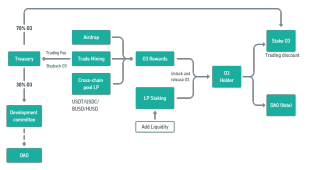
In the economic model of O3 Swap, there are three ways to obtain O3. First, users can get airdrops through early participation in product testing and community contributions. Second, they can get transaction mining rewards by using O3 Swap. Third, users can provide liquidity for the Hub (cross-chain pool) to obtain O3 rewards. When acquired in the three ways above, O3 is in lockout. Users are required to provide liquidity of O3 trading pairs to major DEXs to unlock O3 in their accounts. Unlocked O3 has three main benefits:
(1) Member rights: Mortgage O3 to obtain interest and transaction discounts distributed by the O3 Swap treasury.
(2) Community governance: Users can initiate proposals by staking O3 and participate in community governance through voting and other means.
(3) LP pledge: users can use O3 to synthesize liquid equity proof (LP), which can be used for unlocking and mining.
On the other hand, all transaction fees of O3 Swap transactions will be used to repurchase O3 on the open market on a regular basis, and distributed to O3 stakeholders and the development committee in proportion.
3. O3 Swap ecological role
(1) User: A consumer who uses O3 Swap for transactions.
(2) O3 holders: community members who hold O3 to participate in community governance and pledge with O3 to obtain related rights and interests.
(3) Liquidity providers: partners/users who provide liquidity to O3 Hub (cross-chain pool).
(4) Ministry of Finance: Responsible for regularly receiving, managing, distributing tokens and releasing financial data to the community.
(5) Development Committee: In the early stages, it consists of O3 Labs, community contributors, and representatives with a majority vote. At a later stage, this committee will be elected by the community.
4. Buy back
All income from the O3 Swap platform will be used to repurchase O3 on public exchanges and deposit it in the O3 exchange library for redistribution.
5. Pledge
O3 holders can participate in community governance by staking O3, and obtain transaction discounts and other member rights. According to the amount of pledge, the pledger can get a certain percentage of pledge rewards from the O3 Swap treasury.
The initial ratio defaults to 70%, which means that for each buyback or token bought back, 70% of O3 will be allocated to O3 stakers. The distribution ratio is determined by the later DAO proposal voting.
6. Transaction Mining
7. Yield Farming
After conducting O3 Swap transactions, users will receive O3 as a reward. According to the amount of O3 purchased each time, O3 will be distributed according to the initial default value of 1:1 for trade mining rewards. Rewards are issued and distributed depending on the block time period. The initial ratio defaults to 100%, which means that when each O3 is bought back, the system will release one O3 for trade mining. The distribution percentage is determined by the post-DAO proposal voting.
Users can generate LP tokens by staking single or multiple tokens to increase the liquidity of the O3 cross-chain pool. LP tokens represent the rights of liquidity providers to redeem their assets and receive O3 rewards from transaction fees, proportional to their contribution to the cross-chain pool. 100% of the transaction fees in cross-chain Swap will be allocated to liquidity providers, which means that the number of base tokens that can be redeemed for each LP token increases. When liquidity providers withdraw their liquidity, LP tokens are burned and they can get back their deposited token pairs.
8. Unlock O3
Locked O3:
Users can obtain locked O3 through initial platform airdrops, transaction mining, and liquidity mining (not yet participating in the full functionality of the O3 exchange).
Unlocked O3:
By providing liquidity on O3 trading pairs to major DEXs, users can participate in the full functionality of O3 Swap (see economic model). The steps to unlock are as follows:
l Step 1: Search for the O3 / USDT trading pair on Uniswap V2. Add liquidity to get UNI-LP tokens.
l Step 2: Go to "Vault" and pledge UNI-LP. Locked O3s will start converting to unlocked O3s. The maximum unlocking speed is 15,000 blocks (about 48 hours).
9. Ministry of Finance
The treasury is O3's revenue repository and is responsible for receiving, managing, distributing and regularly publishing financial data to the community. The income from O3 Swap will be used to regularly repurchase O3 on the open market and deposit it in the Treasury. In order to promote the development of O3 Exchange, in the first phase of the governance phase (Q1-Q2 2021), 70% of the revenue of the Ministry of Finance is allocated to O3 stakeholders to incentivize community contributions. 30% is allocated to the Development Committee.
10. Development Committee
The Development Committee is mainly responsible for promoting the development of the project and community building. In the early stages, it will be made up of O3 Labs, community contributors and representatives with a majority vote. In later stages it will be fully elected by the community.
11. Allocation Mechanism
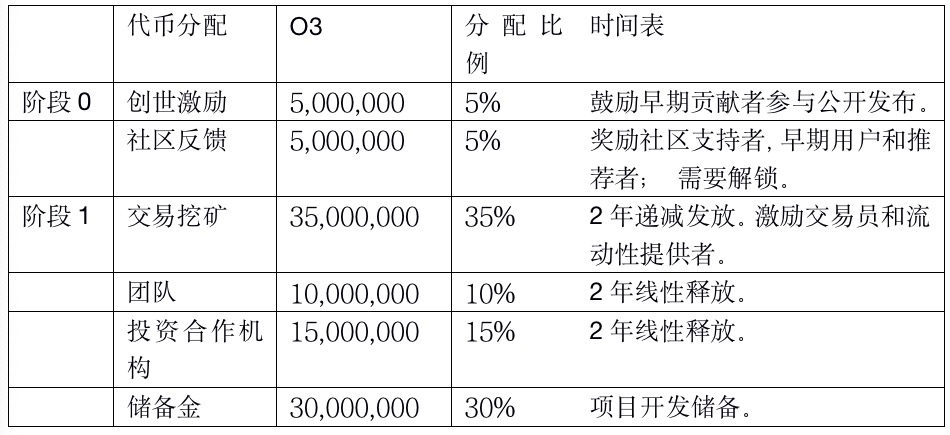
The total distribution limit of O3 is 100,000,000, which is divided into two distribution stages. The total number of phase 0 is 10,000,000, including the following genesis incentives and community feedback; the total amount of the first stage is 90,000,000.
4. Mining stage
(1) Ice Age: a total of 500,000 blocks (about 10 weeks)
Only on Ethereum mainnet.
l Cross-chain pool liquidity mining
1. Deposit USDT/BUSD/HUSD into the Hub (cross-chain stablecoin pool) to get USD - LP.
2. Go to "Vault". Holding USD - LP can get O3 rewards (need to unlock).
l O3 mining
1. Go to "Vault". Holding USD - LP can get O3 rewards (need to unlock).
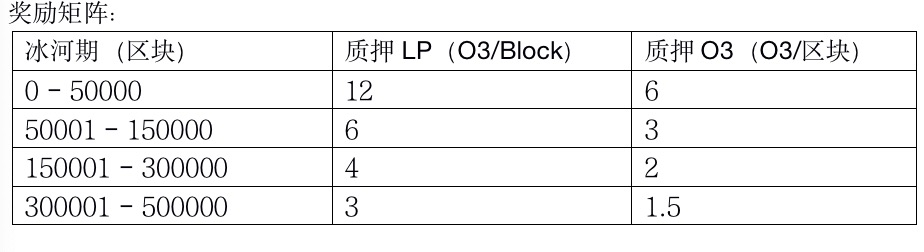
2. The staked O3 cannot be unstaked until the next mining period (Jurassic).
(2) Governance of the Jurassic: Parameters to be determined
① Support Ethereum, BSC, Neo and Huobi ECO Chain.
② Support transaction mining
③ Pledge O3 to get transaction discount
④ Start the repurchase mechanism.
5. Governance
1. 2021 Q1 - Q2:
O3 Swap is committed to promoting decentralized governance and creating an open source ecosystem where the community has full autonomy. Decentralized governance has three stages of development.
2. 2021 Q3 - Q4:
Issuing governance tokens and launching the first phase of the economic model.
3. 2022:
DAO version 2 is launched, and the development committee becomes DAO. Decentralized governance and decision-making fully organized by DAO
6. Summary
6. Summary
O3’s current staking yield is relatively high. In the process of liquidity mining, we face the following obvious risks:
1. The risk of O3 price fluctuations. Although staking mining can obtain income, a drop in price may lead to a decrease in income or even a loss of principal.
2. Obtaining O3 through pledge cannot be unlocked quickly. It is necessary to provide liquidity for the O3-USDT trading pair on uniswap. Only the LP that provides liquidity can unlock the O3 obtained through mining, and there is a speed limit for unlocking.
3. After O3 is pledged for mining, the pledged O3 cannot be released until the next mining period (Jurassic).