






Read an article to understand how the 0x protocol aggregates the decentralized liquidity of Layer 2 and Layer 1



This article is from The Way of DeFi, author Kyle, reproduced with authorization. Source: Messari
Liquidity sources are being dispersed across Ethereum Layer 2 scaling solutions and other Layer 1 networks. Aggregators must make trade-offs when choosing which L2s they will run on. The popular thesis that aggregators will make exchanges fungible remains unproven. Before then, aggregators had to build applications on L2 and other networks to attract the most exchange liquidity. These decisions create trade-offs, as aggregators may choose to forego liquidity sources on one chain in favor of another, such as forgoing rollup deployments in favor of high-growth sidechains. Fragmentation of the exchange market is likely to deepen until the interoperability infrastructure is fully developed.
The 0x project is great for decentralized liquidity. As a set of developer tools, 0x provides peer-to-peer liquidity capabilities for other Ethereum-based applications. Comparing 0x to a decentralized exchange (DEX) is a mistake. Unlike decentralized exchanges (DEXs), 0x breaks down liquidity by enabling trading of composable assets within any application. The core functionality of the project is the exchange API, which connects users and applications to liquidity sources through the most efficient means available. 0x acts like an aggregator as the 0x API connects order takers to DEXs. In addition to the API, 0x also provides its own community of market makers to fill 0x orders. 0x can connect order takers to its internal network of market makers, such as exchanges, when DEX costs are relatively high. The 0x protocol always seeks the lowest cost trade, so it subsidizes market maker costs with ZRX token rewards to keep its prices competitive with the most liquid exchanges. 0x uses DEX and aggregator functions to maintain a competitive asset market among all decentralized resources. A diverse liquidity network differentiates 0x from DEXs and aggregators, while the project's token economics give it a competitive advantage over both.
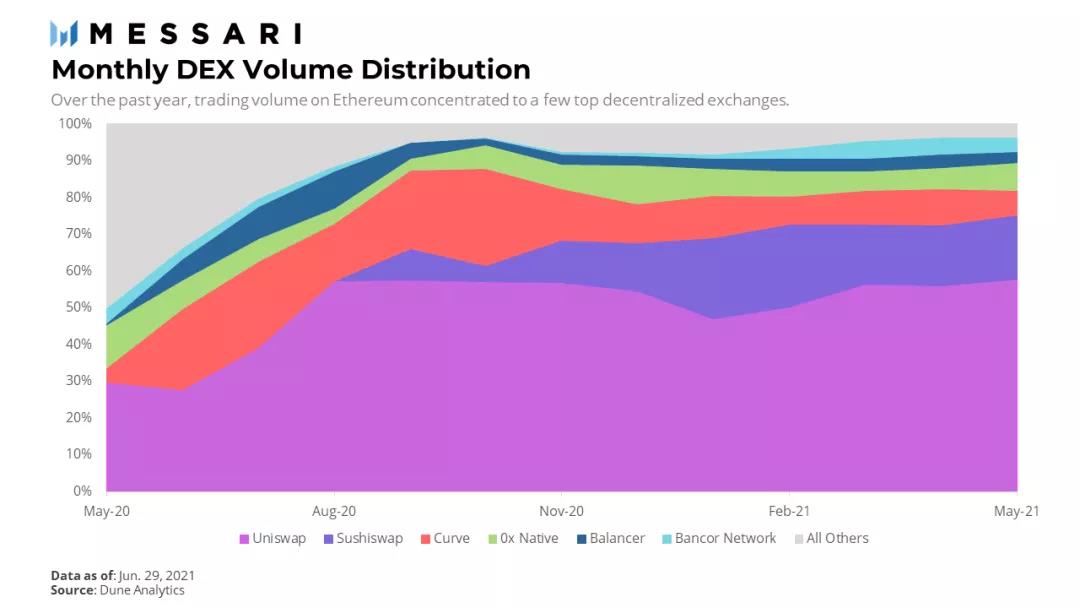
Uniswap and Sushiswap have dominated the DEX market with passive liquidity over the past year. These and other top DEXs pool asset supply from token holders seeking deposit income. The automated sales mechanism allows DEXs to seamlessly meet most market needs, however, 0x’s market share shows that nearly 7% of DEX transactions require active liquidity.
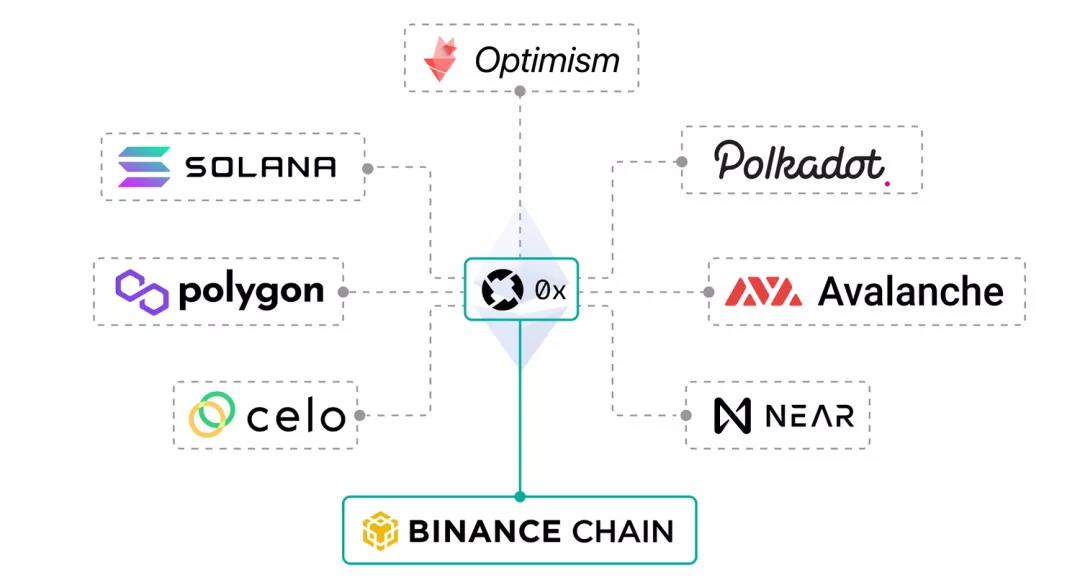
The latest 0x platform is uniquely positioned to benefit from liquid shards across L2. 0x v4 highlights their historical focus for market makers to maintain market competitiveness across any number of liquidity sources. As the market proliferates, they will try to acquire users by reducing costs. The platform's tool suite routes 0x orders through the 0x API to settle users at the lowest possible cost. The protocol rewards market makers for providing liquidity directly through 0x's native exchange infrastructure and ultimately attempts to beat DEX pricing. Through 0x, these market makers can provide all 0x API users or takers that make up the demand side of each market. The 0x API provides out-of-the-box liquidity sources for other applications to meet any number of user asset exchange needs. Currently, applications can be built on the 0x API to access the market supply within the network, be it Ethereum L1, L2 or Binance Smart Chain (BSC).
1 0x product
0x provides a set of tools for blockchain-native applications to directly match exchange orders at the lowest possible cost. The 0x protocol performs matches off-chain and then resolves them on-chain to reduce network usage and cost per transaction. 0x native volume includes all 0x orders from relayers, aggregators, and 0x market makers. 0x API transaction volume only includes exchange endpoints, takers, and demand-side origins. 0x API volume overlaps with 0x Native volume because 0x API orders have access to 0x Native liquidity sources. Matcha volume includes all orders completed on the web app. Because Matcha is built on top of the 0x API, transaction volume overlaps with 0x Native and 0x API transaction volume.
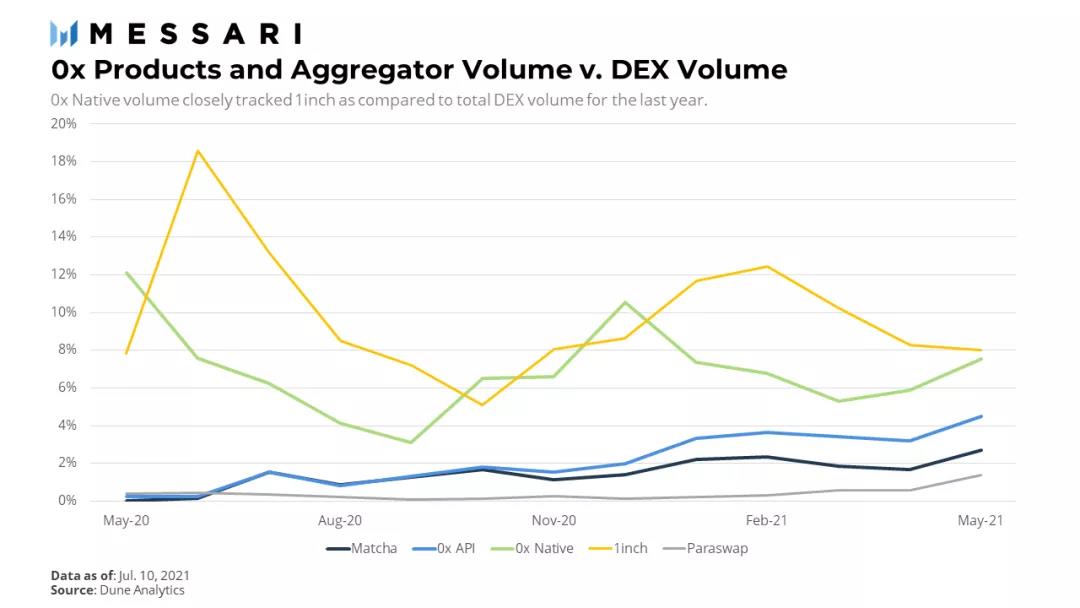
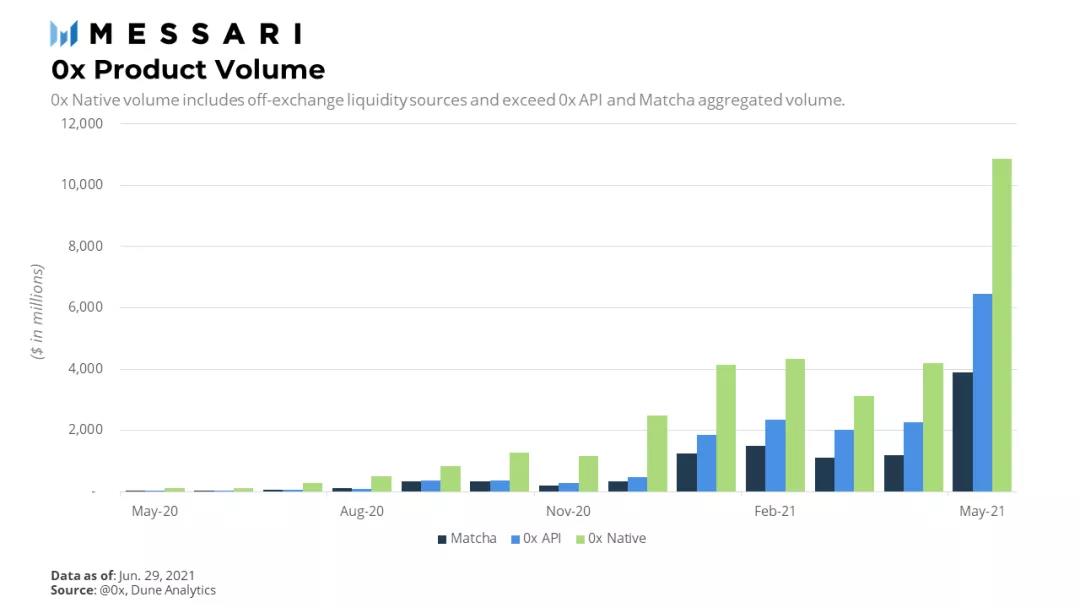 Product transaction volume over the past year shows that 0x Native resources provide most of the network's liquidity. 0x API volume includes Matcha volume because the aggregator is built on top of the 0x API. However, 0x API can aggregate DEX and 0x Native liquidity sources. Over the past year, 0x Native transaction volume surpassed 0x API transaction volume. Whether routed through apps like Zapper.fi and MetaMask, or directly accessing liquidity through proprietary trading operations, the 0x Network caters to more 0x protocol trade volume than any exchange available to 0x API users.
As an aggregator, Matcha gained market share but trailed the 1inch protocol throughout last year. On Ethereum, 1 inch dominates the total transaction volume. Since May 2020, 1inch has captured an average of 10% of all Ethereum DEX trading volume. This aggregator leader provides DeFi users with a vertically integrated one-stop trading interface. 1inch's mission is to obscure the origin of transactions by providing the easiest execution at the lowest cost. 1inch has effectively secured its market leadership by focusing on DEX aggregation.
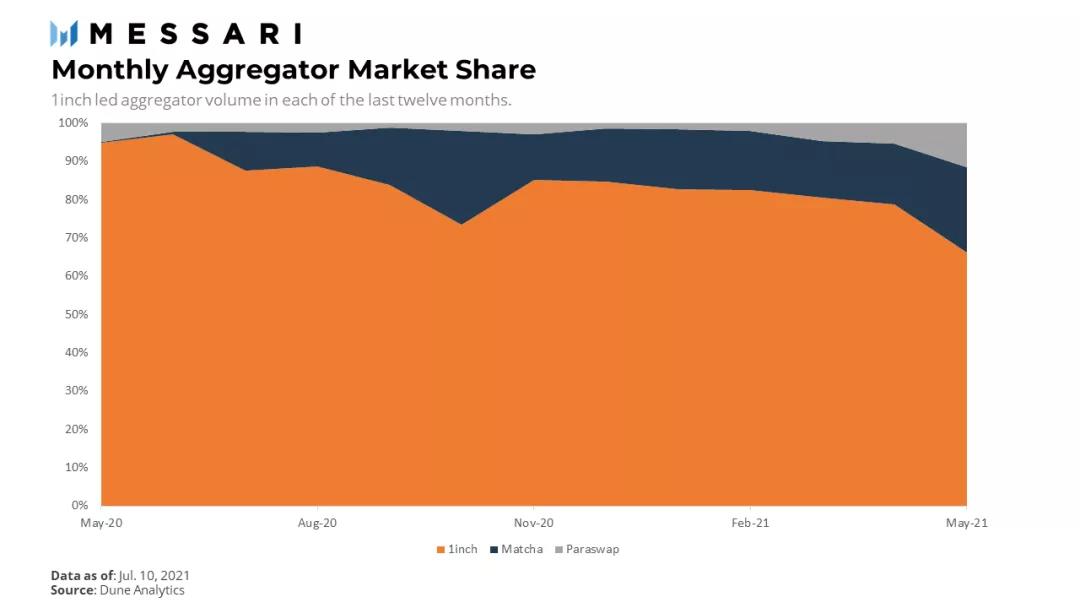
While Matcha is trying to compete with 1inch in the DEX aggregator race, 0x protocol is diversifying to drive trading volume and capture value as a liquidity aggregator. The 0x market maker network does not mainly or exclusively obtain liquidity from DEX, but provides a large amount of liquidity outside the DEX market. The 0x API routed 4% of all Ethereum L1 DEX volume in May 2021 and is also 1 inch behind for the year. In the same month, the 0x network nearly doubled that amount. On the 0x protocol, custom on-chain liquidity has surpassed aggregated on-chain liquidity in each of the past 12 months.
Composable application development tools provide the benefits of 0x. With 0x, application developers can outsource end-user asset exchange functions while remaining focused on the primary use of their applications. 0x market makers have access to diverse demand. Market makers can fill orders large and small by competing with the DEX liquidity aggregated by the 0x API. Applications built using 0x API or other exchange development tools provide users with competitive active and passive liquidity.
2 0x Token Economics
For 0x and other aggregators, off-chain order matching efficiency will primarily drive network value, with competition eventually compressing aggregation fees to zero. With aggregator and exchange capabilities, the 0x platform supports this principle. According to the 0x team, the 0x API routed nearly 4% of DEX transaction volume last year as it kept transaction costs low. Where DEXs offer passive liquidity, 0x offers an active network of market makers who own a significant portion of the DEX market share. Two features of the 0x protocol address fee compression, while the new initiative is poised to maintain the protocol’s strengths into the future.
0x market makers charge protocol fees as liquidity rebates. This rebate has four design goals to improve the 0x market making platform. First, protocol fees are designed to generate more revenue from arbitrage transactions than individual retail exchanges. Second, the fee structure is applied equally to small and large market makers to create an even playing field. Third, fees incentivize user ownership and governance participation. Only market makers can operate staking pools, and ZRX holders can participate in staking pools operated by market makers. Fourth, 0x aims to create an easy way for market makers to predict how liquidity fees will affect their bottom line.
The taker pays the 0x platform fee in proportion to the gas cost of the transaction. Fees are paid in ETH upon execution, so users only experience the cost once per transaction. Other transaction fee models can become expensive relative to low gas prices and can exacerbate high gas prices. 0x protocol fees are designed to be equally expensive regardless of gas price. Recently, the 0x protocol DAO voted to reduce their gas price multiplier as gas prices rose to all-time highs.
0x order fees are only generated by ZRX stakers in pools that must be run by 0x market makers. Market makers earn fees proportional to the liquidity they provide and their ZRX shares. Any excess fees go to 0x treasury for platform development.
Market makers can only increase their share of protocol fees by increasing transaction volume. The only way to increase trading volume is to beat the DEX price. Over the past three months, 0x protocol fees have only increased with transaction volume. At the same time, the amount of ZRX pledged has fluctuated, while the number has grown. The ratio of fees to ZRX value grows with the volume of the 0x protocol.
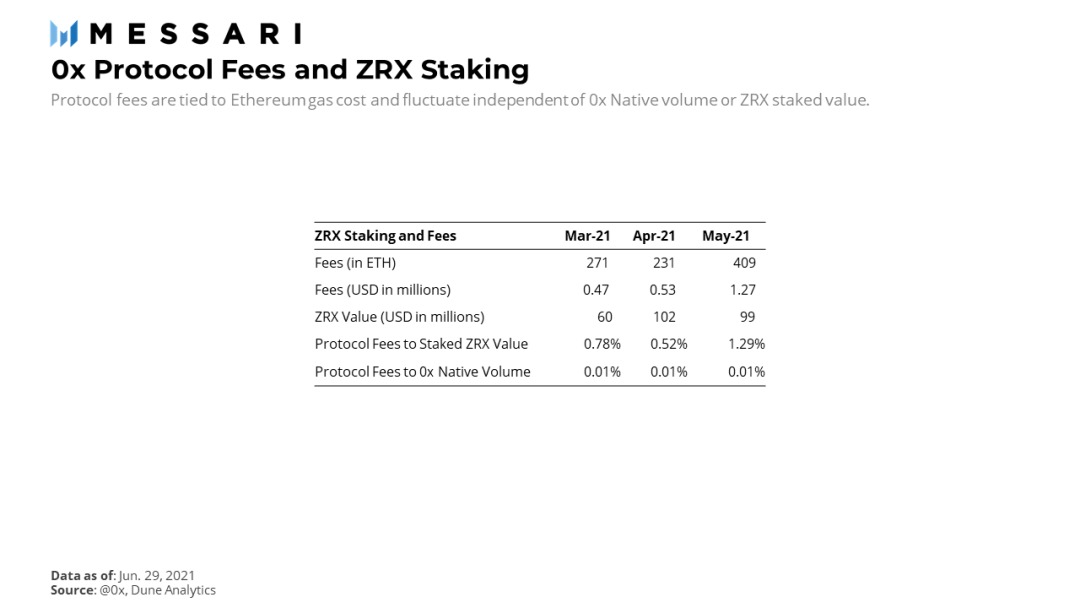
Rewards from the ZRX staking pool improve the 0x end-user experience. 0x protocol fees subsidize market makers to provide supply in line with DEX prices. Market makers earn more rewards when they satisfy more demand. Token holders can stake ZRX in successful market maker pools to passively earn income. Together, market makers and stakers maximize ZRX rewards by maximizing their fee-to-stake ratio. Therefore, market makers have to generate more volume to increase fees as ZRX staking increases. More ZRX rewards enable market makers to maintain competitive prices to increase volume, especially as DEX pricing slowly adapts to market conditions. Subsidizing 0x market makers ensures that end users can get their orders filled at the best possible price. The 0x protocol uses ZRX liquidity rebates to align market maker incentives with end user interests.
3 Conclusion
0x v4 aims to keep up with market makers and DEXs as the protocol is portable to many blockchain networks. When developers want to build exchange functionality into Web3 games or new digital asset wallets, they take 0x with them. As Matcha demonstrates, it is possible to build entire exchange aggregator applications on top of 0x. The 0x project is designed for DeFi builders.
Market makers and application developers are the target users of 0x, and 0x token economics incentivizes them to optimize the end-user experience. The protocol's fees act as liquidity rebates to reward market makers for volume growth. Fees offset the competitive pricing market makers have to offer to compete with 0x API-aggregated DEXs. The competition between market makers and DEXs gives 0x end users the advantages of both passive and active liquidity. Few other exchange protocols offer this best of both worlds.





