How will blockchain + game asset ownership activate the development of the game economy?


There are approximately 2.5 billion gamers in the world. Game developers generate $160 billion a year in revenue from games made for gamers. That's bigger than the global music and film industries combined. Whereas traditional games effectively license digital assets to players, the blockchain game economy allows true ownership of digital goods because a digital good is an asset whose link to its owner is written into an immutable blockchain. Ownership confers property rights when players and developers have true ownership of assets. The unique capabilities of blockchain technology can aid in the granting and enforcement of property rights and create a trustless system.
free game
"free game"The rise of the industry changed the industry. According to Nielsen firm Subdata, four-fifths of gaming revenue is now generated by free-to-play business models, thanks to hit titles like Epic Games' Fordnite, which in 2019 sold its battle pass (a quarterly subscription). At one point, allowing special access to certain game content) and V-bucks, which allow players to use in-game currency to buy skins for their characters.
The success of Fordnite also shows the potential of the free-to-play model. The staggering $1.8 billion in revenue is actually down 25% from 2018's revenue, when the game made $2.4 billion. Revenue and engagement data from early 2020 suggest that interest in gaming may be waning further. Free-to-play games rely on large numbers of players to continually purchase new content and virtual goods, which is harder than ever to maintain in an era of unprecedented competition in an increasingly crowded marketplace. Virtual goods represent irrevocable purchases, cannot be traded or gifted to other players, and cannot be converted back to real-world currency.
digital assets"digital assets") ensure that they offer the potential for real-world value in purchased items, while allowing players to actually own what they buy. Digital assets have an independent relationship with the game they are in, because their existence, characteristics, and ownership status are all recorded by the blockchain. This means that players can delete the game, but keep their digital assets in the game. More critically, this means players can freely buy, sell, and trade these items, including actual fiat currency both within the game and on third-party platforms, opening up entirely new economic opportunities for games.
The Evolution of Game Asset Ownership
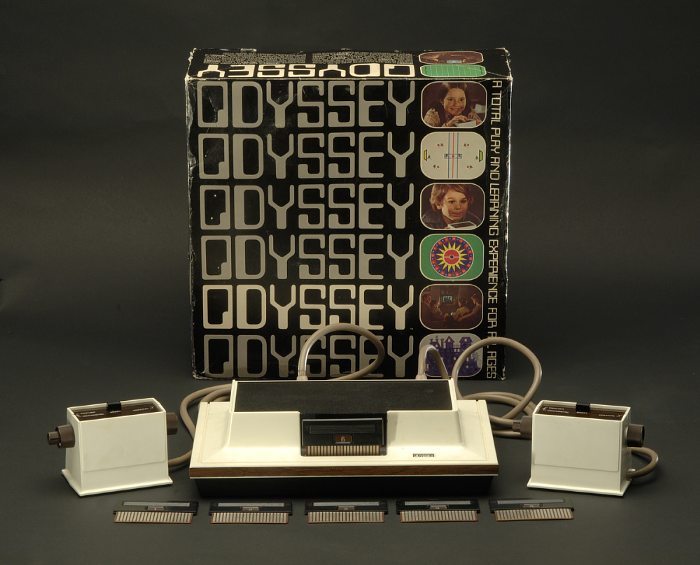
In 1972, the first gaming console was released to the public: the Magnavox Odyssey. It's a simple, basic device that can only generate basic black and white shapes—three square dots and a line of varying heights—and no sound. (The Odyssey's "playground" consists of plastic overlays that are actually glued to the surface of the TV screen to define the playing area.) The Odyssey's cartridges contain no actual components—they're just jumper packs that connect the wires to the system's existing diodes With different modes, the rules of the game are changed. The system's inherent limitations led manufacturers to fall back to "dedicated" consoles that could only play one hard-coded type of game (like Pong) for the next five years.
In 1977, however, came the personal computer revolution, bringing with it new technologies and the expectation that electronic devices should have at least basic programmability and expandability. That same year, the Fairchild Channel F became the first game console to use a cartridge containing a ROM chip encoded with game data, followed by the Atari 2600 in 1978—the game industry's breakthrough hit. Until 1988, when NEC PC-Engine introduced an add-on peripheral that supported CD-ROMs, cassettes became the primary mechanism for distributing games. In 1986, Japan's Super Famicom gave users the option of accepting a cartridge that saved the game, or using a disc that was cheap and easy to store.
But with the launch of the Sega Game Channel in 1994, Sega pointed the way to the future of digitally distributed games. Ten years later, Valve launched the game platform Steam for computer users, laying the foundation for digital distribution of games. Until the advent of mobile app stores in 2007 and 2008, digital game distribution finally trumped disc games. As of 2018, 83% of games were sold digitally, while 17% were sold on physical media.
Digital distribution of games means that users can buy and play games on demand without having to go to game retailers or wait for discs to arrive in the mail. This method greatly facilitates users, enables users to have more choices, and also stimulates competition among developers.
For gamers, the shift to digital means a major change in their relationship with games and with developers. The invisibility of digital downloads emphasizes that players have no ownership over the games they play or any content in them: players only have a personal license to access these games and content (understandable as game accounts); cannot be sold).
Since there's no legal way to transfer items already purchased in-game, spending money on virtual items is, in a sense, a one-way street that can only be bought but not sold. In order to bypass these non-transferable restrictions on virtual goods, some players usually transfer them through the "gray market" on social media or manipulate them by third-party market platforms. There are times when trading in this manner can turn out badly. These platforms have hidden dangers that can be exploited by scammers and hackers, putting players at risk of assets, data, and identity theft.
Players obviously want to be able to buy, sell and trade digital goods. But developers are not yet equipped to build a trustworthy, reliable, and secure digital asset exchange system.
How can developers make money in the world of digital assets?
As mentioned above, in traditional free-to-play games virtual goods are one-way: players buy virtual goods from the game developer and can only use them within the game. These items typically have a specific function to help players level up in the game, or add visual appeal to other game assets, such as game character avatars, residences, or the tools and equipment they use.
In some games, there is indeed a market feature where players can trade, and the developer will usually take a fee from the value of the trade. For example, the game platform Steam, which allows players to sell items from certain games (such as guns with skins in CS: GO) in order to obtain Steam points (which can only be used within the platform). In each transaction, 30% of the cash value corresponding to the Steam points earned by the player will be deducted as a commission for the platform.
However, this ultimately has an unavoidable consequence: usually in games only a small percentage of players (the whales) contribute most of the revenue generated by these in-game purchases. This leaves developers with no choice but to cater to this small group of players by creating new content, similar merchandise. Satisfying the needs of a minority of players without alienating the majority is nearly impossible; thus, free-to-play games can become "pay to win", in which case those who can afford to pay for additional and enhanced functioning have an overwhelming advantage over those who cannot or do not. (It can be simply understood that the more krypton gold, the stronger the game character)
In contrast, in a game world with digital property rights, players have real and transparent rights and interests in the item economy. Not only can they buy items, but they can earn and resell them, generating income that allows them to buy more and better items. Some players may succeed by spending money; others, may purchase items by spending time observing their prices and supply and demand to make the prices of those items appear more reasonable. At the same time, the data of product supply and demand can provide developers with what kind of products players want, so that they can produce more products according to consumers' tastes.
All of this requires a system that is completely trustless - blockchain technology works by creating an immutable, transparent record of every transaction. This makes it possible for the ownership of game digital assets to be owned by users.
For developers, this distrust means an opportunity to participate in the growth of the game economy, rather than just taking a cut of every transaction.
By enabling true ownership of in-game items, developers can empower players and incentivize sustainable in-game economic growth without losing control of how their games operate.
Blockchain Tokenized Assets Enable Innovation
The current one-way sale of virtual goods is essentially a misplaced command economy that is difficult to manage properly; without the strong signals that the market can provide, how can game developers keep up with player demand? How to provide players with the right merchandise to meet changing needs? This is a daunting challenge.
By adopting tokenized assets, game developers can adopt a better economic model to solve these challenges: we call it community economics. The result is a number of benefits:
The interests of players and developers are aligned: in-game peer-to-peer marketplaces enable secure, trustless transfer of assets and value, reducing the need for third-party marketplaces (although items on the blockchain can also be transferred on third-party platforms). Players can earn income by selling in-game assets, and developers can benefit from each transaction by sharing, creating a "win-win" scenario where both players and developers are interested in increasing the turnover rate of items, thereby expanding the game economy.
Creating value for virtual goods: Players' motivation for purchasing virtual goods has shifted from pure expenditure (currently worth more than $100 billion per year) to asset investment. The true value of virtual goods will depend on participants reselling assets, investing equity in new projects, and developing entrepreneurial capabilities—for example, item leasing, a service economy where players earn items for other players, and even banks and businesses. This will greatly promote the development of the overall game economy.
Asset Provenance Eliminates the Need for "Trust": Since the asset's history, authenticity, and ownership status are preserved by the blockchain, players can be assured of the value and integrity of their assets based on blockchain proofs. The greater the trust in a system, the greater the economic growth built upon it.
Smart contracts allow new incentive structures: developers can design novel incentive structures to motivate players and support the development of the gaming community.
Blockchain governance allows players to have governance rights in the game: the game can incorporate a governance mechanism that allows players to vote in the game and influence the future development direction of the game, which also enhances the player's trust in the blockchain system and promotes the game and its economic development.
What exactly are tokenized assets?
Tokenized assets fall into a variety of categories, often defined by two characteristics: fungibility and divisibility.
Fungibility refers to assets that can be easily exchanged for each other. For example, in the real world, one pound of silver is equal to another pound of silver (as long as it is of the same quality), which can be subdivided and traded accordingly. Like silver, coins are fungible so that one coin can be freely exchanged for another without any real difference in the characteristics of the coins. In contrast, irreplaceability means that this asset is unique, and one pound of gold ≠ one pound of silver.
Divisibility is a property of assets that defines whether they can be divided into smaller asset units that can also be exchanged for goods of different value. Currencies are usually divisible. For example, a 10-yuan bill can be split into two 5-yuan bills, or ten 1-yuan bills. In the same way, 1 Bitcoin can be divided into decimals (ie 0.0005 Bitcoin). But in-game virtual weapons and other items are usually inseparable.
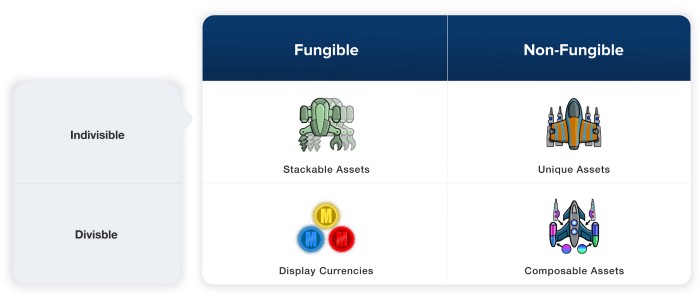
These categories simply define how tokenized assets work within the game. Yet there will be many more iterations within these categories, offering almost limitless possibilities for innovation: interactive NFTs, “virtual land” assets as real estate (e.g. Decentraland), etc. As tokenized assets become more complex, they will enable the rapid development of game economies.
Ultimately it is inevitable that, over time, "digital assets" will become assets and the "game economy" will become part of our real world economy.