






What is the rate of return of the 7 small coins invested by Grayscale, and how do large institutions arbitrage?


Hello, here is the 8-minute blockchain. Today we will continue with yesterday’s program. Have the other 7 mainstream small currencies invested by Grayscale lost money?
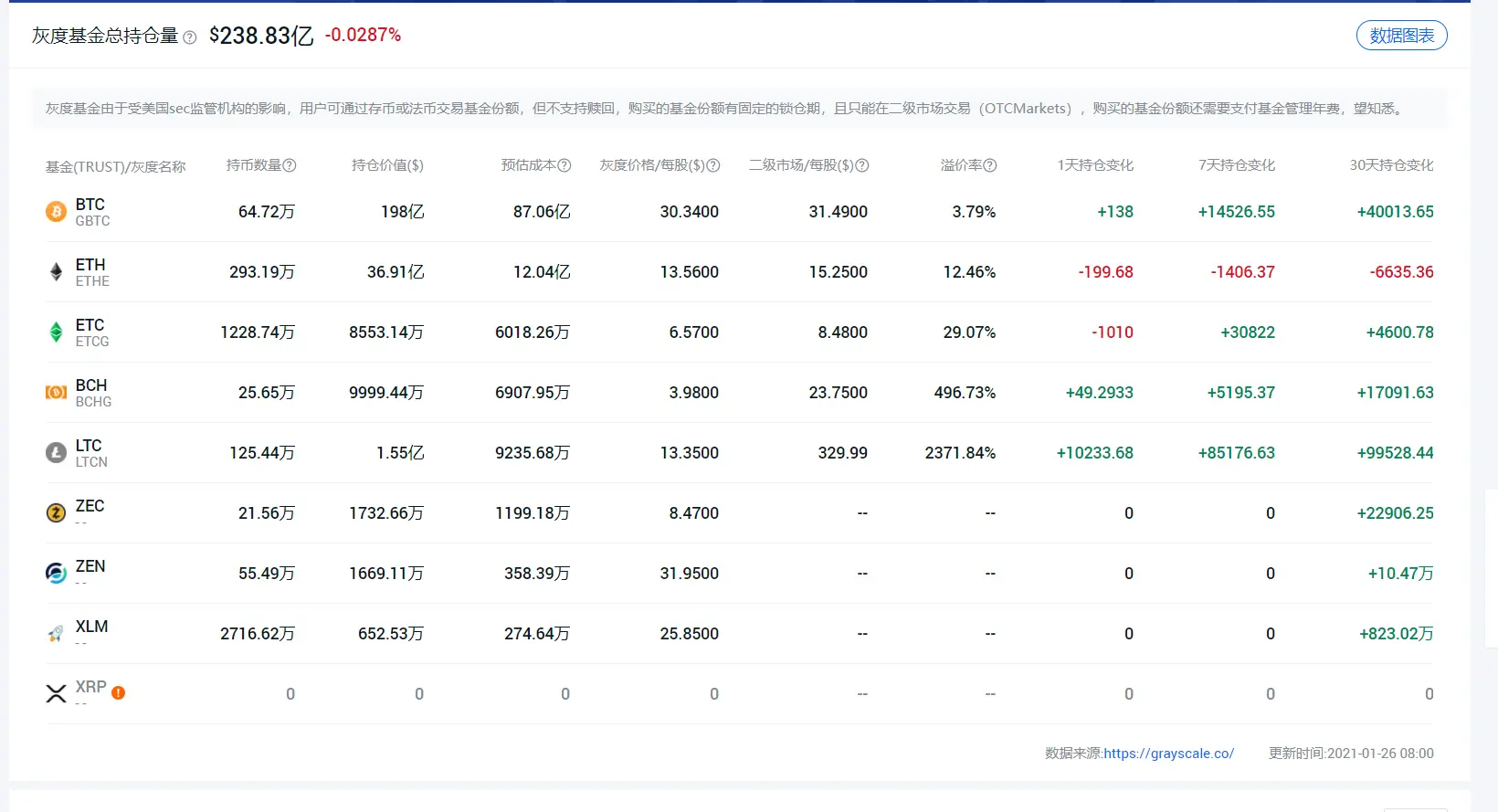
You open the first picture of the program manuscript to take a look. When you look at it, you'd better click on this picture, open the original picture and enlarge it, and take a closer look, because the information contained in this picture is very rich. We Interpret this picture in detail from top to bottom. First, look at the total holdings of the grayscale fund at the top, which is 24.369 billion US dollars. The data is the total market value of the coins held by grayscale as of January 26, 2021 .
The next line is to introduce the basic operation mode of Grayscale, saying that due to the influence of the US sec regulatory agency, users of Grayscale Fund can trade fund shares by depositing currency or fiat currency, but redemption is not supported, and the purchased fund shares have a fixed limit. The lock-up period, and can only be traded in the secondary market (OTCMarkets), the purchased fund shares also need to pay the annual fund management fee, hope to know that I will ask you a question after hearing this, that is, what do you think is Are there more people depositing coins to obtain fund shares or are there more shares obtained through legal currency purchases?
If you are an old leek in the currency circle, you will definitely say that there must be a lot of shares purchased through fiat currency. If I already have bitcoins in my hand, who will hand over the coins to Grayscale, because it is the first time to give it to Grayscale. First, you have to lock me for 6 months, and you have to pay an annual management fee of 2%. Who would be so stupid? In fact, it will not be true. The real situation is that at least 50% of the bitcoin shares are obtained through deposits. I found this specific ratio. In the second half of 2019, 75% of the shares were deposits. 25% is bought with legal tender.
That is, the user gives the bitcoin to Grayscale for exchange, and then exchanges it for a share of GBTC. So as for why they changed like this, you will have the answer after listening to this episode.
Let's continue to look at this picture. The next step is the names and holdings of each currency that Grayscale invests in.
The value of the position: and the estimated cost. Among them, the position value is the number of bitcoins held, and multiplied by the unit price is the total value of the existing trust products.
The calculation rule of the estimated holding cost is as follows: the number of coins that Grayscale increased on the day * the price of the currency on the day of the increase = the holding cost of the day, and the holding costs of all the holding dates are accumulated, which is the total historical holding cost.
We can see that the holding cost of all the currencies purchased by Grayscale in this item is greater than the estimated cost. Because Grayscale does not buy coins in one go, but buys them in batches, and buys the entire investment cycle. Most of the coins are bought directly from the previous wave of bull market to this wave of bull market of.
All in all, Grayscale is not only the largest brand-name bookmaker in this market, but also the largest user of fixed investment in this market, especially for fixed investment in Bitcoin. Since 2013, it has been investing for 8 years.
Ok, let's look at this picture next, the indicator on the right side of the estimated cost: grayscale price:
This data refers to the price of the stock corresponding to Grayscale’s currency in the primary market. For example, today’s price is $30 a share. If you have a bitcoin, go to Grayscale to buy GBTC stocks in the primary market. , when the price of a bitcoin is 30,000 US dollars, it can be exchanged for 1,000 gbtc.
The next indicator is: the price of the secondary market is 31.49, which is the price of the fund share of each currency product in the secondary market in the form of stocks.
The subsequent data is the premium rate, which is (secondary market price-gray price)/gray price*100, and today’s premium rate is 3.79%. The following data is the change of 1 day, the change of 7 days and the change of 30 days. We often say in the program that Grayscale has increased its holdings by 138 coins. We look at this data. The increase in holdings in 7 days is 14,562 coins. The increase in holdings of 40,000 bitcoins in the last 30 days is also the same.
In fact, the increase in the number of bitcoins held by Grayscale does not mean that Grayscale has bought so many bitcoins in the secondary market. It is very likely that there are large capital or institutions that exchange bitcoins for GBTC in the primary market. stock, just handed over Bitcoin to Grayscale for management.
Then, this brings up the question, why doesn’t this institution or the qualified investors in the United States keep the bitcoins themselves, instead of handing them over to Grayscale for management?
The reason for this is actually also in this picture, because the price of Grayscale’s primary market is different from that of the secondary market, and there is naturally room for arbitrage at different prices, so how to arbitrage?
There are many ways of arbitrage, such as cash loan arbitrage, physical loan arbitrage, share loan arbitrage and lock-in premium arbitrage: I will only talk about two relatively simple ones today. The first is cash loan arbitrage.
Investors buy GBTC shares with cash or Bitcoin, and sell them in the secondary market after the 6-month lock-up period. The risk of this method is greatly affected by the price drop of Bitcoin. Only when the price of GBTC is higher than the initial cost can it be profitable.
Does it sound very simple, just exchange btc or US dollars for gbtc and then wait for half a year to sell in the secondary market to make money, and it is possible to earn double money, the first is the appreciation of bitcoin itself Money, the second is the premium money in the secondary market. For example, the premium of gbtc in the secondary market today is 3.79%. If an institution repays 100 bitcoins half a year ago, it can be exchanged for 103.79 bitcoins in half a year. , the annualized rate is as high as 7.58%. Even after deducting the 2% management fee, there is still a 5.58% annualized currency-based return, which is already a considerable return for large institutions.
And the actual income is much higher than this income.
In the past five years, the average premium of GBTC has been 38%, and the highest price has reached 132%. The arbitrage space is very considerable.
In other words, if you have been using this method to arbitrage in the past 5 years, you can obtain an average currency-based annualized return of more than 35%, which is enough to attract all institutional investors around the world.
The second way of arbitrage is to borrow bitcoins for arbitrage, which is to mortgage my US dollars, and then lend a large amount of bitcoins, and then hand them over to Grayscale to exchange them for GBTC. This has advantages. For example, I Mortgaged 3 million dollars on compound and lent out 80 bitcoins. The loan rate of this platform is 80%, and the annualized interest rate of borrowing bitcoins is 4.63%.
Within half a year after borrowing the currency, there are only three results. If the currency rises, the currency will either fall, or it will not rise or fall. Let's talk about the currency drop first.
If the bitcoin plummets after I receive the currency, for example, the price of the currency falls from today's 30,000 US dollars to 15,000 US dollars, then I will not lose money. I only need to buy 80 bitcoins at a low level and pay an annualized 4.76 % interest will do. In this way, it is much better for large capital to lose 4.76% than to buy coins directly.
Let’s talk about the situation that the currency is rising or not rising or falling. When the currency price rises, the secondary market of Grayscale will definitely have a high premium. Let’s calculate it based on the average premium of 38% in five years. If he borrowed 100 coins at the beginning You can get a 138% return in the secondary market, deduct 2% of the management fee, and then deduct 4.63% of the interest on the loan, and still have a return of more than 30%.
If the currency price does not rise or fall, there is actually a premium in the secondary market, and institutional investors only need this premium to exceed 4.75% on average to achieve breakeven.
Looking at it together, the institution is equivalent to taking the risk of a loss of 4.76% and earning more than 30% of the profit. Such an investment is undoubtedly a very cost-effective investment.
It is also the favorite investment of institutions and qualified investors, which is the specific reason why Grayscale has been increasing its holdings of Bitcoin recently, because there is such a huge arbitrage space in the middle.
So, will this arbitrage opportunity continue? Will Grayscale suddenly stop playing one day? Hope to write your answer in the comment area.





