Editor's Note: This article comes fromBlocklike(ID:iblocklike), reprinted by Odaily with authorization.
Editor's Note: This article comes from
, reprinted by Odaily with authorization.
Openfinance, the first U.S. digital securities (STO) trading platform, has made new progress.
Recently, INX, an American digital asset trading platform, finalized the acquisition terms for Openfinance. INX will acquire Openfinance's broker-dealer and ATS business, including its system, listed and traded digital assets, customer base, and licenses.
The ATS license held by Openfinance enables the platform to provide digital alternative asset trading services nationwide in the United States under the supervision of alternative assets.
If you look back at the end of 2018, you can see that that period coincided with the popularity of the STO concept, and compliant issuance and trading methods have attracted widespread attention at home and abroad. Subsequently, the first-mover advantage of Openfinance was gradually revealed, and an earlier batch of digital securities issued in compliance with regulations began to be listed and traded on the platform.
After nearly 3 years of operation, the terms of Openfinance's acquisition have finally been finalized. This acquisition may bring a new stage of development to Openfinance and the ST ecosystem.
secondary title
Openfinance, the leading STO exchange
For a long time, in the continuous exploration of the relationship between fiat currency and cryptocurrency, compliance has always been a key area of focus for various market participants.
The continuous entry of traditional financial institutions has also shown the market a great migration of the digital system. Since the United States was the first to establish a regulatory framework in the field of digital currency, a number of compliant digital securities ecosystems including Openfinance have gradually been established in the United States.
Gu Yanxi, founder of DAEX, blockchain and encrypted digital asset researcher, roughly divides digital asset transactions in the United States into two categories:
Another type of trading platform is a security token (digital securities) trading platform. These trading platforms have been present in the United States since 2018 and hold an ATS license in the Broker-Dealer category. Based on these licenses, they can provide digital alternative asset trading services across the United States in accordance with the relevant regulatory requirements for alternative assets. Such alternative assets include real estate-based interests and shares in private equity funds. These trading platforms are based on distributed ledger technology. Such trading platforms use the US dollar as the medium of exchange.
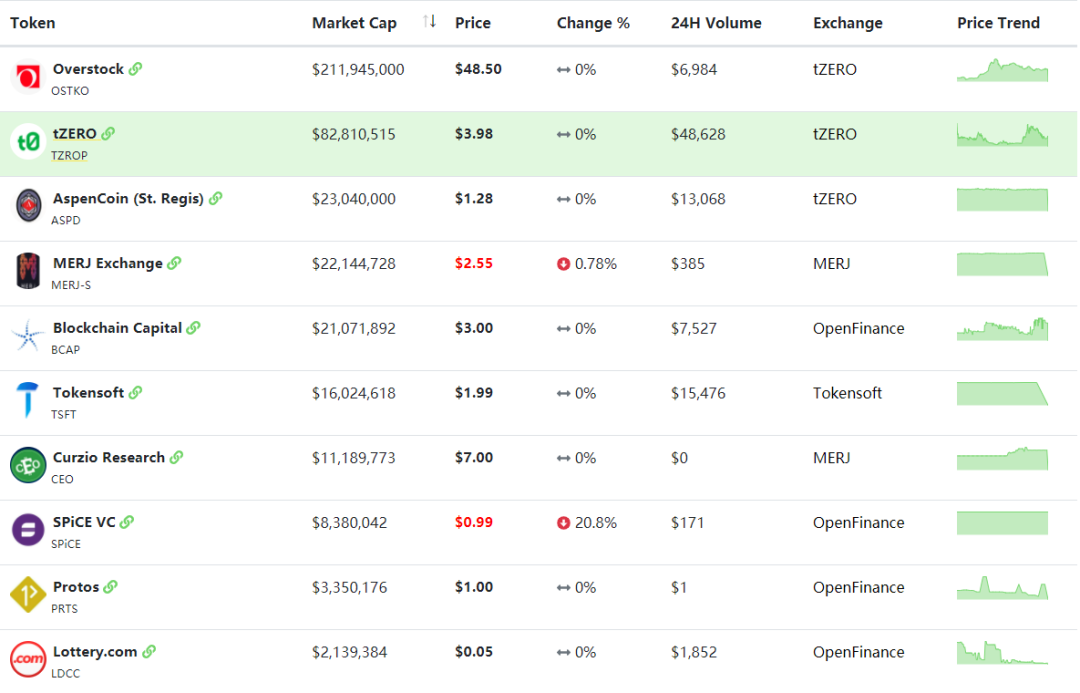
Openfinance is one such trading platform.
(Some tradable digital securities displayed on the digital securities data platform stomarket.com)Since "compliance" is one of the most important links in STO, for a long time, Openfinance also needs to communicate with Wall Street institutions, blockchain communities, and US regulators.In the past few years, companies that have been listed and traded on Openfinance include well-known venture capital institutions Blockchain Capital in the field of blockchain technology, Spice VC, the world's first fully compliant and tokenized venture capital fund, and Internet gaming platforms Lottery.com, Digital Securities Fund 22x Fund and many more.
OFN's "open finance" encounters some difficultiesFrom the perspective of Openfinance's development trajectory, in its implementation of the vision of "open finance", the first batch of compliant ST trading institutions also encountered some more realistic situations.The U.S. Securities and Exchange Commission (SEC) has long been committed to cracking down on fraudulent and non-compliant ICOs and developing and implementing relevant standards in the industry. After digital securities are considered more legal than unregulated tokens, the audit of compliance by trading platforms is even more important.Faced with many problems in compliance, verification, KYC process and AML process, how the compliance platform efficiently handles these problems has become an important point of being able to introduce a large number of investors and revitalize market liquidity.After 2018, the entire digital currency market has ushered in a low tide period, and the market trading volume is relatively flat. This may not be the best period for the first batch of compliant digital securities issuers who have just started listing and trading.At the SEC's regulatory level, the regulatory policies for STOs have also been relaxed in a small range. In March 2020, the US SEC voted to propose amendments to the rules for exempt securities issuance, generally increasing the upper limit of issuance and secondary market sales under various terms, and relaxing the restrictions on qualified investors. For example, for the terms of Reg A, the upper limit of secondary sales is increased from US$15 million to US$22.5 million, and for the terms of crowdfunding of Reg CF with a large number of applications, the upper limit of issuance is also increased from US$1.07 million to US$5 million.Still, market volume for STOs is still relatively early days. The data shows that as of December 2020, among the more than 300 registered issuers that conform to the ST concept, the total market value is only about 374 million US dollars, and the monthly transaction volume in December is only about 2.6954 million US dollars.Gu Yanxi also publicly mentioned: "Due to the restrictions on the trading of alternative assets by the existing regulatory system in the United States, the development of this business is very slow."On the other hand, due to the ambiguity of the U.S. regulatory framework for digital asset transactions, even if many asset issuers have registered the relevant terms with the SEC, they may not necessarily choose a full-fledged exchange in the final stage of listing and trading. Digital securities trading platform.In early 2020, some project parties have directly traded some ST-concept tokens on Uniswap, and some issuers still insist on choosing digital currency exchanges in the encrypted field.
(Some small-issued STs choose to trade through uniswap)In May 2020, an Openfinance announcement announced that non-renewed digital securities would be delisted from the platform and trading suspended. The reason, Tobin McComas, Openfinance's revenue director, said frankly that the cost of digital securities transactions has exceeded the revenue they bring in transactions and listings.It is worth mentioning that due to the technical advantages of the digital securities themselves, even if they are offline from the platform, these digital securities will not be lost, and can still be transferred to other trading platforms, such as tZERO, Uniswap, istoxExchange, etc. Therefore, the event did not bring too much panic to the entire market.Of course, this advantage is temporarily unable to restore the decline of digital securities trading platforms. Openfinance, which is at the forefront, may be moving a little too fast.
INX acquires Openfinance, the next step for STO exchangesOn January 19, INX announced that it has reached a final agreement to acquire Openfinance, which means that it is only a short step away from regulatory approval for its acquisition of Openfinance. Post-acquisition, INX will also ensure continued operations and services for the client base listed and traded on Openfinance.INX is headquartered in Gibraltar, but the majority of its operations are based in the United States. According to public information, INX's vision is to become a compliant exchange for cryptocurrencies, digital securities and derivatives. And Openfinance can just become an indispensable part of its territory.The trading platform is equally obsessed with digital securities. In August 2020, the US SEC announced that INX has been approved and launched that month. INX will issue up to 130 million INX security tokens in the form of an IPO. INX will set the issue price at $0.90 per token. The minimum investment is $1000. This has become a special case in the issuance of digital securities.And INX's ambitions are not limited to the United States. Only about 2 months after listing in the United States, INX once again announced that it has applied to list its digital securities INX on the Canadian Stock Exchange (CSE).At present, on the INX platform, we can see very interesting digital securities based on physical assets issued in compliance, such as the diamond-based digital tangible asset "Diamond Standard Token" DIAM; SolidBlock, a digital security for a real estate "suit" in Haven; or Wave, a digital fund based on a year-round production inventory of Kentucky bourbon whiskey.










