






Roundtable Forum: Discussion on the Open Financial World | 2020 New District Potential


Introduction
Editor | Hao Fangzhou
Produced | Odaily
Introduction
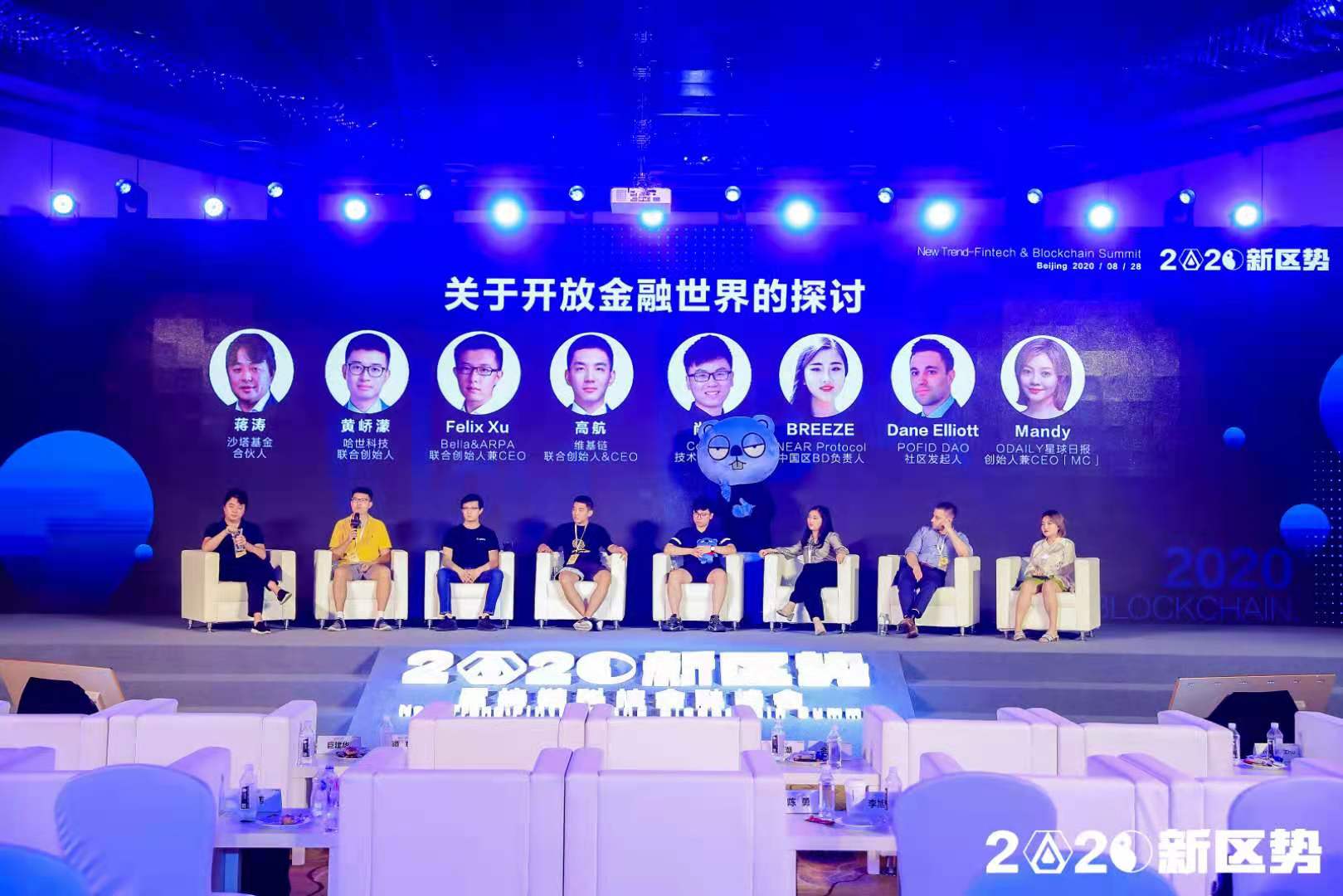
On August 28, the "2020 New District Potential Blockchain Technology Finance Summit" was held in Beijing.
This summit is co-hosted by Huobi Group, 36kr and Odaily, sponsored by Behelix & HBTC, strategically sponsored by ChainUP, specially sponsored by PayPal Finance, Conflux, BitUniverse, WaykiChain, XnMatrix, Hashi Co-sponsored by Technology, Mixpay, COCOS, and Shanghai Diyi.
Many authoritative experts and professors from financial institutions such as funds, securities, banks, and industry leaders gathered here to share new information on financial technology and explore the future potential of blockchain. (Link to the live broadcast of the summit:https://play.yunxi.tv/pages/27c9b4494d09487c8e9c9866e38895e8#/)
The second roundtable forum in the afternoon, with the theme of "Discussion on the Open Financial World", was hosted by Odaily founder and CEO Mandy Wang Mengdie, and 7 guests were invited to participate in the discussion, namely: Shata Fund partner Jiang Tao, ARPA & Bella Protocol Co-Founder and CEO Felix Xu, Conflux Technology and Business Director Shang Shu, WaykiChain Co-Founder & CEO Gao Hang, POFID DAO Community Sponsor Dane Elliott, Hashi Technology Co-Founder Huang Qiaomeng, NEAR Protocol China BD Director BREEZE .
Aiming at the development prospects of DeFi, liquidity mining, and future popular tracks and other issues, the participants expressed their unique insights:
Dane Elliott: This wave of DeFi is caused by liquidity mining, but liquidity mining is only a very small aspect of the DeFi ecosystem. In the future, liquidity mining cannot fully stimulate the potential of DeFi. Just like liquidity trading is only a small aspect of traditional finance. Compared to the crypto world, the real world has more algorithm-driven complex solutions proposed for liquidity problems.
Gao Hang: Liquidity mining is just icing on the cake, an incentive, not the essence of business. We need to look at the real value of DeFi and see if it solves business problems: one is to reduce costs and reduce the existence of middlemen; the other is to improve business efficiency, such as Uniswap providing trading scenarios for long-tail tokens; the third is to change roles, such as 100 USD can also be a liquidity provider.
BREEZE: There must be bubbles in DeFi, but the existence of bubbles is not necessarily a bad thing. For example, the burst of the "tulip bubble" laid the foundation for modern finance. When the tide recedes, only truly powerful companies can survive and change the industry.
Huang Qiaomeng: The threshold for DeFi projects is very high. Although foreign teams have a geek spirit, they do not have the accumulation of user experience; Chinese teams can focus on improving user experience and allowing users to participate better. This is China’s accumulated advantages in the Internet . Of course, the more important point is to know which point needs to be improved, whether it will be easy to use after improvement, and whether it will be really valuable.
Felix Xu: Ethereum is not necessarily the fastest and cheapest, but it must be the most balanced in all aspects. Although the iteration speed is relatively slow, it can effectively integrate developers into the ecology. In the future, other public chains can optimize some functions of Ethereum, reduce transaction costs or improve efficiency, which may solve a serious defect of Ethereum, but I think it is unlikely to fundamentally subvert Ethereum.
Shang Shu: No public chain can match the innovative power of the Ethereum ecosystem. For latecomers, create a potential energy and create a differentiated advantage. For example, the gas cost of Ethereum is high, we can reduce the cost, improve efficiency, and widen the water flow channel, and when Ethereum is unable to hold back one day, we can take advantage of the trend to catch it.
Jiang Tao: There are currently three promising tracks, protocols, assets, and DeFi entry ports. At present, the relatively good assets and agreements basically have two characteristics. The first is in the form of a pool, and using smart contracts to manage the pool currently seems to be a very efficient way; the second is to solve multiple problems through combination. There are two main aspects of the entrance. One is various types of aggregation, including income and transactions; the other is that the smart contract wallet can simplify the interactive experience of beginners and is a good traffic entrance.
The following is the record of the roundtable forum, organized by Odaily
Mandy: First of all, please introduce yourself and the layout of each company in the DeFi field.
Shangshu:I'm Shang Shu, Technical and Commercial Director of Conflux. In the field of DeFi, we have deployed a lot. We have been doing the layout for nearly a year. Now there are many DeFi projects on the Conflux chain. Wealth password can be captured.
Hang Gao: I am WaykiChain co-founder and CEO Gao Hang. WaykiChain began to deploy DeFi in March last year, and launched the first agreement in October last year. So far, WaykiChain is one of the few public chains that have launched a relatively complete DeFi ecosystem such as mortgage lending and stablecoins. Next, we will further build DeFi integration, such as adding derivatives and so on.
Dane Elliott:Hello everyone, my name is Dane Elliott, and I am the initiator of the POFID DAO community. I have had a deep understanding of the blockchain industry for several years. I first learned about POFID at the end of 2019. Since then, I have been fascinated by the project and its potential in the DeFi space.
Now, DeFi is very hot and has become a hot word recently, but I think it is necessary to distinguish POFID from other projects.
POFID is a DeFi infrastructure project. This is a privacy-preserving infrastructure platform that supports advanced financial applications and general tools on the SERO network, including stablecoin issuance.
A lot of people are talking about Finance 2.0 (Finance 2.0) recently. We believe that DeFi is the real Finance 2.0, and POFID DAO is an extremely important infrastructure supporting this revolution.
Felix Xu:I am Felix Xu, co-founder and CEO of ARPA and Bella Protocol. ARPA was born in March 2018. It is the first echelon privacy computing company in China. At the same time, we have also made in-depth attempts to use threshold signatures to do asset cross-chain. Our team is very optimistic about the prospects of DeFi, and has also participated in liquidity mining very early. After two in-depth investigations, our team incubated Bella Protocol at the beginning of the year, positioning it as an asset management platform in the digital currency field, and will use liquidity mining and one-click aggregators to enter in the short term. In the future, we will launch many products. The goal is to allow more incremental users to participate in the world of DeFi and even digital currency. I hope you will support us a lot.
BREEZE:I am BREEZE, the BD director of NEAR Protocol China. As the infrastructure of an open network, NEAR has a well-known technology called sharding. We can greatly improve the throughput of the network through dynamic sharding technology, so that there is no upper limit for scalability; recently we launched the "Rainbow Bridge", which can be used to connect to the Ethereum ecosystem. We have always been very interested in DeFi, and recently we will deploy some solutions to drive the NEAR ecological exchange.
Huang Qiaomeng:I am Huang Qiaomeng, the co-founder of Hashi Technology. Hashi Technology is a company that spans the chain circle & currency circle. In the chain circle, we have made a lot of achievements, providing blockchain technology services; in the currency circle, we have also incubated many DeFi projects, including decentralized exchange platforms, decentralized transaction protocols, and similar DeFi community mining agreement, etc. Now that the products are all online, if you are interested, you can discuss them together. In the chain circle, we have reached strategic cooperation with listed companies including Hongbo shares, Digital Zhengtong, etc., to jointly enter the new blockchain infrastructure,
Jiang Tao:secondary title
Q1
Mandy: Decentralized Finance (DeFi) has been the hottest topic in the past few months. The emerging group is busy participating in liquidity mining and sharing early dividends; the classical group is still speculating on centralized exchanges, and accidentally becomes the receiver of new assets. Many people think that liquidity mining has subverted the process of exploiting gamers in multiple rounds in the past, and it is more open and fair; some people compare it with the former FCoin and feel that it will be a mess. Distinguished guests, please talk about it from your own perspective. What do you think of the current hot phenomenon of DeFi and the prospects for future development?
high flight: I think liquidity mining is a icing on the cake, not the essence of the business model, it’s more about marketing and sometimes leverage.
Many people think that liquidity mining is relatively popular recently. Is it true that DeFi is equivalent to liquidity mining, but it is not. DeFi includes lending, deposits, wealth management, transactions, derivatives, etc. If we want to see the true value of DeFi, it depends on whether it solves the essence of business.
What kind of business essence can DeFi solve?
The first is to reduce financial costs. All brokerages, investment banks, banks, and exchanges are intermediaries, and users will earn the price difference for any activity in the traditional financial field. DeFi is not like this. The existence of intermediaries is directly eliminated, and users directly connect with projects to reduce costs.
The second is to improve business efficiency. For example, Uniswap provides trading scenarios for long-tail tokens, where users can trade efficiently.
The third is to look at the entire business model, whether it can make some people change its role in finance, and change the blockchain as a production relationship.
If the original retail investors only have $100, it is difficult to become a shareholder of a commercial bank or have decision-making or voting rights; but in DeFi, $100 can also become a Uniswap liquidity provider and participate in voting governance of other DeFi lending projects.
If it can really improve efficiency, reduce costs, and change roles, DeFi is valuable.
Shangshu:Every 1-2 years in this industry, there will be a big hot spot. When every hot spot comes, emotions will be aroused. This wave of DeFi hot spots has at least brought very important changes to the industry and found a very important point for the industry.
What problem does DeFi solve?
The first is to solve the problem of global capital disunity. In the past, a lot of capital (money) would be lost in the middle layer during the flow. DeFi provides an opportunity. This is something that DeFi is now hot and tenable.
Now that Compound is overborrowed, can it be credit loans? Options can only be used for currency options now, but can they be used for commodity and real estate options? Insurance is now doing digital currency insurance, can it be insurance for wealth management products? We can do a lot of innovation on the basis of the existing DeFi, and we are also exploring the direction of DeFi, and hope to return to the essence of DeFi to help DeFi go out of the circle.
Second, DeFi brings a wider range of finance. It turned out that if I wanted to buy U.S. stocks, I needed to open a U.S. stock account, which was relatively cumbersome; if I bought gold or commodities, there was huge friction in the process. In this fast-growing world, it is difficult for a novice user to enjoy rich asset returns. Now DeFi provides an underlying framework for accessing inclusive finance at zero cost.
However, from the current point of view, Ethereum should not be able to achieve inclusive finance. If you are not a big player, the money you earn on DeFi may not be enough to pay the handling fee. Therefore, only when transactions on the chain are truly free can it be easier to push DeFi forward, get out of the small circle, and go to the bigger world.
Felix Xu:Whether DeFi is valuable depends on whether it solves business problems. For example, Uniswap has no governance tokens until now, but the daily transaction volume is still so large. In what ways does DeFi surpass centralized exchanges? This is the true value of DeFi.
For example, in centralized exchanges, users pay for liquidity and also pay handling fees; while decentralized exchanges provide liquidity, they can get rewards. These DeFi protocols distribute profits to those who actually participate.
Although there are also DeFi protocols that will brush volumes, they can still solve the liquidity needs on the chain, and at the same time, it is more transparent, and there will be no malicious behavior by exchanges. From this point of view, DeFi liquidity mining is quite different from Fcoin’s “transaction mining”.
In addition, I am personally very optimistic about Ethereum.
The transaction fee of Ethereum can be compared to the company’s revenue. For example, it generates 5 million US dollars per day, which is close to 100 million US dollars a year. However, the market value of Ethereum is only about 40 billion US dollars, so I am very optimistic about Ethereum.
Finally, I think the emergence of DeFi is really forcing the development of infrastructure from the application level. DeFi generates so many transaction fees every day, and the current situation of network congestion will force the ecology of Ethereum to upgrade its infrastructure.
Dane Elliott:It is clear that the current DeFi boom is triggered by liquidity mining. In my opinion, liquidity mining is only a very small and very limited aspect of DeFi, and it cannot fully realize the potential of DeFi. From the perspective of the entire industry, there must be a deeper driving force.
In traditional finance, liquidity trading is just a specific field in finance. In the real world, algorithm-driven liquidity solutions are far more complex than what we see in the crypto world. The model we have seen of rewarding liquidity providers with tokens can actually be considered completely illegal price manipulation, and the attractiveness of liquidity is also very limited.
Moreover, the current Gas fee remains high, and liquidity mining usually costs thousands of dollars to make a profit, so it is still limited to investors with large funds.
Will liquidity mining be the way out for DeFi? Does it replace traditional finance? of course not.
If it is to replace traditional finance and become what people call the real Finance 2.0, it needs fundamental changes starting from the infrastructure.
With the emergence of technologies such as the Internet, smartphones, e-commerce, artificial intelligence, etc., there have been very large innovative financial changes in the past few decades. However, these changes are currently reaching their ceilings, which exist as a result of the centralized infrastructure.
I think DeFi has huge potential to break that ceiling. If this can be done, the potential for development will be several times greater than what we have seen in traditional finance over the past few decades, and the current DeFi boom will seem trivial.
But to do this, DeFi needs to change the infrastructure of traditional finance, which is what POFID is trying to achieve.
Jiang Tao:We still pay more attention to core values. Including at least a considerable part of the DeFi protocol itself that I use provides sufficient technical value, which is one of the most fundamental reasons for our participation.
What the host mentioned earlier refers more to the behavior of mining. I think there is a superposition on the basic value. There are definitely opportunities for short-term liquidity mining, but in the long run, it still plays the role of an assist.
An agreement, if its own value cannot be well accumulated or fully relied on mining, will not solve the fundamental problem. But mining is definitely helpful to the growth of the entire ecology, although it is short-term. Mining also provides many new ways to play. Compared with ICO (Initial Coin Offering) and IEO (Initial Exchange Offering), it is definitely an improvement.
However, liquidity mining may also bring new problems. We are also observing how the current mining model will affect the price of the secondary market, and what will happen in the future.
Huang Qiaomeng:Just now Mr. Jiang said that DeFi is different from before. I feel deeply. I also have four years of experience in the blockchain industry.
At present, the blockchain has not been implemented in a large number or solved the underlying problems, which also leads to users not being aware of it. You tell him that you have solved a very good technical problem. He neither understands the blockchain nor can participate, so it is difficult for users to really feel what the blockchain is like.
In recent years, you have also seen that the mining circle is getting bigger and bigger, the amount of capital in the mining circle is also increasing, and the companies in the mining circle are also listed. Why? A very important point is mining, which makes people feel that they are really playing with something and can generate value in it.
Today's DeFi is very different from before. The key point is that it has been implemented and solved practical problems: first, it solved the problem of making money. DeFi allows all kinds of retail investors to make money in it. Users can mortgage, mine, borrow and mine, and trade. The second solves the problem of custody risk, and the decentralized method prevents exchanges and lending platforms from running away. So I think the real meaning of DeFi is here.
In addition, DeFi is not only a product innovation, but also an essentially conceptual innovation.
Everyone knows the concept of Token. Many projects said that Token is the right to use the chain, and some projects even said that they are ecological credits. These things actually did not provide great support for many projects at the implementation level. If Ethereum has only one Token, can it support today?
Why is DeFi redefining Token? Because I can use tokens to vote on the agreement and distribute dividends, it can get real things, which is of great value. DeFi tokens can determine dividend rights to a certain extent, and DeFi tokens are also valuable because they can distribute the benefits of a larger pool of funds.
In my opinion, the DeFi boom is in the ascendant and it is just beginning now. This process is not the same as the previous "transaction mining", it is essentially an innovation to the blockchain industry.
BREEZE:I think what the bosses said is very reasonable, and I plan to share my views from a more macro perspective.
First of all, whether there is a bubble in the DeFi field, the answer is beyond doubt. But bubbles aren't all bad. The tulip bubble in the Netherlands in the 17th century was the earliest human speculation. After the bubble burst, the foundation of the current financial institutions was laid to a certain extent.
secondary title
Q2
Mandy: The next question I would like to ask the five guests from ARPA, WaykiChain, NEAR, Conflux, and Pofid. Although the most DeFi is still on Ethereum, everyone will suffer from problems such as congestion and high GAS. At present, the ether has been imitated and has not been surpassed. Now most of the public chains are actively deploying DeFi, and there are also many hot spots. Several guests believed that under what opportunity, which core competitiveness and industry opportunities can make the new public chain ecology stand out?
Dane Elliott:Ethereum is a great project, backed by some of the most talented people in the industry. The problems facing Ethereum today are ingrained in its fundamental design.
Now, many people are looking forward to Ethereum 2.0 to solve the disadvantages. As for when it will start and how it will eventually land, this is beyond the scope of my knowledge, and I can't answer it.
But I would say that in the current circumstances, I think the technical limitations and high costs of using Ethereum make it unsustainable and impractical for real-world businesses.
POFID has chosen a basic network SERO different from Ethereum. It is the world's first privacy protection platform that allows developers to publish anonymous digital assets by themselves, and has excellent technical and business capabilities.
It doesn't suffer from the same problems as Ethereum. One SERO token (currently about 13 cents) can carry out 100,000 transactions. The SERO 2.0 under development will introduce more innovations: such as very high TPS, a structure that can be infinitely expanded to achieve cross-chain integration, and oracles.
Even now, SERO still has a huge advantage over Ethereum. In addition to avoiding high gas and network congestion problems, it also fully supports privacy protection, which is crucial for the development of DeFi. Financial activities cannot be separated from data privacy protection, and DeFi cannot avoid this issue, and there is no room for compromise.
While privacy protection is not necessarily a regulatory requirement, it is an essential element necessary to compete and survive in the business world. What is certain is that when DeFi is recognized by global regulation, data privacy protection will inevitably become the focus. POFID is preparing for DeFi's future subversion of traditional finance.
Shangshu:After the emergence of this DeFi boom, we have a very intuitive experience: the innovation power of the Ethereum ecology, no public chain ecology can match. For the nascent public chain community, you may not have 1 million people in your ecology, but Ethereum has 1 million developers, which is very difficult to match.
For latecomers, we want to create a momentum. Water will always flow down. We hope to build a pool downstream. If Ethereum can’t collapse, water will flow down. We build intermediate channels, including basic agreements such as cross-chain, stable currency, derivatives, lending, and options, in order to broaden the flow of water. It is possible for the water (Ethereum) to flow out, and we are ready to undertake it.
Gao Hang:The advantages of Ethereum now lie more in its ecology, the number of developers, and its strong innovation capabilities. This is the ecological accumulation of Ethereum for many years, and it is difficult to break it as a latecomer.
As far as the DeFi industry is concerned, if a public chain is redesigned, will this public chain look like Ethereum? I think it must be very different from what Ethereum is now. The ideal design should have the characteristics of high efficiency and low handling fee. WaykiChain focuses on the research and development of the underlying technology of the blockchain, providing a complete infrastructure for the development of DeFi.
In addition, although Ethereum currently has a large commercial volume, it does not mean that other public chains have no value. If a public chain wants to think about it, it should expand its subdivisions such as loans and assets to form a closed loop and improve competitiveness. WaykiChain currently has decentralized mortgage lending Wayki-CDP, decentralized stable currency WUSD, decentralized exchange Wayki-DEX, decentralized synthetic asset issuance protocol Wayki-X, and governance currency WGRT, forming a complete closed-loop ecosystem .
Felix Xu:We have always been Ethereum developers, and we need a variety of asset classes, development tools. Ethereum is a bit like an excellent class leader with all-round development of morality, intelligence, physique, art and labor. Although it is not necessarily the fastest and cheapest, it must be the most balanced in all aspects. Although the iteration speed of Ethereum development is extremely slow, it can tightly integrate developers into the ecosystem.
In the future, other public chains can optimize some functions of Ethereum, which may solve a serious defect of Ethereum or make up for some shortcomings, but I think it is unlikely to fundamentally subvert Ethereum. Ethereum developers moved to other ecology.
We can combine centralization and decentralization in a compromised way to reduce certain costs or improve certain efficiencies, which is also a short-term optimization solution.
BREEZE:I think the Ethereum Gas is relatively high, which is actually quite normal. It is precisely because it has a very good financial infrastructure accumulated over the years, and because of the combination of DeFi, it has become relatively popular.
NEAR has good scalability, and it is not completely exclusive competition with Ethereum, but supports and helps each other. For example, the Rainbow Bridge we recently developed allows DeFi developers to connect without having to choose between Ethereum and NEAR.
When writing was first invented, it was used as a bookkeeping tool for rulers. The barriers to entry were very high, and the dissemination of information was greatly restricted. Later, with various needs, characters gradually evolved to have more functions, such as writing poems and literature. More and more people are becoming literate, the spread of social culture and the development of science and technology are also increasing, and achievements that have not been completed in the past thousands of years have been accomplished in hundreds of years.
secondary title
Q3
Mandy: The next question I would like to ask the two bosses of Shata Fund and Hashi Technology. In this wave of DeFi boom, a large number of new projects have emerged. Many people compare this stage with 2017. I would like to ask a few guests how to select high-quality projects, and what kind of projects can win the favor of capital? What opportunities exist in this area? From what dimensions should general investors assess the pros and cons of projects?
Jiang Tao:I have indeed encountered many new domestic DeFi projects recently. My overall feeling is that the innovation of domestic projects still needs to be further improved. Most entrepreneurs don't think deeply about what user value they can provide.
Therefore, I think it is still a very basic point, where is the value of DeFi and where is the value of users? For example, what are the advantages of a DeFi lending agreement using Compound as a token? I think there are two points:
The first is to level global interest rates. In the past, we were unable to allow Chinese people to borrow money from Americans, and global deposit interest rates were uneven, and some developed countries even had negative interest rates. Now that DeFI loans are available, it is cost-effective for Americans to save money, and it is cheap for Chinese people to borrow money. This is a fundamental demand. This is very important, and centralization may not be done well.
The second is that basically the DeFi protocol is based on the current fund pool model, which is more efficient. If it is a centralized solution, there are many regulatory issues. Even if there is no regulatory risk, it is very costly to do a good job of risk control in the centralized system.
At least, that's the way we think about it. I think many entrepreneurs don't have much in-depth consideration on these points, and he may consider changing a very small point. We will think, what are the advantages of this DeFi protocol compared with the centralized solution. Many entrepreneurs say why decentralization is good, non-custodial, community... We think these are not the key, non-custodial does not have a particularly big impact on it, there must be other advantages besides non-custodial, then what are your advantages? , which is what we think about.
Let me talk about the promising track in DeFi.
The first is assets and protocols. We have seen that the relatively well-made assets and agreements basically have two characteristics. First, it must be in the form of a pool. It seems that using smart contracts to manage the pool is a very efficient way; second, a relatively successful agreement. , Assets, it does not only solve one problem, its starting point is to solve one problem, and finally solve multiple problems through combination.
In addition to assets and agreements, I think there are great opportunities for the entire DeFi entrance. The entrance probably thinks of two aspects: one is various types of aggregation, including income and transactions; the other is that smart contract wallets can simplify entry The interactive experience is a very good traffic entrance.
Huang Qiaomeng:The current investment is different from the previous blockchain investment.
The previous blockchain investment may really be a financial investment. After you invest, you will be issued with coins. If you don’t issue coins, you will have no choice but to sell the coins to obtain income.
Investing is different now. I don’t know if you have noticed that many overseas projects on the foreign DeFi track are at least half a year or even a year ahead of us, and so are overseas funds. Many overseas DeFi emerging funds, on the one hand, invest in these projects, and at the same time participate in the governance of the projects. After they get the tokens, they have voting rights and decide the future development of the protocol. Therefore, investors may be institutions or large retail investors. As long as there are coins in it, they have the right to speak and can decide the development of the agreement.
Binding investors and project gangs together means that there is a relationship of working together. Different parameters are adjusted according to the needs of the community, and everyone votes together. The way of thinking about investment here is different, and it is not a short-term and fast concept.
Second, the threshold for DeFi projects is very high now. Even the old leeks in the circle have to study it, let alone the new leeks.
Most of the DeFi protocols currently have a poor user experience, and this is precisely what the Chinese team is capable of doing. Because the foreign team is really good in innovation and has a geek spirit, but without the accumulation of user experience, it is impossible for ordinary users to participate better. Our countrymen are very good at it. As long as your experience is better than foreign teams, maybe you really have a chance.
Now it is possible for entrepreneurs to imitate overseas projects. Of course, it is very important to know which points need to be improved, whether the improvement will be useful, and whether it will be really valuable. It doesn't make a lot of sense if things are improved, but the market cap is low. Because foreign projects were launched early, their market value is very high. It is indeed difficult to compete with them, but it is not without opportunities. If the user experience is improved well, there will be opportunities.
(over)
(over)





