Zhang Ran: The Beauty of Bitcoin's Computing Power and the Mystery of Capitalization


text
After 10 years of brutal development, the cryptocurrency mining industry has become a tens of billions of huge industries with many subdivided industries, involving complex phenomena such as energy, hardware, and financial markets. There are many unquantifiable factors in the mining industry that push the entire industry to develop in some unpredictable directions.
At the same time, the industry is full of highly fragmented information. Even direct participants in mining can only obtain this information through some media or a few words in WeChat groups. Fragmented information topology is very difficult for traditional investors to understand the whole picture before making decisions.
One is that some simple quantitative observations cannot be effectively verified, and the other is that it is difficult to deliberate on the overview of the industry to judge future trends. Basically, it still relies on some opinions of individuals, which is not conducive to the industry's continued attraction of traditional funds for continued expansion.
The fourth Omni-Zhongcai Digital Economy Forum specially invited "Founder of Anicca Research, Former Research Director of Iterative Capital, Bachelor of Mathematics from Stanford" Zhang Ran to unveil the mystery of "financialization of computing power" in the digital currency mining industry.
secondary title
Bitcoin is a special computing paradigm and settlement system
To understand one of the driving forces behind the entire mining industry, we need to go back to some very basic questions: what is the function of Bitcoin?
From the perspective of a computer architecture, Bitcoin transactions are actually a state machine replication process. The current traditional computer architecture is basically an extension of the Von-style architecture proposed by Von Neumann in the 1940s. He proposed this framework at that time, connecting instructions and operations through a data bus, and separating them, so that general-purpose calculators can be born and developed.
Bitcoin is a very different computing paradigm. It separates specific storage, communication, and computing from a single hardware, so that each specific hardware has the entire ledger. But in this case where each computing hardware has a ledger, the efficiency of computing is greatly sacrificed.
The important point is "ownership of revised transactions". Although this computing paradigm is at the expense of efficiency, the entire transaction process is transparent to all participants, so that the right to modify the entire transaction history is no longer controlled by a single organization. Such a computing paradigm that is transparent to all participants has the potential to become an independent international settlement system.
secondary title
The Economic Significance of the Settlement System
What is the economic sense of a liquidation system? Everyone knows that the economy is the sum of the market, and the market is the sum of all transactions, and all transaction activities will eventually flow into the settlement system. The existing traditional international settlement system is very complicated, because it is necessary to decide which one happens before another transaction, and the order of transactions determines the relationship of a wealth transfer.
In order to ensure the accuracy of the wealth transfer relationship, in fact, on top of the existing clearing and settlement system, infrastructures of various levels, large and small, have been established to ensure that no matter whether it is transaction risk or account status update, all No doubt about it. At each level, a part of the profits will be divided layer by layer.
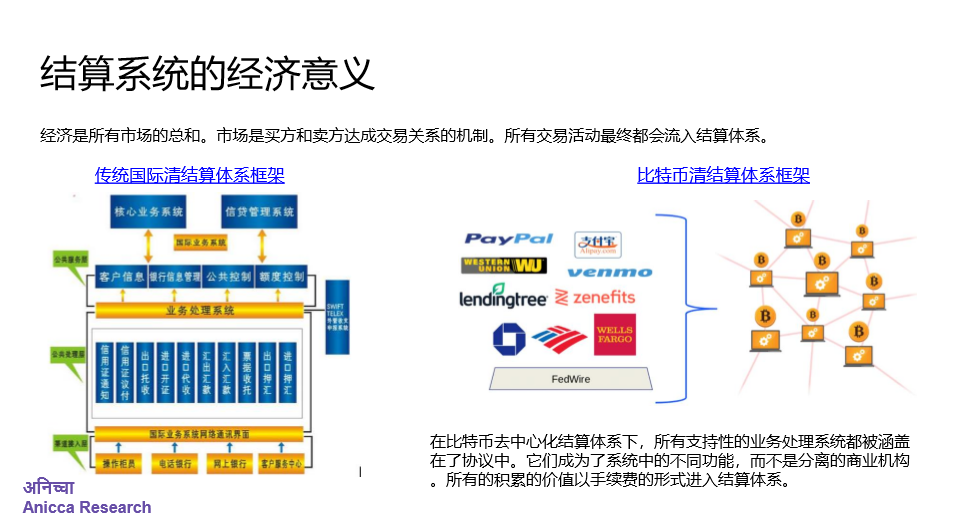
As a clearing system, Bitcoin is relatively effective, because whether it is a control of the ledger or the order of transactions, these are actually completed in the protocol itself.
All such supporting businesses are covered in the entire Bitcoin system, and become different functions in the entire system, rather than the separate business organizations just mentioned. All transaction fees and all accumulated economic value will eventually flow into the settlement system in the form of handling fees.
In addition, under the traditional clearing and settlement system, such as the US dollar settlement system Fedwire, if you want to become a beneficiary of the settlement system, you must become a member of the 12 "Charter Banks". This is a very expensive process, and it also takes many years to accumulate power and wealth. Under the settlement system of Bitcoin, anyone can become a beneficiary of the settlement system as long as they turn on the mining machine.
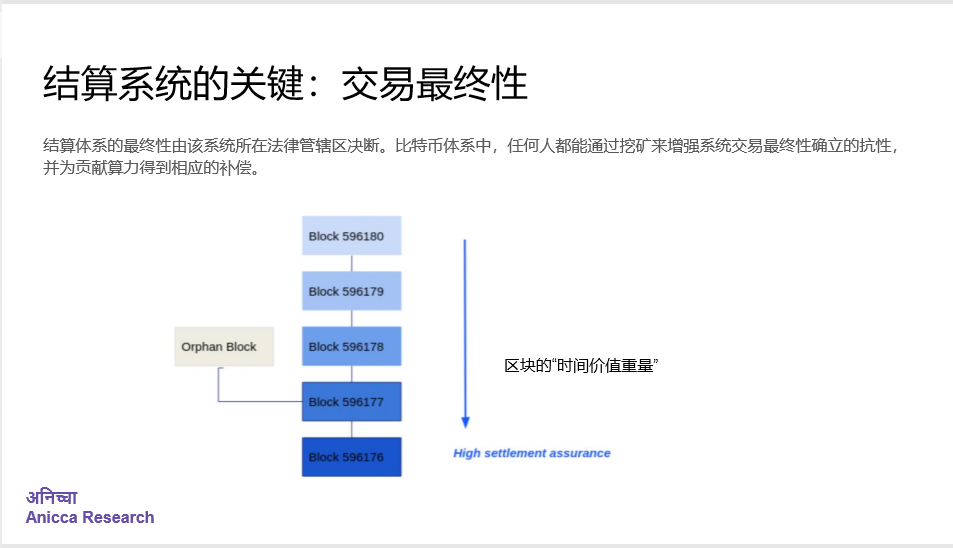
In the Bitcoin system, through the gradual increase in the workload, the time value weight of the block is also getting stronger. In other words, the older the block, the higher the cost of modifying it. A very important concept mentioned here is the certainty of settlement (settlement assurance): With the increase of the computing power of the entire network and the hardening of the consensus of the entire network, the earlier some blocks are, the more certain its settlement will be. high. As a compensation for increasing the weight of the block time value, miners will also be rewarded accordingly.
secondary title
The Lightning Network and Rate Volatility
With the guarantee of "finality", for Bitcoin to become a popular settlement system, it needs very simple transactions and very low rates. Transaction speed is a problem that Bitcoin has been criticized for many years. Although there are various expansion schemes, such as increasing the block size, segregated witness plus twice the number of blocks, etc., each scheme has its own limitations. .
In China, the mention and familiarity of Lightning Network are not very high. I think the current open source, spontaneous development model and development process of the Lightning Network are actually very similar to the early development process of Bitcoin. In the past two years, the Lightning Network has become more and more mainstream. I personally think that the structure of the Lightning Network is the most reasonable and most consistent with the logic of network extension.
The foundation of the Lightning Network is the state channel. For example, the transactions between A and B are very frequent, and they are all small transactions. Every transaction is spread to the whole network, which is actually a very inefficient way. If A and B take out a part of Bitcoin, for example, A takes out 5 BTC, and B takes out 5 BTC for mortgage, and then opens a state channel. When the state channel is open, each transaction As long as it does not exceed some limits set by the amount of collateral, A and B can do unlimited small transactions.
If one party between A and B commits evil, then the other party will take back the entire mortgage, and the state channel will be closed. There are only two transactions in the whole process, which will eventually be recorded in the blockchain main network, one is the first transaction to open the state channel, and the last transaction to close the transaction channel, but this process may have already happened There are tens of thousands or more transactions, and only two transactions are involved in the blockchain.
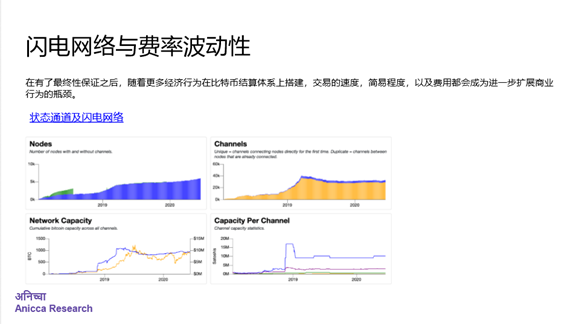
The Lightning Network is gradually being rolled out, and you can see the development in the past two years from these four pictures. Recently, the growth rate has reached a bottleneck. It was a very spontaneous development after all. I think this kind of technology always needs to go through some lag cycles.
Overall, from the series of progress I have seen, I am very optimistic about the Lightning Network.
In addition to the simplicity of transactions, the fees are low. As the number of halvings increases, the proportion of Bitcoin's fee rate to mining revenue is getting higher and higher. At the beginning of the Lightning Network, there was actually a problem. More transactions will be transferred to the second-tier network. Will it absorb part of the rate increase?
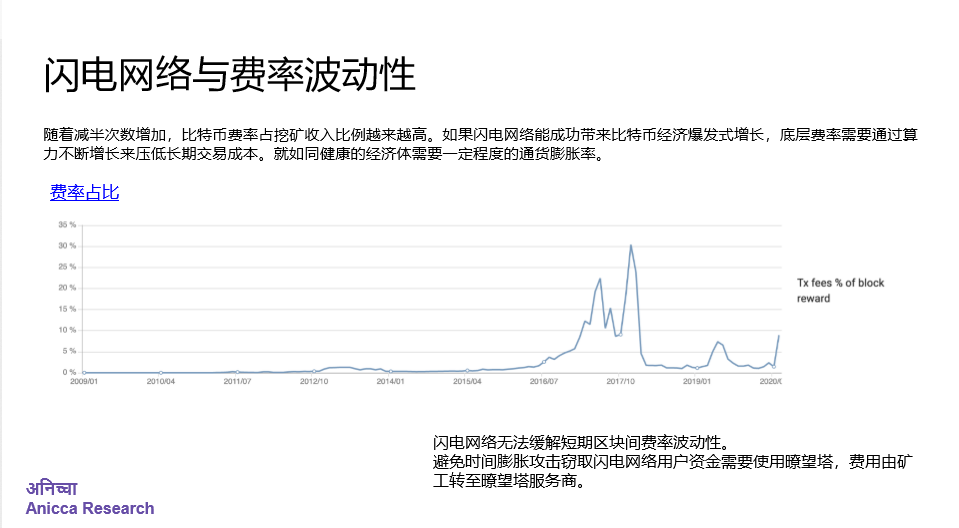
If a large number of small transactions can be transferred to the second-tier network, Lightning should be helpful in suppressing the long-term rate increase, but it is still impossible to control the rate fluctuation between short-term blocks. The reason is a vulnerability called "Time dilation attack", which is essentially a "solar eclipse attack".
This kind of attack does not need to steal users' funds in the case of mobile computing power. This vulnerability can be resolved through a watchtower (Watch Tower) service. But this introduces trust in the third party, and also requires users to pay for the watchtower, and part of the short-term rate increase is transferred from the miners to the service provider of the watchtower.
I personally think that short-term rate volatility is actually a very difficult problem. If the Lightning Network can really successfully bring about the explosive growth of the "Bitcoin economy", then there will be more and more requirements for transactions, and the importance of the fee rate will become more and more significant. Just as a healthy economy requires a certain amount of inflation, a healthy Bitcoin economy requires a certain amount of hashrate inflation to curb long-term rate spikes.
Bitcoin is in much the same situation as the oil industry was in the early 1900s — dominated by speculation and lacking a “killer app.” The early oil industry went through a crazy "black gold" stage, like in many places in Pennsylvania, everyone started digging in their own yards. Everyone knows that someone buys this thing, and the price of this thing is skyrocketing, but basically no one knows what this dark thing is used for.
So I think commodities like Bitcoin will also go through such a process, and they will also need to wait for such an engine moment. Once there is such a moment, the finality of the transaction, the speed of the transaction, the cheapness, and the low rate are all very important factors. These are more or less related to the ability of computing power to maintain long-term inflation. However, as the number of halvings gradually increases, how to continuously attract miners to contribute computing power to maintain long-term computing power inflation is indeed a more complicated issue.
secondary title
Proof of Work and Settlement System Security
For the security of the entire Bitcoin network, computing power alone is not enough. We have also seen various examples of forks, some forks are innocuous, but some forks still have great harm to the resources held by a network. So why does this happen?
First of all, network consensus is a very complicated phenomenon, and computing power does not mean absolute power. The hardness of machine consensus depends on two factors, one is the cost of continuously creating computing power, the cost of leasing computing power, and the other is the distribution of computing power ownership. more difficult.
These two conditions alone are not enough for the security of the entire settlement system. The reason why computing power is not absolute power is because distributed consensus involves two aspects: one is the decision-making of human consensus on development; what kind of things the community likes and what kind of things the community does not like The second is machine consensus, that is, the crystallization of transaction order, which converts energy into a digital absolute ledger. The two actually restrict each other and the yin and yang are in harmony.
The situation of each project is different. If some projects are particularly strong by the developer group, then some industry leaders have a particularly strong voice, and they can control the development of the project; in some projects, the strength of the miners is very strong. They can pass Forks and other ways to threaten the security of the entire network.
I gave these two extremes two names at the time. One was called "fragile balance of fear", that is, in the case of highly concentrated computing power, big miners hijacked the community by threatening forks. We've seen this clearly happen with some projects, including some of the more controversial ones.
This term originated from the Cold War between the United States and the Soviet Union in the 1950s. It was first proposed by RAND, and President Kennedy, Kissinger and others proposed it many times. It is probably because the United States and the Soviet Union maintained a "fragile balance of fear" at the cost of an all-out nuclear war, which prevented the dispute from escalating into a destructive war.
The other extreme is that the entire community has a very fanatical admiration for developers. We have also seen this phenomenon in some small currencies. For example, the distributed storage project is called Siacoin. In 2018, they heard about Bitmain They were building ASICs, and then they tried to build ASICs by themselves, but they failed and directly forked the network, which is equivalent to forcibly shutting down the Bitmain machine.
Including some newer projects now, for example, Grin deliberately made the algorithm memory-intensive at the beginning of the design, making ASICs very expensive to come in. These are all made by some very tough developers in the open source community. decision.
Their dominance plays a decisive role in the direction of the entire project. If the self-awareness of developers becomes very strong, even if there is no obvious upper-lower relationship in the open source community, this invisible class will appear. A disguised bureaucracy.
In any case, the disagreement between developers and miners has little to do with the ideal of decentralization. It is mainly about who controls the coin issuance mechanism and which faction controls the market. These two methods of community management are very extreme, and most projects are between the two, but there is no doubt that computing power, as a process of converting energy into transaction order crystallization, has a very important economic significance.
secondary title
Computing power supply and industry relationship combing
As mentioned earlier, with the development of the industry, if Bitcoin is to be used as a settlement system to attract more business activities in the future, it is very important to maintain a certain degree of inflation in computing power in the long run.
In the past, the supply of computing power was almost completely affected by the price. The price of Bitcoin rises, and everyone thinks that mining is profitable, and then miners start to wrestle, looking for low-cost electricity mining, and the gradual competition makes developers start to look for more advanced technology with each other.
This process cycle makes the network computing power gradually increase, the difficulty rises, the mining profit is reduced, and the growth rate of computing power slows down. The core logic of the whole process is still supply and demand, and other factors affect prices through supply and demand.
At the beginning of its design, Bitcoin actually solved a very complicated problem: how to reach a consensus in the case of a single node failure in an asynchronous distributed system.
secondary title
The Landscape of the Computing Power Industry
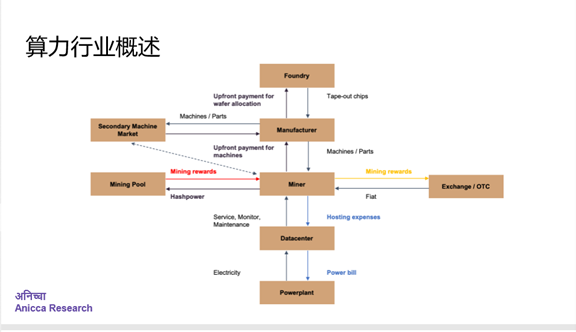
To understand the benefits of miners, we need to understand the pattern of the entire industry. For some unfamiliar audiences, they may often hear terms such as developers, data centers, and power plants, but it is not clear what the interaction between them is. The starting point must be miners and willingness to invest These mining investors, with the increase in currency prices and mining profits, become interested in this matter, and then buy machines directly from mining machine manufacturers.
Generally speaking, the developer needs to pay the entire machine order in full. Basically, more than 80% of the order needs to be paid in advance. This is because the developer needs to order wafers from foundries such as TSMC and Samsung. Also an expensive process.
Friends who are familiar with the semiconductor industry also know that the phenomenon of centralization in the upstream is more intense. Even in the manufacture of lithography machines above TSMC, basically only one company in the Netherlands controls the lifeline of the entire industry.
Recently, with the increase of developers, the competition among them has increased, and some developers are willing to bear part of the down payment risk with miners, but in fact, such adjustments are not particularly meaningful. There are certain historical reasons for this phenomenon of requiring a down payment of more than 70% to 80%.
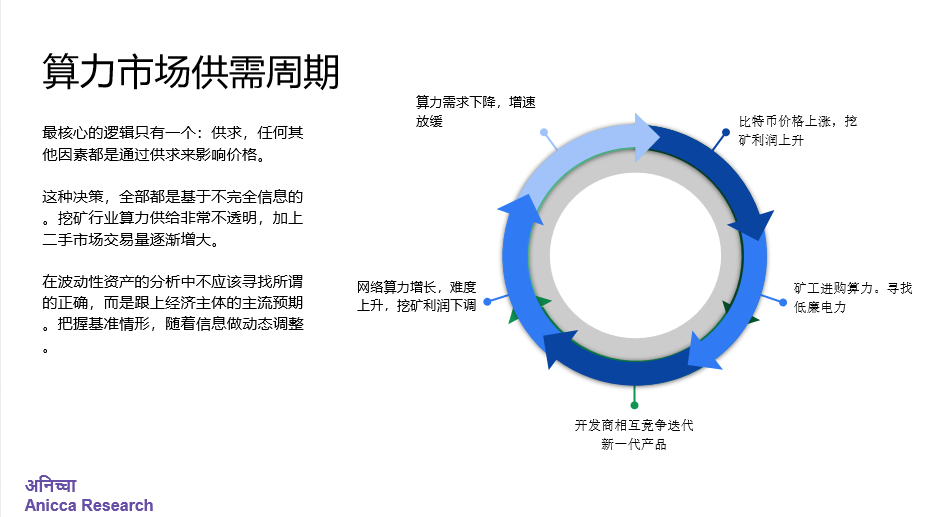
In 2015 and the beginning of 2018, many developers overestimated the entire market because of the previous frenzied bull market. Of course, this is indeed difficult to predict, because the hardware market has a reaction speed to the financial market after all. Whether it is ordering wafers or making new machines, it will take a long time.
In addition to the hardware relationship, data centers and mining farms are also terms that you often hear. In fact, many data centers started the first batch of such professional mines in 2013. Some people who are familiar with the history of mining also know about Toasted Cats. These veteran figures have also made various attempts. Up to now, in fact, some mines in China have been highly specialized and the level is very high, but these are top mines after all. The entire system is from energy to hardware, to miners digging out coins, and then exchange them for legal tender on exchanges or through OTC.
secondary title
Marketization and Classification of Computing Power Capital
Another question is what exactly are you buying when purchasing computing power? As mentioned earlier, computing power is a digital commodity. It is actually an abstract digital commodity. Most other commodities, whether it is coffee beans or some rare metals, have gone through a process of capital marketization.
The process of capital marketization is quite complicated, like the trading of coffee beans as a commodity, which has only become more standardized in the past 10 years or so. Standardization is actually very important. Otherwise, the type and quality of each coffee bean is different. If these factors cannot be quantified or classified by an effective market mechanism, the transaction will be too complicated.
The transaction scale of computing power as a commodity and the shape of the capital market are still in a very early state. The process of trading computing power is actually trading mining machines.
There is a problem here. One is that the transaction process is very troublesome, involving a lot of manpower, material resources, and time lag, coupled with the nature of the market, and because the structure of the market will be very opaque when trading, there is a lot of information. The buyer and the seller are communicated separately, and there is no very public mechanism for everyone to see the pricing well.
So this process is similar to coffee beans, and it also requires a standardized process, which is a relatively longer process and requires a certain degree of spontaneity in the market. But looking at the development of other commodities, this process is definitely inevitable. This is the most important way for physical mining machines to purchase computing power.
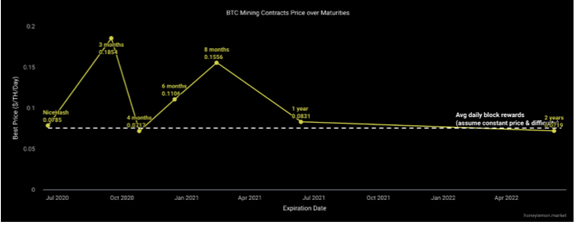
In addition, it is virtual computing power, that is, cloud computing power. I put a picture here, which is the pricing of various term cloud computing power contracts. Now for cloud computing power, some domestic players should be very clear that the water in this thing is very deep. One is that the pricing is very uneven, and there are so many people running around, it is also difficult to define the actual strength behind them. .
This market is also a very standardized process, because it has completed a virtualization process, and it is actually easier to standardize the trading of virtualized computing power.
So I think "standardization of cloud computing power" will actually happen before "standardization of the mining machine market", but a prerequisite is that the cloud computing power market should not kill itself, because this is a very inefficient business model Basically, they rent computing power from miners on the one hand, and sell the computing power to retail investors or some mining funds on the other hand, earning the difference in the middle.
But the pricing model is very complicated, and many of them don't know how to set the price. Then sometimes if there is a huge change in the market, it will have a certain impact on buyers and sellers, as well as the platform itself.
For example, in April 2019, at that time, the currency price basically fluctuated around US$3,000 from November to April, and suddenly rose to US$4,000-5,000 in April. During that time, there was a lot of cloud computing power The platform never had time to adjust the price of its contracts.
Therefore, some very smart players purchased a large number of these cloud computing power contracts at that time, and these cloud computing power contracts were priced at $3,000. Then the price rose rapidly, and it took a while for the entire network computing power to respond. This is a rare situation where cloud computing power makes money.
The final asset class is synthetic computing power, which is a slightly more advanced concept. It means a buyer and a seller. The buyer and seller of bitcoin have reached a long-term swap transaction relationship. Every day, the seller and buyer of bitcoin will exchange bitcoin and fiat currency at a certain exchange rate.
This trading model is still relatively new, and I haven’t seen some particularly interesting services like this, but I think it’s only a matter of time before this kind of thing comes out. In addition, now FTX also has computing power indicators, such as Coin Metrics has computing power indicators, and the synthetic computing power products derived from computing power indicators in the future, I think, will be welcomed by some speculators to a certain extent.
secondary title
The nature of options for mining machines
The mining machine is a very complicated option, and it involves three different variables. On the one hand, it is a call option, which is a call option on the price. The higher the price of Bitcoin, the higher the price of the machine; The put option of the computing power of the whole network, the faster the growth of the computing power of the whole network, the lower the price of the machine;
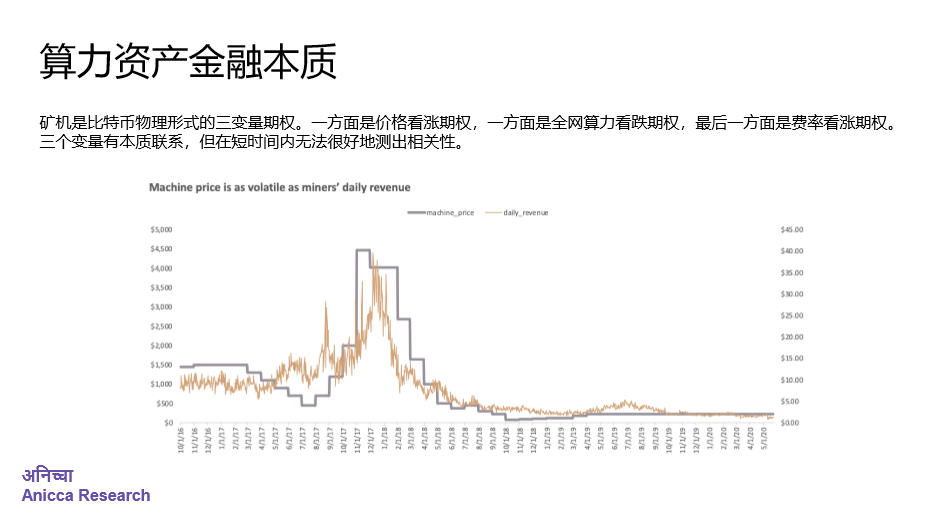
The last aspect is not too much to mention, it is the call option of the fee rate. The higher the fee rate of the entire network, the more beneficial it is to the value of the machine. The three variables must be mixed together, and then they must be analyzed effectively to make a good price for computing power. We all know that there is a relationship between these three variables. Obviously, the higher the price, the faster the growth rate of the computing power of the entire network. The higher the usage rate of the Bitcoin network, the higher the fee rate.
Although theoretically everyone understands that these things are connected together, it is actually very difficult to do a correlation analysis in a very short window, mainly because the hardware market, such as the computing power market, responds to the financial market. Hysteresis, so when the correlation occurs, it has actually been a period of time. After the price changes, the computing power has actually passed a corresponding period of time.
Of course, the data of the machine is difficult to collect. We all know that the sellers in the second-hand market of dealers, because of the quality, the prices they set are all over the sky. This process is related to the need for a standardized process mentioned earlier. But in conclusion, the mining machine is a financial product, and its price is inseparable from the three variables we just mentioned.
secondary title
Computing Power Pricing
After understanding that it is a financial product, a very important question is how to price it. Computing power is a highly complex structured product, making it difficult for everyone to price it.
The standard commonly used in the market now is a "static payback cycle", which means payback in 280 days or payback in 3 months, and payback in 10 months. As the number of halving increases, the data becomes longer and longer. But this indicator is very crude. A very important variable in this option pricing is to measure the volatility of the thing itself. The stronger the volatility, the more valuable it is.A big problem in the static payback cycle: whether it is the future volatility of prices or the future volatility of computing power
, and future volatility in rates, all wiped out. A very direct effect is that the number of the static payback period itself fluctuates violently with the market changes. Of course, the rate is still a relatively small problem, but I think it will increase as the number of halvings increases. It has become an increasingly important issue in the pricing of mining machines. Changes in computing power and prices will have a huge impact on the payback cycle.
In fact, before buying mining machines, many investors and miners are making models, which is why they often cannot see clearly. Since the static payback cycle is an inaccurate pricing method, what other models are there?
In traditional finance, option pricing is inseparable from Black Scholes' derivative model, the core of which is to discount future uncertainties through its risk-free rate. The difference is that computing power is a ternary option, so it is necessary to use three related geometric Brownian motions (also called random motion), and then use the multi-factor Ito lemma to find the solution.
But there is a tricky problem here: computing power and rates do not have a risk-free rate of return. Friends who are familiar with option pricing should be very clear that whether it is equity pricing or some commodity pricing, its core concept is the risk-free rate of return, but there is no such concept in computing power and fee rates.
Although we can use some existing interest rates in the macro market to make a "risk-free rate of return model", there will be several degrees of non-correlation between them. Therefore, although this ternary variable option method can use some methods of stochastic differential equations that we are very familiar with to make a price to a certain extent, it is very complicated and not completely accurate.
Another relatively simple method is to make a simple analysis of the correlation between computing power, fee rate, and price, which is equivalent to folding the growth of computing power and the growth of fee rate into the correlation of price through correlation , turning it into a single variable.
However, this correlation does not occur within the same time window. There is actually a time difference between computing power and price correlation, and this time difference is also changing at any time, so it is very complicated to do this method. But this method is different and complicated. It is slightly simpler in calculation, but more complicated in data analysis and data collection.
The last is the numerical method, which is to simulate the price trend of mining machines through a series of "Monte Carlo models", but one problem is that it is difficult to standardize, basically each transaction party runs its own model, and it is difficult for the entire market to Normalize in this way.
secondary title
Analysis of risk patterns and countermeasures in the cryptocurrency mining market
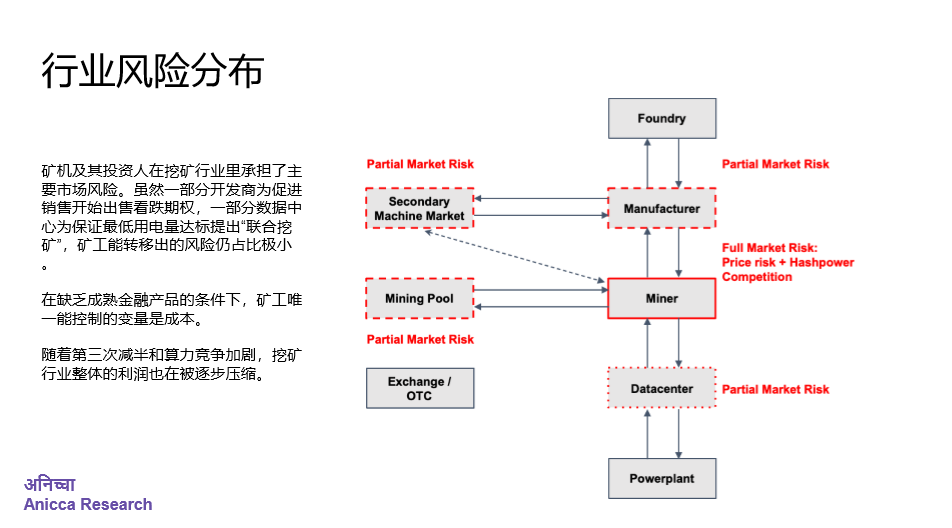
The direct problem with the overly complicated pricing method is that everyone does not have a clear view of the risks in the industry, and it is difficult to quantify and analyze the types of risks. A very important question is who will bear the risks in the industry?
Basically, under the existing market structure, miners take the main risk, although some new miners are willing to sell some put options, or start to attract miners by discounting the down payment. But the main market risk and operational risk are borne by the miners themselves, including some mines. Of course, the fees that the mines have to pay to the power plant are denominated in legal currency, so the risk of currency conversion is still unavoidable.
Now with the increase of some mining farms, because the mining farms and their power plants have some guarantees of the minimum power consumption rate, some data centers have begun to tell the miners that we use this form of joint mining. The electricity price is used to charge, and then some of the coins you dig out will be shared by us in a certain proportion. The current problem is still the lack of some mature financial products. Although everyone has begun to hear some mortgage loans or hedging risks in the form of options, their volume is not very impressive.
The main reason is that the early mining industry was too profitable, so basically as long as the cost is well controlled, there is not much need to do these additional means. As the competition in the entire market intensifies, the number of halvings increases, and the new wave of financial training of these miners strengthens, then I think the combination of financial tools will become more common, including some wealth management products, and some transaction services will also Gradually increase the share of miners.
The concentration of risks in the industry has a big problem with miners, that is, it is difficult to expand the industry. In the past few years, I worked in a fund company in New York specializing in mining. We often talked about mining with some family funds and some traditional investors, and every time we showed them the common feedback on mining income, it was Although this kind of double and triple income seems very attractive, investors like us actually prefer a stable annual income of 5%.
Under the conditions of 2018 and 2019, it is actually almost impossible to make such a guarantee. We realized that in fact, if the mining industry wants to further draw resources from traditional funds continuously, risk control is a very important link. After analyzing the relationship between various players in the entire industry, it can basically be concluded that the only way to control risks is to do a series of hedging through the use of financial tools by miners.
Going back to the topic mentioned at the beginning of the whole lecture, if Bitcoin is to become an independent international settlement system, it is crucial to ensure that the computing power can always grow healthily in the future, and it is crucial to continuously attract resources from traditional funds. important. So I think the "financialization of computing power" is not only a speculative behavior, but also a very important link in the development of the entire industry.
What are the risk forms when mining? There are some risks that everyone needs to face, and some risks that individual miners need to face, which vary from person to person. The macro risk is the comparison of computing power, changes in machine prices, and local policies on virtual currencies.
Everyone knows that the policies of many places have been erratic in the past few years, sometimes supporting them and sometimes suppressing them. Behind this is a more complicated problem. Before some countries have a clearer understanding or acceptance of the nature of digital currency, policies in many places will undergo various changes. I think this is an unavoidable process.
In addition, the delivery rate of some individual hardware risks, previously affected by the new crown, many delivery rates have some problems. Recently, due to internal reasons at Bitmain, there have been some problems with the delivery rate. These are factors that are not easy to predict and control.
The wear rate of the machine, including the previous S17, is a product that is relatively criticized because of the heat sink behind it. If you are familiar with the appearance of the mining machine, you will know that the ant mining machine has been using a single heat sink since the S5. A heat sink is attached to the back of each chip, and Whatsmart is a whole piece. The advantage of this structure is that it is easier to ventilate and the heat dissipation of each chip is faster.
But a very troublesome problem is that once the heat sink falls off, it is relatively expensive to repair. Previously, S9 used adhesives for these, and S17 used low-temperature soldering. One problem is that when the heat sink falls off, it will fall on the adjacent heat sink, causing a short circuit on the entire hash board. Although S17 is a relatively advanced product, the wear rate is still relatively high, which is a troublesome and unpredictable problem.
Power loss, site stability risk, frequent power outages. On an operational level, the risk composition varies from case to case:
One is the control of the cash flow of the miners themselves. Sometimes they are too greedy and do not sell coins, causing the market to plummet in the end, unable to pay the electricity bill for the next month, and then sell coins in excess; sometimes in order to buy new miners The machines sold almost most of the previously mined coins, resulting in no increase in income when the bull market came. These are all cash flow control issues, which are essentially financial issues.
In addition, such as site maintenance and machine theft, these are some things that have happened. Then there are passive risks, including floods during high water seasons, and a recent fire in a mine in Yunnan. These are issues closely related to the quality of the site.
From a macro perspective, I summarize these three main factors as the token supply mechanism, climate cycle, and hardware iterations. These three parts will affect different parts of the entire miner's profit calculation formula. For example, the mining income itself is closely related to the supply mechanism, and the monthly price paid by miners is related to the climate cycle, and The efficiency of income and the depreciation of hardware are related to the iteration of hardware.
Let's do a simple analysis of these three factors step by step. The supply mechanism of tokens is very easy to understand. Unlike many tangible commodities such as coffee beans and gold, the contract clearly stipulates that the halving will be done every 4 years. Every day, new bitcoins are issued at different A percentage of that is sold and then flows into the rest of the overall Bitcoin economy.
Since miners are the only natural supply side in the entire Bitcoin ecosystem, this means that it is the most stable seller. In the early years, miners had a huge impact on market liquidity and pricing, mainly because at that time, firstly, the number of tokens generated by each block was relatively large, and at that time, the liquidity of global Bitcoin was relatively relatively It is worse, so it is very important to do this kind of "selling pressure" analysis of miners at that time.
As the halving has passed three times now, the number of coins generated in each block has gradually decreased, transaction behavior has become more and more complex, and the number of participants in the transaction has gradually increased, and the transaction volume has increased. In fact, the selling pressure of miners is also increasing. gradually getting smaller. If we simply analyze the proportion of the coins mined every day as the daily transaction volume, we can actually see from this table that its impact is already very small.
The second factor is the climate cycle. This climate cycle is actually a derivative phenomenon. The main reason is that the mining industry is very geographically concentrated. Everyone knows that most of the computing power in the world is in China, and then A large part of computing power is concentrated in places like Sichuan and Yunnan. During the high water season between May and October, various activities begin. Developers basically start to promote new mining machines in April and May. Shuttle between these meetings, some miners in Inner Mongolia, Xinjiang also began to transport their machines to the Southwest to get cheap electricity during this time.
This phenomenon has actually become a very important link in the entire mining industry cycle. Therefore, every wet season, the growth of computing power is relatively fast. This phenomenon is of course a very unique derivative phenomenon. If more computing power is moved overseas in the future, we can see that many people in Russia, Central Asia, and the United States are interested in mining. With the further dispersion of computing power, the climate cycle will gradually withdraw from the stage of history. The phenomenon of Fengshui will definitely continue to exist, but its impact may not be as obvious as it is now.
The last question is the factor of machine iteration. We know that new machines will come out every few years. Although they are more expensive, they are more efficient, consume less power and generate more computing power. From Bitmain's dominance, to now two or three companies are competing to share the market share of mining machines, which is actually a very good thing for this market.
After users choose more, because the mining machine itself is a commodity, when you buy a mining machine, you only look at a few indicators, such as efficiency, price, wear rate, and others including customer service and delivery time. There are points, but the core must be price, energy efficiency ratio, and wear and tear.
The matter of wear and tear is actually very interesting. Among the previous major mining machines, wear and tear was not a matter that was talked about a lot. As the rate of machine iteration decreases in the future, everyone knows that Moore's Law is gradually slowing down. We have just gone through the process from 16nm to 7nm and 8nm, and then we will become more and more advanced when we reach 5nm and even 3nm in the future. It gets harder, it gets slower, and then it hits the limits of physics.
The average life of the machine is also gradually extending, and the life of the machine is extended, and the wear rate becomes more and more important. If a 4- or 5-year-old machine has been in need of maintenance, the cumulative cost will be significant.
These three factors restrict each other and entangle each other, which has produced some very complex and unpredictable phenomena in the short term for mining. But in the long run, as Bitcoin becomes more and more mainstream and popular, some institutions and governments begin to take an interest in it. After all, the mining industry is still the most effective way to collect a large number of coins, and the competition in this area is also more and more intense.
Recently, we have seen that some institutions in the United States, such as Fidelity, Blockstream, and even some veterans of the oil and gas industry have also begun to have a strong interest in mining. Although machines imported from the United States need to bear an additional 27.5% tax, at least in terms of energy distribution, North America is quite competitive.
On the whole, the entire industry will develop towards a more resource-intensive industry. Miners who started in 2013, or even earlier miners, only need to control costs to sit still and earn profits. In the future, they will definitely need to do it The combination and use of some financial products.
There is still a lot of room for improvement in the matter of mining itself, and it will develop in a more industrialized direction. We have begun to see some high-end liquid refrigeration products appearing. These things were proposed a few years ago. At that time, I felt that the initial investment was too high, but as the life of the machine was extended, this kind of thing became more and more reasonable.
Two major trends: industrialization and financialization. We also mentioned some common financial tools, such as cloud computing power leasing, then mortgage loans, and then futures options. I personally think that mining pools are actually the first step in the financialization of computing power, because you sell computing power to mines. The pool virtualizes the mining process to a certain extent through common calculation methods such as FPPS and PPS+. So "financialization of computing power" is something that started to happen a long time ago, but now it has become more complicated.
What is the final form of "financialization of computing power"? I think it is inseparable from "derivatives of computing power". Derivatives are actually very familiar to friends who are familiar with the traditional market. In the past 40 to 50 years, the trading volume of derivatives has become very huge, even surpassing many commodities themselves or A volume of some equity itself. They are actually a huge milestone for the "activity" of the entire capital market.
In the current market design, you have no other good way to buy computing power except for buying mining machines and cloud computing power. I think that through the combination with derivatives, the computing power can be better virtualized. This enables participation in market pricing without computing power, and accelerates the process of standardization.