Odaily Frontline | When will the DeFi boom benefit Ethereum?


This article comes fromBeInCrypto, original author: Martin Young
Odaily Translator |

This article comes from
, original author: Martin Young
DeFi has undoubtedly become the hottest field in the crypto industry right now. It is largely powered by ethereum, however, whose recent performance has been relatively lackluster in comparison. Analysts can't help but wonder: When will the ETH price benefit from the great momentum of DeFi?
The DeFi market is hovering near all-time highs in terms of total value locked (TVL), currently standing at just over $1.5 billion (as of press time). Since the beginning of 2020, the DeFi market has grown by 124% (in TVL equivalent USD). In comparison, the total market capitalization of the cryptocurrency market has only increased by 42%.
Even excluding the distribution of Compound governance token COMP, which has lasted for more than a week, the DeFi market has grown by 45% so far this year, still outperforming the overall crypto asset market. Investors have realized that they can earn handsome interest on their crypto holdings, while savvy traders are looking for arbitrage opportunities between different assets and protocols in this new yield farming craze.
secondary title
ETH underperforms
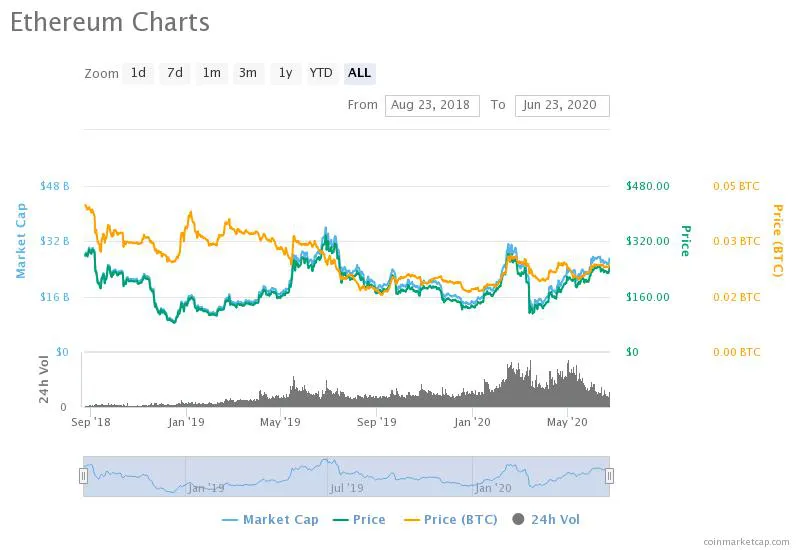
It stands to reason that Ethereum should benefit the most from the DeFi boom, but the truth is that ETH has yet to achieve any real price momentum.
ETH has been rising slowly and steadily this year, from $130 on New Year's Day to an 85% jump to around $240. However, if we go back to mid-2019 before the DeFi boom really broke out, the price of ETH is still down 32%.
Looking further ahead, the follow-up for Ethereum prices has been bleak, to say the least. ETH is still down 83% from its all-time high, and has not seen much improvement in price over the past two years.
The next six months at that time were definitely a milestone for Ethereum, which soared to $1400 in the midst of the IC0 boom, which was amazing. Although DeFi is also growing at a relatively slow pace, Ethereum has yet to gain much in terms of price action.
Industry watcher and well-known Ethereum milk king Ryan Sean Adams digs into the situation in his latest Bankless newsletter. He pointed out that some of the top DeFi tokens, namely COMP, AAVE and SNX, have risen sharply in the past week, but Ethereum has only managed to achieve a 3% increase in the same period.
Adams went on to add that the answer to this question can be drawn from both camps of Ethereum bears and bulls.
secondary title
Bears VS Bulls
The first bearish point: Ethereum is losing its "moneyness" to be replaced by stablecoins and other ERC-20 tokens. In 2017, ETH was the money used to fund ICOs. However, in the current environment, it has largely been replaced by other coins.
Adams added that bears will claim that DeFi is not necessarily correlated with rising ETH prices because ETH is used to transact: “People buy the minimum amount of ETH needed to run a DeFi transaction. ETH is like gas for a car — you don’t You need to hold it, you just need to keep the tank full - the minimum needs are met."
In the end, bears always claim that the Ethereum network will be surpassed by other blockchain networks that are more cost-effective and have advanced technology. Today’s gas fees are unsustainable, and scalability concerns are deep and significant, although a true “Ethereum killer” has yet to emerge.
A bullish view is more pragmatic and requires more patience. After all, ethereum is still going through a two-year bear market, just like bitcoin did after its first big rally. Adams asserted that the market is "backward-facing" and still sees ETH as a utility cryptocurrency.He added that ETH is the reserve asset for DeFi, and as DeFi adopts it, it is the only scarce asset and the market will soon follow.“As a reserve asset for DeFi, ETH is not threatened by stablecoins and other ERC-20 tokens. The success of DeFi is good for ETH. More economic activity increases ETH locked as collateral and as a transaction portfolio. DeFi Profits from tokens will all be recycled back into ETH. Wait and see."
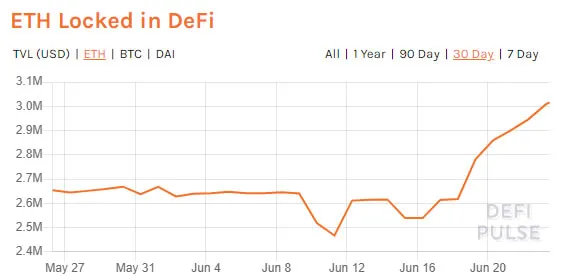
The bullish view is more likely to be accurate, Adams concluded, for three reasons. First, the amount of ETH locked in DeFi has increased significantly. sinceCOMP Token DistributionIn the beginning, another 400,000 ETHs have been locked in DeFi smart contracts, and now the total number of locked ETHs has exceeded 3 million.
In addition, Adams mentioned that a fund manager is adjusting his portfolio to reduce Bitcoin and increase Ethereum. Earlier this year, it was reported that of all the Ethereum mined this year,More than half were bought by Grayscale Investments, further cementing the narrative of a shift in institutional momentum.
The third reason comes fromProtocol Sink Theory, that is, the DeFi protocol with the highest settlement guarantee becomes the base layer of encrypted banks-maybe even commercial banks and national banks.
Beyond that, another reason to be bullish on Ethereum is the long-awaited launch of ETH 2.0, which will herald PoS and Layer 2 scalability solutions. The first phase of the Serenity upgrade, the Phase 0 Beacon Chain testnet, has gone live. As previously reported by BeInCrypto,Ethereum’s on-chain metrics are also improving, hitting a record high.
There are also some concerns in the crypto community, arguing that