Odaily reports that Binance has announced its stock lending product, FPSL, is now scheduled to go live on June 10. Through FPSL, users can lend out their held stocks to generate income. While stocks are lent out, users can still sell their holdings at any time, but must temporarily forgo the corresponding proxy voting rights, and dividends will be distributed in the form of cash-in-lieu payments.


Odaily reports, OKX market data shows ZEC rebounded above 350 USDT, currently trading at 342.02 USDT, with the 24H decline narrowing to 36.53%.


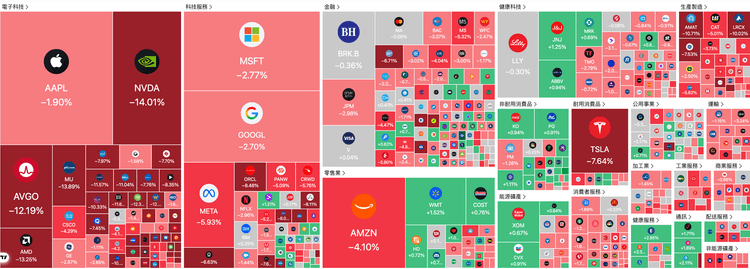
According to MSX.COM data, US pre-market AI concept stocks are broadly declining, with Broadcom down 12.59%, CrowdStrike down 3.81%, Arista Networks down 4.79%, Micron down 7.74%, and Arm down 4.47%.
MSX is a leading RWA trading platform that has listed hundreds of RWA tokens, covering popular US stocks and ETF token targets such as NVDA, GOOGL, MSFT, AMZN, META, TSM, and AMD.
Odaily: According to market sources, an internal employee at Tencent revealed that WeChat Pay is testing AI payment capabilities with WorkBuddy, currently in early internal testing within the company. WeChat Pay's AI payment will set up an "AI-specific card" within WeChat Wallet, with spending depending on the amount the user has topped up, giving users control over the scope of payment authorization.
Odaily Planet Daily News: Mark Zandi, chief economist at Moody's, pointed out that although U.S. GDP has risen this year and the economy appears resilient, warning signs are already flashing. Under the leadership of new Chairman Kevin Warsh, the Federal Reserve may face problems because the Fed is currently unable to implement policies to boost the economy and support employment growth, i.e., interest rate cuts. During the Iran war, U.S. inflation expectations surged sharply. Zandi stated that if inflation expectations continue to rise, it could force the Fed to raise interest rates, even if it triggers a full-blown economic recession, because policymakers will prioritize controlling inflation.
Odaily reported that according to an official announcement, South Korean cryptocurrency exchange Upbit will list the BABY token on the Korean Won market, with trading set to begin at 20:00 local time on June 5.
Odaily: Three major U.S. banks, JPMorgan, Citi, and Bank of America, plan to launch a shared tokenized deposit network by mid-2027. The network will be operated by The Clearing House. The banks aim to convert traditional bank deposits into blockchain-based tokens, enabling 24/7 rapid fund transfers while keeping them within the regulated banking system. The initiative leverages tokenized deposits to represent bank customer funds as digital tokens on the blockchain, facilitating fast transfers and settlements. (CoinDesk)
Odaily Planet Daily News Market news: Iran has informed Pakistan that it accepts transferring part of its uranium stockpile to an agreed third country. (Jinshi)
Odaily reported that the ZEC treasury company Cypherpunk disclosed on X platform that Edward Snowden participated in the early design and creation process of Zcash (ZEC). Zcash is one of the earliest projects globally to implement large-scale zero-knowledge proofs (ZK proofs) applications, with long-term accumulation in the field of privacy computing, as well as in security and cryptographic foundations.
Odaily: The China Securities Regulatory Commission (CSRC) spokesperson answered questions regarding the "Guidelines of the General Office of the State Council on Strengthening Regulation, Preventing Risks, and Promoting the High-Quality Development of Private Investment Funds." Risks will be handled in a stable manner. Fund managers that fail to meet requirements will be resolutely phased out.
Multiple measures will be taken to prevent other institutions from engaging in illegal or irregular business activities under the guise of private funds. Information sharing and situation reporting will be strengthened, risk assessment will be enhanced, and the division of responsibilities between central and local authorities for resolving and disposing of private fund risks will be detailed to strengthen collaboration and create synergy. Standardized development will be promoted.
Private fund managers will be urged to improve their internal control and risk management systems to promote standardized operations. Industry self-regulation will be strengthened. The market-based oversight and constraining role of intermediary service institutions will be actively leveraged. A favorable environment will be created for private equity funds and venture capital funds to implement national strategies, and private securities funds will be guided to establish long-term investment and value investment philosophies. (Jin Shi)
Odaily Planet Daily News: The General Office of the State Council has issued guidelines on strengthening supervision, preventing risks, and promoting the high-quality development of private investment funds. The guidelines state that, adhering to both goal-oriented and problem-oriented approaches, and targeting issues such as the need to improve the access mechanism for the private fund industry, inadequate supervision, an imperfect institutional framework, insufficient inter-ministerial and central-local coordination, the failure of some government and state-owned enterprise investment funds to fulfill their investor responsibilities, and the use of some private funds as tools for illegal activities, new types of corruption, and hidden corruption, the guidelines aim to build a robust institutional system and long-term mechanism for strengthening supervision and preventing risks, thereby driving industry development amidst regulation and improvement through development.
The guidelines emphasize adhering to functional positioning, coordinating overall planning, optimizing new supply while revitalizing existing stock, supporting the strong while limiting the weak, improving quality and efficiency, and strictly prohibiting private funds from illegally engaging in activities such as lending and "nominal equity, actual debt". They uphold classified supervision, implementing supervision tailored to different categories based on dimensions such as capital contributors and product types. The guidelines also insist on managing both legal and illegal entities, applying strict supervision to lawful institutions, resolutely shutting down illegal ones, and severely cracking down on illegal activities.
Odaily reported that, according to data from MSX.COM, Green Resonant Harmonic rose 20.00% today, with a trading volume of RMB 7.929 billion and a turnover rate of 12.22%. Post-market data shows that the stock trading mogul's seat recorded net purchases of RMB 111 million.
Odaily Planet Daily News: The Hong Kong Securities and Futures Commission and the Hong Kong Monetary Authority have published a joint consultation summary on amendments to the OTC derivatives trading rules under the Settlement Rules. Given the broad market support, the Hong Kong Securities and Futures Commission and the Hong Kong Monetary Authority will proceed with the legislative process to introduce the proposed amendments into the Settlement Rules, and plan to implement the relevant amendments on March 1, 2027 (i.e., the start date of the proposed new calculation period).
According to Onchain Lens monitoring, a whale became active after being dormant for 3 years. The whale originally held 38,554 ETH, worth $64.28 million. They deposited 20,000 ETH (worth $33.28 million) into Aave V3, borrowed 30 million USDT, and used recursive borrowing to purchase 17,826 ETH at a price of $1,683. The whale now holds 56,380 ETH, worth $94.04 million. Onchain Lens noted that the whale may continue to buy more ETH.
Odaily reported that driven by a sharp decline in the South Korean stock market, emerging market stocks and currencies weakened for a third consecutive trading day. The MSCI Emerging Markets Index fell 1.7% to 1,728.66 points, while the Korea Composite Stock Price Index (Kospi) once dropped by as much as 7% during the session. The sell-off was primarily concentrated in the chip sector. Samsung Electronics and SK Hynix led the declines, with these two companies accounting for more than half of the Kospi's market capitalization. The downturn followed Broadcom's AI chip sales outlook, which failed to meet high market expectations, triggering a shift in investor sentiment.
Charu Chanana, Chief Investment Strategist at Saxo Markets, stated that if US non-farm payroll data comes in stronger than expected, it could serve as another reason for investors to reduce crowded AI trades. The market is currently closely monitoring this data to gauge the future path of the Federal Reserve's interest rates.