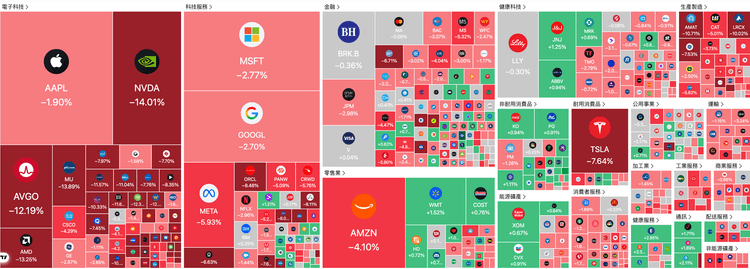
Odaily reported that driven by a sharp decline in the South Korean stock market, emerging market stocks and currencies weakened for a third consecutive trading day. The MSCI Emerging Markets Index fell 1.7% to 1,728.66 points, while the Korea Composite Stock Price Index (Kospi) once dropped by as much as 7% during the session. The sell-off was primarily concentrated in the chip sector. Samsung Electronics and SK Hynix led the declines, with these two companies accounting for more than half of the Kospi's market capitalization. The downturn followed Broadcom's AI chip sales outlook, which failed to meet high market expectations, triggering a shift in investor sentiment.
Charu Chanana, Chief Investment Strategist at Saxo Markets, stated that if US non-farm payroll data comes in stronger than expected, it could serve as another reason for investors to reduce crowded AI trades. The market is currently closely monitoring this data to gauge the future path of the Federal Reserve's interest rates.


Odaily Odaily reports that the Boston Federal Reserve released a new study on Thursday stating that fundamental changes in the U.S. energy structure have completely altered the transmission path of oil price shocks to the domestic economy and reshaped the logic of the Federal Reserve's monetary policy. Currently, the Fed's mainstream inclination is to hold steady in the short term, watching for the subsequent impacts of the conflict. However, officials generally worry that a prolonged conflict could solidify high inflation, and some voices have already suggested the possibility of raising interest rates within the year. The Boston Fed's research provides support for this stance, arguing that even if rates are raised this time, the optimized economic structure would prevent the severe employment downside pressure seen in the past.
However, Morgan Stanley holds a distinctly different view, believing the current oil price increase is a short-term supply disruption and will not become the core driver for a Fed rate hike. Morgan Stanley predicts that inflation will gradually warm up in the second half of the year, the job market will experience volatility, and the Fed is likely to keep interest rates unchanged throughout the year, with rate cuts potentially beginning in 2027. (Jin Shi)
Odaily reported that Jiang Zhuoer, founder of Leibite Pool, stated on the X platform that he has bought back all of his previously sold Ethereum positions at an average price of $1,645. He had previously liquidated these positions when ETH was trading between $2,200 and $2,400. He believes that Bitcoin is still in a downtrend, but since the $61,000 level has been tested twice without breaking down, a rebound is likely. He expects to sell again after a market rebound within 1-3 days.


Odaily, Cypherpunk, the company managing the ZEC treasury, stated that all software has vulnerabilities. Historically, Bitcoin once "over-minted" 184 billion BTC due to a bug. However, this does not mean abandoning blockchain technology; rather, security should be enhanced through formal verification and provable correctness.
Cypherpunk emphasized that with the development of AI technology, vulnerability detection will become faster and broader, but the key lies in who can discover issues before malicious actors. Zcash will demonstrate this capability through an upcoming update.
According to data from MSX.COM, the Hang Seng Index closed down 1.15%, while the Hang Seng Tech Index fell 1.75%. Memory concept stocks led the decline, with the Southern 2x Leveraged SK Hynix ETF falling over 19%, the Southern 2x Leveraged Samsung Electronics ETF dropping over 13%, Montage Technology falling over 9%, and GigaDevice declining over 8%. The AI application sector also fell, with MINIMAX-W down over 16% and Zhipu AI dropping over 9%. The semiconductor sector weakened, with Hua Hong Semiconductor falling over 7% and SMIC declining over 7%.
Odaily reports that Bitcoin's price is approaching the key support level of $60,000, and a breach below could trigger accelerated selling.
Jean-David Péquignot, Chief Commercial Officer of Deribit, stated that $60,000 is more than just a psychological round number; it is a structural threshold with tangible implications for institutional investors and the derivatives market. Over the past year, a significant amount of institutional capital, including ETF buyers, large holders, and short-term speculators, purchased BTC at prices between $60,000 and $67,000. As the price approaches these buy zones, investors are near their breakeven point. If the price falls below their cost basis, unrealized losses will increase. This pressure is amplified when traditional markets, such as AI stocks, are rising, raising the opportunity cost of holding BTC and potentially prompting investors to accelerate their selling.
The derivatives market is also under strain. Deribit data shows that approximately $1.2 billion in notional value of $60,000 put options remain open. Market makers hedging this risk may be forced to sell spot or futures contracts, thereby accelerating the decline. Simultaneously, there is still a large amount of leveraged long positions in the system. A break below $60,000 could trigger a cascade of liquidations, intensifying market sell pressure. Péquignot believes that billions of dollars in leveraged long positions have already been liquidated this week. If the $60,000 support level fails, the downward momentum could amplify further, leading to a rapid and chaotic sell-off scenario. (CoinDesk)
Monitoring by the Odaily Seer Channel shows that in the Predict.fun "2026 World Cup Winner" prediction market, Spain and France are tied for the top spot with a 17% probability each. England ranks second with a 12% chance of winning, followed closely by Portugal with a 10% probability. To date, the total trading volume for the Predict.fun "2026 World Cup Winner" event contract has exceeded $260 million.
The 2026 World Cup will officially kick off next Friday at 3:00 AM Beijing time on June 12th. This edition of the tournament will be jointly hosted by the United States, Mexico, and Canada, making it the first World Cup in history to be co-hosted by three countries. The number of participating teams has expanded to 48.
The Odaily Seer Channel continues to monitor the prediction market, observing changes before the pricing is set.
Odaily reported that “New Stock God” Serenity and Garrett Jin are debating the timing for entering the A-share robotics track. Serenity previously posted on platform X, stating that humanoid robotics is the most favored Chinese listed target, but Garrett Jin, the proxy for the “1011 Insider Whale,” believes it is now too late to call it out, suggesting Serenity might be trying to get followers to buy at the top. This morning, Serenity made the first call for A-share stock “Leaderdrive,” and its share price has already hit the daily limit (20%).
Odaily reports that Binance has announced it will suspend deposits and withdrawals for the NEAR Protocol (NEAR) network at approximately 07:00 (Beijing Time) on June 10, 2026, to support its network upgrade and hard fork. The project team expects to execute the network upgrade and hard fork at 08:00 (Beijing Time) on June 10, 2026.
According to Coinglass data, ZEC liquidations surpassed $108 million in the past 24 hours, with long liquidations reaching $76.96 million and short liquidations totaling $30.85 million. The largest single liquidation was $4.658 million. Today's Zcash (ZEC) liquidations were primarily concentrated on Binance (38.75%), Hyperliquid (36.95%), and Bybit (8.26%), indicating a high concentration of active leveraged trading on these exchanges.
Odaily reported that according to official sources, MGBX will launch BTWUSDT, EWTUSDT, and LLYUSDT perpetual contract trading pairs at 18:00 (SGT) on June 5, 2026.
Trading opening time: 18:00 (SGT) on June 5, 2026
Leverage: BTW and EWT support up to 25x; LLY supports up to 20x
Odaily reported that emerging market assets fell for a third consecutive session, led by a decline in South Korean stocks, as investors’ enthusiasm for artificial intelligence stocks waned. The MSCI Emerging Markets Index fell 1.7% to 1728.66 points, while South Korea's KOSPI index once plummeted 7% on Friday.
Chipmakers such as Samsung Electronics and SK Hynix led the decline after Broadcom’s AI chip sales outlook fell short of overly high market expectations. These two companies together account for more than half of the KOSPI's total market capitalization. After two consecutive weeks of gains, emerging market stocks and currencies are expected to record weekly losses this week.
Charu Chanana, Chief Investment Strategist at Saxo Markets, said: “Broadcom is a trigger, reminding the market just how excessive expectations have become. Investors have priced in a lot of perfection for AI, so even a small disappointment can lead to a rather sharp revaluation. If non-farm payroll data comes in stronger than expected, it could become another excuse to cut back on AI investments." (Jinshi)
Odaily reported that according to official news, Gate ETF will list SPCX3L/USDT, SPCX3S/USDT, MRVL3L/USDT, MRVL3S/USDT, ANTHROPIC3L/USDT, ANTHROPIC3S/USDT, OPENAI3L/USDT, and OPENAI3S/USDT at 17:00 (UTC+8) on June 5, supporting 3x long/short positions on SPCX (SpaceX), MRVL (Marvell Technology), ANTHROPIC (Anthropic), and OPENAI (OpenAI) respectively. Gate ETF currently supports trading in 358 tokens.
In addition, Gate ETF will launch an ETF new listing trading challenge from 18:00 on June 5 to 18:00 on June 14 (UTC+8). Users participating in trading SPCX3L/3S, MRVL3L/3S, ANTHROPIC3L/3S, and OPENAI3L/3S can share rewards of 50,000 USDT. Users with a daily trading volume ≥1,000 USDT can check in to randomly receive 20–100 USDT, with a cumulative maximum of 1,000 USDT. If the total user trading volume reaches ≥3,000 USDT, participants can share an additional 30,000 USDT reward pool based on their trading volume proportion, with a maximum of 200 USDT per person. Furthermore, by inviting friends to trade, users can win blind box rewards of up to 500 USDT.
Odaily reported that Nvidia CEO Jensen Huang’s first stop in Korea was at the T1 base in Hongdae, Seoul, where he met with Lee “Faker” Sang-hyeok, a player from the League of Legends team T1, drawing significant attention from the esports community.
Huang stated that South Korea is the birthplace of esports and the shaper of spectating culture, noting that numerous top Korean players have contributed to the success of GeForce graphics cards. He emphasized that Korea holds a special place in his heart and is also a very important market for Nvidia, adding, “We are your fans too.”
The meeting took place at the T1 base, with T1 players Doran, Oner, Peyz, Keria, and T1 COO Ahn Woong-ki in attendance. This discussion built upon their previous collaboration around projects like VALORANT and was themed around “PC Bang Player Meet-up.” During the interactive session, when Faker was asked about the graphics card he uses, he replied “5070,” sparking attention.
Huang also introduced Nvidia’s next-generation AI PC platform, RTX Spark, stating it will become the new computing architecture for the future AI era. Faker expressed that the meeting with Nvidia’s CEO was very meaningful and thanked the technology and industry support that has helped the development of professional esports. (Zdnet)
According to monitoring by on-chain analyst Ai Yi, an entity affiliated with Hex Trust has accumulated 72.23 million H tokens over the past 4 hours, representing 2.55% of the token's circulating supply. In April, the foundation made significant adjustments to the token vesting schedule for early investors, either extending the unlock period or distributing the full token amount at a discount (a 70% reduction) in a single payment on June 26. Hex Trust is one of the strategic investors, and it remains unclear whether this asset transfer is related to the upcoming unlock.
According to MSX.COM data, most major Asia-Pacific stock indices declined today. A-shares and Hong Kong stocks experienced volatility throughout the day, with the Nikkei 225 index dropping nearly 900 points intraday and the Korea Composite Stock Price Index falling over 5.5%.
Specifically, by the close, the ChiNext index fell over 3%, the STAR Composite Index and the Shenzhen Component Index dropped over 2%, and the Shanghai Composite Index declined about 0.7%. The trading volume on the Shanghai and Shenzhen stock exchanges reached 3.07 trillion yuan, an increase of 311.5 billion yuan from the previous trading day. More than 3,200 stocks across the market rose. The robotics concept surged against the trend, with Zhongda Lide hitting its daily limit twice in four days, while Leader Drive, Keli Motor, and Guangyang shares hit their daily limits. Semiconductor industry chain sectors such as memory chips and CPO led the declines, with Wit-O dropping nearly 13%, Biwin Storage and Longsys falling over 8%, and the trillion-yuan heavyweight Zhongji Innolight declining nearly 8%.
In Hong Kong stocks, a broad sell-off in semiconductors caused the Hang Seng Tech Index to expand its afternoon decline to 2%. As of press time, Uboholdings fell nearly 15%, Montage Technology and GigaDevice dropped over 9%, Hua Hong Semiconductor declined over 7%, and SMIC fell over 6%. The AI application sector continued to slide, with MINIMAX-W falling over 15%, Xunce dropping over 10%, and Zhipu declining over 9%.
In Japanese and South Korean stock markets, semiconductor stocks broadly declined, with SK Hynix falling nearly 10%, Samsung Electronics and Tokyo Electron dropping over 6%, and Advantest declining nearly 5%.