What exactly makes it so hard for AI Agents to spend money on-chain?


- Core Viewpoint: In the second half of 2026, the AI Agent economy shifts toward being driven by real demand. The key obstacles to machine payments lie in identity admission, compliant custody, gas friction, and performance evaluation, with the core of competition being ownership of the payment gateway.
- Key Elements:
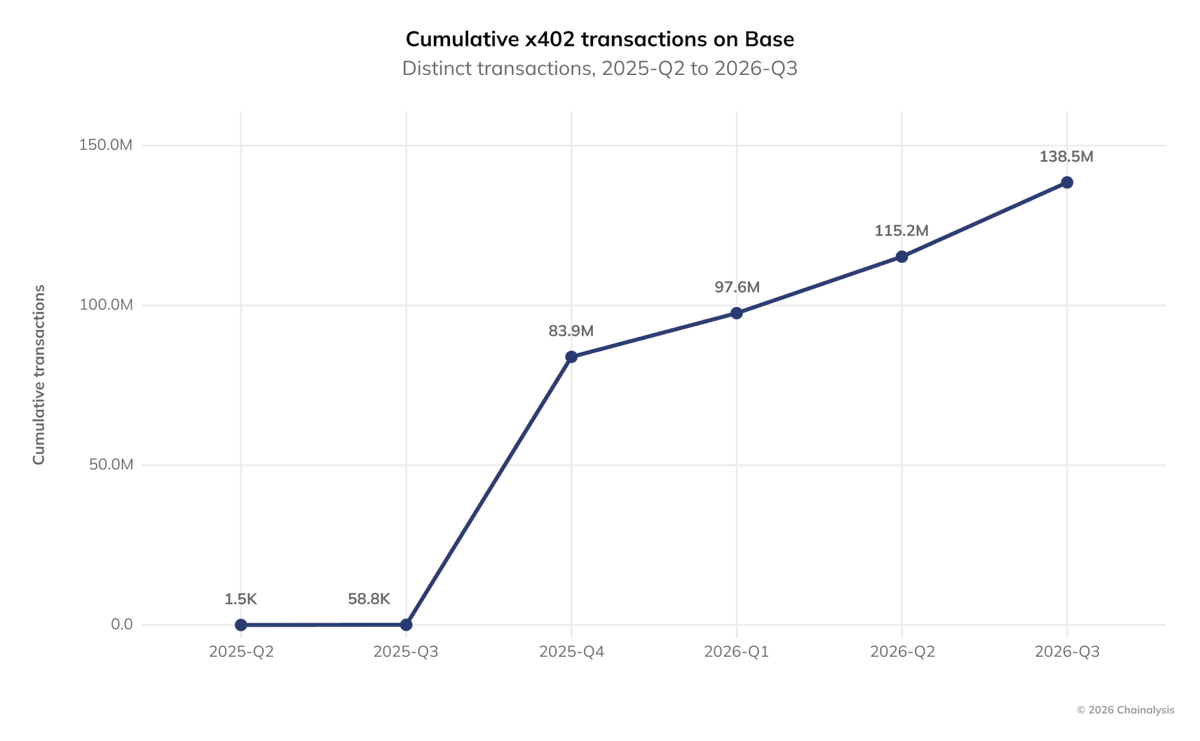
- The x402 protocol's transaction count on Base surged from 58,800 in Q3 of last year to approximately 138.5 million by the end of Q3 2026, representing rapid growth.
- Machine payments still face four barriers: Agents cannot complete KYC, private key custody security, multi-chain gas pricing mismatches, and the irreversibility of on-chain settlement combined with the lack of accountability attribution.
- Industry maturity ranking is payments > identity > hosting > authorization. The authorization segment remains unbroken due to security boundaries and the red line of user control rights.
- Pharos Network has launched the Agent Native protocol layer, building ecosystem-level infrastructure through solutions such as Sponsored Transactions and Gas Abstraction.
- The "fully autonomous Agent economy" and "Agents大规模 replacing human accounts" are judged to be short-to-medium-term bubble narratives; the account subject remains human.
- Inferred development timeline: 2026–2027 for payments and identity to land, 2027–2028 for authorization collaboration to be established, and 2028 for end-to-end workflows to mature.
Original | Odaily (@OdailyChina)
Author | Wenser (@wenser 2010 )
As we enter Q4 2026, AI Agents have already begun taking over the execution of online and offline consumer transactions. In particular, the explosive popularity of Muse and Grok Bot demonstrates that once AI Agents gain operational execution authority, they can get things done better.
But few people think further down the line: when an AI Agent receives a payment or trading task, what bottlenecks will it encounter in sequence when spending money on-chain: no private key wallet, who pays the gas, who approves the authorization, what is the spending cap, and how does it pass the compliance window?
A group of financial infrastructure, public chain, and payment teams are now answering "how AI Agents spend money," but before that, there are three more critical questions that need to be answered first: Why now? How does machine payment work? What stage are we at now? Odaily will review the development of related projects in this article to offer a glimpse into the matter.
Key Question One: Why the Second Half of 2026?
This timing has prerequisites, and all of the following conditions are simultaneously met in the second half of 2026:
First, off-chain Agents have already become highly productized. The explosive popularity of OpenClaw earlier this year cleared away user education barriers. AI Agents, leveraging iterations of large models, have penetrated into real-world scenarios and begun handling paid API calls and offline task execution. However, the "machines need to pay" demand generated by off-chain scenarios has long lacked a productized on-chain settlement supply.
Second, public infrastructure for machine payments has begun to take shape. From the x402 protocol to the MPP machine payment protocol built by Tempo, and then to the 40-member Linux Foundation operating it in practice, BNB Chain also launched Agent Studio in July this year. Only with the improvement of payment standards and tools could "Agent payments on-chain" be actually advanced.
Finally, there is the growth anxiety behind the development of crypto public chains and crypto projects. As numerous narratives such as GameFi, SocialFi, DAO, the metaverse, and NFT have reached dead ends due to liquidity shortages, user growth traffic has gradually dried up. Meanwhile, AI Agents, whose numbers are in a period of rapid growth, are expected to become the next source of gas consumption and trading activity, and a potential primary entity of the crypto network ecosystem.
From the perspective of the motivations of the various parties turning toward this direction, the main drivers and potential risks of developing toward the AI Agent economic ecosystem are as follows:
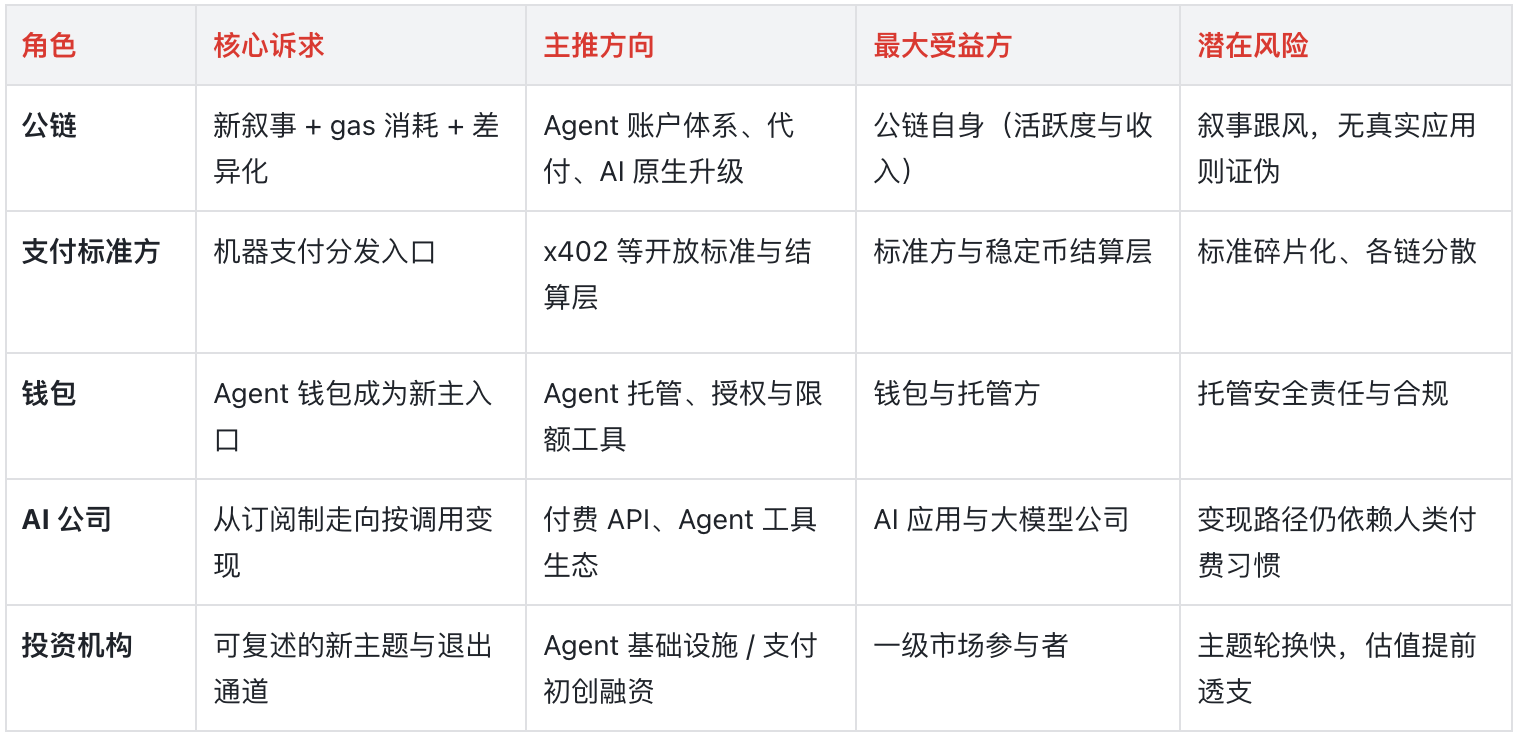
The real needs behind existing Agent projects and applications are facing a round of screening:
- Real needs already validated by the crypto market: settlement (machines paying for services), authorization (security boundaries and limits), identity (verifiable, traceable), and reusable Skill functions (already validated off-chain).
- Bubble narratives excessively amplified by market sentiment: "fully autonomous AI Agent economies" and "Agents massively replacing human accounts." In the short to medium term, the account subjects for payments and transactions remain humans, and AI Agents only function in an executor role.
Based on the above information, this wave of "AI Agent economic shift" in the second half of 2026 is not purely chasing hot narratives, but rather, in the face of real demand and bubble narratives, a proactive choice and passive necessity for crypto public chains, protocols, and projects to extend their lifecycles and gain competitive advantages.
Key Question Two: How Does Machine Payment Cross "the First Hurdle for Agents Spending Money"?
The industry shift has already begun, but the industry's difficulties cannot be solved overnight. Although the large-scale adoption of AI Agents has been underway for nearly a year, the so-called "first hurdle for AI Agents spending money" facing machine payments presents the following problems in terms of subjects, costs, processes, and compliance:
The Four Barriers to AI Agents' Autonomous On-Chain Operations
For AI Agents' autonomous on-chain operations, this is not an isolated act of "executing a purchase operation," but a systematic economic behavior involving multiple processes such as identity access, compliant custody, gas execution friction, and execution result evaluation.
In terms of identity access, AI Agents cannot complete compliance adoption requirements such as traditional KYC, bank account opening, filling out transfer forms, anti-money laundering, and counterparty screening—without identity, AI Agents cannot enter the financial system;
In terms of compliant custody, who holds the Agent's wallet and private keys, how to ensure they are not leaked, and how to avoid overspending caused by prompt injection, erroneous decisions, unlimited retries, etc.—without a "safe," AI Agents face security risks at all times during operation;
In terms of gas execution friction, on the one hand, gas costs are mostly denominated in each chain's native asset, and when multi-chain execution is involved, autonomous processes are easily interrupted; on the other hand, the service fees that AI Agents must pay have also caused denominational unit mismatch problems, which machines cannot complete on their own—without a universal ecosystem, AI Agent transactions cannot run smoothly;
In terms of execution result evaluation, given the high-frequency, small-amount characteristics of the machine economy and the ultimate irreversibility of on-chain result fulfillment, there are asynchrony issues between machine payment execution and fund settlement. Related responsibility attribution, compliance review, as well as "historical reputation mechanisms" and outcome evaluation all require clear standards—without performance evaluation, AI Agent execution can only remain at the review stage and cannot form an ecosystem network.
An Overview of the Main Points of Divergence Among the Three Existing Market Solutions
At present, the mainstream solutions for machine payments include the following three:
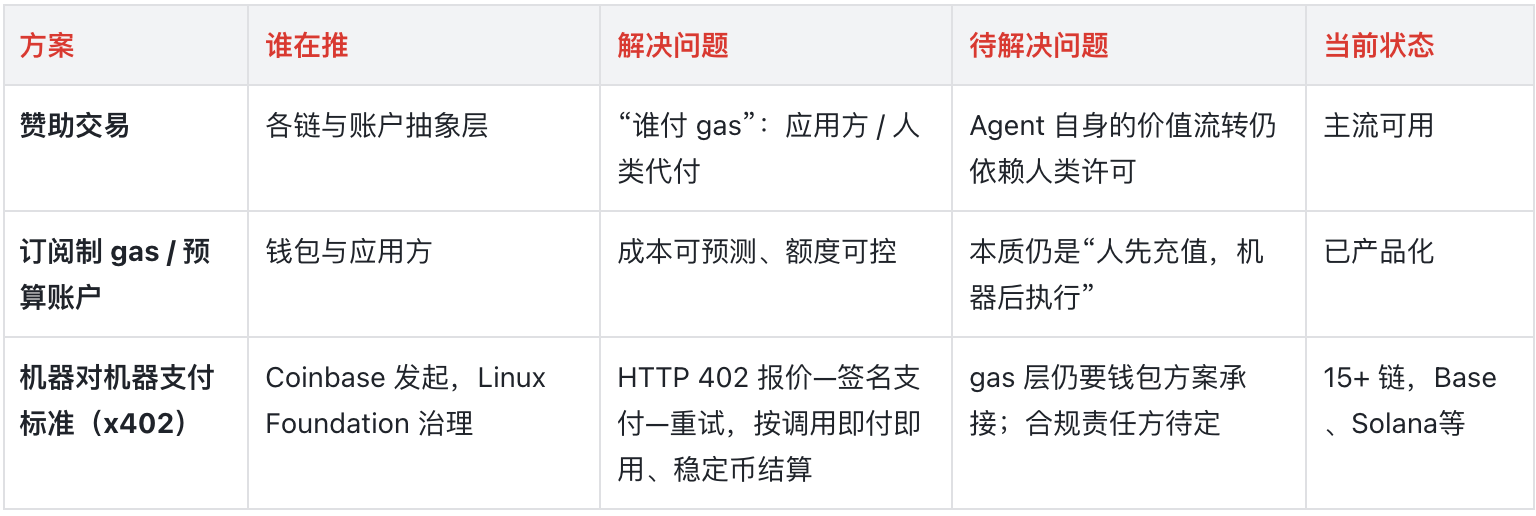
Different solutions correspond to different protocol standards; and behind the battle over machine payment protocol standards, the more important question is—does machine payment behavior occur at the "application layer" or the "on-chain protocol layer"? Whoever controls the pricing layer is equivalent to controlling the distribution entrance for machine payments. This question also periodically determines whether crypto public chains are "pipes" or "cash registers."
Therefore, although the x402 protocol has garnered the market's main attention, it is still difficult for us to conclude that the race is over. Specifically, the issues yet to be resolved also include the following aspects:
- Has the "two-layer payment structure of gas costs + service fees" been obscured by the machine economy narrative?
- Can the battle over payment standards lead to the endgame of a universal solution, or in the future can we only hope that different on-chain ecosystems start separately, resulting in the fragmentation of related machine payment standards?
- Who bears the compliance costs (KYB / AML) of stablecoin settlement? Is it the on-chain ecosystem network, the specific transacting parties, or the protocol builders?
According to the latest data released by Chainalysis on October 15, as of the end of Q3 2026, Coinbase's x402 payment protocol had recorded approximately 138.5 million transactions on the Base blockchain; while in Q3 last year, this number was only 58,800, representing rapid growth.
Key Question Three: What Stage Has Agent On-Chain Development Reached?
Through the development of x402 transactions, we can also indirectly understand that all four aspects involved in AI Agents' on-chain operations have made certain breakthroughs. According to their development stages (official operation stage / demo sample stage / paper planning stage), we can briefly summarize the following information:
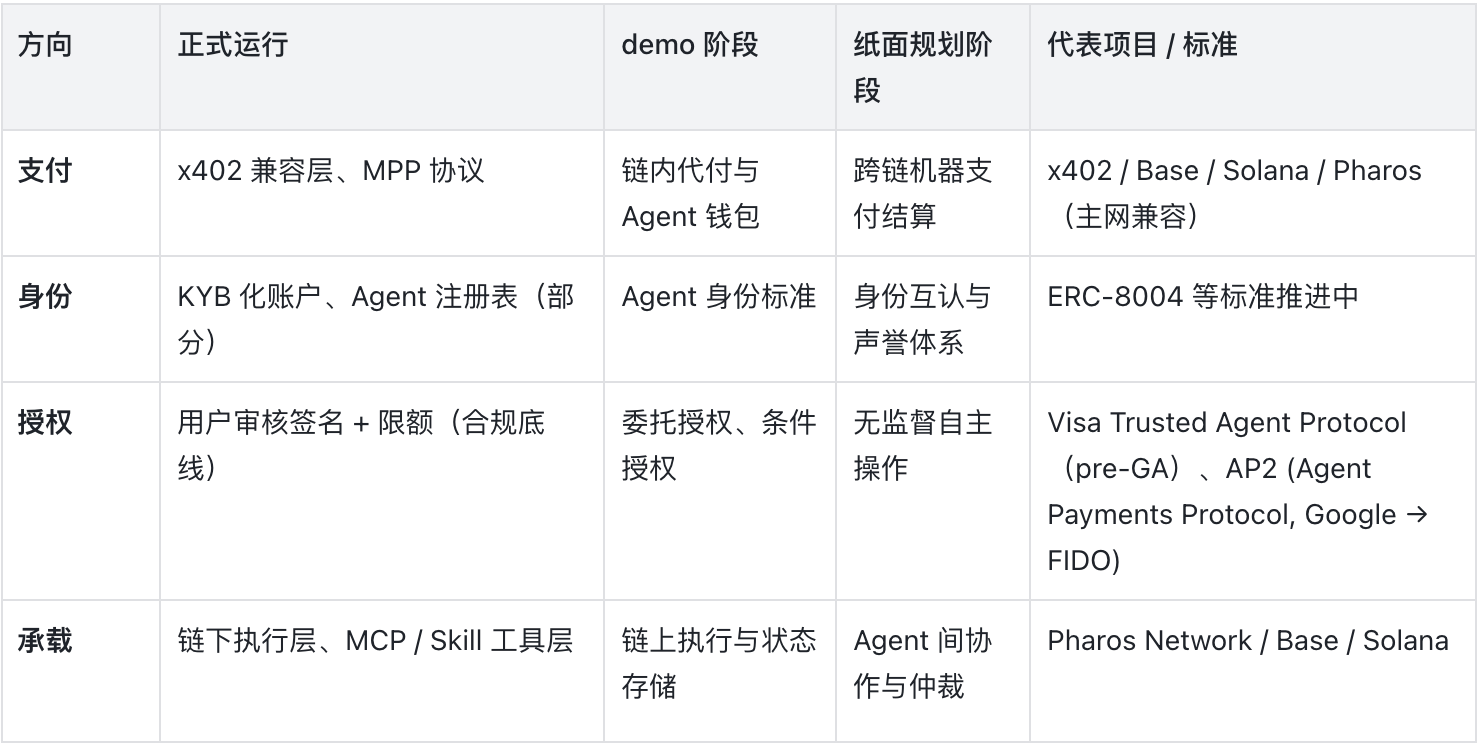
At present, the maturity ranking of industry projects is payment > identity > carrier > authorization. Because it involves red-line issues such as security boundaries and user control rights, the "authorization" part is where the "Agent autonomy" narrative was first falsified. It has not yet been fully broken through and still depends on demo sample tests from projects such as Visa and Mastercard. In terms of carrier and payment, aside from Base, Solana, and Tempo networks, Pharos Network, which recently officially announced its Agent Native upgrade, has become an ecosystem network proposing a new solution.
Pharos Network's Unique Solution: Building a New Ecosystem with an Agent Native Network
According to official introduction, Pharos Network's core positioning is to bring real-world value on-chain through RealFi, and one of its bet paths is the Agent Native ecosystem architecture: enabling AI Agents to operate as on-chain native economic entities—holding assets, invoking tools, collaborating with other Agents, and paying for their own operations.
To achieve this goal, Pharos Network chose to build an Agent Native protocol layer that endows AI Agents with asset, authorization, payment, and identity capabilities, rather than simply adding an AI feature to the on-chain application layer.
From the perspective of roadmap planning, Pharos Network's plan is quite steady and pragmatic. Aside from plans to further improve the network's foundational capabilities in Q4 2026, Agent accounts, transaction interfaces for Agents, the State Economy, and others are still in the protocol definition or testing stage; the end-to-end workflow is tentatively scheduled for implementation in 2028.
In April this year, Pharos Network's mainnet Pacific Ocean officially launched; its SALI engine-driven deep parallel execution, modular SPN, compatibility with EVM and WASM, native compatibility with the x402 standard, and a series of other technical advantages also provide convenience for the construction and in-depth development of the AI Agent economic system; its team members are all former executives and core engineers of Ant Group; its investors include Sumitomo Corporation, Flow Traders, SNZ, Hack VC, Faction VC, and a series of well-known institutions inside and outside the industry.
In addition, the members of its carefully built RealFi alliance also include Circle, Chainlink, Anchorage Digital, Centrifuge, Morpho, and many other crypto infrastructure service providers. To further incentivize developers and ecosystem projects, Pharos Network has also launched a $10 million builder incubation program. Furthermore, in terms of adapting to the AI Agent economic system, the network has also made a series of optimizations and preparations:
- Sponsored Transactions (already live on testnet): separates the transaction initiator from the gas payer. Applications or sponsors pay the gas, preserving the initiator's attribution and control, reducing sybil attack and abuse risks, while supporting large-scale AI Agent activity.
- Gas Abstraction / Substitution: AI Agents do not need to purchase gas midway, supporting uninterrupted multi-step execution.
- Agent Accounts & KYA (2027): account abstraction + permission control framework, preserving human sovereignty over assets and enabling controllable machine execution.
- AEA (Agentic Economic Activity) framework: does not simply count Agents or transactions, but measures effectiveness (meaningful operations triggered by Agents), end-to-end delivery, signal-to-noise ratio, pipeline continuity, security and self-healing, sybil defense, and more.
- High performance supporting micropayments: official data of approximately 30,000 TPS and sub-second finality, compatible with x402-type high-frequency small payments and protocol operations; supports ERC-20 and EVM compatibility, and is equipped with compliance-related modules.
- Developer and user tools: PharosMCP (on-chain data and operations), SkillEngine, official llms.txt, Port Agent Widget (natural language RealFi interaction, with users retaining final execution control), and the ai.pharos.xyz official website.
At a time when AI Agents are gradually transforming into on-chain economic entities, a single protocol, project, or application can no longer build a complete Agent Ecosystem. Pharos Network, by contrast, builds an entire circular ecosystem while remaining compatible with existing machine payment networks and protocols.
Open Discussion: Inferring the Success or Failure of the Agent Economic System
Having discussed the specific solutions, let us boldly infer, based on existing information, which parts of the future AI Agent economic system are likely to continue developing, and which steps face potential risks or the possibility of elimination.
At present, the parts with a relatively high probability of success and with real demand and actual transaction behavior include: machine payment standards and the settlement layer (payment scenarios genuinely exist: APIs, data, computing power); the reusable Skill / tool layer (validated off-chain); and KYB-based Agent identity (a compliance necessity);
The steps most likely to be falsified, leaning toward narrative hype and marketing, are concentrated in three aspects: 1) A fully autonomous, unsupervised Agent economy. Considering that the red line of user control rights cannot be ceded, this goal is destined to be unachievable in the short term. 2) "Agents massively replacing human accounts." In the medium to long term, the decision-making subject of economic accounts remains human users; and as an intermediate step in the operation and execution of AI Agents, human accounts still have necessary value and will be difficult to replace in the short term. 3) Public chain "AI Agent." At present, this role appears more marketing-oriented than practical, with no real application support at the moment, and it is also difficult to bring real incremental users and usage to public chain networks. At present, it is also not essential.
Based on existing information, we can offer rough time-node inferences for the development progress of the AI Agent economic system:
2026–2027: the period of gradual implementation of AI Agent payment and identity;
2027–2028: the gradual establishment of AI Agent authorization and collaboration mechanisms;
2028: with the steady advancement of operational authorization processes and compliance regulation, AI Agent end-to-end workflows are expected to be further improved and gradually become a key component of the operation of the socioeconomic system. From this perspective, Pharos Network's Agent Native network development roadmap, which sets 2028 as the planned implementation period, reflects considerable long-termist consideration.
Of course, the development of the AI Agent economic system will not happen overnight, and it also faces a series of potential risks: such as stagnation in x402 protocol adoption, intensified fragmentation of machine payment standards, fragmented liquidity across different on-chain ecosystem networks, a significant pullback in AI Agent-related transaction volume, regulators halting unsupervised AI Agent on-chain transactions, and leading blockchain networks or ecosystems shifting to new narratives, among others.
Conclusion: The Battle for the Entrance
Returning to the initial question: how do Agents spend money on-chain. The answer is most likely not in any single technical solution, but in the ownership of the entrance—public chains, HTTP-layer payment standards, or on-chain wallets.
At present, the "ecosystem-level preparation" offered by Pharos Network may be the best answer, because it is the "ultimate entrance" solution. During the transitional stage of AI Agents moving from off-chain operational execution to on-chain economic participation, a complete and matching ecosystem is the better answer covering identity, authorization, payment, and carrier. And the purpose and endpoint of all this coincide with the trajectory of AI Agents' influence radiating from the digital world to the physical world—just as Pharos Network's value proposition states: everything is meant to drive the value of the real world into motion.
References
x402 Protocol Transactions Surpass 138.5 Million: AI Agents Reshaping Crypto Payments