After two delays, the merger goes live as Aero bids farewell to the ve(3,3) economic model


- Core Viewpoint: Aerodrome and Velodrome have merged into Aero, which launches across seven chains, with tokenomics shifting from fixed emissions plus weekly voting to revenue-driven emissions and a predictive allocation mechanism.
- Key Elements:
- At 8:00 on October 22, emissions from the old protocols ceased, and Aero launched simultaneously on Base, Ethereum mainnet, OP Mainnet, and four other chains; legacy AERO converts 1:1, 1 VELO converts to 0.044 new AERO, and Aerodrome holders account for approximately 94.5%.
- veAERO/veVELO converts into transferable sAERO, with rebase eliminated; weekly voting is replaced by Predictive Allocation, allowing holders to adjust allocations multiple times within a week and earn revenue from their selected pools.
- Emissions are tied to revenue: Gauge Caps bind pool reward ceilings to projected revenue, targeting average rewards at roughly 1.2x projected revenue, with no minting of excess; the current annual issuance rate is approximately 11%, which under this framework translates to roughly 8%, with an annualized inflation cap of 20%.
- During the four weeks ending September 2026, revenue flowing to veAERO holders totaled $14.9 million, while fixed emissions paid to LPs in AERO were worth $10.5 million over the same period, highlighting the disconnect between legacy emissions and revenue.
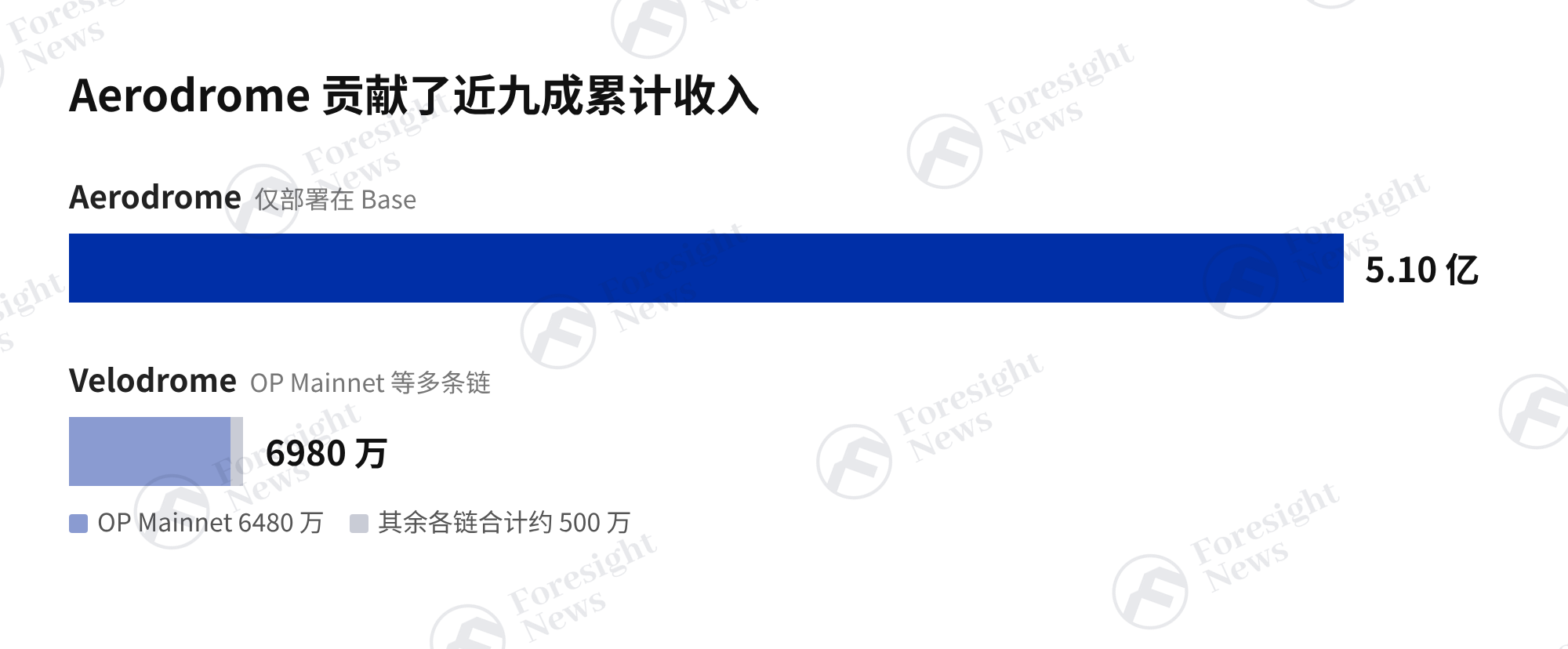
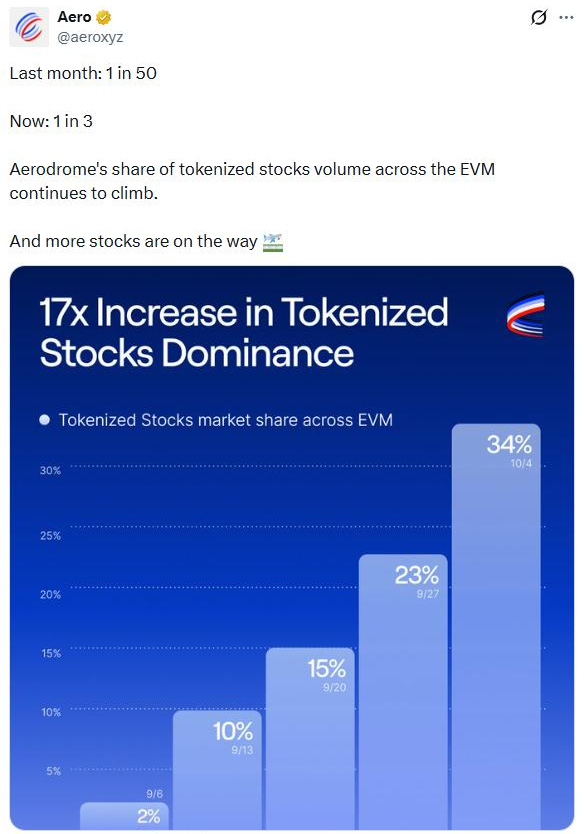
- Revenue is highly concentrated on Base: the two protocols have generated a cumulative approximately $580 million, with Aerodrome accounting for approximately $510 million; tokenized equity trading volume share rose from 2% on September 6 to 34% on October 4.
- New chain expansion incentives: unstaked LP platform fees are 0% on Ethereum mainnet, Arbitrum, and Robinhood Chain, and 5% on the other four chains; Metaswaps cross-chain swaps also went live simultaneously.
Author: Sanqing, Foresight News
At 8:00 on October 22, emissions from Aerodrome and Velodrome will stop simultaneously, and the merged Aero will go live at the same time, covering seven chains: Base, Ethereum mainnet, OP Mainnet, Arc, Ink, Arbitrum and Robinhood Chain.
On the conversion ratio, old AERO converts to new AERO at 1:1, and 1 VELO converts to 0.044 new AERO; among the new token, Aerodrome holders account for about 94.5% and Velodrome holders about 5.5%. Self-custodied tokens must be manually upgraded through the official upgrade portal, and the operation is irreversible; tokens held on exchanges will be converted uniformly by the platforms.
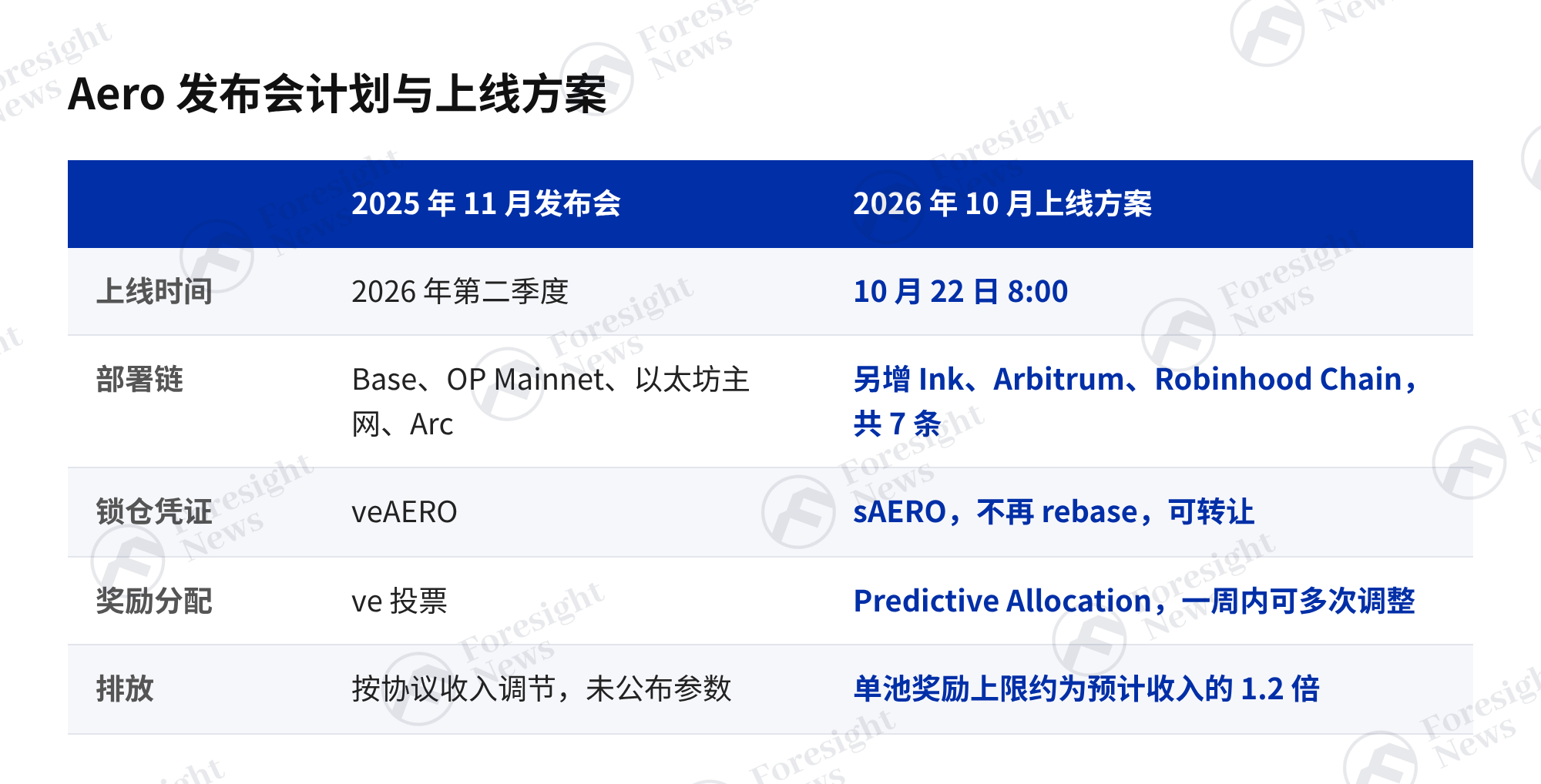
This merger plan was announced at the New Horizon launch event in November 2025, originally scheduled to go live on Ethereum mainnet and Arc in the second quarter of 2026; the target was later adjusted to September, and then set for October due to an extended audit period. Over the course of a year, the plan itself has also undergone quite a few changes.
Weekly Voting Replaced by "Prediction"
Under the old mechanics of Aerodrome and Velodrome, ve holders voted once a week to decide where the following week's token emissions would flow, based on each pool's fee performance in the previous week.
At last year's launch event, the development team Dromos said the ve(3,3) model would be retained. This launch plan has instead switched to "staking": veAERO and veVELO convert to sAERO, with remaining lock terms preserved and rounded up to full weeks, permanent locks converted to the maximum staking period, and no unstaking allowed before expiry. Unlike before, sAERO no longer rebases and is transferable.
The weekly voting mechanism will be replaced by the newly launched Predictive Allocation, with rewards flowing continuously into each pool. sAERO holders no longer need to wait for a weekly concentrated vote; they can adjust allocations multiple times within a week (in the early launch period, each position must wait 47 hours between adjustments) and simultaneously earn income from the selected pools.
Token issuers, in turn, can pay allocators through Liquidity Payments and Launch Payments. Because sAERO itself is deployed on Base, holders need only initiate one transaction on Base to allocate rewards to pools on any of the seven chains, without having to operate chain by chain.
Aero posted on X that allocators are not betting on whether a token goes up or down, but on whether a given market will generate trading. The incentive logic thus shifts from paying out based on last week's results to placing bets in advance.

Emissions Start Following Revenue
According to an economics article Aero published on October 19, during the four weeks of September 2026, revenue flowing to veAERO holders was $14.9 million (of which $6.1 million was trading fees and $8.9 million was Liquidity and Launch Payments), while the AERO paid out to LPs under the fixed emissions schedule over the same period was worth $10.5 million.
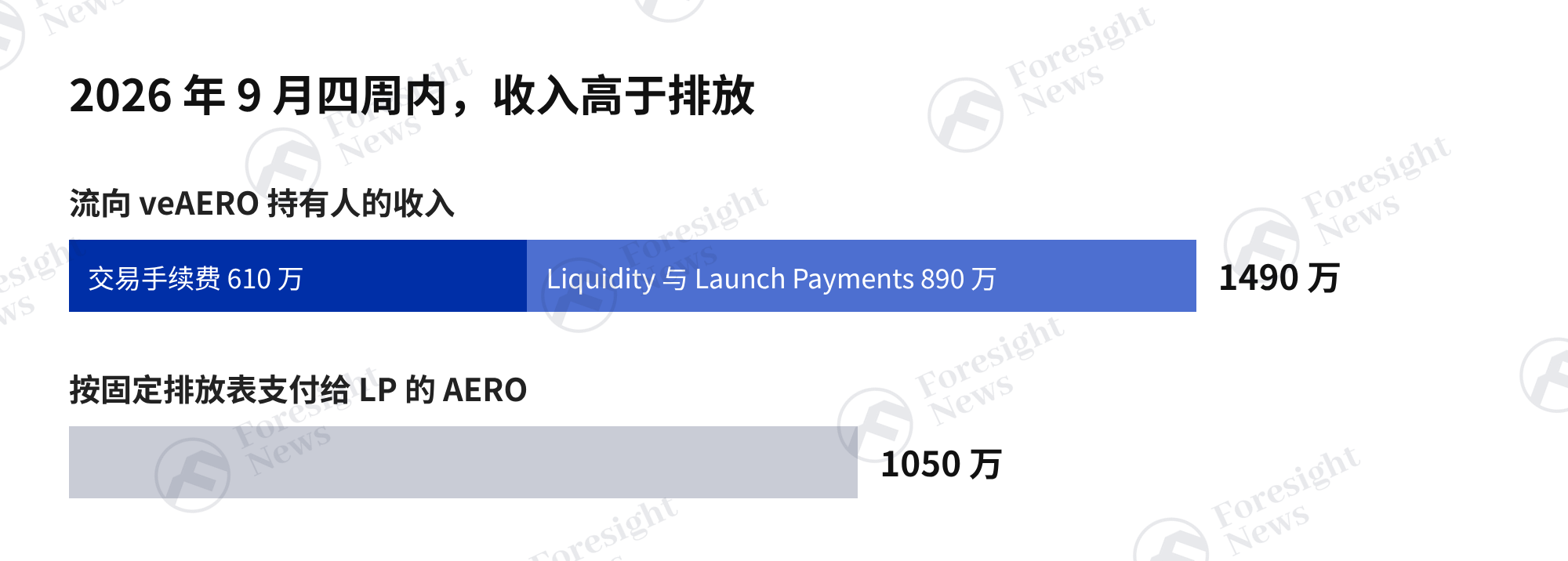
But the problem is that in the past, token emissions were released only according to a fixed timetable, with no direct relationship to protocol revenue.
Last year's launch event only mentioned that emissions would be adjusted according to protocol revenue; this time specific parameters have been given. Gauge Caps tie each pool's reward cap to its projected revenue, with the long-term goal that the exchange-wide average reward is about 1.2 times projected revenue; AERO exceeding the cap will not be minted.
At the same time, rewards are minted only upon claiming; LPs who withdraw before completing the minimum staking period forfeit their rewards, and this portion is likewise not minted.
According to Aero's estimates, AERO's current annual issuance rate is about 11% of supply; based on the 1.2x cap and current revenue it would be about 8%, with an annualized inflation cap of 20%. In addition, the Momentum Fund, consolidated from the original buyback program, has cumulatively repurchased or locked about 110 million AERO.
While making issuance depend on revenue, the revenue side has also been adjusted. Slipstream concentrated liquidity pools have launched dynamic fees, raising fees during volatile markets and lowering them during calm ones.
Aero backtested nine data sets from three pools during calm and volatile periods in August and September 2026; on the premise of the same average fee rate, dynamic fees generated higher revenue than fixed fees in every case. Another MEV tax will also be rolled out gradually: transactions whose priority fees exceed the threshold for ordinary retail transactions must pay an additional fee, and this revenue is distributed to LPs or sAERO holders in the same way as trading fees.
Revenue Concentrated on Base — How Will Aero Break Out?
According to Aero's Dune data page, as of mid-October 2026, the two protocols had cumulatively generated about $580 million in revenue, of which Aerodrome, deployed only on Base, accounted for about $510 million, while Velodrome across OP Mainnet and several other chains totaled about $69.8 million, with OP Mainnet alone accounting for $64.8 million.
But new sources of trading have emerged on Base. Tokenized stocks issued by Coinbase went live on Aerodrome on August 24, and Aero disclosed that its share of EVM tokenized stock trading volume rose from 2% on September 6 to 34% on October 4.
Although revenue is almost entirely concentrated on a single chain, Aero is still trying to expand market share through a seven-chain gateway. Aero says the chains where the two original protocols operate account for about 17% of EVM spot trading volume, and once all seven chains are live, that proportion is expected to roughly triple.
To attract liquidity on the new chains, Aero has set the platform take rate for unstaked LPs at 0% on Ethereum mainnet, Arbitrum and Robinhood Chain, and 5% on the other four chains. The cross-chain swap feature Metaswaps has also launched, allowing users to complete swaps between supported chains within a single app.
Beyond expansion to new chains, the previously supported chains have not been entirely discontinued. Velodrome's pools on Celo, Fraxtal, Soneium and Unichain remain tradable but no longer carry AERO incentives, while deposits on Lisk must be withdrawn before October 31.
Per Aero's schedule, the first round of Predictive Allocation will take place at 0:00 on October 23, and sAERO staked before then will begin earning returns from this round.