Oil prices won't peak until they fall, and Treasury yields won't peak until oil prices fall


- Core View: Citi Research shows that a pullback in oil prices is a necessary precondition for Treasury yields to peak. Current geopolitical tensions are keeping oil prices stubbornly high, and the ultimate peak in yields may not yet have arrived, with market signals contradicting one another and direction extremely difficult to determine.
- Key Points:
- Historically, front-end breakeven inflation rates have typically rolled over 1-2 months before the peak in 10-year Treasury yields, and a peak in oil prices is almost a necessary precondition for a peak in yields.
- Breakeven inflation rates are still strengthening, the dollar index has resumed its upward trend, and oil prices are being supported by geopolitics—all three together indicate that the yield peak has not yet formed.
- High-yield credit spreads have widened, and cyclical stocks have underperformed defensive stocks for 2-3 consecutive months, already showing characteristics consistent with a peak in yields—the signals conflict with one another.
- Both core CPI and headline CPI are lagging indicators, and hot readings cannot rule out that yields have already peaked; the VIX index has almost no reference value for timing the yield peak.
- Citi's cycle model has already switched to a "late-cycle" strategy: underweight equities and credit, overweight bonds (excluding Treasuries) and commodities, and keep duration neutral.
- If there is positive geopolitical progress (especially after the midterm elections), it would significantly raise the probability of an oil price peak and create conditions for a sustained decline in Treasury yields.
Author: Zhao Ying
Source: Wallstreetcn
When US Treasury yields will peak is one of the hardest questions for the market to answer right now. Citi's latest quantitative cross-asset research shows that a pullback in oil prices is almost a necessary precondition for Treasury yields to peak, while ongoing geopolitical tensions are keeping oil prices elevated, meaning the ultimate peak in yields may not yet have arrived.
According to the Zhuifeng Trading Desk, Citi's research shows that the pullback in front-end breakeven inflation rates and oil prices are historically the most reliable leading signals for anticipating a peak in 10-year US Treasury yields. However, breakeven inflation rates are still strengthening rather than declining, and the US Dollar Index (DXY) has recently resumed its upward trend, both of which suggest that the yield peak has not yet formed. At the same time, market signals such as widening high-yield credit spreads and cyclical stocks underperforming defensive stocks have already shown characteristics consistent with a peak in yields, leaving current signals contradictory and making directional judgment extremely difficult.
At the asset allocation level, Citi's cycle model currently follows a "late-cycle" strategy — underweight equities and credit, overweight bonds (excluding Treasuries) and commodities. The global macro strategy team remains neutral on duration, prefers receiving the ECB-versus-Fed rate differential, and favors equities over credit.
Oil Prices Are a Necessary Condition for Yields to Peak
Citi quantitative global macro strategists Alex Saunders and Vinh Vo reiterated their cross-asset analytical framework in the report, adding three additional rate selloff episodes exceeding 70 basis points while keeping their core conclusions largely unchanged.
Historical data shows that before 10-year US Treasury yields peak, cross-asset performance exhibits a clear lead-lag pattern. Front-end breakeven inflation rates typically decline 1 to 2 months before the yield peak, while oil prices peaking is almost a necessary precondition for yields to peak. By contrast, 2-year real rates tend to continue rising even after the yield peak, making them a lagging indicator.
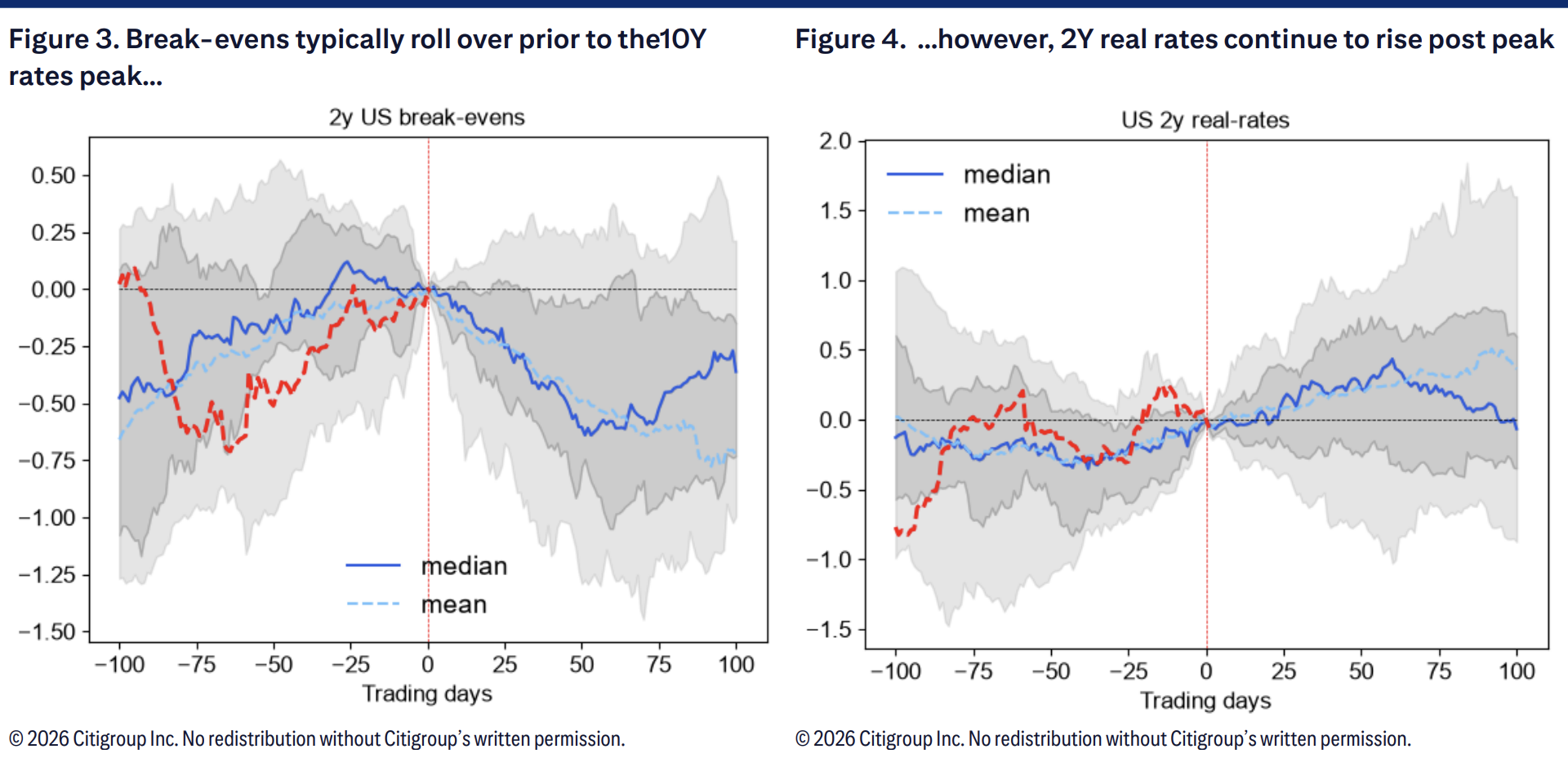
Currently, the strengthening trend in breakeven inflation rates has emerged, but the critical "pullback" signal has not yet formed. Citi notes that persistent geopolitical uncertainty is keeping crude oil prices elevated, making it difficult to determine when oil prices will peak. Against this backdrop, any forecast for a yield peak can only be pushed further out.
Which Signals Work and Which Don't
Citi's research systematically reviews commonly used market indicators and clearly distinguishes which ones have leading significance and which ones tend to mislead.
Among effective signals, flattening of the 5-year to 30-year Treasury yield curve (5s30s) typically occurs about one month before the peak, but this trend has reversed over the past 25 trading days, with the signal becoming muddled. Widening high-yield credit spreads and relative outperformance of low-default-risk stocks are also consistent with historical patterns around yield peaks. In addition, quality stocks typically perform strongly within a 200-day window around the yield peak, which has been somewhat reflected recently; growth stocks, meanwhile, tend to peak before the yield peak and persistently underperform thereafter.
On ineffective or lagging signals, Citi explicitly states that both core CPI and headline CPI year-over-year data are lagging indicators, and recent hotter-than-expected CPI readings do not rule out the possibility that yields have already peaked. Two-year real rates likewise do not reverse at yield inflection points. The VIX index has virtually no reference value for timing yield peaks, but historically tends to decline after a peak is confirmed.
Current Signals Are Contradictory
Citi acknowledges that comparing current market dynamics with historical patterns yields clearly conflicting signals, making a definitive directional call difficult.
On one hand, cyclical stocks' performance relative to defensive stocks has weakened for 2 to 3 consecutive months, and high-yield credit spreads are widening — both consistent with post-peak market characteristics. On the other hand, breakeven inflation rates are still strengthening, the US Dollar Index has recently resumed its rise, and oil prices remain supported by geopolitical factors — all three pointing to the possibility that the ultimate yield peak may still lie ahead.
Citi believes that positive developments in the geopolitical situation — especially after the midterm elections — would significantly increase the probability of oil prices peaking, thereby creating conditions for a sustained decline in US Treasury yields. Until then, the near-term trajectory of yields will remain highly uncertain.
Under the above framework, Citi's cycle model has shifted to a "late-cycle" mode. Specifically, the model is underweight equities and credit, overweight bonds (excluding Treasuries) and commodities, and has recently further reduced equities to underweight. The global macro strategy team remains broadly neutral on duration, favors the ECB-versus-Fed rate differential in rates strategy, and prioritizes equity exposure over credit. The core logic of this allocation is: with peak-yield signals still unclear and neither oil prices nor breakeven inflation rates having shown a decisive pullback, maintaining a neutral rather than actively long stance on Treasuries is more prudent.