


How to define the native benchmark interest rate in the encrypted world?


Author: Colin Li, Researcher at Mint Ventures
Author: Colin Li, Researcher at Mint Ventures
This post is part of the #Mint Clips series by Mint Ventures. Mint Clips are some of our thoughts on industry events after internal and external exchanges. Compared to our #进入研究报and #运车进入 series of articles, Mint Clips does not discuss specific projects, but mainly presents "phased insights" on specific issues.Multicoin CapitalThe narrative about the "bond market" in the blockchain industry has gradually been valued by the market and various investors after DeFi Summer, including
So, is there a bond market in the chain world? What kind of development model might the crypto native bond market have? To answer these questions, thinking about the crypto-native risk free rate is an important entry point, which is the cornerstone of determining the direction of the bond market, because it is an important component of the discount factor of crypto-native assets. After thinking about the "risk-free interest rate", we will know what kind of economic activities in the encrypted market may match the risks and benefits.
first level title
1. The narrative of the public chainHow to treat the public chain has long been one of the important topics that many investment institutions and researchers think about. Joel Monegro from USV proposed "fat protocol
"The concept is deeply rooted in the hearts of the people, and it is considered by many investors as an important starting point of the public chain narrative until now.In 2021, Tascha proposed the "" logic, questioned the mainstream way of using the stock valuation model to value the public chain at that time, and believed that the currency exchange rate model was more useful to value the public chain. In 2022, Jake Brukhman also proposed that the blockchain Technology is the new way humans collaborate, more like apublic productpublic product
, but the blockchain has the possibility of making profits.
When we start with a "country" narrative, the next step is to define currency. A country's currency is of course issued by the country's "authority". Mapped in the blockchain world, the public chain token of a public chain should be regarded as the currency of this chain. For example, Ethereum’s ETH, Solana’s SOL, Fantom’s FTM, etc.
first level title
2. Potential risk-free rate
The risk-free interest rate does not include credit risk, term risk, etc. Generally, in the traditional world, it is considered to be the short-term treasury bond interest rate, or the benchmark interest rate level set by the central bank.
Now let’s take a look at some of the major interest rates in the crypto market.
secondary title
2.1. Stable currency lending rate
Some investors in the market regard the lending rate of the stable currency as the risk-free interest rate of the encryption market. For example, the lending rates of USDC and USDT in Aave and Compound.
The price relationship between stablecoins such as USDC and public chain tokens on the public chain is more like the exchange rate of foreign exchange, and the interest rates of the two types of currencies are also more like the relationship between the U.S. dollar in an offshore center and other national currencies. different interest rates.
secondary title
ETH, SOL, etc. also have corresponding lending pools in the lending agreement, and the lending interest rate is very low most of the time. Taking ETH stored in Aave as an example, most of the time the interest rate level of ETH is at a low position.
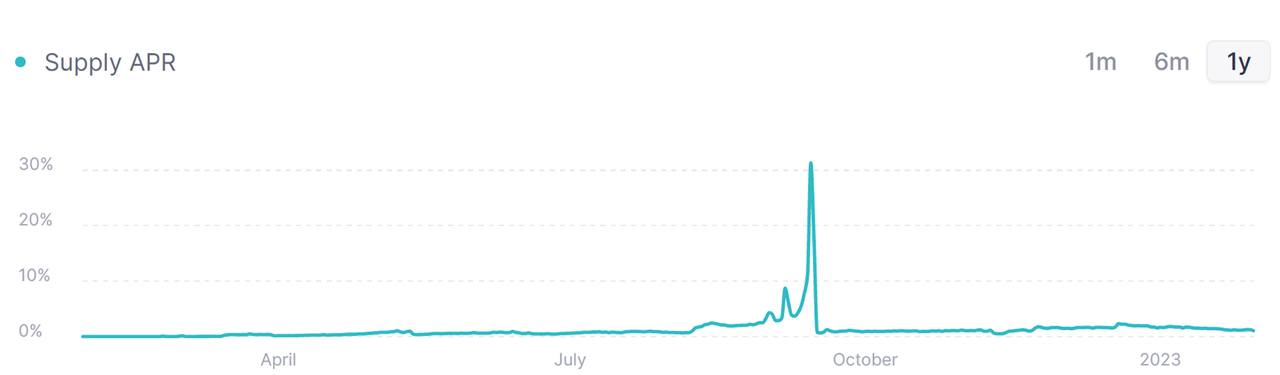
However, the borrowing of public chain tokens has default risks and liquidity risks. The former is caused by the counterparty of the loan (counterparty risk), and the latter is the overall market risk. Such risks are not included in the "risk-free rate", so this type of lending rate cannot be used as a benchmark for the "risk-free rate".
secondary title
2.3. Public chain POS/POW rate of return
image description
source:https://explore.flashbots.net/
source:https://explore.flashbots.net/
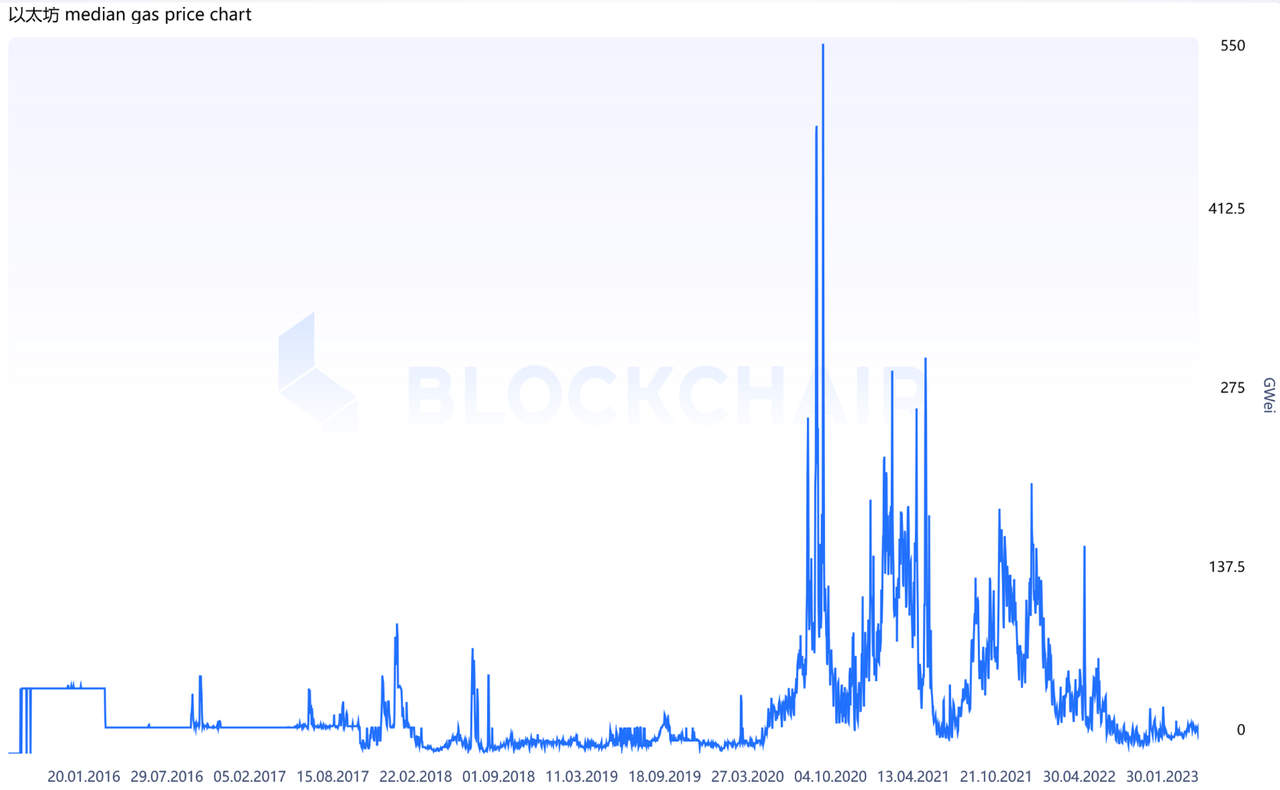
Another related metric — on-chain gas fees — also shows corresponding characteristics.
source:https://blockchair.com/zh/ethereum/charts/median-gas-price
source:
However, from a risk perspective, is the POS rate of return really completely risk-free? Nor is it.
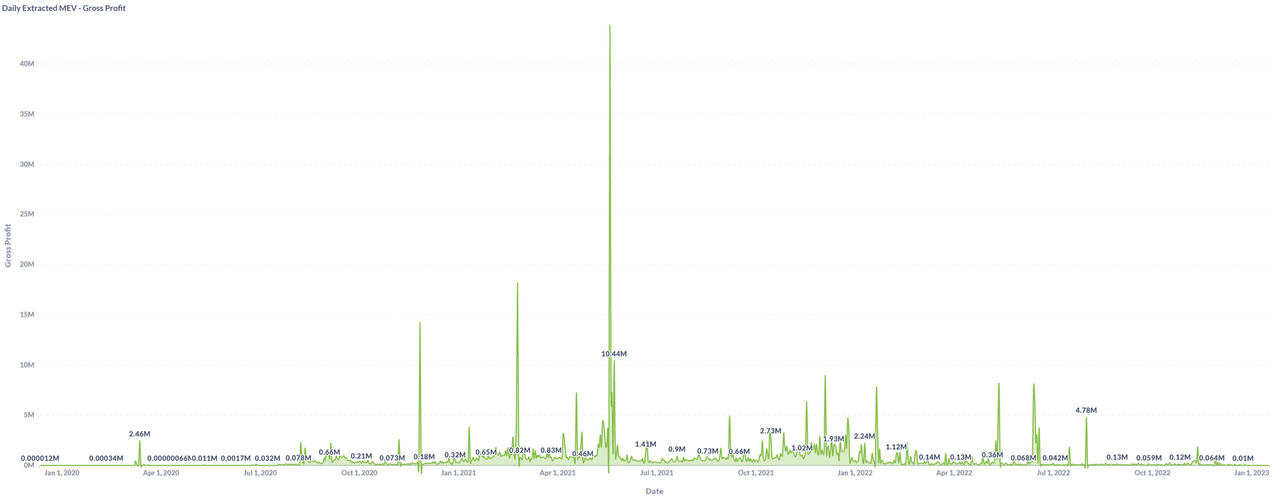
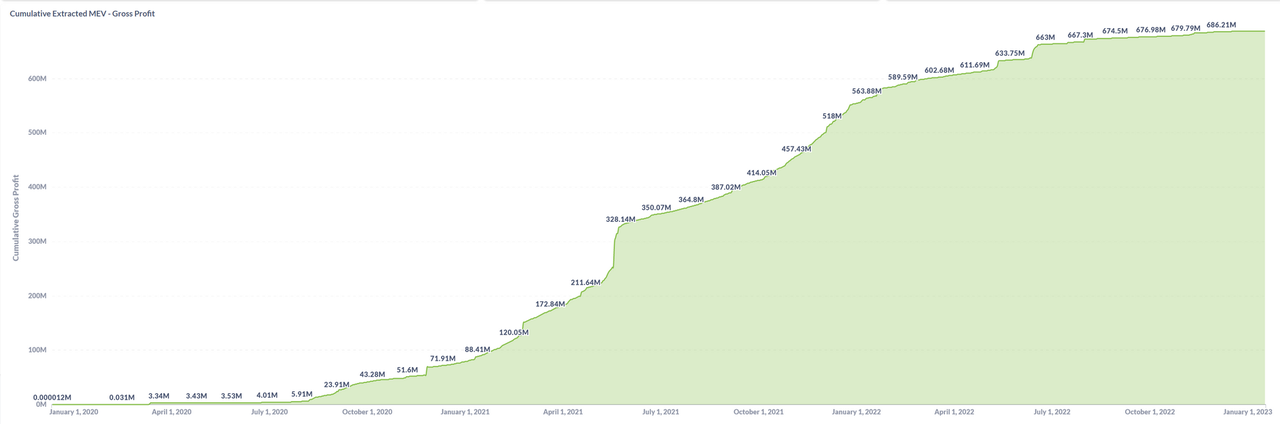
In general, the benefits obtained by miners/validators, on the one hand, include the inflation of the public chain tokens, and on the other hand, they also have the benefits of the activity level on the chain, which is better than the previous two interest rates, and the Pos rate of return is more suitable.” The "risk-free rate" under the "country" narrative level.
secondary title
2.4. Understanding interest rates of other currencies
Some friends may have this question: "Many of my operations on the chain are performed with stablecoins like USDC, why can't I use the interest rate of stablecoins as the risk-free interest rate"?
Secondly, under the "country" narrative, the public chain currency is used as the local currency of the public chain, and other currencies should be regarded as "foreign exchange". Unlike a country in the traditional sense, under normal circumstances, a country can only use its own currency for daily production and business activities with the support of violent institutions. In the cryptocurrency market, there are no violent institutions and certain mechanisms to enforce Only the public chain currency can be used as the payment currency for any activity, so the public chain looks more like an extremely open "country" that accepts any currency as a payment tool. Therefore, stable coins and other non-public chain currencies can be regarded as "foreign exchange".
first level title
3. Basic usage of POS rate of return
Now let’s take a look at the POS yield of some public chains. Here we select public chain projects with a TVL of more than 100 million US dollars, POS revenue and continuous inflation. On the whole, the situation is very similar to that in the real world: the more mature the economy is, the lower the interest rate level offered by the economy is.
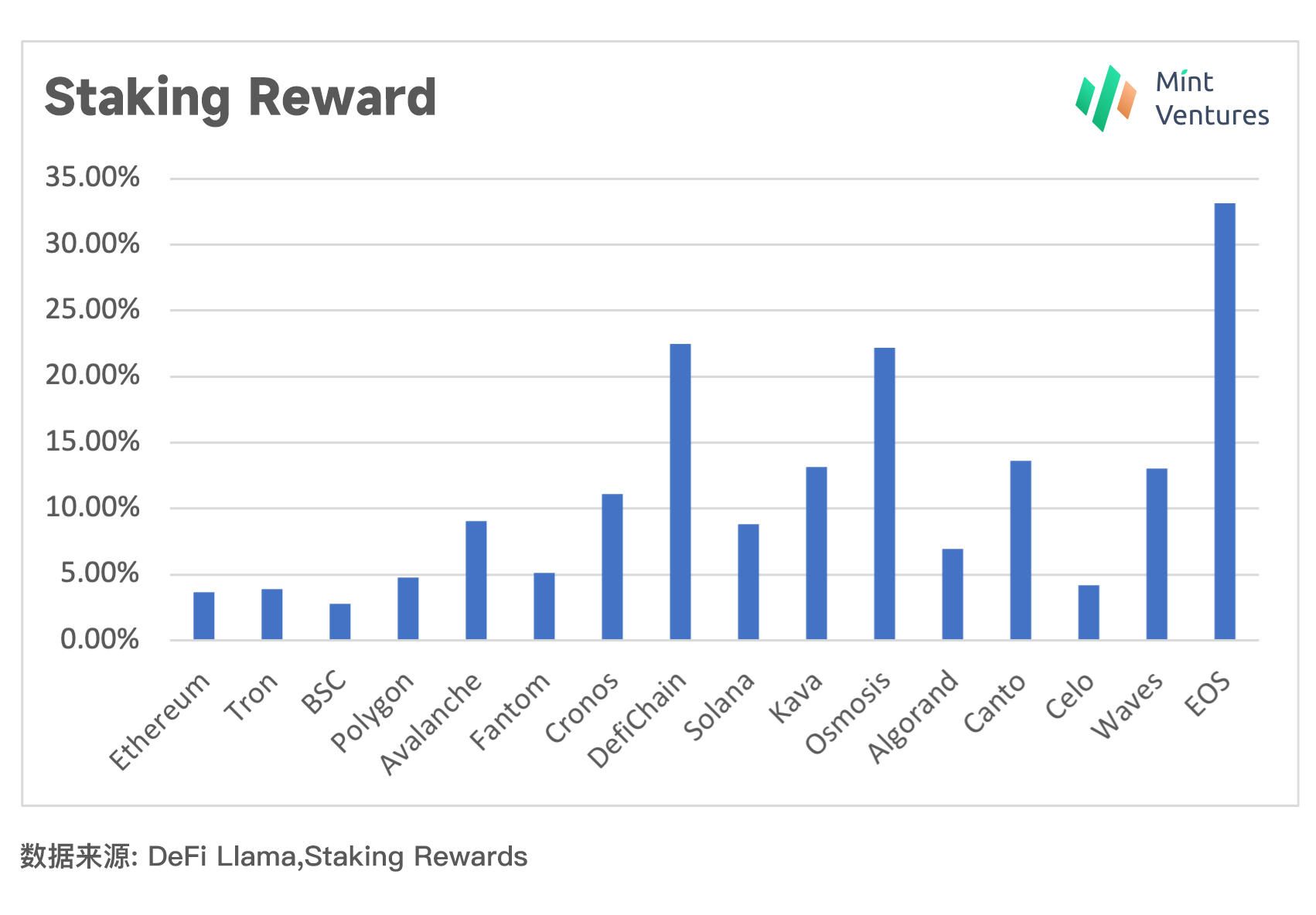
image description
Data source: DeFi Llama, Staking RewardsThen look at the real interest rate level. The real interest rate level of an economy is mainly related toPotential growth rate, demographic structure, asset return differentiation of economies
StakingRewards gives the adjusted reward, which is calculated by adjusting the inflation of network supply. The adjusted reward can be used to represent the actual interest rate. As can be seen from the figure below, most public chain projects are still growing.
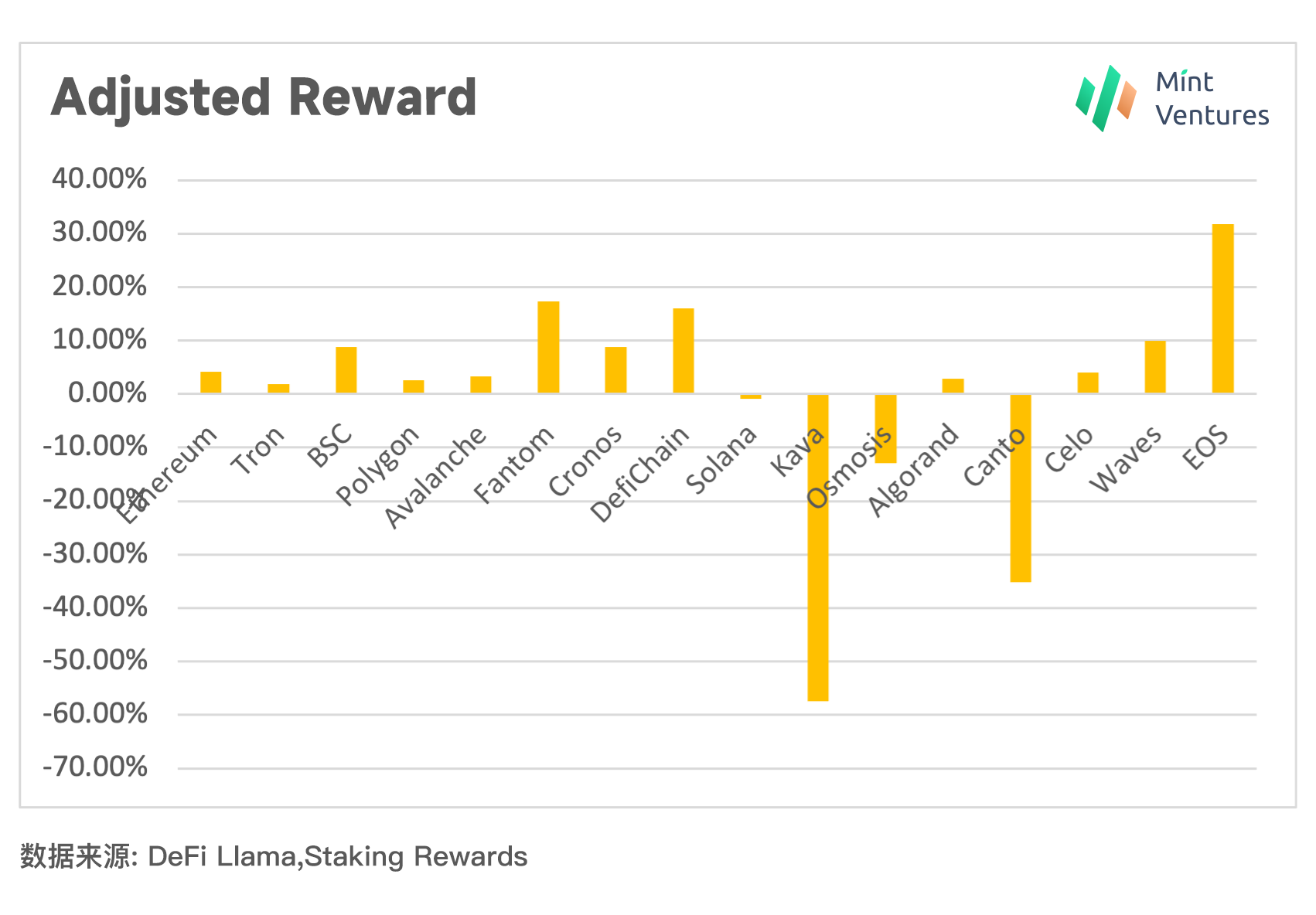
image description
Data source: DeFi Llama, Staking Rewards
text
references:
1、Exploring the Opportunity for DeFi Interest Rate Markets, Multicoin Capital
2、Fat Protocols, USV
3、Price layer 1 blockchain tokens like countries, Tascha Labs
4、Crypto Networks Are Monetizable Public Goods, Jake Brukhman
5、Determinants of the real interest rate, European Central Bank





