自由現金流暴跌91%,Meta的AI豪賭有多貴?


- 核心觀點:Meta 2026年第二季營收因AI廣告增長強勁,但受訴訟、重組費用和AI算力投入激增影響,淨利潤下滑14%,自由現金流暴跌91%,引發市場對AI投資回報率的擔憂。
- 關鍵要素:
- 營收與利潤分化:總營收608億美元,年增28%;淨利潤158.48億美元,年減14%,每股盈餘低於華爾街預期。
- 廣告業務增長:AI驅動的廣告展示量年增14%,平均單價年增12%,應用全家桶日活用戶達36億。
- Reality Labs虧損:營收4.31億美元,營運虧損46.2億美元,自2021年累計虧損約856億美元。
- 算力成本飆升:資本支出310.8億美元,研發支出年增67%至217億美元,自由現金流從85.5億美元驟降至7.84億美元。
- 一次性費用拖累:35.8億美元非營業費用,包括24億美元法律訴訟提列和11.8億美元裁員遣散費。
- AI商業化路徑:計劃將算力用於訓練大模型、優化廣告、開發個人智能體,並嘗試透過Muse系列模型進入企業服務市場。
- 未來指引謹慎:第三季營收指引中位數625億美元低於預期,全年資本支出指引下限上調至1300億美元,增速預期放緩。
Original Author: Li Hailun
Original Editor: Xu Qingyang
Original Source: Tencent Technology
Meta's second-quarter revenue surged thanks to AI-driven advertising, but profits took a hit due to litigation, layoffs, and rising computing costs.
On July 29, US local time, Facebook parent company Meta Platforms released its second-quarter 2026 earnings report for the period ending June 30, after the US stock market closed.
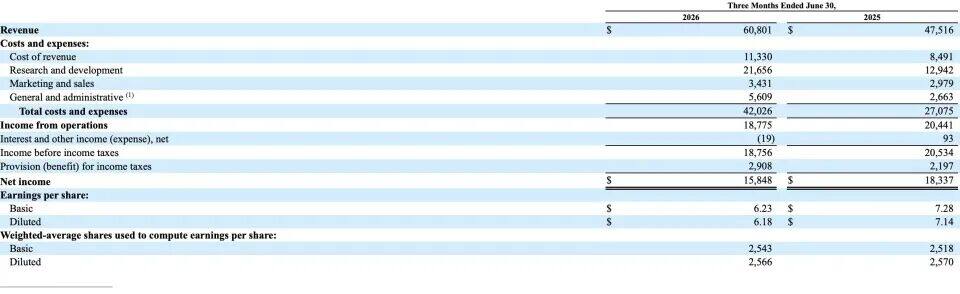
The report showed Meta's total quarterly revenue reached $60.801 billion, a year-over-year increase of 28%. However, dragged down by one-time expenses including legal litigation provisions, restructuring severance costs, and surging computing expenditures, net profit fell 14% year-over-year to $15.848 billion, with diluted earnings per share of $6.18.
Market sentiment quickly turned cold after Meta's earnings release. As earnings per share missed Wall Street expectations and the midpoint of the Q3 revenue guidance at $62.5 billion was slightly below the average Wall Street estimate of $63.1 billion, Meta's stock price fell over 6.37% in after-hours trading, dropping to $548.30. Before the earnings release, Meta's stock had already fallen for 10 consecutive trading days, erasing approximately 13% of its market value since July 15.
As tech giants vie for the endgame of AI, and the development of open-source large models, agent ecosystems, and computing infrastructure enters deeper waters, Wall Street's scrutiny of "AI return on investment (ROI)" is becoming unprecedentedly direct and stringent.
The strong revenue growth contrasted with the cold market reaction, revealing investors' deeper concerns underlying the growth of the core business: Amidst the surge in AI infrastructure investment, can Meta's robust digital advertising foundation support the pressure from trillion-level computing expenditures and a sharp decline in free cash flow?
AI Drives Ad Growth, Reality Labs Still Bleeding Cash
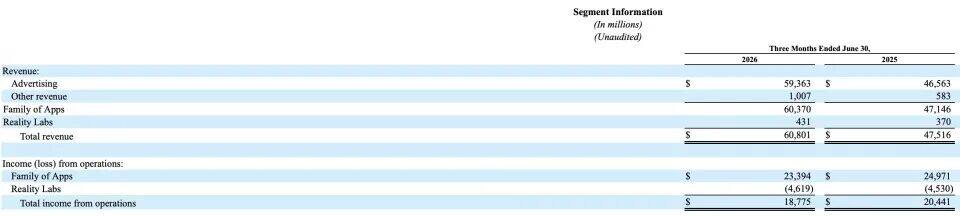
Looking at specific business segments, Meta's core business this quarter showed a pattern of "strong ad foundation providing support, while Reality Labs revenue recovers but losses widen."
The "Family of Apps" division, the core source of the group's cash flow, performed stably, encompassing social platforms like Facebook, Instagram, WhatsApp, and Threads. In June 2026, the average daily active people (DAP) across the family of apps reached 3.60 billion, a 3% year-over-year increase. Notably, Instagram's daily active users officially surpassed the 2 billion mark in Q2, and Threads' monthly active users (MAU) reached 500 million.
Meta's advertising business in Q2 showed a simultaneous increase in volume and price: ad impressions grew 14% year-over-year, and the average price per ad rose 12% year-over-year. Commenting on this performance, Meta founder and CEO Mark Zuckerberg said in the earnings statement: "AI is accelerating our core business today, driving our next-generation products, and opening up entirely new enterprise-level opportunities. The financial results are starting to show, and I'm optimistic about the potential ahead."
Analysis by CNBC suggests that despite macroeconomic uncertainties, the AI algorithm-reconstructed precise ad targeting system (such as Advantage+) is continuously improving conversion efficiency, providing Meta with a stable cash flow foundation.
For the Reality Labs division, tasked with the metaverse and smart hardware mission, Q2 revenue reached $431 million, higher than the $370 million in the same period last year and analyst expectations of $423.4 million. The quarterly operating loss was $4.62 billion, wider than the $4.53 billion loss in the same period last year, but better than the analyst-estimated loss of $5.07 billion.
Since 2021, Reality Labs has accumulated approximately $85.6 billion in operating losses. The division's current business focus is primarily on the Ray-Ban Meta smart glasses, developed in partnership with EssilorLuxottica. With new frame styles and AI features, Meta is trying to position them as a hardware terminal for personal AI assistants.
Soaring Computing Investment, Meta's Free Cash Flow Plummets 91%
Analyzing the total costs and expenses of $42.026 billion in Q2 (up 55% year-over-year) reveals that the increase primarily stems from two main lines: rigid investment in infrastructure and the provision for one-time non-operating expenses.
In R&D and hardware construction, Meta's R&D expenses in Q2 increased by 67% year-over-year to $21.7 billion. Meta is accelerating its data center deployment globally.
Meta also announced a joint venture with BlackRock to build a data center in El Paso, Texas, with a total development cost of approximately $14 billion. The regional investment scale for the expanded data center in Louisiana will exceed $50 billion. The company also plans to invest over C$13 billion in Alberta, Canada, to build its first data center there.
In addition to computing investment, the Q2 income statement included $3.58 billion in one-time non-operating expenses, which was the main reason directly dragging down earnings per share below expectations. Of this, $2.40 billion was related to legal litigation costs, stemming from regulatory scrutiny the company currently faces regarding teen social media use and mental health. The Wall Street Journal pointed out that multiple lawsuits are scheduled for trial in the US this year, which could lead to continued losses.
Another $1.18 billion was for layoff severance costs, corresponding to the restructuring of approximately 8,000 people initiated in May 2026. As of June 30, Meta's global employee count was 75,472, a 1% decrease year-over-year.
Meta CFO Susan Li explained during the earnings call that excluding the $2.4 billion litigation provision and the $1.18 billion severance costs, Meta's Q2 operating profit would have achieved approximately 9% year-over-year growth, instead of the reported 8% decline.
However, the metric most alarming to the capital market was the shrinking free cash flow. Q2 operating cash flow was $31.86 billion, but after deducting a massive $31.08 billion in quarterly capital expenditures, free cash flow fell from $8.55 billion in the same period last year to $784 million, a year-over-year decline of 91%.
The pressure on free cash flow is not unique to Meta but is a common picture for the entire tech giant camp in the AI arms race. For example, Google's parent company Alphabet during the same period saw its quarterly capital expenditure surge to $44.9 billion, directly leading to its free cash flow turning negative for the first time in history.
Ryan Lee, Senior Vice President of Products and Strategy at Direxion, noted in a media interview that while Meta did not slip into negative free cash flow, free cash flow below $1 billion is still attention-grabbing, reflecting the company's massive current cash burn rate.
Zuckerberg Seeks New AI Avenues: Personal Agents and Enterprise Services
In the view of analysts, Meta's business model differs from competitors that have cloud service systems. Microsoft has Azure, Google has Google Cloud, and Amazon has AWS; they can use their cloud computing businesses to sell computing power directly to external enterprises. Meta lacks a large-scale native cloud business and relies primarily on revenue generated from its advertising business to support its AI capital expenditure.
To address this, Meta is attempting to adjust its AI layout and commercialization strategy.
In early July, Meta launched the Muse Spark 1.1 model. This is a significant product following Meta's $14.3 billion investment in June 2025 and the introduction of Scale AI founder Alexandr Wang to lead the technical team. It focuses on agents and code generation, with pricing lower than comparable products from OpenAI and Anthropic. However, the concurrently launched Muse Image feature, which used Instagram public accounts to generate images, sparked controversy and has since been suspended.
Regarding the subsequent application of the vast infrastructure, Zuckerberg articulated a clear vision for analysts during the earnings call. He explicitly stated that the vast majority of computing power the company procures will be prioritized for training next-generation large models, optimizing the core advertising business, and delivering personal agents and new products to users. He also anticipates the company will build the capability to serve large enterprise clients.
Just a day before the earnings release, Zuckerberg published a bylined article in the Wall Street Journal and gave an exclusive interview. He clearly stated that powerful AI tools should be widely available and benefit the whole of society, opposing the monopolization of AI power within a few closed-source institutions. He reiterated Meta's core vision: striving to deliver "Personal Superintelligence" to every ordinary user, seeking broader technological and commercial justification for its high capital expenditure.
Capital Expenditure Guidance Raised, Q3 Growth Expected to Slow
Regarding future performance outlook, Meta's financial guidance leaned towards caution, which was a primary reason for the pressure on the stock price in after-hours trading.
For the third quarter of 2026, the company expects total revenue to be between $61.0 billion and $64.0 billion (assuming an approximately 1% negative impact from foreign exchange). The midpoint of this guidance is $62.5 billion, lower than the average analyst expectations of $63.15 billion to $63.24 billion. Some foreign media analysis suggests that this implies the Q3 revenue growth rate will slow from 28% in Q2 to a range of 19% to 25%, sparking concerns about a slowdown in ad revenue growth and the timeline for realizing AI returns.
Regarding expense guidance, Meta further raised the baseline for investment. The company adjusted its full-year 2026 capital expenditure guidance range from the previous $125 billion to $145 billion to a new range of $130 billion to $145 billion, raising the lower end by $5 billion.
Considering the $2.4 billion legal litigation expense confirmed in Q2, the lower end of the full-year total expense guidance was raised to $165 billion to $169 billion. The company estimates the effective tax rate for the second half of the year will be between 15% and 17%. However, the company also explicitly stated that it continues to expect operating income for the year to surpass the 2025 level.
Meta's Q2 earnings report reflects the reality the company faces during its AI transformation: the core advertising business foundation remains solid and can provide cash flow for cutting-edge exploration. However, on the other hand, the extremely high capital thresholds for AI infrastructure like data centers and GPU procurement have significantly squeezed free cash flow, while one-time legal and restructuring costs have dragged down current profits.
For the capital market and investors, the key to observing Meta going forward lies in whether its annual hundred-billion-dollar hardware infrastructure investment can penetrate enterprise services through the Muse series of large models, achieve high-rental pricing for computing power, and be quickly converted into feasible commercial outputs.
During the Q2 earnings call, Zuckerberg emphasized that while earnings per share fell short of expectations due to legal costs and significant investment in AI computing power and talent, the company's revenue grew strongly by 28% year-over-year to $60.8 billion, demonstrating robust underlying business vitality.
Zuckerberg stated that AI technology has fully accelerated its core advertising and recommendation algorithm systems, driving the implementation of new product lines such as personal and business AI agents. Addressing market concerns about rising capital expenditure, he reiterated Meta's goal is "to put superintelligence directly into the hands of everyone." He emphasized that in the context of the AI computing shortage, the company's full-stack in-house development and forward-looking infrastructure construction plan will create irreplaceable long-term competitive advantages and high returns.
Special thanks to contributing translator Wuji for their work on this article.