存储暴跌,一夜驚魂


- 核心觀點:在存儲巨頭交出史上最亮眼財報後,股價卻遭遇「黑色星期二」暴跌,市值蒸發近430億美元。這源於三重壓力:ADR套利、韓國槓桿ETF監管收緊導致資金踩踏,以及矽谷巨頭AI資本支出回報不確定性引發的市場恐慌。
- 關鍵要素:
- 業績與股價背離:SK海力士營收同比增257%、美光營收暴增346%,但三星電子、SK海力士等股價暴跌超10%,市值蒸發數千億美元。
- 套利交易與監管風暴:SK海力士ADR發行催生「做多美股ADR、做空韓國正股」套利,疊加韓國收緊單一股票槓桿ETF規則觸發程序化拋售。
- AI投資回報擔憂:谷歌上調資本開支但股價下跌,穆迪警告雲巨頭債務高達4600億美元,市場對AI週期可持續性及HBM供應鏈重新定價。
- 「大空頭」做空邏輯:《大空頭》原型貝瑞做空美光,理由包括股價偏離200日均線創1984年新高、ROIC中位數僅4%、終端需求依賴表外融資。
- 韓國超級擴產計劃:三星、SK海力士計劃投入5160億美元新建晶圓廠,打破供給紀律,市場預期2027-2028年產能過剩將侵蝕價格。
Original Author: Su Yang
Original Editor: Xu Qingyang
Original Source: Tencent Technology

Overseas storage giants are caught in the eye of the storm, with their total market capitalization plummeting by nearly $43 billion overnight on July 28.
During the last trading day, the stock prices of storage leaders like SK Hynix and Micron experienced a "night of terror." SK Hynix and Samsung Electronics both fell over 13%, with their combined market value evaporating by about $28 billion. On Tuesday, the U.S. stock market saw Micron close down 8.85%, SanDisk plunge 14.25%, Seagate drop 8.53%, and Western Digital fall over 6.9%, collectively losing approximately $14.8 billion in market cap.
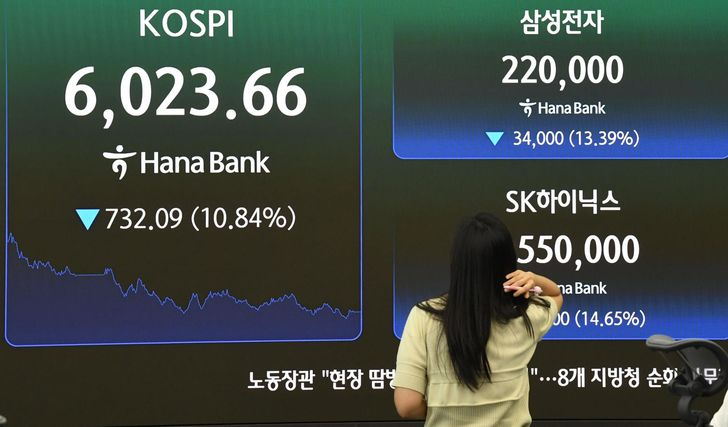
Screens in the trading room of Hana Bank in Seoul display the benchmark KOSPI index and the closing prices of Samsung Electronics and SK Hynix on Tuesday.
Public data shows that SK Hynix has retraced approximately 45% to 47% from its June high, with market value evaporating nearly $600 billion. Micron Technology has corrected over 30% from its peak. Japan's Kioxia has nearly halved in value within a month.
In stark contrast to the stock price collapse, the storage giants have just reported their best-ever financial results.
The Logic of Earnings Failing to Support Stock Prices
On July 7, Samsung Electronics released its preliminary Q2 results, posting an operating profit of 89.4 trillion Korean won for the quarter, a staggering 18-fold increase year-over-year, even surpassing the total profit sum of the three years from 2023 to 2025. However, this impressive earnings report failed to lift the stock price; instead, it caused Samsung's shares to plummet over 10% during the session, dragging the KOSPI index down by nearly 5%.
The same anomaly played out with other giants.
On the 29th, SK Hynix released its Q2 earnings, reporting revenue of 79.3 trillion Korean won, a 257% increase year-over-year; operating profit reached 60.5 trillion Korean won, up 557% year-over-year, with an operating profit margin climbing to 76%.
Micron Technology reported revenue of $41.5 billion for the fiscal quarter ending in May 2026, a massive 346% surge year-over-year. Its gross margin soared to 84.6%, and free cash flow hit $17.6 billion. Micron's management even confidently stated, "Demand far exceeds supply capacity, and this boom will continue until 2028."
Despite the red-hot fundamentals, the stock prices of storage leaders have been plunging. The first clue and potential trigger is the cross-market pair trading arbitrage activity generated by SK Hynix's issuance of ADRs in the U.S.—"going long on U.S. ADRs, going short on domestic Korean stocks."
Bloomberg, citing a report from UBS to its clients, noted that many global portfolio managers who previously did not include SK Hynix shares listed in Korea in their investment asset classes can now purchase the new SK Hynix ADRs.
"Buying the American depositary receipts and selling the Korean ordinary shares from day one looked like a no-brainer trade," UBS wrote in the report.
Another catalyst is related to regulatory adjustments in South Korea.
On July 16, the South Korean Financial Services Commission suddenly announced stricter regulations for single-stock leveraged ETFs, not only raising the minimum margin requirement from 10 million Korean won to 30 million Korean won but also limiting each person to a maximum purchase of 20 shares.
Nikolaos Panigirtzoglou, an analyst at JPMorgan Chase, pointed out that at the time, the holdings of storage chip leveraged ETFs as a proportion of the relevant companies' market capitalization were three times that of regular stock ETFs. During the stock price decline phase, the mandatory end-of-day rebalancing mechanism of leveraged ETFs triggered programmed automated selling, instantly creating a "capital stampede."
That day, SK Hynix fell another 11%, Samsung slumped over 8%, and the wave of panic quickly swept across Europe and the Americas.
Looking at a longer timeline, the recent pullback in storage concept stocks is also linked to concerns among Silicon Valley giants regarding "unbalanced investment returns" from their AI spending and related capital expenditures.
On July 22, Google released its Q2 report and raised its full-year capital expenditure forecast from $180–190 billion to $195–205 billion. However, its stock price fell in both after-hours trading and the following day. The core reason was the pressure on free cash flow from relentless high capital spending and the uncertainty surrounding returns on AI investment. This is a common challenge that Microsoft, Amazon, and Meta will also face moving forward.
Rating agency Moody's also issued a timely warning: the nearly $1 trillion annual AI arms race is forcing cash-rich giants like Google and Microsoft to over-rely on debt and off-balance-sheet financing. The direct debt of the six largest cloud service providers has now reached approximately $460 billion.
This means that if the guidance from these giants falls even slightly short of expectations, the market will promptly reprice the highly sensitive HBM supply chain stocks.
Shinhan Securities analyst Kang Jin-hyuk summarized the situation: "As investors refocus their attention on concerns about the sustainability of the AI investment cycle and the increasing competitiveness of China's storage industry, market risk aversion has been thoroughly ignited."
With these various factors combined, storage concept stocks experienced a "Black Tuesday" on July 28.
Sundeep Gantori, Chief Investment Officer for equities at Standard Chartered Bank, stated that the current sell-off reflects a general deterioration in market sentiment towards the semiconductor sector. Some institutions are even predicting in their latest research reports that storage prices will peak in 2027.
"The Big Short": Taking a Clear Stance Against Storage
At the most panic-stricken moment in the market, Michael Burry, the inspiration for "The Big Short," disclosed through his personal column that he is aggressively shorting the memory chip sector and is continuously increasing his position.
Reviewing Burry's position-building timeline: On July 2, he first established a short position in Micron Technology, entering around $1,051.87. On July 25, he increased his short positions in Micron (stock price $933.86) and Nvidia (stock price $210.28), while also establishing a short position in the SOXX semiconductor ETF.
Burry's heavy bet against storage is primarily based on three points:
First, valuations are severely deviated from the mean. Micron, the only pure DRAM stock in the U.S. market, has experienced deep corrections of over 30% 34 times in its 42-year history. The current deviation of its stock price from the 200-day moving average has reached its highest level since 1984, even surpassing the peak of the 2000 dot-com bubble.
Second, the return on capital is extremely mediocre. Micron's long-term median ROIC (Return on Invested Capital) is only 4%, and its ROE (Return on Equity) is only 7%. Historically, about one-third of its quarters have actually been in a state of "capital destruction."
Third, there is a risk of inflated end-user demand. Burry firmly believes that the strong demand sparked by Nvidia does not entirely stem from genuine end-user consumption but is a facade driven by off-balance-sheet financing and capital cycling arrangements. He cites the 2026 annual report from the Bank for International Settlements (BIS) as evidence.
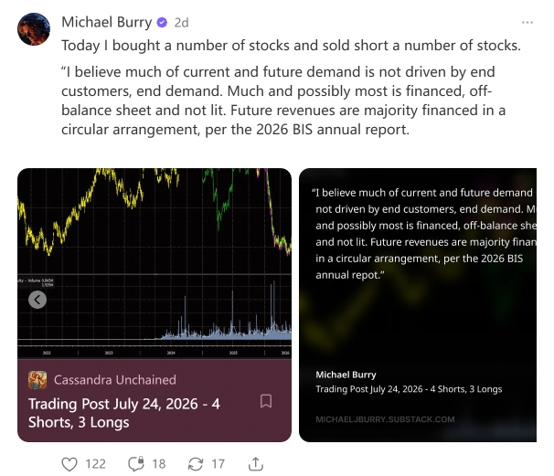
"The Big Short" Burry shorting memory stocks
Regarding the recent expansion plans announced by the Korean giants, Burry asserts this is a "landmark point where the semiconductor cycle turns from boom to bust," predicting the entire sector will face a correction of at least 30%.
However, there are also dissenting voices in the market. Bulls argue that the quarterly report Micron just delivered is the best in the company's history, with revenue, profit margins, and cash flow all hitting records.
Analysis from tech media CoinCentral highlights the real logic behind Burry's bet: he is not betting on an immediate collapse of end-user demand, but rather on the loss of control over memory manufacturers' capital expenditure. Micron's own massive capital expenditure of $27 billion is sowing the seeds for a "crash" in the next downward cycle.
High Stakes and Consequences
Just weeks before the "stampede," the global storage industry was still immersed in an unprecedented "super alignment."
At the AI Summit in San Francisco from July 24 to 25, SK Group signed a long-term agreement with Nvidia worth over $500 billion, securing HBM supply and joint development of HBM4. Combined with its partnerships with Microsoft and Anthropic, the total scale of these agreements is approximately $750 billion.
Simultaneously, Samsung Electronics signed a memorandum of understanding with Broadcom worth up to $200 billion. These two deals, totaling around $950 billion, have been called the largest long-term semiconductor supply lock-in in history by foreign media.
Around the same time, AMD acquired MEXT in an attempt to use flash memory to "disguise" as DRAM to reduce memory costs, and Meta locked in a multi-year NAND supply agreement with SanDisk.
This new round of alignment among Silicon Valley giants failed to provide positive momentum for storage concept stocks. More than short-term stock volatility, what truly unsettles long-term capital is a mega-industry plan announced by the South Korean government at the end of June. Samsung and SK Group will jointly invest 800 trillion Korean won (approximately $516 billion) to build four new fabs in southwestern Korea, aiming to double memory chip production capacity within five years.
Including a supporting 550 trillion Korean won HBM packaging hub and data center construction, the total investment scale reaches 1,350 trillion Korean won (approximately $880 billion), equivalent to 5% of South Korea's 2024 GDP.
The increased production expansion by memory manufacturers signifies the end of the industry's "supply discipline" and strict financial prudence maintained over the past two years.
Over the past two years, storage companies successfully pushed memory chip prices back to high levels by strictly controlling production and allocating capacity towards high-margin HBM. Now, SK Hynix's 2026 capital expenditure is projected to jump significantly, by 43% to 40 trillion Korean won, while Micron's capital expenditure for fiscal 2026 has also doubled year-over-year.
Morningstar analyst Jing Jie Yu warns that as these new capacities come online intensively between 2027 and 2028, the industry will inevitably face severe price erosion.
Analysis firm AInvest states that the expansion by manufacturers is no longer a victory march driven by AI demand but a replay of the script from the 2022-2023 overcapacity crash cycle.
Although it typically takes 18 to 24 months from fab construction to production launch, such as Samsung's P5 fab scheduled for mass production in the second half of 2027, and TrendForce judges that the DRAM supply shortage pattern is unlikely to fundamentally reverse before then, the stock market always trades on expectations, not the present.
It can be said that South Korea's mega-expansion plan shattered the market's fantasy of "sustainable high chip unit prices." The "night of terror" for the storage sector is essentially a disconnect between fundamentals and expectations.
Now, the sensitive capital markets have begun pricing in the potential supply glut of 2027 in advance. According to "The Big Short" Burry's expectations, the time window from the second half of 2027 to 2028, when the new Korean fabs enter mass production, will be the true test for the storage industry.