SpaceX逼近100美元,市場預期差在哪?


- 核心觀點:摩根士丹利認為SpaceX股價因鎖定期解禁導致的賣壓創下新低(約108美元),但這提供了買入機會,因其當前估值已完全忽略AI業務價值,僅靠火箭發射和星鏈業務即可支撐股價。
- 關鍵要素:
- 分析師維持增持評級及300美元目標價,若股價跌至100美元,市場對SpaceX AI業務的估值將為零甚至為負,火箭發射+星鏈業務的隱含EBITDA預測將比其基準低約30%。
- 以100美元股價計算,SpaceX對應2028年EV/EBIT為18倍,接近行業中位數,但其收入複合年增率(76%)是可比公司中位數(26%)的三倍。
- 摩根士丹利的15年DCF模型對火箭發射+星鏈業務單獨估值約為每股136美元,已高於當前股價,意味著AI業務是「搭贈品」。
- 當前SpaceX佔據全球質量入軌和可機動衛星在軌數量超過四分之三的份額,連接業務增長近50%,EBITDA利潤率高達40%。
- 近期正面催化劑包括星艦第14/15次試飛(9/10月)、Grok 4.6發布、以及算力翻倍至2吉瓦,可能觸發股價修復。
- 下行風險包括鎖定期解禁壓力、星鏈用戶增長放緩、AI基礎設施成本高企,以及監管不確定性,下行情景目標價75美元。
Author: Yang Chen
Source: Wall Street Sights
SpaceX’s stock price is under pressure from the looming lock-up expiration, but Morgan Stanley believes this creates a buying window due to a valuation mismatch.
During Monday’s trading session, SpaceX’s stock price once fell to $108.66, hitting a new low since its listing, dropping more than half from its high of $225.64. As the lock-up period nears its end, some investors believe the stock could dip further to $100.
According to reports from the trading desk, Morgan Stanley analyst Adam Jonas recently published a report stating that if the stock price truly falls to $100, it would imply the market is valuing SpaceX’s AI business at zero or even negative. Meanwhile, the implied 2028 EBITDA for its rocket launch and Starlink business would be about 30% lower than the firm's base case forecast.

The firm maintains an Overweight rating on SpaceX with a price target of $300. Morgan Stanley believes the current divergence between pessimistic sentiment and fundamentals presents an attractive entry point. At prices below $120, investors are essentially getting the option value of the company's entire AI business for "free," while the core rocket launch and Starlink business alone covers the current stock price.
Divergence Between Market Sentiment and Fundamentals
Although there have been no significant changes in SpaceX’s fundamentals over the past few weeks, bearish conviction has gradually strengthened, while bulls are increasingly inclined to wait for clearer catalysts.
From investor conversations, the core disagreement lies in the pricing of the AI business. Most investors heavily discount or completely ignore the value of Grok and Cursor, believing that AI monetization opportunities are primarily concentrated in the neocloud sector.
Reasons include: AI business capital expenditures are too high relative to the rocket launch and Starlink business, significant uncertainty in the economic model, and management’s excessive focus on this area.
Some investors even assign a negative value to AI, arguing that high capital expenditures will erode overall value. Morgan Stanley holds a different view, considering this pricing approach overly conservative and overlooking multiple potential AI monetization pathways.
What $100 Means
Based on the firm’s 2028 base case forecast—revenue of $157 billion (including an average 6GW of compute power priced at $16.5 per watt, and 35 million average consumer users with $46 monthly ARPU), and EBIT of approximately $69 billion—if the stock price falls to $100, SpaceX’s FY28 EV/EBIT would be 18x, roughly in line with the median level of comparable companies. However, its revenue compound annual growth rate from 2025 to 2030 is 76%, about three times the 26% median for comparable companies.
From a cross-sectional perspective, an 18x EV/EBIT ranks around the 81st percentile in the S&P 500 (excluding financials and real estate), falling within the same range as Boeing (21x), Waste Management (19x), CSX (18x), and Garmin (18x).
Breaking down the business further: If the rocket launch and Starlink business is valued at 40x EV/EBITDA—slightly below the median of 46x for space comparables—the implied value of the AI business would be exactly zero. If a slightly higher 50x multiple is used, the AI business would have an implied negative value of $300 billion. Morgan Stanley believes neither scenario is reasonable.

Core Business Already Supports Current Stock Price
Even completely excluding AI value, SpaceX’s rocket launch and Starlink business alone is sufficient to support the current stock price.
The firm's 15-year DCF model values the rocket launch and Starlink business independently at approximately $136 per share, using a 56x EV/EBITDA multiple. At the assumed price of $100, the implied 2028 EBITDA for this business is about 28% lower than Morgan Stanley’s base case forecast, while AI is assigned zero value.

Currently, SpaceX holds over three-quarters of the global share in quality orbital launches and maneuverable satellites in orbit. Its connectivity business has grown nearly 50% this year, with an EBITDA margin of 40%. Buying SpaceX at current valuations means acquiring a space and connectivity business with a dominant market position and high growth certainty at a discount, with almost all AI option value effectively thrown in as a "bonus."
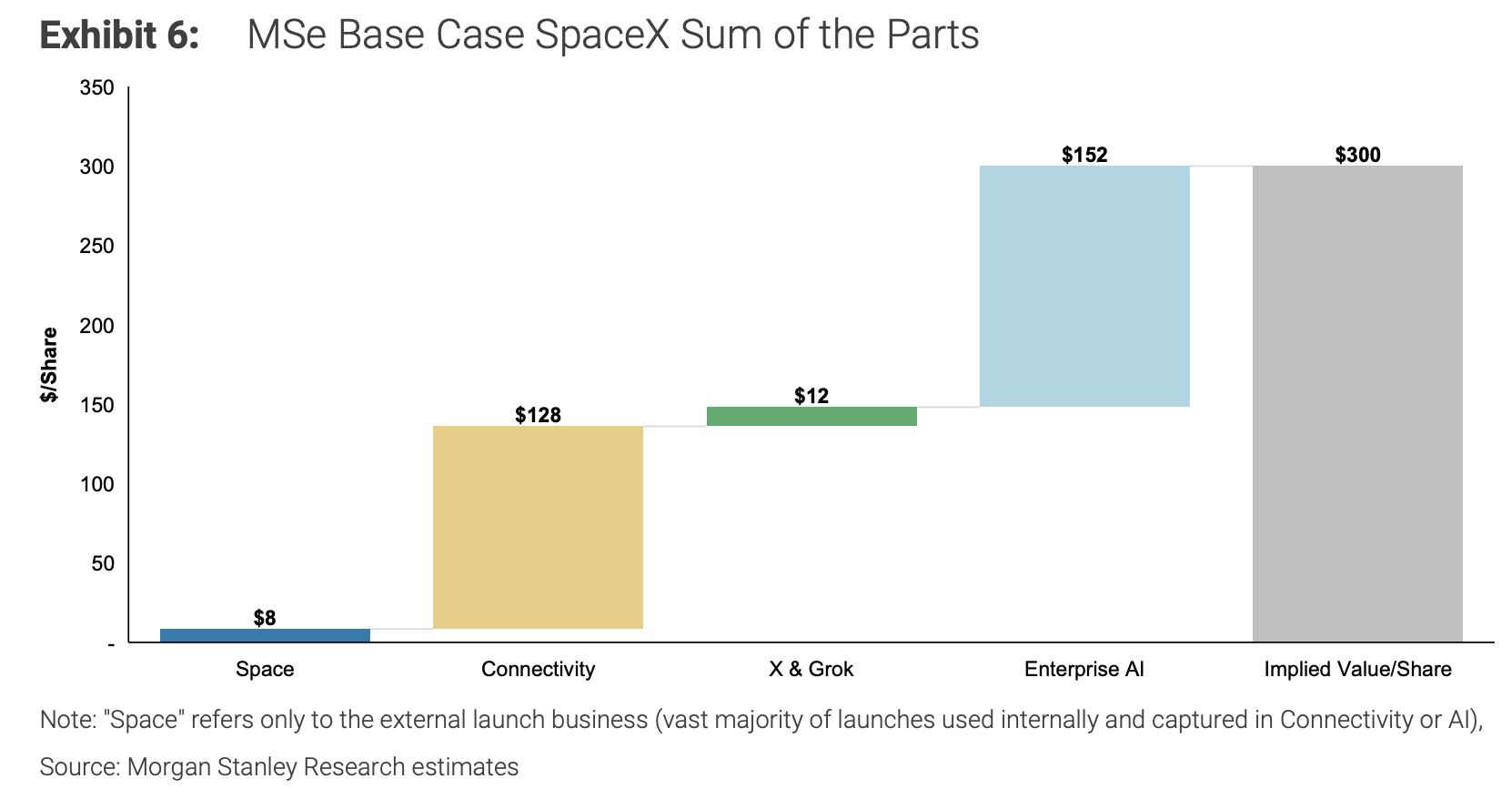
From a sum-of-the-parts valuation perspective, Morgan Stanley’s base case target price of $300 consists of: Space business $8, Connectivity business $128, X and Grok business $12, and Enterprise AI business $152.
Upcoming Positive Catalysts
On the launch front, Starship’s 14th and 15th test flights are expected in September and October, respectively, potentially including the first catch of the V3 Starship booster, the first orbital flight (with simultaneous deployment of operational V3 satellites), and the first catch of the Starship upper stage.
On the AI front, Grok 4.6 (a 2-trillion parameter model) is expected to be released within the next month, while Grok 5.0 (a 6-trillion parameter model) is expected later this year. The Cursor acquisition is expected to close by the end of the third quarter, at which point substantive updates on Cursor’s annual recurring revenue (ARR) and Grok platform adoption rates will be disclosed.
On the compute expansion front, SpaceX expects to double its computing power from current levels to 2 GW by year-end, which could lead to more large neocloud contract signings.
Given the market’s current near-zero pricing of AI, any of the above positive developments could serve as triggers for an upward stock price correction.
Key Risks Cannot Be Ignored
In the short term, the stock faces dual pressure. First, the upcoming lock-up expiration will bring additional supply pressure. Second, the upcoming earnings report may fail to answer investors’ most pressing questions.
A bear case scenario (price target $75) assumes: Starship delays compress the narrative, AI monetization speed is significantly below expectations, the rocket launch and Starlink business accounts for over 90% of total valuation, and Starship operations are postponed to 2029.
Other major downside risks include: slowing Starlink user growth, persistently high per-watt costs for AI infrastructure, prolonged AI business construction cycles, equity dilution from increased financing needs, and regulatory uncertainties.
A bull case scenario (price target $600) assumes full acceleration of Starship, orbital compute, and Terafab rollouts, with AI accounting for over 60% of total valuation and compute deployment achieving a 46% compound annual growth rate.