






AI牛市最大的敵人,不是泡沫,而是債市?


- 核心觀點:美國銀行首席策略師警告,美債收益率飆升和金融條件收緊已超越企業獲利,成為市場核心風險;這可能導致聯準會升息,進而引發科技股和AI相關資產去槓桿,同時超大規模雲端服務商的信用風險創歷史紀錄,質疑AI資本開支的回報邏輯。
- 關鍵要素:
- 30年期美債收益率升至5.2%(2007年6月以來最高),實質收益率達3%(2008年11月以來最高),美國科技債券價格跌至兩年低點,金融條件收緊成市場主要矛盾。
- 超大規模雲端服務商的CDS升至歷史最高水準,債券持有人質疑AI資本開支回報率,即使谷歌和英特爾財報穩健,晶片股仍遭拋售。
- 報告提出「FCI > EPS」框架,認為金融條件對市場的衝擊已超過企業獲利支撐;聯準會7月升息隱含機率達38%,升息可能扭轉股市牛市邏輯。
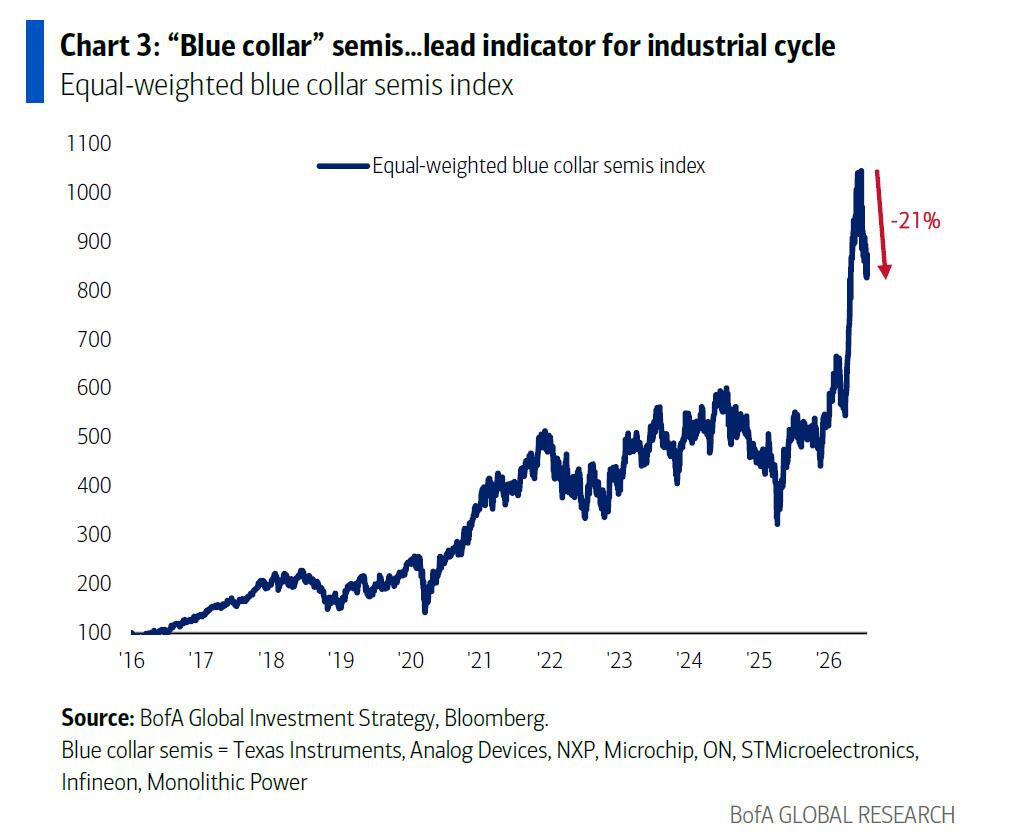
- 「藍領半導體」股票(如德州儀器)自6月高點下跌21%,代表工業週期領先指標走弱;超大規模科技巨頭正艱難守住200日移動均線支撐。
- 宏觀層面,2020年代供給成為驅動核心,包括勞動力、進口和石油供給受限,而債券與股票供給增加,資金壓力浮現。
- 黃金和比特幣正在2026年悄然築底;銀行股指數有望在2020年代下半段跑贏券商和私募股權指數。
Author: Dong Jing
Source: Wall Street Sights
The bond market is becoming the most dangerous variable in the AI bull run.
On July 27, Michael Hartnett, Chief Investment Strategist at Bank of America, issued a warning in the latest Flow Show report: The 30-year US Treasury yield has risen to 5.2%, its highest level since June 2007, the real yield has hit 3%, a peak not seen since November 2008, and US tech bond prices have fallen to two-year lows — the tightening of financial conditions is beginning to outweigh corporate earnings as a market support factor.
Hartnett's core thesis is: The pressure in the bond market will not dissipate on its own; instead, it may force the Federal Reserve to hike interest rates, which is precisely the outcome the stock market least wants to see. He warns that if the bullish combination of "rising bond yields and rising bank stocks" flips to "higher yields cause bank stocks to fall," it could trigger a new round of deleveraging in risk assets.
Meanwhile, credit default swaps (CDS) for hyperscale cloud computing companies have surged to record highs, as bondholders are voting with their feet, questioning the logic of returns on the AI capital expenditure frenzy.
The backdrop to this warning: Despite robust earnings reports from Google and Intel, chip stocks were still sold off. The market's real concern has shifted from "can they make money?" to "who will foot the bill?" — If the bond market stops funding the AI boom, where will the capital come from for those sky-high memory chips and frontier models with negative returns?
Bond Market Pressure Outweighs Earnings; Financial Conditions Become the Core Variable
In his report, Hartnett explicitly introduces the core framework "FCI > EPS": the impact of tightening financial conditions (Financial Conditions Index) on the market now exceeds the supportive role of corporate earnings (EPS).
The nominal 30-year US Treasury yield has reached 5.2%, the highest since June 2007; the real yield has risen to 3%, the highest since November 2008; and US tech bond prices have fallen to two-year lows. The convergence of these three indicators means that market financing costs are systematically rising, a pressure not yet fully priced in by stock investors.
Hartnett notes there have been 23 central bank rate hikes globally so far in 2026, with Bank of America expecting 18 more before year-end. More notably, the implied probability of a Fed rate hike at the July 29 FOMC meeting has risen to 38%, while the September 16 meeting is fully pricing in one hike. He even posed a provocative question in the report:
"Politically, it's smarter for the Fed to hike this week rather than waiting until September, isn't it?"
Hartnett's logic points to a paradoxical outcome: The pressure in the bond market might actually force the Fed to hike rates to stabilize long-term yields. He believes the only way to resolve this situation is for the Fed to raise rates to curb the disorderly rise in long-end yields.
However, rate hikes are not good news for the stock market. Hartnett warns, it's crucial to watch if the bullish combination of "rising yields and rising bank stocks" flips to "higher yields cause bank stocks to fall" — such a flip would be the trigger for deleveraging risk assets. In this scenario, he suggests going long on the US dollar as the best hedge against the Fed's hawkish stance.
He also points out that stock investors currently do not see interest rates as a threat to the "Anything But Bonds" (ABB) bull market. But if a pro-market Trump administration tolerates rate hikes to "put the brakes" on the stock market and anti-billionaire sentiment, the market could face a significant negative shock.
Hyperscaler Credit Risk Hits Record High; Logic of AI Capital Expenditure Questioned
The most direct manifestation of bond market pressure is the sharp deterioration in credit risk indicators for hyperscale cloud companies. The report states that credit spreads for the hyperscaler group have widened significantly, CDS levels have reached record highs, and concession on bond issuance is also expanding.
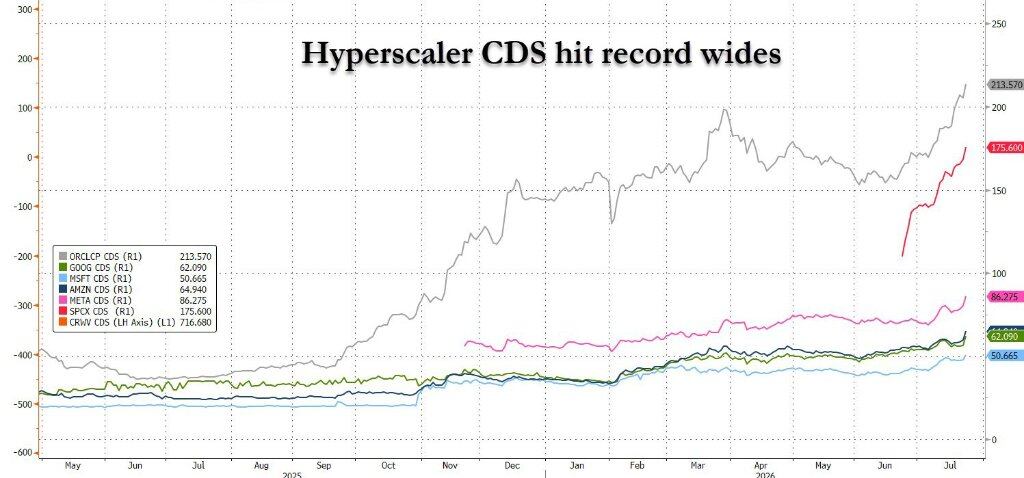
The root cause of this phenomenon is market skepticism regarding the return on investment (ROI) for AI capital expenditure. Google and Tesla are considered benchmark companies for "capital expenditure ROI." Despite solid earnings from Google and Intel last week, chip stocks were still sold off. The core question the market is asking:
If bondholders are no longer willing to fund the AI boom, frontier models and memory chip demand that heavily rely on continuous capital investment face the risk of funding drying up.
Hartnett's views echo those of Brian Garrett, a top derivatives trader at Goldman Sachs, who previously warned that the real risk for AI stocks lies not within the stock market itself, but in the bond market. Garrett had warned for two consecutive weeks about increasing pain in the credit market, pointing out that the S&P 500 is increasingly less representative of average stock performance, with internal market dispersion (low correlation, high dispersion) intensifying.
Additionally, Hartnett considers "blue-collar semiconductors" — namely Texas Instruments, Analog Devices, NXP, Microchip, ON Semiconductor, STMicroelectronics, Infineon, and Monolithic Power Systems — as leading indicators for the industrial cycle. This group has fallen 21% from its June high.
Meanwhile, the mega-cap tech giants (MAGS) are struggling to hold the support level of the 200-day moving average ($65), challenging the widely held "boom" consensus. The Bank of America July fund manager survey shows investor overweight in industrial stocks is at its highest since July 2021.
In response to these signals, Hartnett's short-term trading advice is: Go long on defensive stocks, high-dividend stocks, and long-duration bonds; go short on bank stocks (which have seen significant recent inflows), broker-dealer stocks, tech stocks, and industrial stocks, to position for a reversal of the "boom" expectation.
Dual Pressure on Bond and Stock Supply; Gold and Bitcoin Quietly Forming a Bottom
From a broader macro perspective, Hartnett characterizes the 2020s as: an era of rising political populism, globalization yielding to national security, fiscal excess pivoting to AI capital expenditure excess, Fed independence compromised by politics, and US exceptionalism evolving towards global rebalancing.
In this context, "supply" rather than "demand" becomes the primary driver of macroeconomics and markets. This is manifested in three dimensions:
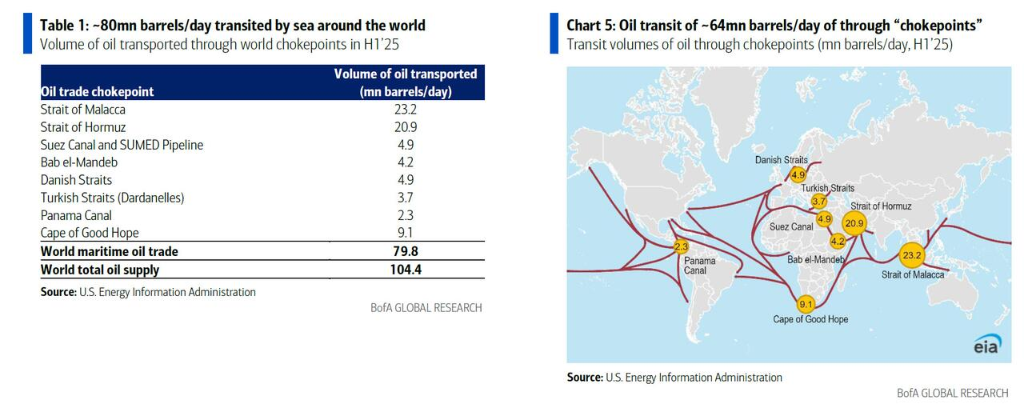
Immigration controls compress labor supply (US initial jobless claims fell to their lowest since 1969); protectionism and tariffs limit import supply (US plans new tariffs on 60 trading partners); geopolitical factors disrupt oil supply (of the ~80 million barrels/day of seaborne oil, ~64 million barrels pass through vulnerable chokepoints like the Strait of Hormuz and Bab el-Mandeb).
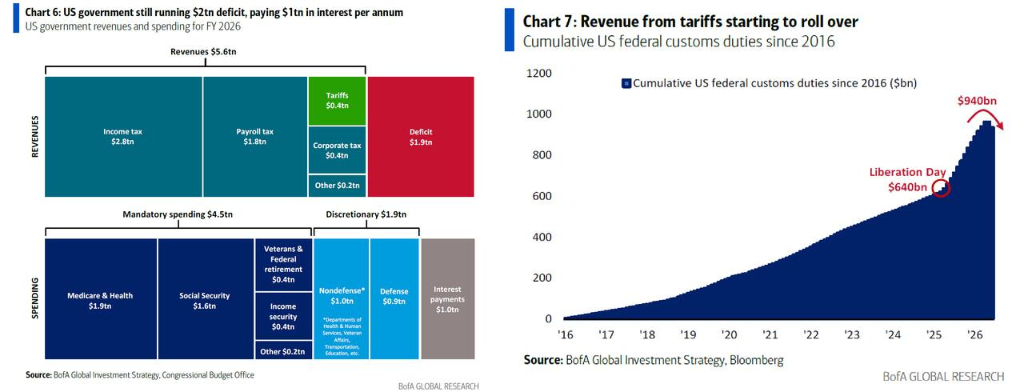
In contrast, constraints on bond supply and stock supply are loosening. The US government maintains an annual fiscal deficit of $2 trillion, with interest payments reaching $1 trillion per year. Even the $250 billion in tariff revenue over the past 12 months is insufficient to fill the gap. Companies with negative free cash flow are reducing stock buybacks, further diminishing support from stock supply.
Against this backdrop, Hartnett believes gold and Bitcoin are quietly forming a bottom in 2026, while the bank stock index, representing "Main Street," is poised to outperform the broker-dealer and private equity indices, representing "Wall Street," in the latter half of the 2020s.
Furthermore, he identifies Hong Kong property stocks as one of the most attractive long-term buying opportunities — their current prices are the same as 30 years ago. He states he will buy the dip during any sell-off triggered by Fed tightening or a BoJ exchange rate crisis.





