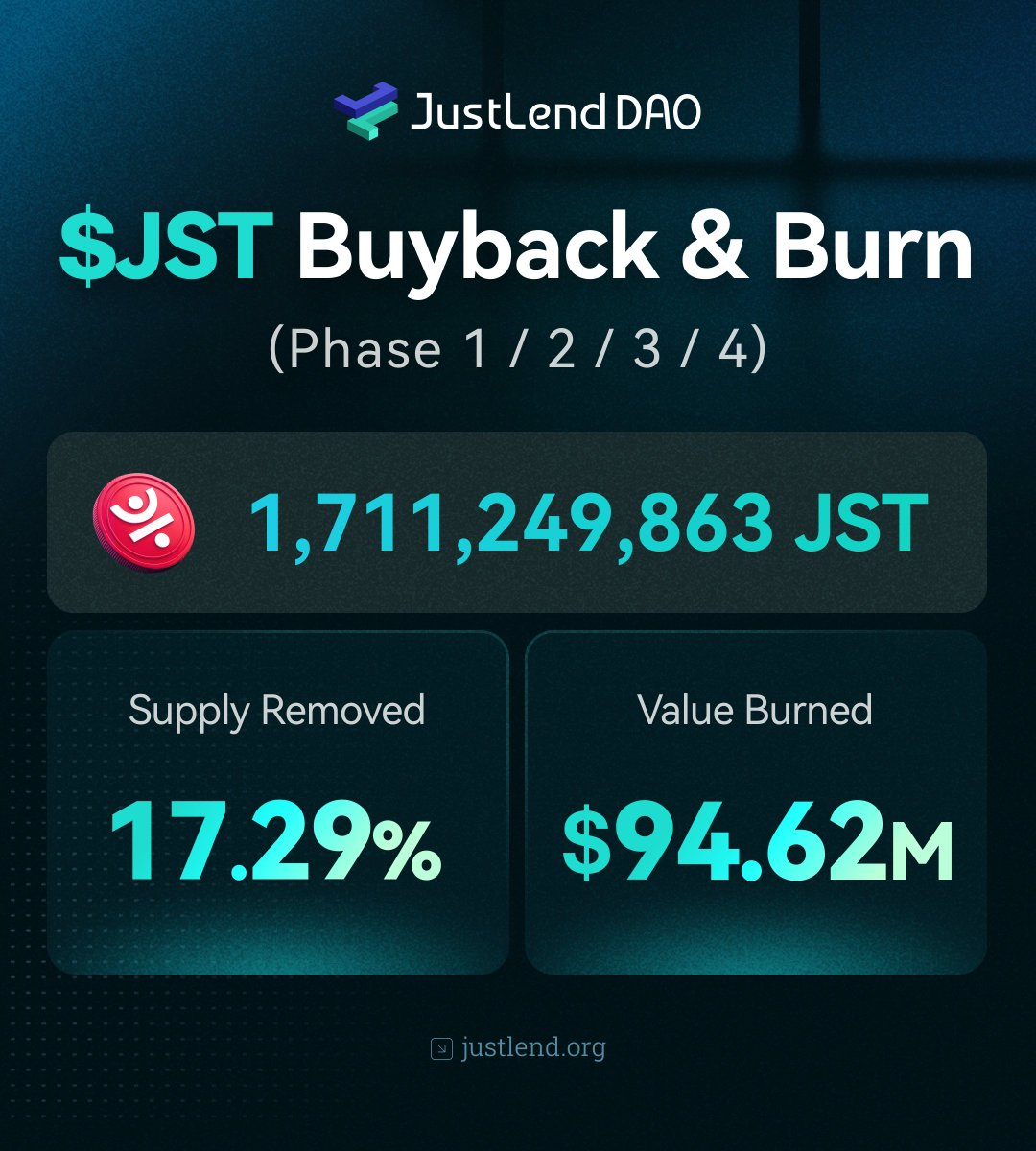
JUST completed four rounds of JST buybacks and burns, cumulatively destroying 1.711 billion JST with a deflation rate approaching 20%. JustLend DAO's revenue continues to drive deepening deflation.


- Core Insight: Amid a deep downward cycle in the crypto industry, the JUST ecosystem, powered by real business profits from its core protocol JustLend DAO, has completed four rounds of large-scale JST buybacks and burns over nine consecutive months. A total of 1.711 billion JST (17.29% of total supply) has been destroyed, with an investment of over US$94.6 million, achieving counter-trend deflation and price appreciation for JST. This validates a token value growth model driven by real earnings.
- Key Elements:
- The four rounds of buybacks and burns cumulatively invested US$94.62 million, destroying 1.711 billion JST (17.29% of total supply). The scale of destruction increased with each round, with the fourth round reaching an all-time high single-round investment of US$34.59 million.
- Over US$94 million in burn funds came entirely from the real business net profits of JustLend DAO (including existing reserves and new quarterly profits). The single-quarter net profit has stabilized at over US$10 million, forming a sustainable cash flow.
- The JST price rose from approximately US$0.03 to US$0.1, and its circulating market cap surged from below US$300 million to US$830 million, achieving an increase of over 333% during the period, ranking JST among the top 70 globally. Over the same period, Bitcoin fell by approximately 40%.
- JustLend DAO's TVL stands at US$6.664 billion, supporting a diversified business matrix including SBM Lending (TVL US$3.29 billion, top 4 globally), sTRX Liquid Staking, Energy Rental, and the GasFree Wallet, ensuring diversified revenue streams.
- The ecosystem's total TVL is US$11 billion, accounting for 41% of the entire TRON network's TVL. The USDD stablecoin supply exceeds US$1.53 billion, poised to become the "second profit engine" for JST deflation.
- All buybacks and burns are executed on-chain independently by the decentralized Grants DAO, with transparent and traceable data. An estimated ~US$21.55 million is projected to be invested in JST buybacks in the next quarter.
With the successful completion of the fourth round of buyback and burn on July 17, the JUST ecosystem, the core decentralized finance infrastructure of the TRON ecosystem, has orderly and fully completed four consecutive large-scale JST buyback and burn operations, backed by the stable profitability of its core DeFi protocol, JustLend DAO.
To date, a cumulative total of 1.711 billion JST has been burned across four rounds, accounting for 17.29% of the initial total supply. Nearly one-fifth of JST has been permanently removed from circulation, with cumulative funds deployed exceeding $94 million.
This substantial achievement presents a stark contrast to the current environment of the crypto industry. The sector is currently in a deep downward correction and consolidation cycle. A large number of DeFi projects are facing the triple impact of shrinking revenues, drying cash flows, and user attrition, forcing them to cut costs, while some established protocols have even chosen to shut down operations. Yet, in this counter-cyclical environment, the JUST ecosystem has continued to deploy tens of millions of dollars in real funds round after round, driving each large-scale on-chain JST buyback and burn on schedule and in full amount. Even as the crypto market remains under pressure and overall industry sentiment is low, JUST has never reduced the scale of any burn round nor interrupted the planned deflationary execution.
The core confidence behind JST's ability to forge this independent, counter-cyclical deflationary growth curve lies in JustLend DAO's long-term, stable ecosystem profitability. As the primary financial pillar for JST buybacks and burns, JustLend DAO relies on real business operations to generate positive returns consistently. Its quarterly profitability has remained stable at the tens of millions of dollars level for several consecutive quarters, providing sufficient and stable funding sources for JST's regular large-scale buybacks.
More importantly, the JUST ecosystem is continuously exploring new incremental funding channels. The fourth round of burns included, for the first time, a dedicated burn of historical USDJ stability fees. Meanwhile, the cumulative profitability of the USDD ecosystem is also poised to surpass the $10 million mark. These new funding sources, combined with JustLend DAO's core business revenue, form a solid foundation for long-term, sustainable large-scale burns. As the ecosystem's profitability continues to grow, the intensity and sustainability of future burns are expected to increase, accelerating the token's deflationary process.
Accelerated Release of JST Deflationary Value: Over 1.711 Billion JST Burned Across Four Rounds, Deflation Rate Reaches 17.29%, Total Funds Deployed Exceed $94.6 Million
Since the buyback and burn mechanism was implemented in October 2025, JST has successfully completed four rounds of large-scale buybacks and burns in just nine months. A cumulative total of 1.711 billion JST has been burned, representing approximately 17.29% of the total token supply, with cumulative funds deployed exceeding $94.62 million. Based on JST's recent market price of around $0.10, the total market value of the permanently burned JST tokens over the four rounds is nearly $170 million.
Such frequent, large-scale, and consistently executed real burns are rare across the entire Web3 and DeFi industry, fully demonstrating the JUST ecosystem's firm strategic determination to empower JST value in the long term and adhere to genuine deflation.
A review of the complete execution data for the four rounds of buybacks and burns clearly shows that the scale of funds deployed in each JST burn round has maintained a steady upward trend. Multiple rounds have exceeded expectations by broadening revenue sources, continuously escalating the deflationary intensity:
- First Round (October 22, 2025): Burned approximately 559 million JST, representing 5.66% of the total supply, with corresponding funds of $17.72 million. The funds were entirely sourced from JustLend DAO's historical retained earnings, marking the official start of JST's regular deflationary cycle.
- Second Round (January 15, 2026): Burned approximately 525 million JST, representing 5.30% of the total supply, with corresponding funds of $21 million. The funds comprised JustLend DAO's retained earnings plus the net profit from Q4 2025, with the burn scale exceeding market expectations.
- Third Round (April 15, 2026): Burned approximately 271 million JST, representing 2.74% of the total supply, with corresponding funds of $21.3 million. Supported by DAO retained earnings and new profits from Q1 2026, the scale of funds deployed continued to increase slightly.
- Fourth Round (July 17, 2026): Burned a total of approximately 355 million JST, representing 3.59% of the total supply. Regular burn funds were sourced from DAO retained earnings and Q2 2026 net profits. Additionally, a dedicated burn of historical USDJ stability fees was included for the first time, significantly boosting the total deployed funds to $34.59 million, setting a new all-time high for a single burn round.
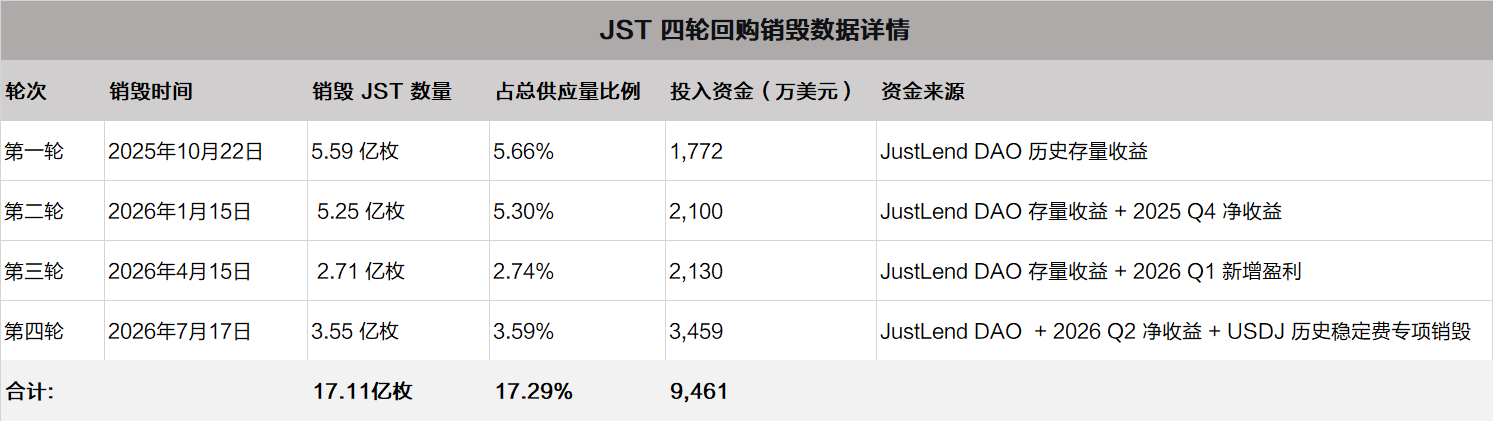
Looking at the scale of funds deployed across the four buyback and burn rounds, an upward trend of steady increase and sequential expansion is evident: The first round relied solely on JustLend DAO's historical retained earnings for a $17.72 million burn. The second round added new net profits from Q4 2025, increasing the fund scale to $21 million. The third round incorporated profits from Q1 2026, with the deployed scale slightly increasing to $21.3 million. The fourth round added dedicated historical USDJ stability fees as incremental funds on top of regular quarterly earnings, pushing the single-round burn volume to over $34.5 million. This multi-round data clearly confirms that the JST buyback and burn fund pool is continuously widening, and the burn intensity consistently surpasses market predictions, repeatedly delivering value returns that exceed community expectations.
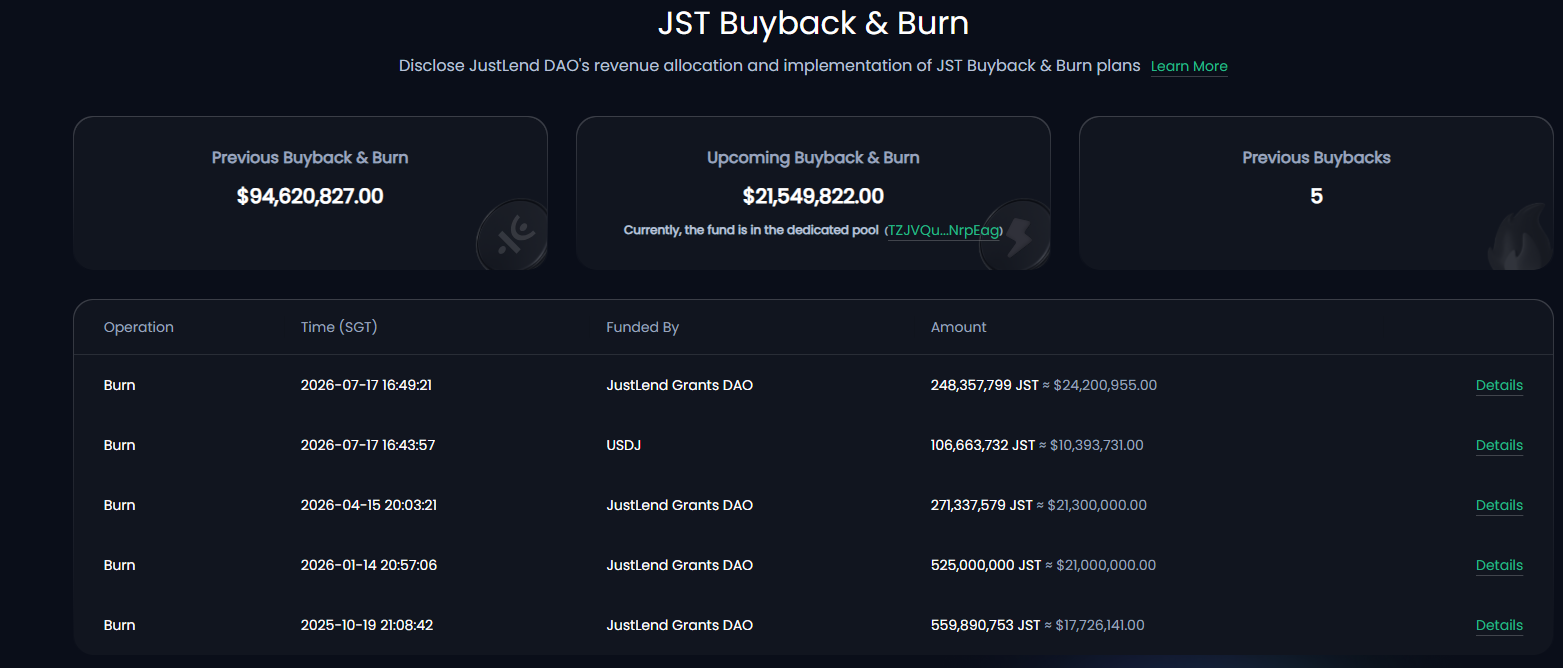
Importantly, all JST buyback and burn operations are executed independently on-chain by the decentralized governance organization Grants DAO, without centralized institutional intervention. Users can check the complete records, including the number of tokens burned, fund amounts, and on-chain transaction hashes for each round, via the JustLend DAO official website's Transparency section or the Grants DAO official page. All burn records are permanently stored on-chain, with data being open, transparent, and fully verifiable and traceable.
In just nine months, the JUST ecosystem has orderly executed four rounds of large-scale on-chain buybacks and burns according to governance plans. Cumulatively, nearly 20% of JST's original total supply has been permanently burned and removed from circulation. Under the fundamental rule of a constant total token supply with no additional issuance, each buyback and burn is a permanent reduction of the circulating supply. As rounds of burns proceed on schedule, the circulating tokens in the market continue to shrink, constantly strengthening JST's scarcity attribute and steadily enhancing its intrinsic value.
CoinGecko data intuitively confirms the effectiveness of this value logic: Since the official buyback and burn mechanism was launched in October 2025, JST has charted an independent, counter-cyclical trend completely detached from the broader market. The token price has steadily risen from a low of approximately $0.03 to the current threshold of $0.10. The circulating market cap has surged from under $300 million to $830 million, achieving a cumulative gain of over 333% during the period, successfully propelling the token's market cap ranking into the global top 70 cryptocurrencies.
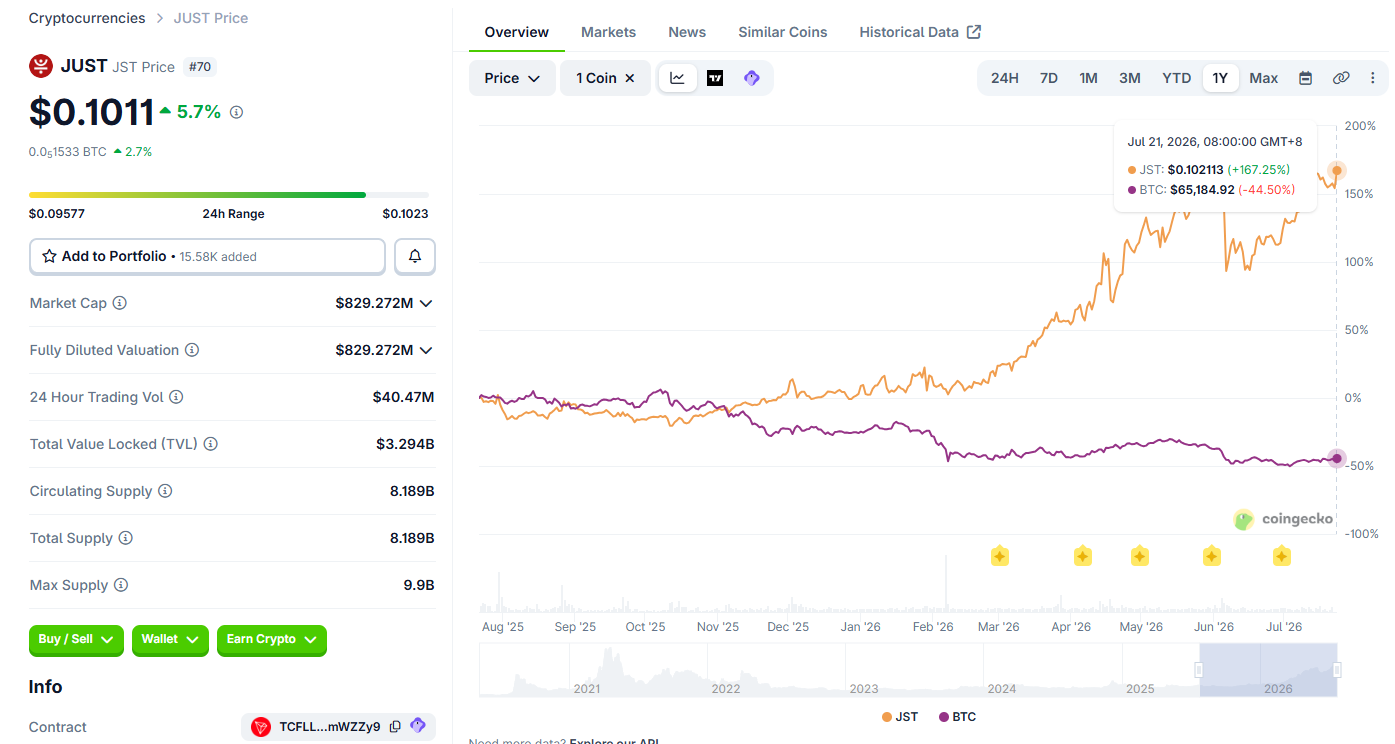
In contrast, the broader crypto market trend over the same period saw Bitcoin decline from an all-time high of around $100,000 to a volatile downtrend to its current price near $65,000, a cumulative drop of 40%. In a bear market environment where mainstream crypto assets were generally under pressure and most token prices saw significant pullbacks, JST's contrarian upward trend strongly demonstrates that a regular deflationary mechanism supported by real business revenue can build a solid value moat for a token.
Looking ahead, as each round of buybacks and burns continues, JST's circulating supply will keep decreasing, the scarcity effect will be further amplified, and the deflationary value will be released at an accelerated pace.
JustLend DAO Drives JST Deflation with Real Revenue, Diversified Product Matrix Continues to Bolster Long-Term Deflation
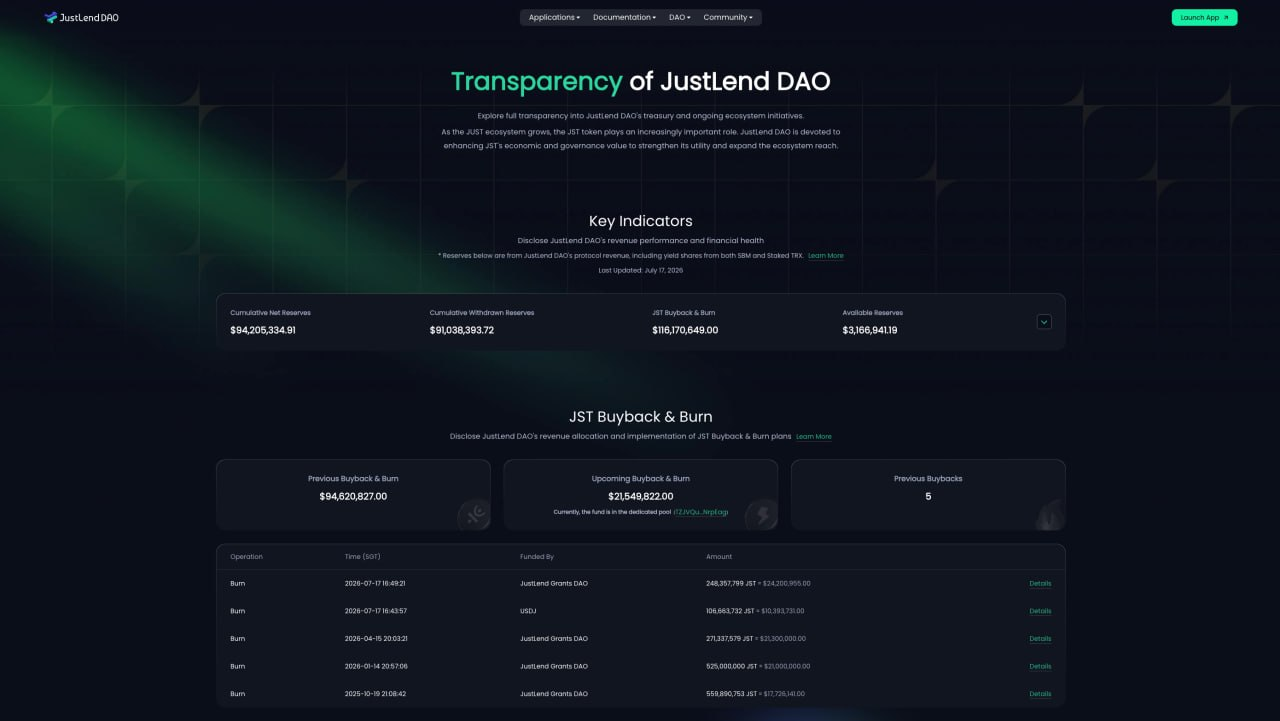
Reviewing the achievements of the four rounds of large-scale JST buybacks and burns, the cumulative total funds deployed for burns have exceeded $94.62 million. Over $94 million of this came entirely from JustLend DAO's real business net profits, including both the historical retained earnings accumulated in the early stages of the ecosystem and the new operating profits released each quarter. As of now, JustLend DAO still holds $10.34 million in retained earnings, ready to be deployed in the next regular buyback and burn round.
According to the previously established buyback and burn mechanism, JST's buyback funds primarily come from two core sources: firstly, JustLend DAO's historical retained earnings and new net profits per quarter; secondly, excess profits generated after the USDD multi-chain ecosystem's revenue surpasses the $10 million threshold. To date, USDD's cumulative revenue has not yet met the criteria for inclusion in the fund pool. Therefore, aside from the first-time dedicated burn of historical USDJ stability fees in the fourth round, all funds for the four regular buyback and burn rounds came entirely from JustLend DAO's real business operating income. The funding source is transparent and genuine, with no external fundraising or subsidies involved.
Looking at the specifics: when the JST buyback and burn mechanism was officially launched in October 2025, the ecosystem initially withdrew 59.08 million USDT from JustLend DAO's retained earnings as a startup fund pool. The first round directly utilized 30% (approximately $17.72 million), and the remaining 70% was scheduled to be deployed evenly over four quarters, with a fixed quarterly deployment scale of approximately $10.34 million. Starting from the second round of buybacks and burns, the fund composition evolved from a "single retained earnings release" to a "retained earnings + quarterly new net profit" dual-engine model. This immediately pushed the funds deployed in a single round to over $20 million: $21 million in the second round, approximately $21.3 million in the third, and about $20.6 million for the regular portion of the fourth round. With the addition of the dedicated USDJ historical stability fee burn, the total for the fourth round exceeded $34 million, setting a new historical high for JST buyback and burn scale.
This clear trajectory of fund evolution fully confirms that, from Q4 2025 to the present, JustLend DAO's single-quarter net profit has consistently remained above the $100 million scale. This has formed a predictable and sustainable stable cash flow, securing an unshakeable and solid foundation for the long-term operation of JST's deflation mechanism.
According to the latest data disclosed on the official Transparency page, JustLend DAO's platform cumulative net profit has surpassed $94.2 million. A total of $91.04 million has been withdrawn, with approximately $3.17 million in profits remaining. Of this, the funds deployed to the JST buyback and burn pool have reached nearly $105 million. Deducting the $10.39 million USDJ dedicated historical stability fees, nearly $94 million originated from JustLend DAO. Currently, JustLend DAO still has about $10.34 million in retained reserve earnings, which will be deployed as planned in the next regular burn process.
As the core financial pillar for JST buybacks and burns, JustLend DAO is not resting on its current earnings scale. Instead, it continues to inject stronger real revenue support for future buybacks through the iterative improvement of its product matrix and healthy growth in operational data.
Currently, JustLend DAO has built a comprehensive DeFi business matrix covering multiple scenarios, including SBM Lending, sTRX Liquid Staking, Energy Rental, and the GasFree Smart Wallet. Driven by the synergistic operation of the entire ecosystem, it consistently maintains stable and sustained revenue output capability, continuously supplying "ammunition" for JST buybacks and burns. As of July 21, JustLend DAO's Total Value Locked (TVL) stands at a substantial $6.664 billion, providing secure and efficient one-stop DeFi services to nearly 486,000 global users.
Looking at individual product dimensions, whether it's the core SBM Lending market, specialized features like TRX Liquid Staking and Energy Rental, or innovative tools like the GasFree Smart Wallet, each business line of JustLend DAO possesses strong market competitiveness, firmly holding a top-tier position in its respective niche.
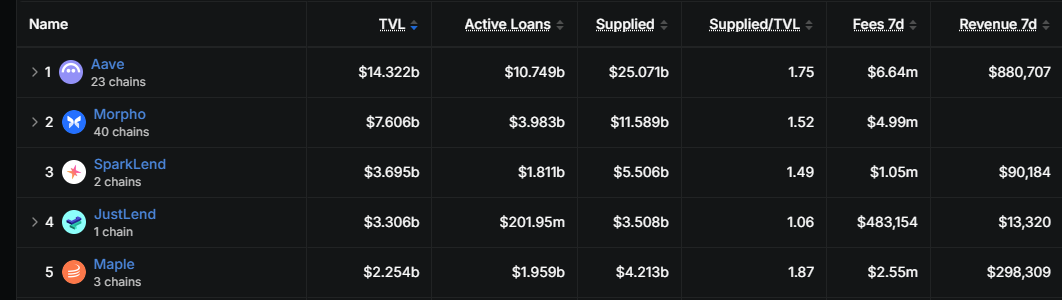
According to public data from DeFiLlama, JustLend DAO's SBM Lending market has a TVL of $3.29 billion, consistently ranking among the top four globally in the lending track. Within the SBM lending market, the supply asset size exceeds $3.492 billion, while borrowed assets amount to $200 million. Capital activity and overall scale remain at the forefront of the industry.
More notably, in June 2026, JustLend DAO officially launched SBM V2, innovatively introducing an isolated pool mechanism. This expands the lending business from a single market structure to a dual-track model where SBM V1 and SBM V2 operate in parallel. SBM V1 continues to handle the deposit and borrowing needs for mainstream assets. SBM V2 adopts an isolated lending market architecture, capable of covering more new types of assets, further enhancing the platform's overall security and risk resistance capabilities.
sTRX Liquid Staking has long been the preferred platform for TRON ecosystem users to stake their TRX. According to the latest operational data, the amount of TRX staked via sTRX has exceeded 9.73 billion, with the number of unique participating addresses surpassing 17,000. Both the total staked amount and the number of participating users have maintained a steady upward trend. The Energy Rental business, derived from liquid staking, utilizes a flexible "pay-as-you-rent" model. It thoroughly solves the pain point of ordinary users needing to stake large amounts of TRX long-term just to reduce gas costs, allowing all on-chain users to enjoy the low-cost transaction advantages of the TRON chain with zero barriers. To date, the total cumulative users participating in energy rental has exceeded 80,000.
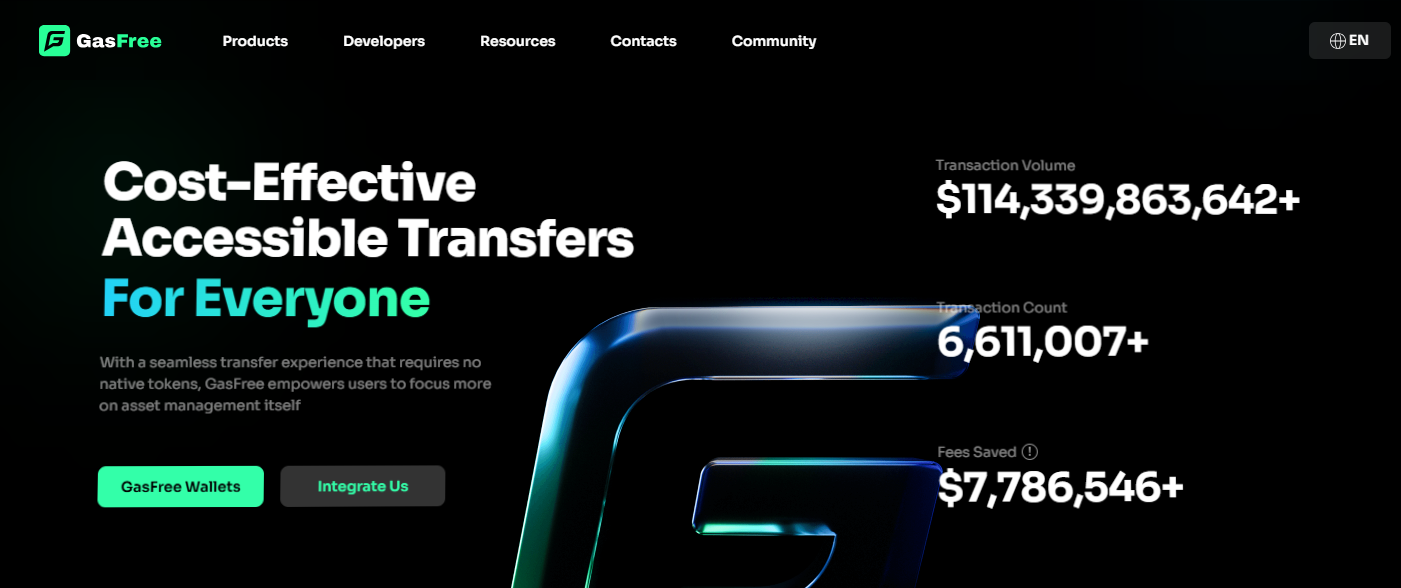
Simultaneously, the GasFree Smart Wallet, as an innovative smart tool focused on gas optimization, allows users to pay on-chain fees directly from the target tokens being transferred, without needing to hold the network's native token, TRX. This effectively removes the barrier of requiring native tokens for on-chain transactions. Its user scale and transaction volume are growing rapidly. As of July 21, the GasFree Smart Wallet has processed a cumulative transaction volume exceeding $114.3 billion, served over 6.6 million accounts, and saved users a cumulative total of $7.78 million in fees. It is rapidly becoming a new growth engine for the JustLend DAO ecosystem.
From SBM Lending, sTRX Liquid Staking, and Energy Rental to the GasFree Smart Wallet, JustLend DAO has constructed a comprehensive DeFi platform with complete functionality and diversified revenue sources. Multiple business lines create stable income synchronously, forming a profitable landscape where various initiatives flourish.
Currently, the funds for JST buybacks and burns mainly come from JustLend DAO's mature businesses, such as sTRX Staking, Energy Rental, and SBM Lending. Going forward, revenue from innovative businesses like GasFree will be gradually incorporated into the overall revenue statistics system of the JustLend DAO platform, continuously broadening the funding channels for JST's buyback and burn operations.
JUST Ecosystem Synergy Contin