






The first blockchain stock's share price plummeted 96%, will Canaan Technology be delisted?


- Key Takeaway: Canaan Technology received a 180-day grace period from Nasdaq until January 2027 due to its stock price remaining below $1 for an extended period. However, its sharp revenue decline, widening losses, and strategic missteps have led to a severe delisting crisis, reflecting the survival difficulties of the crypto mining industry during a cyclical downturn.
- Key Elements:
- Canaan Technology received a 180-day grace period until January 11, 2027, after its ADS stock price remained below $1 for 30 consecutive trading days. Its market value has shrunk over 90% from its peak to approximately $217 million.
- Q1 2026 financial report showed total revenue of $62.7 million, a year-over-year decline of 24.3%, with a net loss of $88.7 million, a sharp sequential increase of 68%, and an inventory impairment provision of approximately $25 million.
- The company terminated its non-core AI chip business and returned to Bitcoin mining machines and self-operated mining. However, this business incurred operating expenses of up to $21.42 million in fiscal year 2024, contributing only about $900,000 in revenue.
- The company's Bitcoin reserves hit a record high, holding 1,807.6 Bitcoins (worth $142 million) at the end of Q1 2026, but its performance is highly correlated with Bitcoin's price, increasing risk.
- The company is transitioning into a computing power infrastructure service provider, with self-operated mining total computing power reaching approximately 11 EH/s, and has received $72 million in strategic investments from institutions like BH Digital.
On July 15, Canaan Inc. announced that it had received a written notice from Nasdaq granting an additional 180-day grace period, extending the deadline to January 11, 2027. Previously, the closing price of its ADS had been below $1 for 30 consecutive trading days, triggering a compliance alert for Nasdaq's minimum bid price requirement.
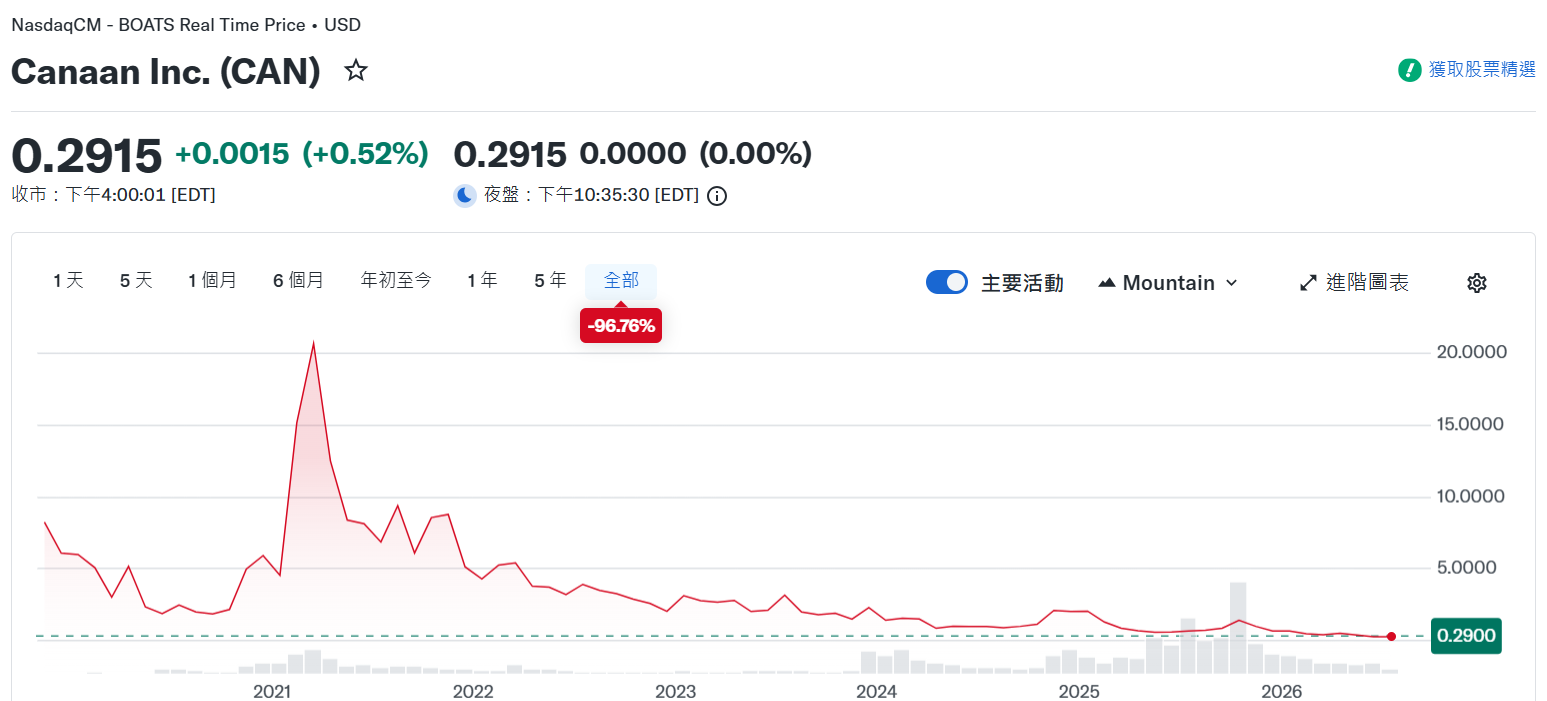
The market reaction was muted. At market close, Canaan's stock was priced at $0.29, with a total market capitalization of approximately $217 million—a drop of over 90% from its peak valuation in November 2019, when it was first listed. This company, once hailed as the "world's first blockchain stock," now stands on the brink of delisting.
The 180-Day Countdown to Delisting
Canaan's tug-of-war with Nasdaq's compliance department began in May 2025. At that time, the company first received a delisting warning due to its stock price persistently trading below $1. It temporarily resolved the crisis on the back of a Bitcoin price rebound. However, the reprieve was short-lived. On January 14, 2026, Nasdaq issued another notice: Canaan's ADS closing price had been below $1 for 30 consecutive trading days, requiring the company to achieve compliance by July 13, meaning its closing price must meet or exceed $1 for 10 consecutive trading days.
The initial grace period expired on July 13. Canaan failed to meet the requirement. On July 1, the company urgently transferred its listing from the Nasdaq Global Market to the Nasdaq Capital Market, which has relatively lower entry thresholds, and submitted an application for an additional 180-day extension.
On July 15, the application was approved, setting a new deadline of January 11, 2027.
According to Nasdaq rules, if Canaan still fails to regain compliance by then, it could face eventual delisting. The company has stated that, if necessary, it will consider implementing a reverse stock split to boost the share price, although this is typically viewed by the market as a sign of weakness.
2026 Q1 Financial Report: Total Revenue Down 24.3%, Net Loss of $88.7 Million
Canaan's stock price slump is not without reason. Its latest financial report reveals a company in a severe state of financial bleeding.
On May 19, 2026, Canaan released its unaudited first-quarter financial report: total revenue was $62.7 million, down 24.3% year-over-year and a sharp 68% decline quarter-over-quarter; net loss was $88.7 million, widening from the $86.4 million loss in the same period last year. The company recorded a gross loss of $22.9 million, which included approximately $25 million in non-cash inventory write-downs—meaning Canaan had to significantly devalue its miner inventory, reflecting a sharp contraction in market demand.
More concerning is the company's second-quarter revenue guidance, which is only between $35 million and $45 million, indicating continued short-term performance pressure. As of March 31, 2026, the company's cash balance was $43.5 million, a significant drop from $80.8 million at the end of 2025. However, in April, the company collected approximately $42 million in customer receivables, providing some relief to its liquidity.
Notably, despite losses in its core business, Canaan's cryptocurrency reserves hit a record high: at the end of the first quarter, the company held 1,807.60 Bitcoins (valued at $142 million). These digital assets provide some hedging on the balance sheet but also tie the company's performance closely to Bitcoin price fluctuations.
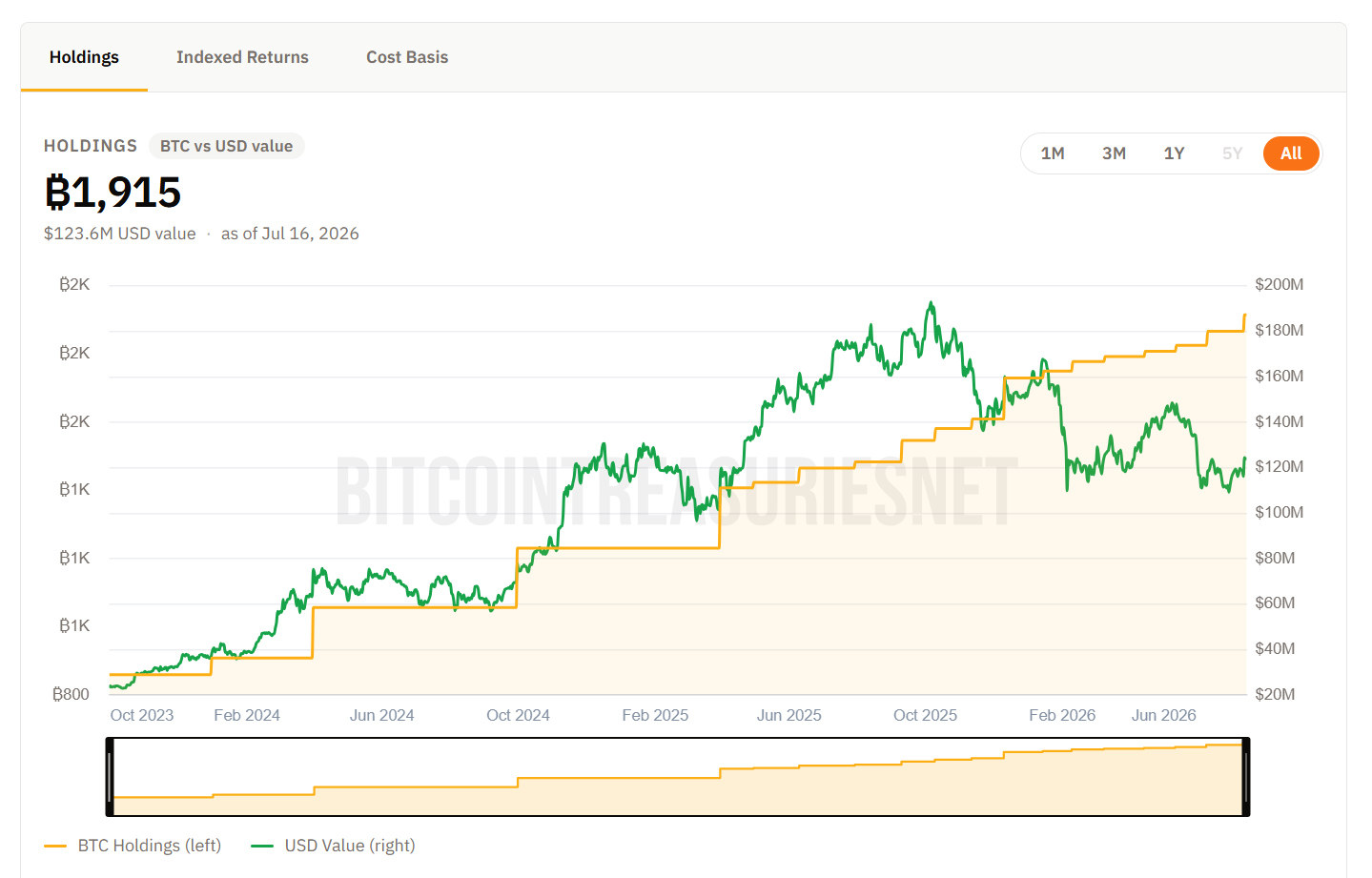
According to the latest data, Canaan's Bitcoin reserves have risen to 1,915 BTC, but their total value has dropped to $120 million.
The Shattered AI Chip Dream and the "Shovel Seller" Dilemma
Canaan's predicament partly stems from a costly strategic misjudgment.
On June 24, 2025, the company announced it would terminate its non-core AI chip business and fully return to Bitcoin mining machines and self-operated mining. Its multi-year exploration for a "second growth curve" ended in failure. According to public information, Canaan generated only about $900,000 in revenue from edge computing products in fiscal year 2024, but related business operating expenses were as high as approximately $21.42 million, accounting for 15% of the company's total annual operating expenses. Under the pressure of a $249.8 million net loss in fiscal year 2024, this "money-burning, no-return" business was decisively cut off.
However, returning to its core business hasn't made things much easier for Canaan. The mining machine industry is facing unprecedented competitive pressure. Compared to rivals like Bitmain, Canaan's market share continues to be squeezed. In the second quarter of 2025, the company's total computing power sold was 6.4 million TH/s, a year-over-year increase of only 3%. By the first quarter of 2026, product revenue had plummeted to $42.9 million, a sharp drop from $164.9 million in the fourth quarter of 2024.

Canaan Inc. Founder, Zhang Nangeng
The essence of being a mining machine manufacturer is "selling shovels"—its fate is closely tied to the Bitcoin cycle. When prices are high and mining profits are substantial, miners are eager to invest capital; once prices fall and competition for network hash rate intensifies, demand for mining machines cools rapidly. Since 2025, despite periods of strong Bitcoin price performance, the mining industry has entered a low-marginal-profit stage in the "post-halving" era, severely impacting Canaan's traditional business model.
Facing the dual pressures of delisting and losses, Canaan's management is attempting to transform from a pure hardware seller into a "computing power infrastructure service provider," seeking opportunities through vertical integration and energy deployment.
Self-operated mining has become a key lever. As of the end of the first quarter of 2026, Canaan's total computing power across 10 joint mining projects has reached approximately 11 EH/s, a year-over-year increase of 66% and a quarter-over-quarter increase of 10.7%. The company acquired a 49% stake in Cipher Mining's Texas ABC Projects. Additionally, it launched a 3-megawatt mining pilot project in Canada, exploring the use of waste heat from mining machines for greenhouse agriculture, and signed a 4.5-megawatt contract with a Japanese power engineering company to participate in grid load regulation.
On the capital front, in November 2025, Canaan secured a $72 million strategic investment from institutions including BH Digital and Galaxy Digital to strengthen its balance sheet and expand infrastructure. In December of the same year, the company's board approved a $30 million share repurchase plan, aiming to signal confidence to the market.
However, the stock price trend suggests the market is not buying it.
Summary
Canaan's predicament is a microcosm of the entire crypto mining winter.
Since 2025, the global capital market's narrative around the crypto industry has shifted significantly. With the explosion in demand for AI computing power, a large amount of capital originally directed towards mining machines and operations has pivoted to AI data centers and high-performance computing. Miners have started migrating their computing power to AI projects, directly compressing the demand space for Bitcoin mining machines.
The deeper challenge lies in the sustainability of the business model. As an ASIC chip design company, Canaan needs to continuously invest in R&D to maintain product competitiveness.
From a broader perspective, Canaan is undergoing a brutal, bubble-shedding baptism. When it went public in 2019, the company enjoyed a high valuation thanks to its "first blockchain stock" concept. Now, the market no longer pays for concepts but demands tangible cash flow and profitability.
Until the next Bitcoin bull market cycle arrives, mining companies' profitability will remain under pressure. Canaan must prove within six months that it has the ability to weather this cycle.





