Ethereum 形成三大權力中心,商業化命脈掌握在 ETH 大戶手中


- 核心觀點:以太坊基金會透過業務拆分、成立 Ethlabs 與 Ethereum Institutional 兩大獨立機構,解決了自身中立性與商業化之間的矛盾,將技術研發與商務推廣剝離給外部實體。此一架構的成敗,高度依賴於 ETH 價格走勢與持倉巨頭的資金支持。
- 關鍵要素:
- 兩大新機構職責明確:Ethlabs 負責完善底層基礎設施與 ETH 貨幣敘事,解決機構入場顧慮;Ethereum Institutional 全權負責向銀行與資管公司推介以太坊的代幣化與穩定幣業務。
- 資金來源與利益深度綁定:Bitmine(持有 570 萬枚 ETH)與 Sharplink(持有 88.7 萬枚 ETH)合計持有約 5.46% 的 ETH 流通量,是兩大機構的出資方,其財務收益直接與以太坊生態發展掛鉤。
- 基金會高層持續流失與角色重新定位:過去五個月至少八名高階主管離職;基金會 2026 年新綱領明確自身僅作為自主主權、隱私與安全理念的守護者,不再承擔商業職能。
- 技術進展與性能瓶頸:PeerDAS 已提升二層網路數據容量約十倍,但報告預測以太坊主網 TPS 在 2034 年前仍不足 100 筆;二層網路吞吐量需至 2029 年才能超越 Solana。
- 市場前景存在巨大分歧:花旗銀行將 ETH 12 個月目標價下調至 2,240 美元,熊市情景為 1,094 美元;渣打銀行則堅持 2026 年底 ETH 有望觸及 4,000 美元,反映短期不確定性。
Original Author: Gino Matos
Original Translation: Chopper, Foresight News
On July 1, Ethereum Institutional was established, consolidating the marketing efforts of the Ethereum Foundation into a single team tasked with promoting Ethereum's tokenization and stablecoins to banks and asset management companies.
Ethlabs, which debuted a few days prior, was founded by five former senior researchers from the Ethereum Foundation, focusing on two main areas: improving on-chain settlement efficiency and perfecting the ETH monetary narrative.
Bitmine, Sharplink, and Ethereum co-founder Joe Lubin jointly provide funding for both new organizations.
The timing of these two new institutions coincides with a continuous exodus of high-level talent within the Ethereum Foundation. On June 18, co-executive director Hsiao-Wei Wang announced her departure, following Tomasz Stańczak's resignation. Over the past five months, at least eight senior executives have left the Ethereum Foundation.
As early as March 2026, the Ethereum Foundation released a new functional charter, redefining its positioning: solely as a guardian of sovereign autonomy, censorship resistance, open-source code, privacy, and security values, not claiming to be the parent company of Ethereum nor holding final decision-making power over the protocol. This positioning deliberately leaves a business vacuum, with commercial implementation tasks handed over to external organizations.
Ethlabs takes on technology R&D and asset value narrative, responsible for improving the underlying infrastructure and building a complete logic for ETH as a monetary asset, alleviating institutions' hesitations about entering the Ethereum ecosystem. Ethereum Institutional is fully in charge of business development, building industry forums, maintaining institutional relationships, and customizing promotional plans to convert industry interest into actual deployed capital.
The core reason these two teams operate independently from the foundation is that the foundation's neutral stance cannot accommodate commercial work. A neutral standard-setting body simultaneously acting as an ETH promotional team and a corporate sales department would directly undermine its own credibility.
Thus, Ethereum's three-pronged power structure is formed. The foundation is responsible for legitimacy and long-term protocol value, Ethlabs for ETH value capture and technological R&D, and Ethereum Institutional for corporate business development.
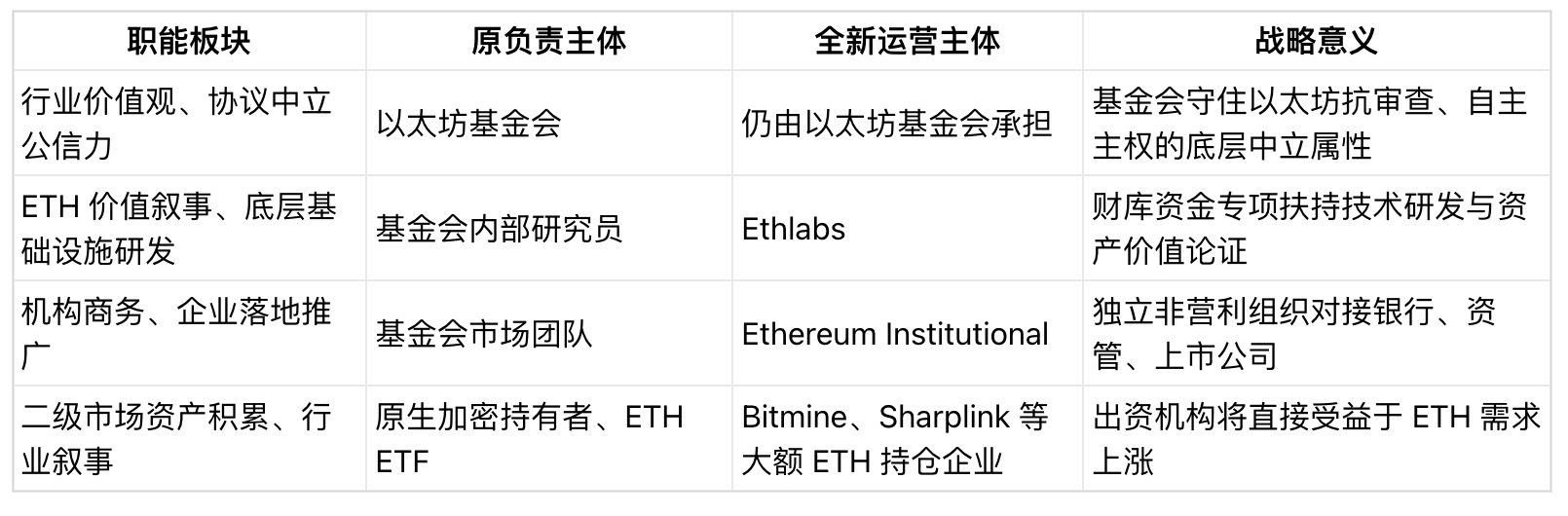
Ethereum Institutional revealed that the team has already connected with over 500 top-tier banks, global asset managers, sovereign wealth funds, custodians, and market infrastructure providers. Its hosted Ethereum Institutional Summit gathered over 150 senior financial executives, with participating institutions managing a total of $250 trillion in assets. This vast industry resource pool is also the core reason for the official separation of business into an independent entity rather than keeping it as a subsidiary department of the foundation.
Outsourcing corporate business and ETH value promotion to external institutions resolves the execution disconnect within the foundation, but it also means that giants holding massive amounts of ETH and possessing huge balance sheets now control the promotional channels to Wall Street. Convenience and independence are opposing directions, and Ethereum has chosen convenience.
Supporting Ethereum's Wall Street strategy are enterprises holding massive quantities of ETH
Bitmine currently holds 5.7 million ETH, accounting for 4.7% of the total circulating supply. Combined with cash and marketable securities, its total asset size reaches $9.8 billion. Sharplink holds 886,725 ETH and added 10,000 ETH on June 28 at an average price of $1,611.
Together, these two institutions hold 6.59 million ETH, representing 5.46% of the 120.7 million circulating supply. At current prices, the total value of their holdings is nearly $10.6 billion; Bitmine itself has a market cap of $6.55 billion, while Sharplink's market cap exceeds $1 billion.
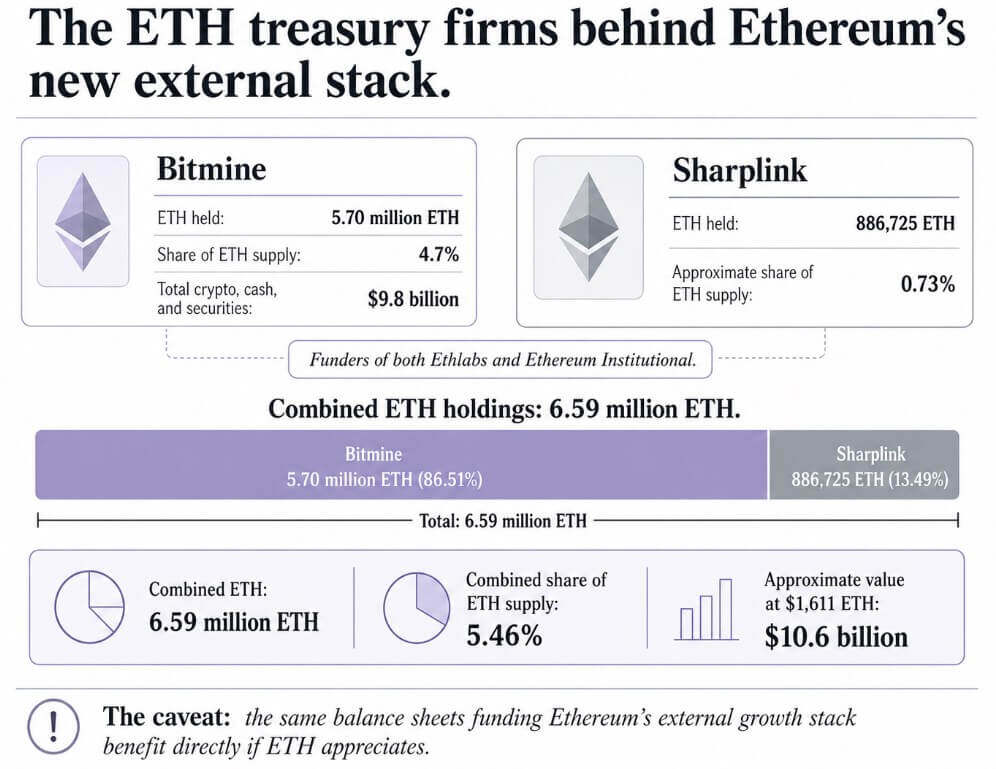
Once this business separation model proves successful, the two funding enterprises will directly benefit: improved underlying infrastructure and more mature institutional business will boost ETH market demand. Given their massive holdings, even minor fluctuations in ETH will cause hundreds of millions of dollars in book value changes. Ethereum co-founder Joe Lubin, simultaneously supporting both non-profit organizations, sits at the core of this interest system, while Bitmine and Sharplink's financial returns are deeply tied to the development of the Ethereum ecosystem.
PeerDAS has already launched, capable of increasing the data availability capacity of Layer 2 networks by approximately tenfold. Meanwhile, Glamsterdam, planned for release in the second half of 2026, aims to achieve base layer scaling, parallel transaction processing, and larger block payloads.
An academic report from June 2026 shows that the transaction throughput of the mainnet and Layer 2 networks has doubled; the median mainnet transaction fee has dropped from over $2 to below $0.02, while Layer 2 fees have decreased by more than 95% to as low as $0.0015.
The report also provides long-term performance projections: before 2034, the Ethereum mainnet's transaction processing capacity per second will still be less than 100; only by March 2029 will Layer 2 throughput surpass Solana, but by then, Layer 2 fees will be far lower than its competitor. Whether Ethereum can attract institutional entry depends almost entirely on Layer 2 scaling and industry standard implementation, which is precisely the core work scope of Ethlabs.
Two potential paths for ETH price will determine the ultimate direction of this structure
The bullish argument is that Ethereum already has considerable scale. Ethereum currently hosts a $157 billion stablecoin market cap, accounting for over half of the global stablecoin market; DeFi total value locked stands at $37.2 billion, representing 62% of the entire industry. Data from RWA.xyz shows tokenized real-world assets on Ethereum amount to $15.8 billion, with the total market across all chains at $31.52 billion, firmly placing Ethereum first among public chains.
Citibank predicts that the global tokenized real-world asset market will expand from the current $17 billion to $5.5 trillion by 2030, with a lower bound of $2.7 trillion and an upper bound of $8.2 trillion. If Ethlabs continues to iterate on infrastructure and Ethereum Institutional can convert its network into actual deployed capital, holding giants like Bitmine and Sharplink will become early beneficiaries of the industry, Ethereum will become the default settlement layer for compliant digital assets, and the value of ETH assets will rise accordingly.
The bearish argument primarily revolves around price. Citibank lowered its 12-month target price for ETH from $3,175 to $2,240, citing weak ETF demand and negative capital inflows, setting a bear case scenario for ETH at $1,094.
Standard Chartered holds the completely opposite view, insisting that ETH could reach $4,000 by the end of 2026. The vast discrepancy in expectations between the two major institutions also reflects the significant uncertainty in the short-term market outlook.
If ETH remains weak for an extended period, the stock prices of Bitmine and Sharplink will continue to trade at a discount relative to their held assets, and their ability to fund the two non-profit organizations will continuously shrink. Even if Ethlabs and Ethereum Institutional can maintain operations, their financial stability will significantly decline, and the market will constantly question whether the core purpose of establishing these two institutions is to boost ETH prices rather than build genuinely usable, institutional-grade infrastructure.
Regulatory developments are positive for a bull market logic but cannot guarantee price increases. The United States passed the
Conclusion
By splitting its business and establishing two independent organizations, Ethereum has resolved the inherent conflict between the foundation's neutrality and commercial activities. However, since the funding for both organizations comes entirely from enterprises holding massive amounts of ETH, this structure has both advantages and disadvantages.
On the positive side, with specialized institutions focusing on infrastructure and engaging with Wall Street, Ethereum has the potential to become the universal settlement layer for tokenized finance. On the risk side, the entire ecosystem's expansion is entirely tied to the balance sheets of these holding giants, meaning the direction of ETH's price directly determines the availability of funding. Both scenarios will coexist; the price of ETH one year from now will determine which trend dominates.