Chip stocks' "Black Tuesday": A technical correction, or a bull market turning point?


- Core Viewpoint: The global chip stock crash on June 23, 2025, was not solely triggered by South Korea's "rumor mill," but rather an inevitable unwinding under the extreme crowding and leverage fragility within the AI sector. Institutions like Goldman Sachs believe the AI narrative remains unchanged, deeming this more of a technical correction. However, pressures from rate hikes and buyback blackouts have been accumulating, warranting caution regarding mid-term risks.
- Key Factors:
- South Korea's KOSPI index plummeted over 10% in a single day, with SK Hynix (amid rumors of slowed HBM4 capacity expansion) and Samsung Electronics falling over 10%, triggering circuit breakers; the US Philadelphia Semiconductor Index (SOX) dropped 7.9%, with all 30 constituent stocks declining, and Micron Technology falling 13% (after a year-to-date gain of over 300%).
- Goldman Sachs noted the day's selloff was "orderly," with trading volumes flat, and investor discussions focused on the price action rather than a shift in the AI narrative, with no large-scale rotation observed; losses were concentrated in "crowded long" sectors (e.g., Goldman's memory stock basket fell 10%, and the AI semiconductor basket dropped 620 basis points).
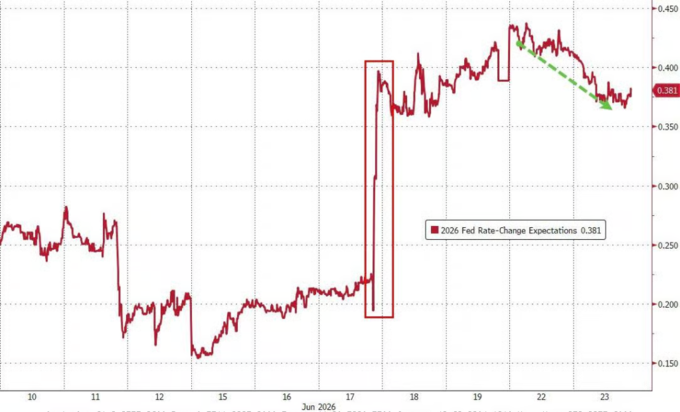
- Structural risks include: the Nasdaq is up over 30% since the end of March, and the Philadelphia Semiconductor Index moved more than ±5% on half of its trading days in June; 65% of companies are in a buyback blackout period, lacking a "safety net"; expectations for a Fed rate hike are growing (the probability for July rose to 50%), pressuring high-valuation tech stocks.
Original Title: "South Korea Sets Off 'Black Tuesday,' Global Chip Stock Bull Market Hit with a 'Blow from a Rod,' Just a 'Technical Adjustment'?"
Original Source: Wall Street Sights
The sharp sell-off in chip stocks is not an accident triggered by South Korean "rumors," but rather an inevitable liquidation driven by extreme crowding in the AI sector and fragile leverage. Analysts at Goldman Sachs and others believe the AI narrative has not shifted, and the selling concentrated in crowded long positions more closely resembles a "technical correction." However, with rising expectations of interest rate hikes and 65% of companies in a buyback blackout period, multiple pressures are building. There is no clear boundary between a correction and medium-term risk.
On Tuesday, June 23, global chip stocks were caught off guard by South Korea. One Wall Street strategist dubbed the crash a "chip-wreck."
The first to collapse was South Korea, this year's "world's hottest stock market." The KOSPI index plummeted 10% in a single day, triggering circuit breakers multiple times. SK Hynix and Samsung Electronics each fell over 10%.
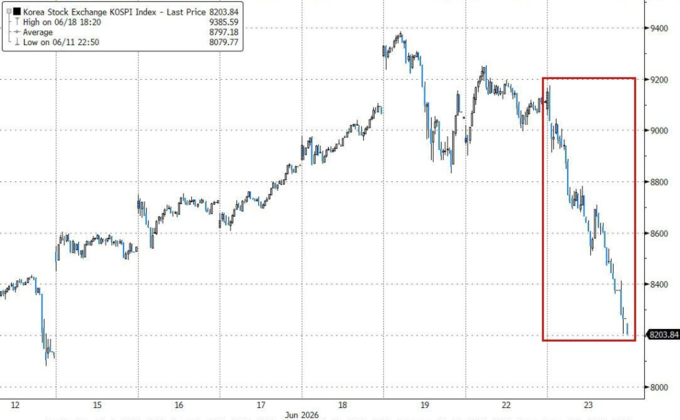
The storm was ignited by several rumors: South Korean media reported that Nvidia's Rubin is expected to see production cuts, and SK Hynix is slowing the expansion of high-bandwidth memory (HBM4), shifting towards cheaper standard DRAM. Secondly, Yonhap News reported that multi-party lawmakers in South Korea are discussing a tax on unrealized gains from stocks, real estate, and other assets—meaning paper profits not yet sold would also be subject to taxation.
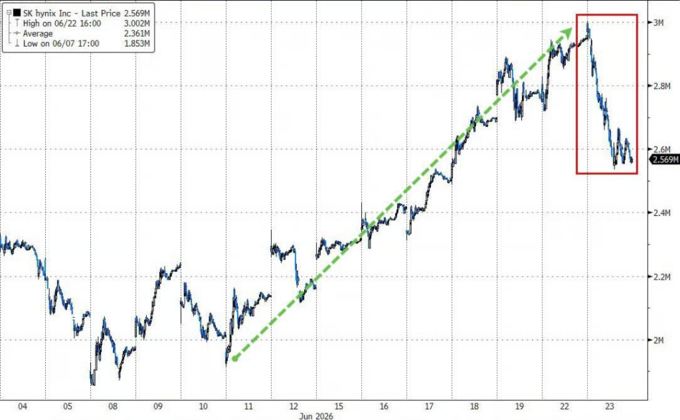
This "chip earthquake" then transmitted to the US stock market.
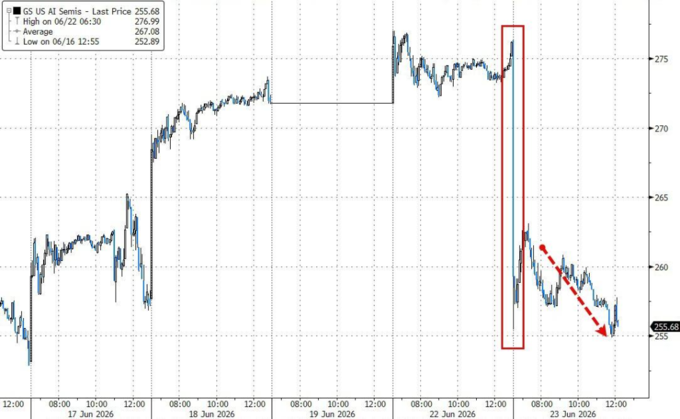
Overnight, the Philadelphia Semiconductor Index (SOX) fell 7.9%, with all 30 constituent stocks declining. Micron Technology dropped 13%—before Tuesday, it had surged over 300% this year, making it the SOX's strongest performer year-to-date. Micron, Nvidia, and AMD together accounted for roughly 50% of the S&P 500's decline. The Nasdaq fell 3.3%, the Dow Jones edged down 0.1%, and the S&P 500 dropped 1.4%.
Jonathan Krinsky, Chief Market Technical Analyst at BTIG LLC, stated: "Regardless of any near-term rebound, we still see medium-term downside risk in the tech/AI space." He believes the semiconductor sector still has 10% to 15% downside and described Tuesday's action as a "chip-wreck."
However, Peter Callahan, Goldman Sachs' Global Banking & Markets TMT sector specialist, wrote in a rapid commentary on June 24: "Today's conversations with investors are mostly around 'what are you seeing out there' rather than signs of a broader narrative shift." This comment is key. It sets a boundary for the sell-off: The price action was ugly, but at least on that day, there was no evidence of capital broadly abandoning the AI trade.
So, the issue isn't simply that "one rumor from South Korea crashed the global AI bull market." It looks more like a crowded, highly-leveraged sector that had run up significantly hitting a catalyst and undergoing collective de-risking. In the short term, it has the hallmarks of a "technical adjustment"; in the medium term, the vulnerabilities in the AI trade haven't disappeared.
This Was a Contagion, Not an Accident
South Korea's collapse seemed sudden, but the logic behind it isn't complex.
The news of SK Hynix slowing HBM4 expansion crashed its stock. This stock's weight in the South Korean market is akin to Apple's in the Nasdaq—its sheer size means that when it falls, the entire index struggles to hold up. More critically, South Korean retail investors heavily use leveraged ETFs to participate in AI/semiconductor trading. These products are forced to sell during market declines to maintain their leverage ratios, creating mechanical selling.
The news itself was the spark, but the leverage structure was the dynamite. Meanwhile, some market observers are asking, "Could South Korean leveraged retail investors be the terminator of the US tech bull market?"
This question is certainly an exaggeration, but it points to a real vulnerability: AI/semiconductor trading is highly concentrated, and global investors' portfolio structures are strikingly similar. A sell-off at any node can potentially propagate along this chain.
According to Goldman Sachs' after-hours data, both long and short sides were selling that day: long-only funds (LO) showed a selling skew of -18%, hedge funds (HF) also sold persistently throughout the day, with shorts accounting for 60% of sales volume (versus a recent average of about 50%). The selling volume from both types of institutions exceeded $1 billion in notional exposure.
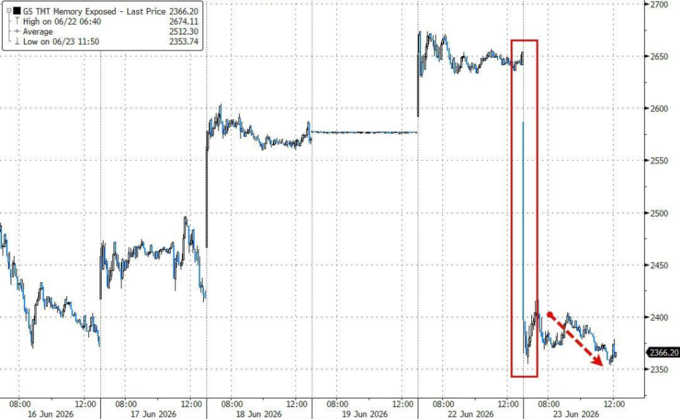
The US stocks that fell the hardest were the "crowded longs," the "most profitable stocks of the year." Goldman's Memory Stock Basket (GSTMTMEM) fell 10%, its AI Semiconductor Basket (GSCBSMHX) dropped 620 basis points, its AI Stock Basket (GSTMTAIP) fell 440 basis points, and its 12-Month Momentum Stock Basket (GSXHUHMOM) declined 420 basis points.
Technical Adjustment? Goldman: Narrative Hasn't Shifted
After such a significant drop, how does the market actually view it? Looking only at the decline, Tuesday appeared to be a repricing of the AI trade. But judging from trading volume and capital flows, the conclusion is less absolute.
Goldman Sachs TMT desk specialist Peter Callahan wrote in his after-hours note that the day's feeling could be described as "orderly"—despite the sizable losses, overall Nasdaq volume was roughly in line with the 20-day average, and cash and volatility desks functioned normally.
More crucially, he described his conversations with investors that day: "Today's conversations with investors mostly revolved around the theme of 'how are things on your end,' with no sign of a broader narrative logic shift. There were no incremental inquiries about 'new names' or 'laggard names.'"
In other words, no one was rotating or looking for new investment directions. Everyone was just exchanging information.
Another Goldman Sachs market strategist, Chris Hussey, provided specific data: Among the 12 tech stocks that fell over 8% today, all but one are still up double-digits year-to-date, with most having more than doubled. His assessment:
"Today's sell-off looks more like a 'skimming of froth' from an exuberant stock price rally, rather than a fundamental reassessment of the AI infrastructure trade. Investors aren't broadly dumping indices; they are re-evaluating: for stocks that have doubled in six months, what price should one pay?"
Jack Janasiewicz, a portfolio manager at Natixis Advisors, offers a similar view:
"This looks more like a technical sell-off than anything else. Market breadth was decent at the open, despite all the big red numbers—a signal of a narrow sell-off." He also cautioned, "When we see such massive crowding in beta and momentum, it can easily lead to an ugly deleveraging."
The Other Side of "Technical Adjustment": Structural Concerns That Can't Be Ignored
The term "technical adjustment" sounds reassuring, but it can explain everything while also masking real risks. The daily price action did have technical characteristics: losses concentrated in winning stocks, no widespread loss of control in volume, and investor conversations not signaling an immediate end to the AI narrative. However, there is no clear wall between a technical adjustment and structural risk—the former, if violent enough, can easily evolve into the latter.
Several background numbers deserve consideration.
First, rallies were too rapid. The Nasdaq has risen over 30% since the end of March. In June alone, the Philadelphia Semiconductor Index had eight trading days (out of 16) with daily moves exceeding ±5%—meaning half of the trading days in June saw sharp swings in chip stocks. Even after Tuesday's decline, the SOX is still up about 5% for the month, outperforming the Nasdaq and S&P 500 by about 8 percentage points. A pullback from this level carries both the justification of a technical correction and the fragility of being at elevated highs.
Second, positions are too crowded, and "support" is temporarily absent. Julian Emmanuel, Chief Equity and Quantitative Strategist at Evercore ISI, told Bloomberg TV: "People are looking for reasons to hedge while simultaneously wanting to stay invested." This perfectly describes the market's conflicted sentiment. Furthermore, 65% of publicly traded companies are currently in a buyback blackout period. In past downturns, corporate buybacks were a crucial source of support, but this card cannot be played now.
Third, the macroeconomic backdrop is shifting. Expectations for Fed rate hikes are rapidly rising—Bank of America expects three more rate hikes within the year, and market pricing for a July rate hike has risen from near zero to about 50%. The valuation logic for high-growth tech stocks is built on discounting future cash flows at low interest rates. If rates move higher, the present value of future earnings naturally contracts, hitting hardest those stocks whose high valuations are supported by expectations.
Michael O'Rourke, Chief Market Strategist at JonesTrading Institutional Services, writes: "Hyperscale cloud companies are the new software stocks. This sector is dragging the 'Magnificent Seven' down while struggling itself."
Torsten Slok, Chief Economist at Apollo, lists three core questions facing the market: What if AI companies start cutting their compute budgets due to insufficient ROI? What is the impact on equities and credit markets if the Fed hikes in September and December? These questions have no easy answers, but the market is shifting from 'being willing to overlook these risks' to 'starting to take them seriously.'
A technical adjustment deserves serious attention not because of the decline itself, but because it occurs when valuations, positioning, interest rates, and sentiment are all at extreme levels.
Historically, South Korean Crashes Have Been Brief—The Next Stress Test is Micron
Historical data shows that sharp declines in the South Korean stock market are often severe but short-lived. This is a "silver lining" that bulls are keen to reference.
However, the current context differs from past South Korea-specific events: it touches the central nerve of the global AI trade—is memory chip demand truly as strong as expected? Has the data center construction frenzy already borrowed from the future?
These questions will be partially answered after Micron's earnings report on Wednesday. Micron is this year's strongest component of the Philadelphia Semiconductor Index, having surged over 300% before Tuesday. Wednesday's earnings will be a true stress test.
Perhaps BTIG's Krinsky put it most directly: "Regardless of a short-term rebound or not, the medium-term downside risk for semiconductors remains."