Whether you understand the game or not, is betting on a draw the best strategy for this World Cup?


- Key Takeaway: During the World Cup group stage, executing a "bet on a draw every match" strategy based on Polymarket prediction data yielded a return rate of up to 105%. This demonstrates that the high odds for low-probability draws significantly outweigh the cumulative losses from frequently betting on strong teams to win.
- Key Factors:
- In the 40 group stage matches so far, 13 draws have occurred. With a total investment of $40,000, the net profit is approximately $41,914, a return rate of nearly 105%, highlighting the profit potential of the draw strategy.
- The key to the draw strategy lies in "the value hits": When a low-probability draw hits (e.g., Spain vs. Cape Verde with a 5.5% draw probability), the settlement multiplier can be as high as 18x. A single hit can cover multiple losses.
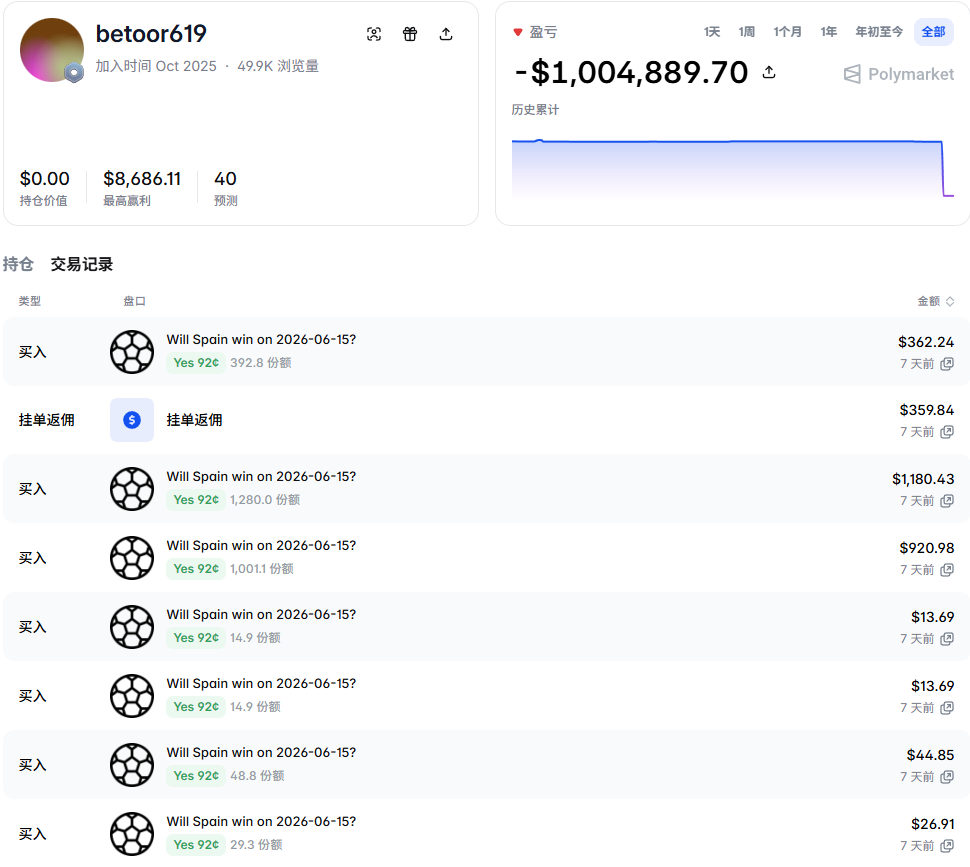
- Typical upset case: User @betoor619 bet on Spain to win (92 cents) in the match against Cape Verde. Due to the 0-0 draw, they lost $999,000, highlighting the trap of betting on popular favorite teams.
- Draws are concentrated in 1-1 results (e.g., Canada vs. Bosnia, Brazil vs. Morocco – 7 matches) and 0-0 results (e.g., Spain vs. Cape Verde, Ecuador vs. Curaçao). 0-0 draws yield higher settlement returns. For instance, a $1,000 bet on the Spain vs. Cape Verde match would have returned approximately $18,182.
- Group G had 3 draws in 4 matches (Belgium 1-1 Egypt, Iran 2-2 New Zealand, Belgium 0-0 Iran), indicating that draws are a norm in group stage competitions, driven by conservative play from weaker teams and cautious strategies from stronger teams.
Original: Odaily Planet Daily (@OdailyChina)
Author: Asher (@Asher_0210)

As the World Cup group stage progresses, a counterintuitive phenomenon is becoming increasingly apparent: Betting on strong teams doesn't guarantee profit, and betting on upsets is hard to hold onto. However, blindly betting on draws in every match could actually lead to massive gains.
According to Polymarket's pre-match prediction data, if $1,000 were placed on a "draw" for every match, out of the first 36 games, 11 have ended in draws (as shown below). This means a total investment of $36,000 would yield settlements of $73,214. After deducting the principal, the net profit would be $37,214, representing a return rate of over 100%. 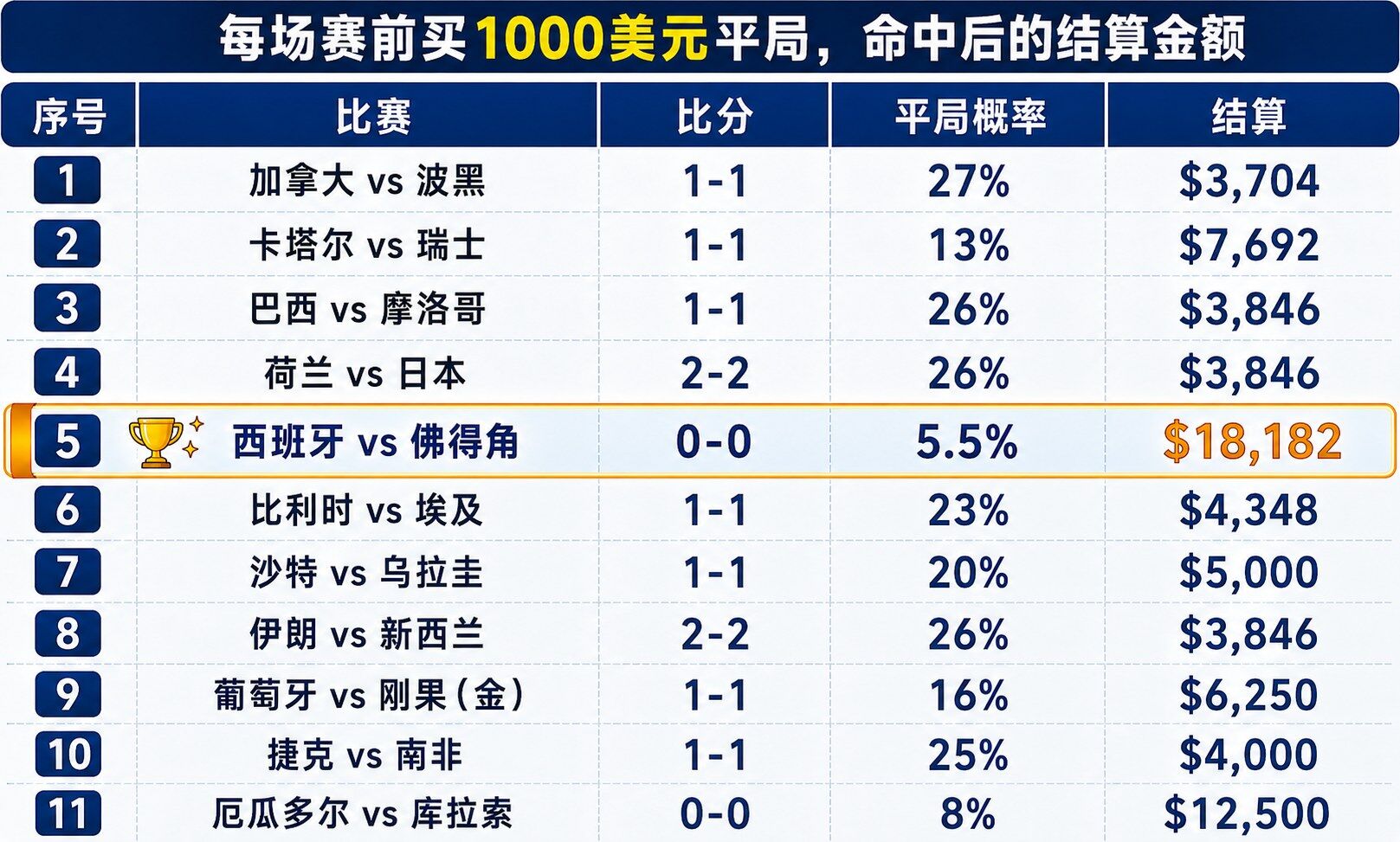
Even more striking, if the same strategy of "$1,000 on a draw per match" (total investment of $4,000) were applied to today's four games based on Polymarket's pre-match data, results show: Spain 4-0 Saudi Arabia, and New Zealand 1-3 Egypt – both bets lost. However, Belgium 0-0 Iran and Uruguay 2-2 Cape Verde hit, with a combined settlement of approximately $8,700. This means, even with only two wins, the net profit for today alone is around $4,700.
Including today's four games, out of the 40 World Cup group stage matches, 13 have ended in draws. With a total investment of $40,000, the total settlement for winning bets is roughly $81,914. After deducting all investments, the net profit is about $41,914, yielding a return rate of nearly 105%.
A hit rate of 13/40 isn't particularly high, but the key to the draw strategy has never been "hitting often," but rather "hitting big." The lower the pre-game probability of a draw, the higher the settlement multiplier upon hitting. Matches like Spain vs. Cape Verde (draw probability 5.5%), Ecuador vs. Curaçao (draw probability 8%), and Qatar vs. Switzerland (draw probability 13%) only need a few hits to turn the entire strategy from a small loss into a significant profit.
Cape Verde's Draw Against Spain is the Most Typical "Ruinous" Match of the World Cup So Far
The group stage match between Spain and Cape Verde wasn't just a goldmine for the draw strategy; it was also a nightmare for bettors who backed the pre-match favorite.
In this group stage match, Spain's win probability before the game was as high as 92%. Polymarket data shows that an account, @betoor619 (address: 0x70088c990ffae782c699b9250f5aa6cbe4e3c666), bet on Spain to win in the World Cup group stage match against Cape Verde. The match ended 0-0, resulting in a loss of $999,000 for this user.
It's worth noting that the user bought at 92 cents, essentially risking $1 million in principal for a potential profit of $85,000. What seemed like a sure win turned into a devastating loss due to Cape Verde's 40-year-old goalkeeper making seven incredible saves and their tenacious defense.
0-0 and 1-1 are Becoming the Leitmotif of This World Cup
Looking at the draws that have occurred so far, the draws in this World Cup's group stage aren't appearing randomly but are concentrated around a few very typical scorelines.
The most common is 1-1. Canada vs. Bosnia, Qatar vs. Switzerland, Brazil vs. Morocco, Belgium vs. Egypt, Saudi Arabia vs. Uruguay, Portugal vs. DR Congo, and Czech Republic vs. South Africa all ended this way. The commonality in these matches is that neither side was completely without a chance, nor did the weaker teams simply park the bus for 90 minutes. More often, the stronger team failed to convert dominance into victory, and the weaker team capitalized on an opportunity to respond. The games were back and forth, but ultimately, no one could truly break down the opponent.
For traders, the value of a 1-1 draw lies in its stability. It's not the most spectacular source of profit, but its high frequency forms the bedrock of this "bet on a draw every match" strategy.
What truly elevates the returns are the 0-0 draws.
The Spain vs. Cape Verde match is the most typical example. Spain was seen as the absolute favorite, with the draw probability at just 5.5%. But the game ended 0-0. A $1,000 pre-match bet on a draw would have resulted in a settlement of approximately $18,182. The Ecuador vs. Curaçao match followed a similar logic. The draw probability was only 8%, and it also ended 0-0, with a $1,000 investment yielding a settlement of $12,500.
Therefore, the draw strategy's real profitability doesn't come from winning every match, but from the fact that when a few low-probability draws hit, the settlement multiples can be astronomical. This is especially true for 0-0 games, which typically see the favorite attack relentlessly while the underdog's goalkeeper and defense clear the ball again and again.
Group G is Even More Extreme: 3 Draws in 4 Games
If Spain vs. Cape Verde represents the low-probability draw, then Group G is a microcosm of the "draw density" of this group stage.
In four games so far, Group G has produced three draws. In the first round, Belgium drew 1-1 with Egypt, and Iran drew 2-2 with New Zealand. In the second round, Belgium drew 0-0 with Iran. The only game that produced a winner was New Zealand vs. Egypt, but this doesn't change the fact that the entire group's rhythm has been completely slowed down by draws.
Belgium, in particular, has drawn both of its group stage games. For the team, this means the pressure to advance from the group remains; but for those who bet on a straight Belgium win, the result for both games was the same – they didn't lose, but their positions were wiped out.
This is where draws are most easily underestimated in prediction markets. Markets favor betting on strong teams because it seems more intuitive. But the real logic of the group stage isn't "strong teams must win." Many teams are content with just 1 point. The weak teams don't want to lose, the strong teams don't want to take early risks. Once a game gets bogged down, a draw becomes a very realistic outcome.
Three draws in four games for Group G shows that draws aren't just accidental upsets, but a part of the strategic game within the group stage. Especially when points aren't clearly separated, every team starts to do the math – winning is best, of course, but not losing first is often the safer choice.
Summary
In this World Cup, the strong teams are still the protagonists.
Spain will win, Brazil will win, and the strong teams will have their dominant games. But if you look purely at trading returns, the most profitable script for the group stage so far hasn't been the big wins by the giants. It has been the recurring 1-1, 0-0, and 2-2 draws.
Those betting on strong teams are waiting for goals; those betting on draws are waiting for the final whistle. And so far, the latter are laughing louder.