After being noticed by IBM, three surged 50 times


- Core Insight: The Solana ecosystem project three.ws gained market attention through collaborations with enterprises like IBM. Its token, three, once surged 50 times, but its core goal is to build a "3D Agent Layer," allowing AI to move from the chat box to the web, equipping AI Agents with 3D avatars, memory, identity, wallets, and distribution channels.
- Key Elements:
- Direct Catalyst: IBM's official Twitter account responded twice regarding the collaboration, driving the market cap of the three token from $300,000 to $16.38 million, a peak increase of 53 times.
- Core Positioning: three.ws aims to solve the problem of AI Agents lacking a "body" and recognizability, transforming them into 3D digital characters that can interact on the web and execute on-chain transactions.
- Technical Architecture: The project consists of four parts: the Rendering Layer, the Agent Layer (brain and behavior), the Identity Layer, and the Embedding and Distribution Layer, allowing developers to flexibly combine and use them.
- On-chain Capabilities: Agents can own a Solana wallet, pay with USDC via the x402 protocol, and register their identity as a Metaplex Core asset on Solana.
- Business Model: Revenue is generated through a subscription system (free version, Pro version at $49/month) and platform fees (2.9% for Pro version), entering the enterprise procurement system via channels like AWS and IBM.
Original Author: KarenZ, Foresight News
A partnership announcement with IBM quickly brought the Solana ecosystem project three.ws into the market's spotlight, with the three.ws token (three) surging 50 times.
The direct catalyst for the price surge came from IBM. On the night of June 1st and early morning of June 2nd, IBM's official Twitter account responded twice to content released by three.ws regarding their collaboration.
During the news spread, the three.ws token (three) rapidly appreciated. According to GMGN data, three's market cap soared from around $300,000 before IBM's response to a high of $16.38 million on June 4th, a gain of 53 times. Currently, three's market cap is fluctuating around $13 million.
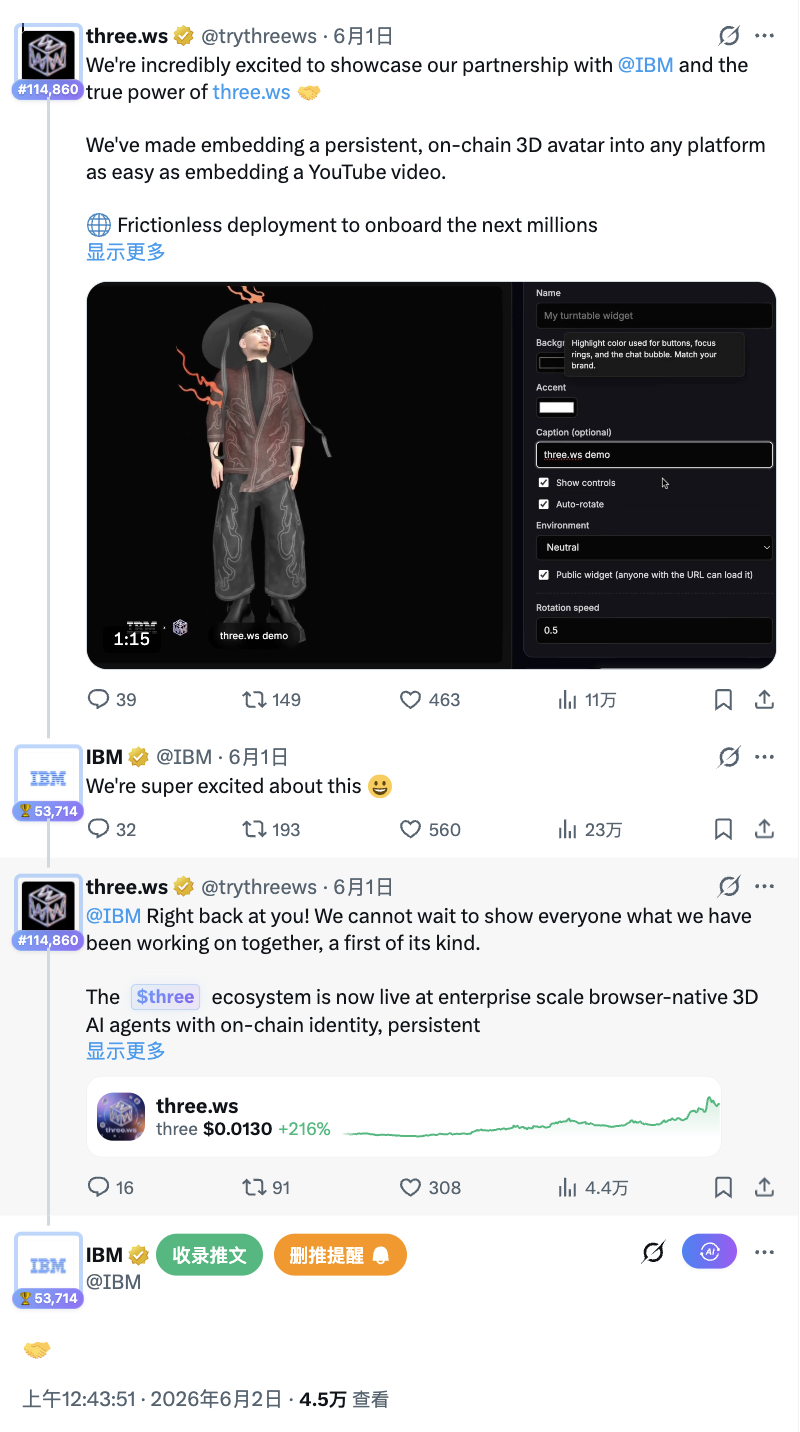
It's evident that this wasn't a continuously heating trend starting from the token's launch. The three token was issued on the Solana chain as early as late April, with the main price surge occurring around the time of IBM's public response and the collaboration announcement.
However, understanding three.ws merely as a Solana AI project endorsed by IBM would miss the core problem it aims to solve: Currently, most AI Agents remain hidden within chat interfaces and backend programs. Users can't see them and struggle to identify, own, or invoke them across different websites, devices, and on-chain environments.
three.ws aims to equip AI Agents with a body, memory, identity, wallet, and distribution channels, transforming them into 3D digital characters that can appear on web pages, perform actions, and conduct transactions.
Bringing AI from the Chat Interface to the Web Page
three.ws defines itself as the "3D Agent Layer" for the internet. Founder @nichxbt currently has over 20,000 followers on Twitter and is verified (Blue Checkmark).
The project is already listed on AWS Marketplace and Alibaba Cloud's International Marketplace and has joined the Google Cloud for Web3 Startups program. three.ws is also listed in Anthropic's official MCP Registry, is a W3C Contributor, and a participant in the Solana Frontier Hackathon.
Based on the project's existing code and documentation, three.ws's foundational capabilities include loading, inspecting, and displaying 3D models on the web. It has subsequently integrated large language models (LLMs), memory, voice, skills, on-chain identity, and payment functions.
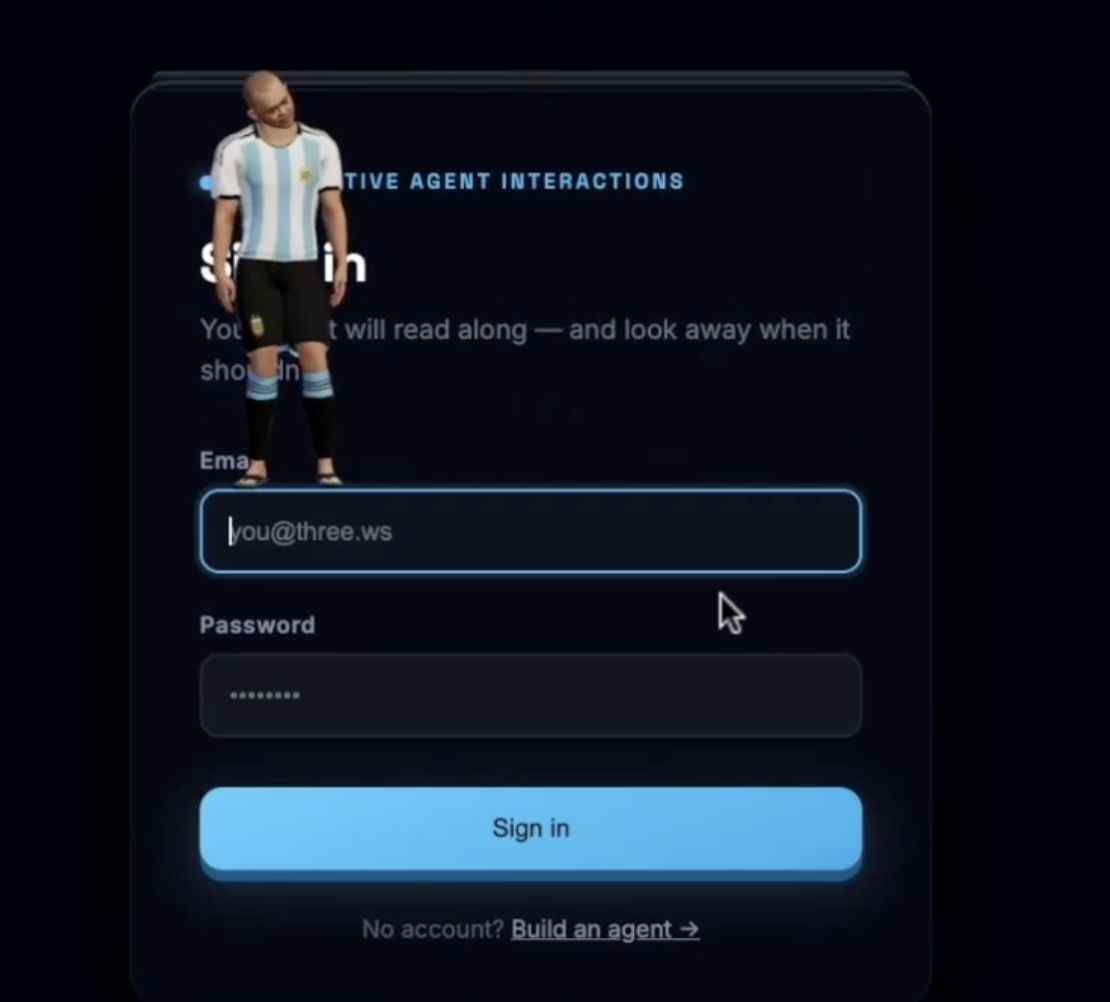
Simply put, developers can create a 3D character on the platform, connect it to LLMs, memory systems, voice, and skills, and then embed it into a website using an
For example, a company could deploy a 3D shopping guide Agent on a product page to introduce items, answer questions, and showcase product features through actions. Developers could also build digital customer service reps, virtual teachers, game characters, or personal AI assistants.
This process is somewhat similar to embedding a YouTube video. Developers don't need to build complex 3D pages from scratch; by adding the component and Agent ID, users can see and interact with the Agent directly in their browser.
three.ws offers various ways to create a character. Users can upload a selfie to generate a 3D avatar capable of animation in about 60 seconds; generate a model via text or image; upload their own GLB/glTF files; or use the character editor.
Once the character is generated, developers can configure different LLMs, voice capabilities, and skills for it.
three.ws also integrates on-chain capabilities for Agents. An Agent can possess a Solana wallet, pay for premium APIs using USDC via the x402 protocol, and register its identity as a Metaplex Core asset on Solana or via ERC-8004 on EVM chains. It's important to distinguish between identity and funds: on-chain identity proves who owns the Agent and links to its profile, while the wallet handles payments and transactions.
How Does a 3D Agent Operate?
three.ws consists of four independent, interchangeable technical layers. Developers can use a combination of all four or just specific parts.
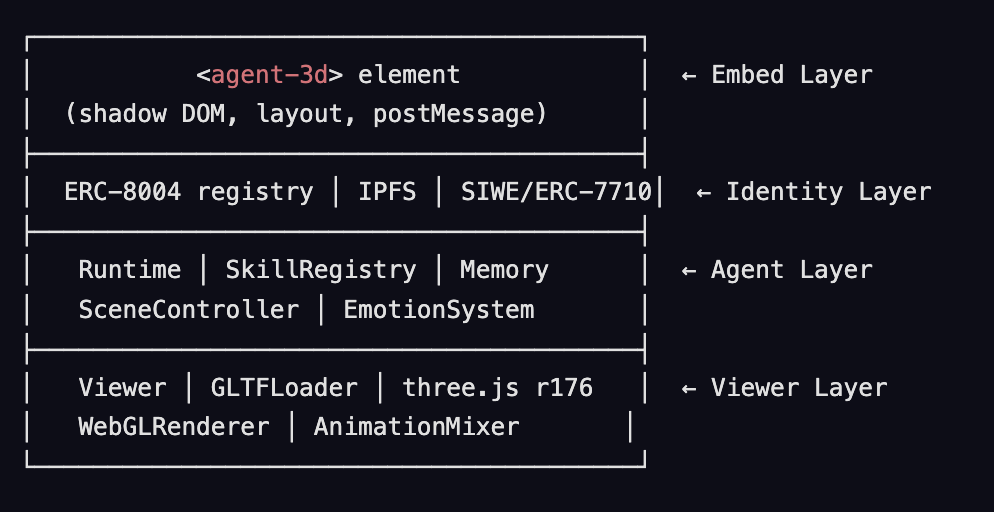
The bottom layer is the Viewer layer, i.e., the rendering layer.
This layer is responsible for loading and displaying 3D models in the browser, including lighting, camera, materials, and animations. It is built on three.js and is unaware of whether an AI, wallet, or on-chain identity exists behind the model. Therefore, even without connecting to an Agent, the Viewer can function independently as a 3D model viewer.
The second layer is the Agent layer, which acts as the character's brain and behavior system.
After user input, the LLM makes decisions based on the character's settings, historical memory, and installed skills. If a user asks the character to wave, the model calls the corresponding tool, and the scene controller plays the waving animation. If the character needs to remember something, the memory module saves the relevant information.
This layer also includes an emotion system. Characters can change expressions, gaze, and movements based on events—for example, appearing happier after completing a task or showing concern when an operation fails.
The third layer is the Identity layer. This is an optional module.
The identity layer ensures the Agent maintains the same identity across different websites, devices, and sessions. The Agent's profile, memory patterns, and resource addresses can be written into a Manifest file and stored via IPFS or platform servers.
According to three.ws's official documentation, its Solana Agent already supports registering on-chain identity via Metaplex Core, while on-chain reputation registration and verification registries related to ERC-8004 are currently only available on the EVM side, with the verification registry still in the testnet phase.
The fourth layer is the Embedding and Distribution layer. This layer brings the Agent to the user. Developers can integrate the character into websites, applications, and enterprise interfaces via web components, iframes, Widgets, or SDKs.
In simpler terms, the rendering layer provides the body and movements, the Agent layer supplies the brain, memory, and skills, the identity layer offers an optional digital passport, and the embedding layer deploys the character onto websites and applications.
three.ws's fee structure should be understood from two dimensions: How does the user access or purchase the service? And what fees are incurred after using the platform?
Regarding purchase/access channels: users can subscribe directly, choosing between a free version, Pro ($49/month), or Enterprise plan based on their needs. The AWS Marketplace serves as an enterprise procurement channel.
After subscribing to three.ws, developers can use x402 to set prices for the Agent's chat, content generation, or API calls, with callers paying per use in USDC. Platform fees are deducted from the developer's revenue: the platform fee is 0% for the free version during the public beta (rates post-beta are TBD), 2.9% for the Pro version, and custom rates for the Enterprise version.
IBM Complements Enterprise Capabilities, AWS and Others Handle Distribution
For a 3D AI Agent project, creating a demo-able digital character isn't difficult. The real challenge lies in making the product accessible within enterprise procurement systems and meeting requirements for billing, deployment, identity verification, and AI governance.
three.ws is filling these gaps through platforms like IBM and AWS Marketplace.
On May 27th, three.ws announced its membership in the AWS Partner Network (APN) and subsequently went live on the AWS Marketplace. This allows enterprise customers to procure three.ws services through their existing AWS accounts.
Following this, three.ws published a technical article on its SaaS product billing on the AWS Builder Center blog. This solution connects AWS Marketplace's customer verification, usage-based billing, and subscription management with the on-chain x402 payment interface.
Regarding the IBM partnership, three.ws plans to integrate its 3D Agent technology with IBM's enterprise AI, hybrid cloud, and market channels, and also to incorporate the IBM Granite series of models for use cases like conversational AI, image understanding, semantic matching, market prediction, and enterprise governance.
AWS Marketplace helps three.ws enter enterprise procurement and billing systems, while IBM provides enterprise AI technology and commercial channels. Both partnerships point towards the same goal: transforming the 3D AI Agent in the browser from a flashy demo into a service that enterprises can procure, deploy, and manage.
In a bear market, IBM's public response has granted three.ws scarce market attention.
But after the hype fades, the project must still answer more practical questions: do enterprises and developers truly need an AI Agent with a body, skills, and digital identity? And what role will "three" ultimately play within this system?