Solana和Hyperliquid最忠實的衛兵,互相罵了起來


- 核心觀點:Kyle Samani 與 Arthur Hayes 等社群成員圍繞「HYPE vs SOL」爆發論戰,核心爭議在於加密項目應優先追求去中心化還是產品增長,Hyperliquid 的崛起正在挑戰 Solana 作為「互聯網資本市場」敘事的地位。
- 關鍵要素:
- Samani 抨擊 Hyperliquid 高度中心化、存在監管風險,稱其本質是無市場營銷團隊的「Binance 2.0」,並指控其可能面臨與美國司法部類似的指控。
- Hayes 等社群成員強烈回擊,Hayes 直接打賭 HYPE 將在剩餘七個月內跑贏加密貨幣前十其他代幣,並提議用 100 HYPE 獎金舉辦針對 Samani 的創作競賽。
- Solana 的核心邏輯是構建高效鏈上金融基礎設施,吸引流動性自然聚集;而 Hyperliquid 直接從核心需求切入,通過永續合約形成正向飛輪(更多交易者→更多手續費→HYPE 回購→價格上漲→更多資本)。
- Hyperliquid 的現金流能力已超過包括 Solana 在內的公鏈生態,逐漸從永續合約向現貨、預測市場等擴張,更貼合「互聯網資本市場」敘事,搶佔了 Solana 的市場敘事空間。
- Samani 的攻擊話術(質疑去中心化、監管風險)與過去以太坊陣營批評 Solana 的方法高度相似,顯示出立場上的「雙標」:Solana 崛起時強調效率優先,如今卻以去中心化質疑 Hyperliquid。
Original by Odaily Planet Daily (@OdailyChina)
Author: Azuma (@azuma_eth)

As HYPE continues to hit new highs, a heated debate has erupted on X around "HYPE vs SOL."
At the center of the war of words is Kyle Samani, former co-founder and managing partner of Multicoin Capital and a flagship figure in the Solana community (see: The Man Who Best Shilled SOL Exits the Crypto World). On the outside, besieging him are the loyal "followers" of Hyperliquid, led by BitMEX co-founder Arthur Hayes.
The Brawl Between SOL Defenders and HYPE Believers
Over the past weekend, Samani posted heavily on X, launching an intense broadside against Hyperliquid, accusing the project of being still highly centralized in nature and facing serious regulatory issues.
At 6:30 AM on May 30, Samani wrote: "Hyperliquid is essentially just Binance 2.0 without a marketing team (sorry for dragging Binance into this…). It has made thousands of technical design decisions that only work in a centralized environment and are completely unsuitable for a permissionless, decentralized one. Now, they are already many steps behind on this path. Also, no real US company will ever cooperate with them."
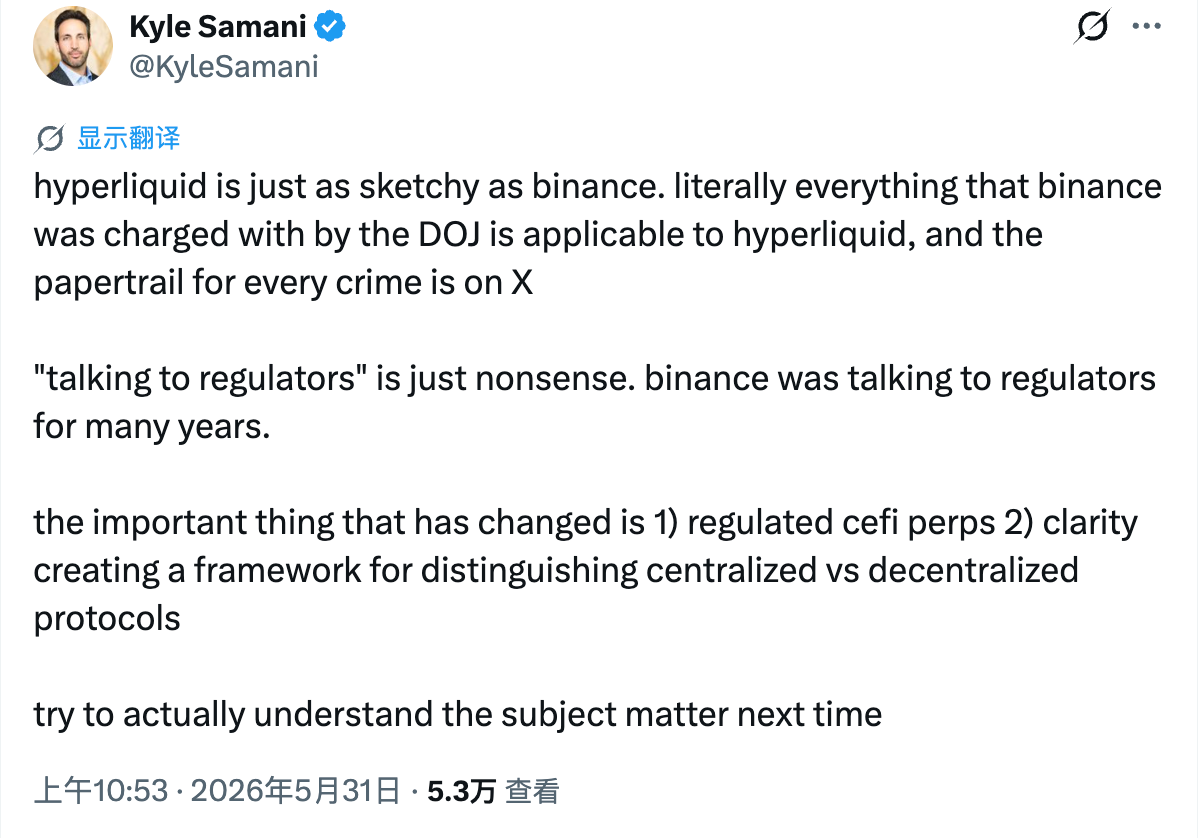
At 10:53 AM on May 31, Samani added: "Hyperliquid is just as suspicious as Binance (again, sorry…). All the allegations the US Department of Justice once made against Binance apply to Hyperliquid, and the evidence for each crime is on record. So-called 'communication with regulators' is pure nonsense. Binance has also been 'communicating with regulators' for years…"
While attacking Hyperliquid, Samani also took time to take a jab at old rival ETH, calling it "credibly neutral but technically flawed," which is to say "basically useless"…
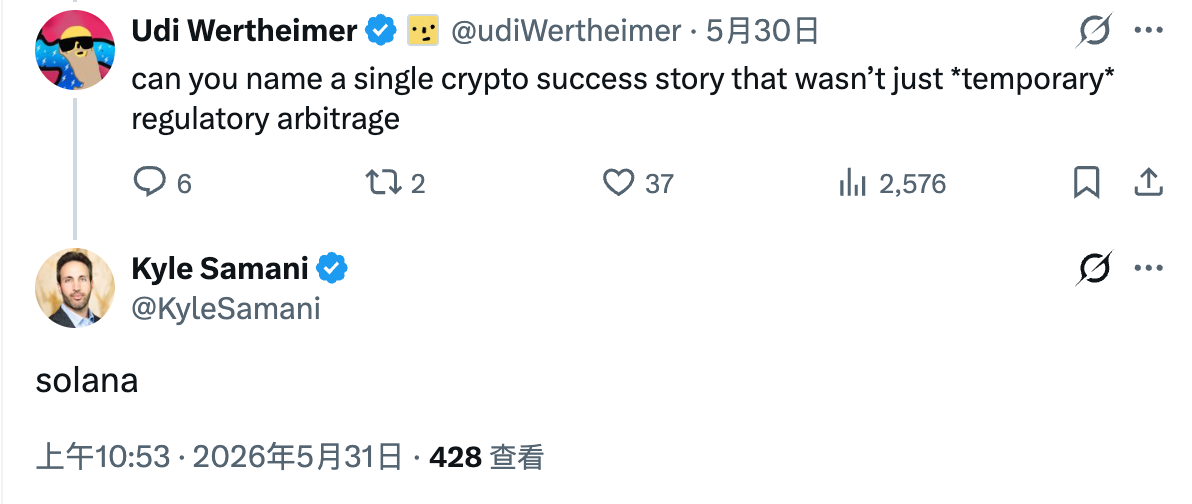
Ultimately, when asked by renowned Bitcoin developer Udi Wertheimer which token he considered a success story, Samani gave the predictable answer — Solana.
Unsurprisingly, Samani's remarks drew fierce rebuttals from the community, especially amidst HYPE's bullish momentum. Investors like Hayes, developers like Wertheimer, and traders like Ansem all countered Samani's views with varying degrees of force.
Hayes' counterattack was the most direct. On May 31, Hayes posted a sarcastic message to Samani, saying: "Before this cycle ends, HYPE should at least surpass SOL."
Earlier this morning, Hayes posted again, proposing a content competition with a prize pool of 100 HYPE, requiring participants to humorously and offensively rebut Samani… Meanwhile, Hayes directly challenged Samani to a $100,000 bet, claiming HYPE would outperform all other top 10 cryptocurrencies in the remaining seven months of the year.

The Narrative Clash Between Solana and Hyperliquid
In recent years, Solana's greatest success has been building a high-speed, low-cost on-chain financial infrastructure. From Memes, DeFi, to AI Agents, various assets and applications choose to launch and trade on Solana. The core logic is that liquidity gravitates towards the most efficient markets.
However, Hyperliquid goes a step further on this logic.
Unlike Solana, which provides infrastructure and waits for applications and liquidity to grow naturally, Hyperliquid directly targets the core demand of the crypto industry—trading. It accumulates users, fee revenue, and liquidity through a perpetual contract market, then gradually expands into spot, stock tokens, prediction markets, and more financial products.
As a result, Hyperliquid has formed an extremely rare positive flywheel: More traders bring more fee revenue; more revenue fuels HYPE buybacks and ecosystem incentives; HYPE price increases attract more capital; more capital further enhances platform liquidity and trading depth. The cash flow capability generated by this flywheel has even exceeded that of public chain ecosystems like Solana.
In recent years, Solana's core narrative slogan has been "the Internet's capital market." However, as users, assets, liquidity, and pricing power continuously shift towards Hyperliquid, the latter now seems to fit this narrative far better than Solana. In other words, Hyperliquid seems to have become what Solana aspired to be.
As Solana's most loyal standard-bearer, Samani is clearly unwilling to accept this situation.
Samani's Tactic: Using the Arguments Once Used Against Solana to Attack Hyperliquid
Looking closely at Samani's recent attacks on Hyperliquid, a rather dramatic phenomenon emerges.
In the debates between Ethereum and Solana over the past few years, the most common attack from the Ethereum camp was questioning Solana's decentralization. The validator node threshold was too high, the hardware requirements too demanding, the network frequently down, and the ecosystem too dependent on a few core institutions… In the eyes of many Ethereum supporters, Solana, while fast, was essentially sacrificing decentralization for performance.
The Solana camp's response was simple—users don't care. For the vast majority of users, what they need is faster confirmation speeds, lower fees, and a better product experience, not a research report on node distribution.
In a sense, Solana's rise itself is a huge victory for the "efficiency-first" approach. But now, as Hyperliquid grabs market attention, Samani is waving the very flag that the Ethereum camp once loved to wield.
Centralization, regulatory risk, censorship resistance… These accusations even sound familiar, except the former "defendant" was Solana, and now it has become Hyperliquid.
This might seem somewhat hypocritical, but perhaps in Samani's view, Solana represents the perfect balance—Ethereum is decentralized enough but too clunky, Hyperliquid is extremely smooth but essentially feels like a CEX, whereas Solana? It just seems so honest and upright…
In a way, the essence of this debate is not about HYPE vs. SOL, but the decade-old question the crypto industry has been grappling with: Should we prioritize decentralization, or prioritize product and growth?
Back then, Ethereum and Solana argued endlessly over this issue. Today, Solana and Hyperliquid find themselves in the same spot.
Only this time, facing a more aggressive opponent, Solana's followers have become the ones holding high the banner of "decentralization."