从 HYPE 到 ZEC,拆解山寨局部行情的四條主線


- 核心觀點:當前加密市場呈現局部輪動行情,四類獨立敘事(去中心化永續合約、AI 公鏈、隱私幣、Meme 幣)同時驅動資金流動,其中 HYPE、NEAR、ZEC 等資產因各自催化劑確認度高而表現突出,而 WLD、GRASS 則受制於供給壓力。
- 關鍵要素:
- HYPE(Hyperliquid)佔 Perp DEX 約 70% 市場份額,週收入 1400 萬美元,97% 費用用於回購,疊加機構加倉與 ETF 上市,價格創歷史新高,市值進入前十。
- LIT(Lighter)作為 Perp DEX 賽道第四名,市值僅為 HYPE 的 1/40,受 Vitalik 公開認可及新品上線驅動補漲,但交易量含刷量成分且年底有團隊解鎖壓力。
- NEAR AI 推出隱私功能自動剝離提示詞中的敏感資訊,疊加 OpenAI 同期發布類似模型,引發隱私 + AI 敘事炒作,30 日漲幅領跑 AI 線(50%)。
- ZEC 受益於 SEC 調查結束、Robinhood 上線交易、ETF 申請預期等三重催化劑,30 日漲幅翻倍,年內漲 15 倍,成為隱私幣龍頭。
- USELESS(Meme 幣)憑藉 Coinbase 等 CEX 入口、社區記憶與名稱傳播力,30 日漲近 70%,但缺乏基本面支撐,熱度波動風險極高。
- WLD 雖有 Eightco 機構持倉、美國市場擴張等敘事升級,但團隊大額存入交易所且解鎖壓力持續至 7 月,價格表現最弱(僅漲 5%)。
- GRASS 雖有 AI 實驗室付費客戶及回購機制,但 Season 2 空投與團隊解鎖共約 1.7 億枚形成短期供給壓力,價格受供需博弈壓制。
Original Author: David, TechFlow
The crypto market this week clearly has local movements.
Although Bitcoin dominance is hovering around 60% and the Altcoin Season Index is only 35, far from the 75 threshold that would confirm altcoin season, if you scroll through English Crypto Twitter (CT), you'll see that capital is no longer waiting for macro signals.
In the past week, at least four independent narratives have been running simultaneously:
1. Perpetual DEXs are surging to new highs,
2. AI L1 blockchains are rotating,
3. Privacy coins are being repriced,
4. Memecoins are reigniting.
Seven tokens frequently mentioned recently – HYPE, LIT, NEAR, GRASS, WLD, ZEC, and USELESS – are typical representatives, corresponding to four directions of market attention.
Let's first look at their recent performance:
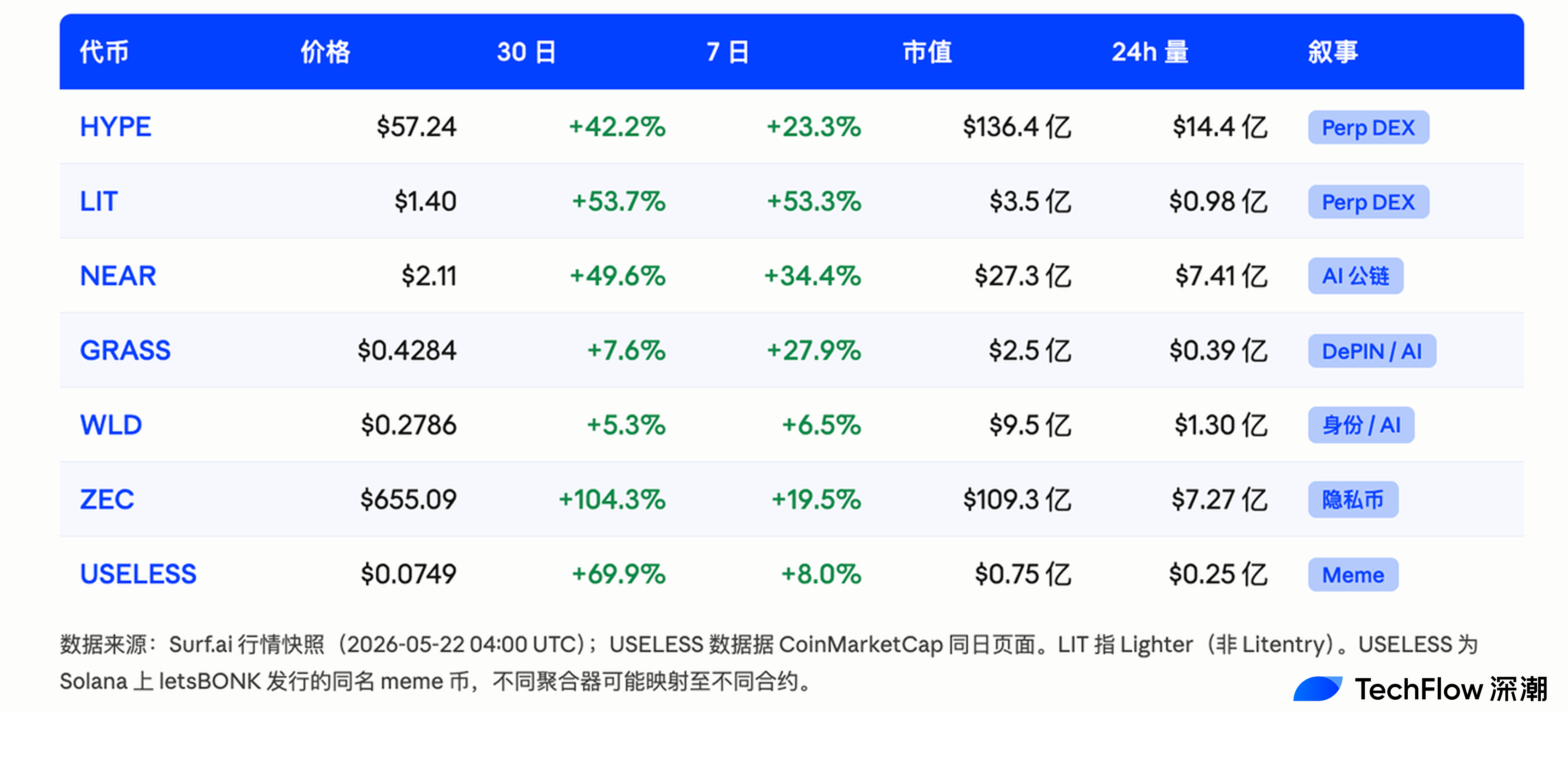
The table reveals several insights.
Firstly, ZEC and HYPE show the strongest 30-day gains and volume, indicating the most confirmed capital inflow along their respective narrative lines. LIT leads in 7-day gains but has a market cap only 1/40th of HYPE, offering high beta but also higher drawdown risk.
USELESS has quietly risen nearly 70% in 30 days, but its market cap is only $75 million, an entirely different magnitude compared to ZEC's tens of billions. WLD has barely moved, making it the weakest price confirmation in this group, although it still generates significant discussion on English CT.
Below, we dissect the logic behind each narrative.
1. Perp DEX Narrative: HYPE Hits New Highs, LIT Catches Up
The Perp DEX narrative has the most complete capital flow in this altcoin rally. For HYPE, protocol revenue, institutional holdings, and ETF packaging have all materialized within the same month.
HYPE's foundation is its revenue. Hyperliquid accounts for approximately 70% of open interest in the perp DEX market, with weekly fee revenue of $14 million, annualizing to over $600 million. 97% of protocol fees are used to automatically repurchase HYPE.
This flywheel has been spinning since the token launch at the end of 2024, and by May of this year, millions of tokens from circulation had been burned cumulatively. Arthur Hayes' Maelstrom fund publicly stated it was selling holdings in ENA, PENDLE, etc., to increase its HYPE position, setting a price target of $150, citing this revenue-buyback model.
Institutions are also following suit.
On-chain analyst @ai_9684xtpa tracked a wallet suspected to be linked to a16z, which had accumulated approximately 9.18 million HYPE (worth about $356 million, unconfirmed by a16z) since mid-April. On May 12 and 15, two HYPE spot ETFs from 21Shares and Bitwise were listed on Nasdaq and NYSE respectively, attracting over $5.6 million in net inflows in their first week.
BHYP's first-day trading volume set a record for altcoin ETF listings in 2026. Bitwise also allocates an additional 10% of management fees for repurchases. On May 21, HYPE hit an all-time high of $62.14, entering the top 10 by market cap.
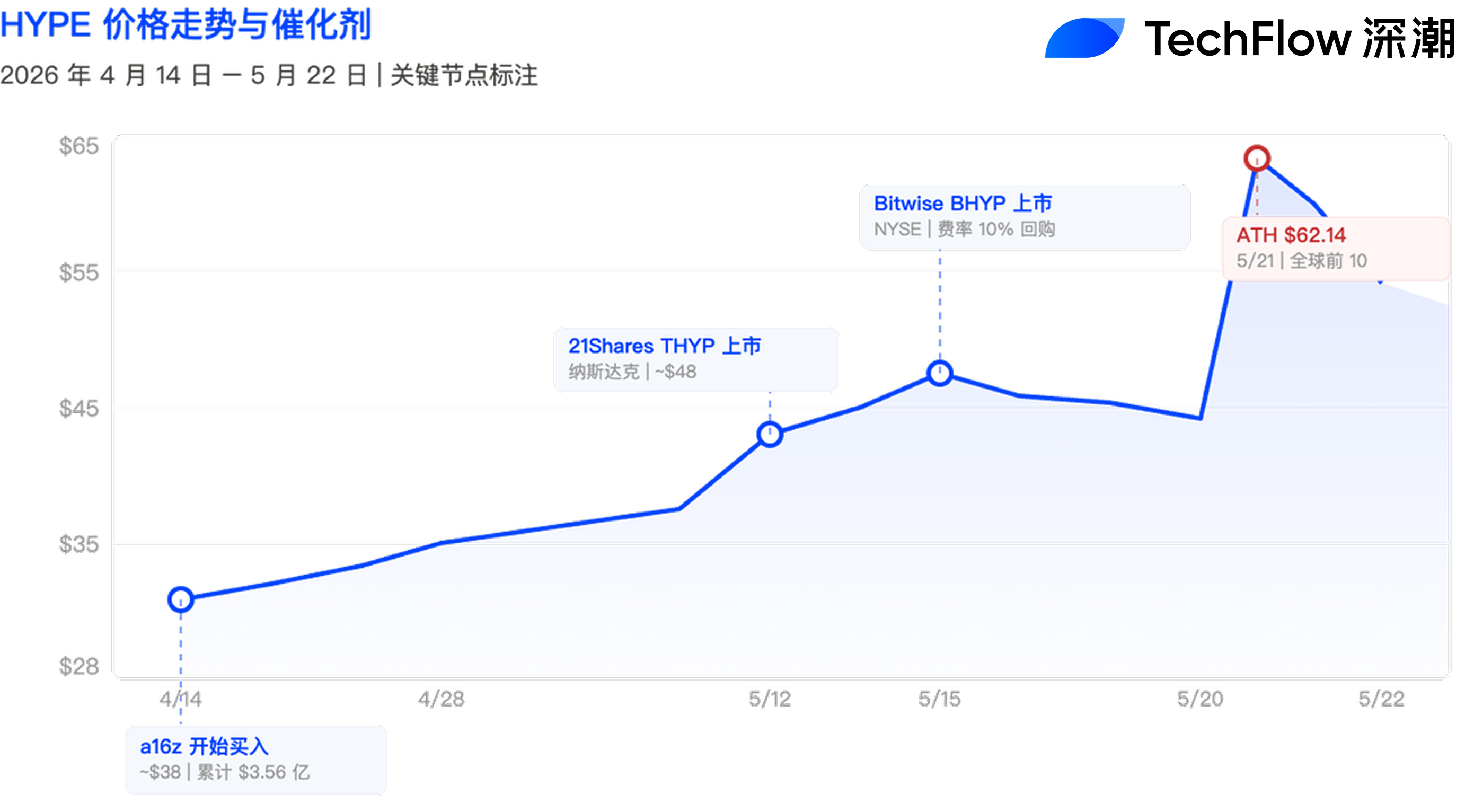
Revenue = Foundation, Institutions = Amplifier, ETF = On-ramp. Having all three layers align simultaneously is indeed rare among altcoins.
The logic of this heat spilling over into the same sector is straightforward. Lighter is the fourth-ranked player in the perp DEX space, with about 10% market share, but its market cap is only 1/40th of HYPE's. After HYPE hit record highs and entered the top 10 by market cap, traders naturally look for higher-beta plays along the same narrative.
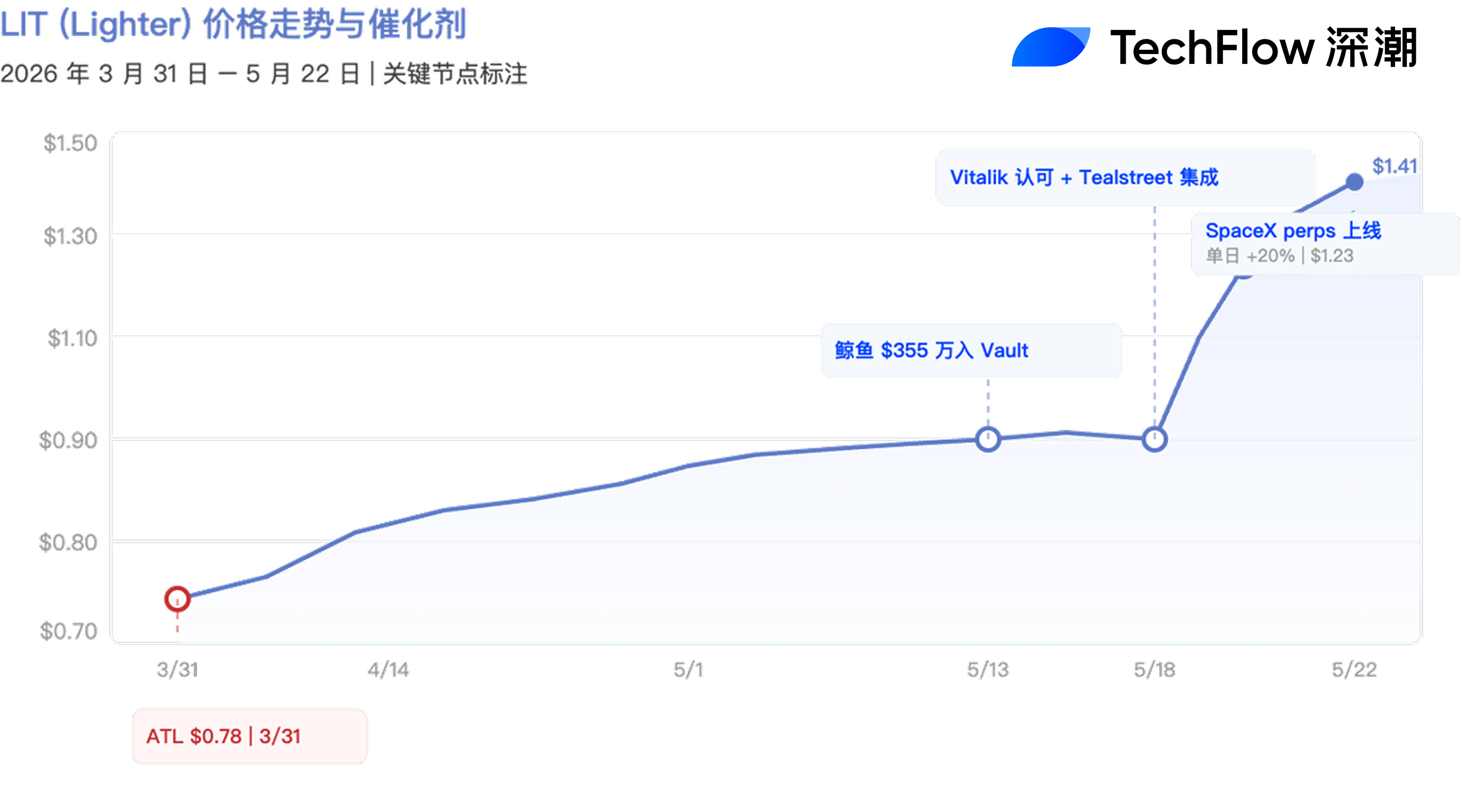
On May 18, Vitalik mentioned Lighter as a "relatively successful new project" in the Ethereum ecosystem during a public discussion, providing a celebrity endorsement for this catch-up trade. LIT subsequently rose 30% over the next three days. Lighter has also been active: launching a SpaceX pre-IPO perpetual contract, integrating with the Tealstreet trading terminal, generating annualized revenue of approximately $26.3 million, and also having an automatic buyback mechanism.
However, the risks for LIT are also clearer compared to HYPE.
A significant portion of Lighter's earlier high trading volume came from incentive programs and zero-fee designs. Some market analysis suggests its volume-to-open interest ratio is high, and whether wash trading is a factor remains to be seen. LIT's circulating supply is only 25% of the total, with team and investor tokens starting to unlock at the end of the year at a rate of approximately 13.5 million per month.
The flip side of high catch-up potential is that if the HYPE narrative cools down, LIT's retracement could be faster and deeper.
In my view, this main narrative will likely continue to attract attention and capital in the short to medium term. Key points to watch are:
1. Whether ETF inflows for HYPE can reach a higher magnitude.
2. Whether Hyperliquid's protocol revenue can tap into new growth areas like traditional asset synthetic trading (crude oil, stock perps), for example, SPCX.
If both materialize, the perp DEX narrative still has room to run. If ETF inflows stagnate and revenue growth slows, the pressure from long-short position churn near HYPE's ATH will quickly transmit to LIT.
2. AI Narrative: NEAR Takes the Lead, GRASS and WLD Face Their Own Hurdles
The AI narrative isn't new in crypto, but the current capital allocation shows a shift in attitude.
NEAR is up 50% in 30 days, GRASS 8%, and WLD 5%. All carry the AI label, yet price performance differs tenfold. The market is no longer painting with a broad brush and is starting to differentiate between new developments and catalyst-driven sentiment.
$NEAR: Privacy + AI Narrative
NEAR's outperformance is directly linked to its flurry of product actions in the last two months.
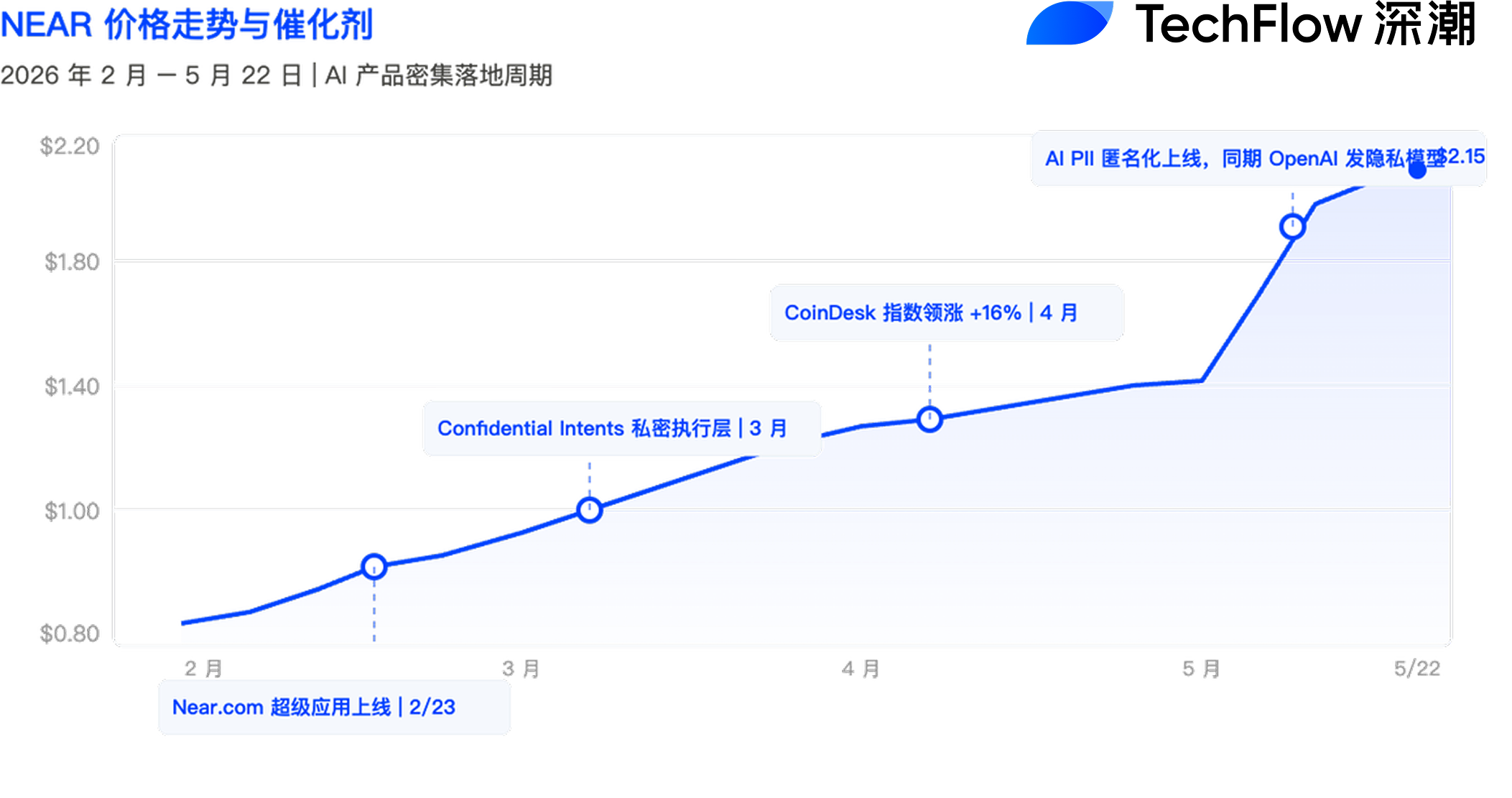
On May 19, NEAR AI launched a framework-level privacy feature:
When users send prompts to external models like ChatGPT or Claude, the system automatically strips away passwords, API keys, and personal information. Developers can enable this feature by adding a single header line.
This creates a narrative around AI privacy identity, and it's relatively practical. Privacy and user rights are highly valued in overseas tech discourse, so NEAR taps into both AI hype and privacy-centric sentiment.
Furthermore, the timing of this feature launch aligns with the AI sector's heat. OpenAI released its own Privacy Filter model at the end of April, and Microsoft simultaneously pushed PII Shield.
NEAR is essentially doing the same thing but running it on-chain, giving funds a reason to speculate.
Looking further back, the super app Near.com launched in February integrated wallets, cross-chain swaps, and confidential transactions. March saw the launch of Confidential Intents, a private execution layer. All these products converge on the same narrative: Enabling AI agents to trade and coordinate on-chain while preserving privacy.
$GRASS: Real Utility, but Unlocks Weigh Down
GRASS's situation is different.
On the product side, it's one of the few DePIN projects with real paying customers, including a "seven-figure" AI laboratory as reported by Blockworks. Part of its revenue is used for GRASS buybacks.
On April 24, OKX listed GRASS trading pairs, improving liquidity access to a certain extent, leading to a 28% rise in 7 days.
In my view, the drag on price performance comes from supply-side unlocks. The Season 2 airdrop is releasing approximately 170 million GRASS, combined with team and investor unlocks, keeping short-term supply pressure on the price. Community discussions also focus on this point. Grass's business is operational, but the token is currently more in a supply-demand tug-of-war rather than a trending market.
$WLD: Identity + AI Narrative
Furthermore, WLD is the most easily misinterpreted token in this group.
Many simply classify WLD as a "Sam Altman shadow trade" and move on, but in recent months, the foundation for its narrative speculation has been changing:
The more prevalent AI becomes, the more valuable proving you are human becomes. New variables supporting this logic have been emerging frequently in recent months.
1. Nasdaq-listed company Eightco Holdings (ticker: ORBS) holds 283 million WLD, representing 8.3% of the circulating supply, making it the largest publicly disclosed institutional holder globally.
2. Eightco also indirectly holds $90 million in OpenAI equity, with total assets of approximately $337 million, positioning itself as a bundled exposure to "AI + Identity + Creator Economy."
3. On May 1, World officially entered the US market, planning to deploy 7,500 Orb scanning devices within 12 months, several times the current global deployment count.
The issue also lies on the supply side. WLD has a total supply of 10 billion, with about 3.4 billion currently in circulation. The team frequently deposits large amounts of tokens to Coinbase and Bybit. After July 24, the unlock rate will decrease by 43%, which could be a potential turning point, but until then, supply pressure remains significant.
3. Privacy Narrative: English CT Re-FOMOs on Privacy Coins, ZEC Doubles in 30 Days
ZEC needs little introduction; you can refer to our previous article: "Doubled in 30 Days, Up 15x This Year: Why is English CT FOMOing on $ZEC Again?"
Aside from HYPE, English CT is full of ZEC mentions.
There's Naval Ravikant calling ZEC "insurance against Bitcoin," Arthur Hayes suggesting a long-term target of "10% of Bitcoin's price" at Consensus, and Multicoin Capital publicly disclosing a large position and retracting its 2019 view that "privacy isn't worth paying for separately"... Behind this wave of hype are several strong catalysts materializing simultaneously:
· The SEC confirmed the closure of its three-year investigation into the Zcash Foundation, recommending no enforcement action.
· Robinhood listed ZEC for trading across the US on April 23, opening a retail on-ramp. Grayscale's ZEC Trust is applying to convert into a spot ETF (ticker ZCSH), which would be the first privacy coin ETF in the US if approved.
AI and privacy are almost overarching narratives on English CT, with ZEC clearly acting as the leading indicator.
4. Meme Narrative: USELESS Doesn't Need Fundamentals, But Needs Liquidity
USELESS is up nearly 70% in 30 days, second only to ZEC.
During last summer's Solana launchpad wars (pump.fun, letsBONK, BelieveApp fighting for traffic), USELESS was one of the few survivors from letsBONK. The name itself is a meme: "I'm completely useless, and I don't pretend to be useful."
This revival has nothing to do with fundamentals – memecoins never do. The key variable is CEX accessibility: Coinbase, Bybit, and Crypto.com have all listed it, with 24-hour trading volume around $25 million, providing sufficient liquidity for short-term trading. When meme capital rotates on Solana, an old meme with CEX listings, community memory, and a name with built-in virality is easily pulled back into the spotlight.
However, the risks of memecoins are well-known; hype changes faster than any other asset class, acting more as an amplifier of market sentiment.
Its all-time high of $0.43 is still far from the current price, and both the token distribution structure and the significant prior retracement need to be noted. Also, a reminder: memecoin names like USELESS can suffer from same-name mapping issues on different aggregators, so always verify the contract address before trading.
In summary, these seven tokens correspond to four narratives, with vastly different sources of hype and degrees of confirmation.
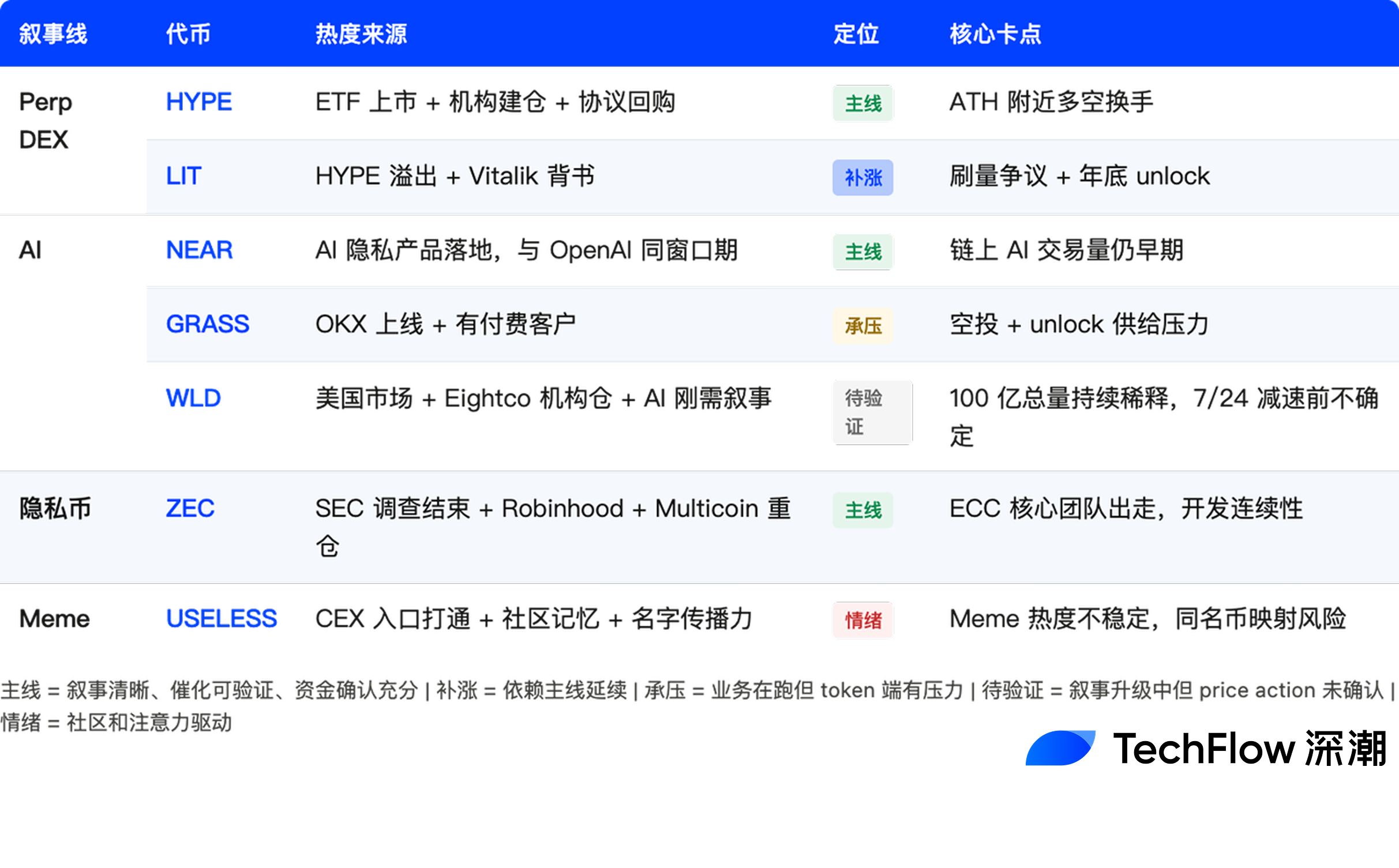
· HYPE, NEAR, and ZEC are the most confirmed assets on their respective narrative lines, with verifiable catalysts and traceable capital flows.
· LIT and GRASS depend more on the continuation of the main narrative and digesting supply pressure. They offer high beta but have lower certainty.
· WLD's demand narrative is upgrading, but supply-side pressure remains a concern until July, requiring further direction. USELESS is pure attention and sentiment trading, not suited for fundamental analysis.
For spot investors, understanding the general trends of these narrative lines is essential. The current crypto market has limited hotspots; prices may retrace, but the main trends are unlikely to change in the short to medium term.
For derivatives traders, timing is more critical, requiring deeper analysis of metrics like Open Interest (OI) and funding rates within shorter timeframes (e.g., 1-2 days).
Finally, structural opportunities still exist in the market. Research remains a good way to find yield when it's least sought after.