






深入拆解 Anthropic 封号风暴的背后:安全宗教、AI 内战与中美脱钩下的 Claude 困局


- 核心觀點:Anthropic嚴苛的封號政策是其創始人Dario Amodei的「安全優先」執念、商業模式聚焦高溢價企業客戶、美國AI產業安全派與加速派的內鬥,以及中美AI技術脫鉤地緣政治共同作用的結果,旨在透過預防性執法保護企業客戶利益並規避監管風險。
- 關鍵要素:
- Anthropic在2025年下半年封禁145萬帳戶,申訴成功率僅3.3%(1700/52000次成功),執行「寧可錯殺」的預防性風控。
- 創始人Dario Amodei因父親病逝及從OpenAI出走經歷,將「控制風險」執念內化為公司DNA,堅持「憲法AI」安全理念,甚至為拒絕國防部軍事合同而起訴美國政府。
- 商業模式聚焦銀行、律所等企業客戶,以「安全溢價」盈利;對普通用戶採用補貼式訂閱,透過封禁打擊「薅羊毛」行為以控制成本。
- 安全派(Anthropic)與加速派(OpenAI/國防部)的內鬥,以及Amazon/Google資本的利益綁定,共同推動了其極端風控政策。
- 中美AI脫鉤背景下,Anthropic為遵守美國出口管制並避免罰款(如曾被罰1200萬美元),對中國用戶執行最嚴格的「地區風控」封禁。
In April 2026, at an American agricultural technology company called Agricultural Technology Company, employees opened their computers as usual, preparing to use Claude Code for coding, data, and supply chain analysis, only to find that 110 employee accounts had been completely banned without any warning. The company's network administrator received an email from Anthropic: Activity violating usage policies detected, your account has been suspended.
Although the accounts were collectively banned, the backend API continued to function normally and charge fees as usual. The company's network administrator even received a payment reminder text message. Subsequently, the company's management sent appeal emails and contacted Anthropic, but ultimately made no progress. The strike of Claude Code directly plunged the entire team into a work stoppage.
At the same time, on Chinese-language internet forums like V2EX, Zhihu, and Juejin, complaints from Claude users were everywhere: someone had just topped up their Max subscription but got their account banned seconds before even using it; someone bound a virtual card, and the moment the payment succeeded, the system flagged "account violation" and banned it; someone logged in using a third-party tool and got blacklisted by the system immediately, having 4 accounts banned within three months without a single successful appeal.
In fact, since Anthropic entered the market with its flagship product Claude Code and rose to the top tier, it has become notorious as the account-banning maniac.
According to Anthropic's Transparency Hub risk control data for the second half of 2025, released in January 2026, in just six months, the platform banned a total of 1.45 million accounts. Out of 52,000 appeals filed, only 1,700 were successful. This means the success rate for appeals was only 3.3%.
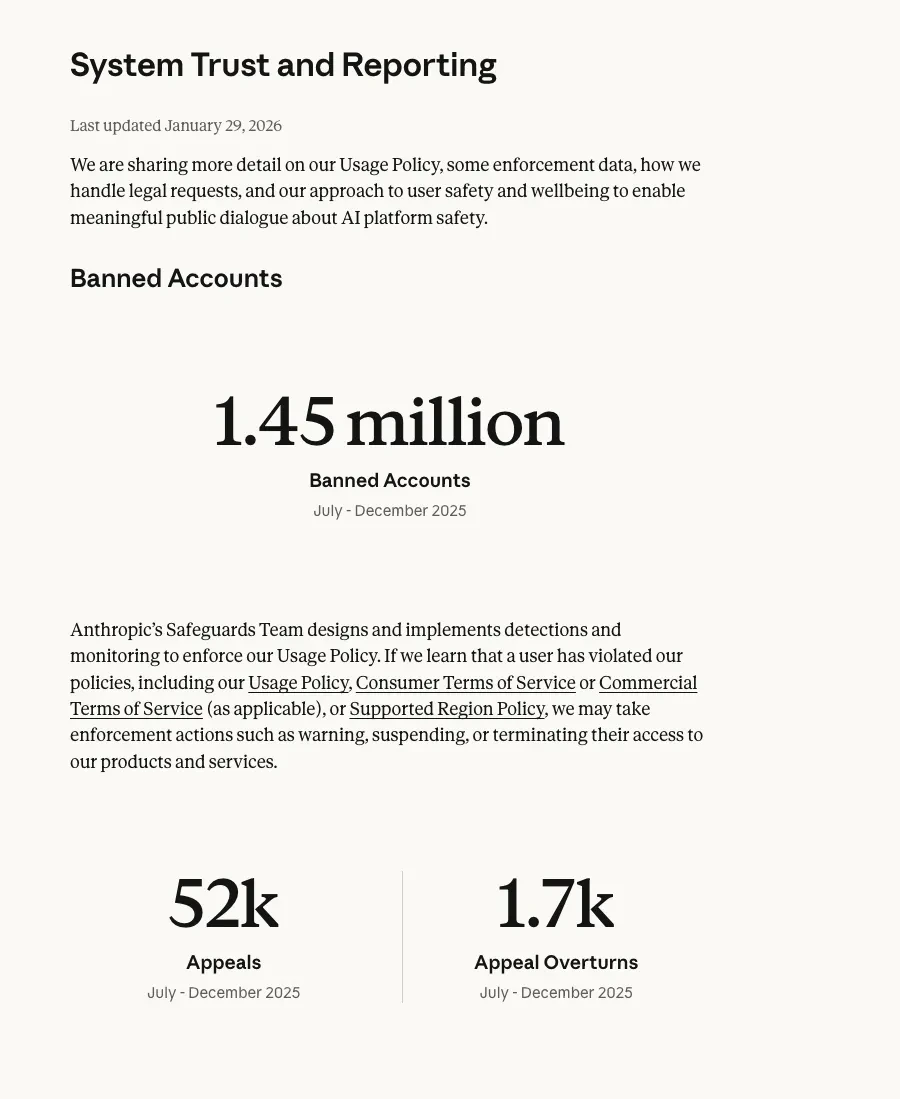
Source: https://www.anthropic.com/transparency
In other words, out of 100 users who felt particularly wronged about being banned, only about 3 could get their accounts back. The remaining 97 had to just accept their bad luck.
So this also illustrates that Anthropic does not operate on the principle we might understand—investigate the facts first, then penalize accordingly. Its approach is more about preventive enforcement. Its core goal is to intercept risks in their infancy through high-coverage blocking, preferring to mistakenly punish 1,000 rather than let a single one slip through.
In comparison, its counterparts like ChatGPT and Google Gemini are relatively more lenient.
ChatGPT is much more tolerant of third-party tools and edge prompts, with relatively lax account banning.
Gemini, even when occasionally tightening risk controls, rarely conducts unwarned collective punishment or mass purges.
Only Anthropic treats "account banning" as a daily routine, especially Claude Code, which has become a disaster zone for bans.
So why is Anthropic's user policy so strict? I believe the reasons are relatively complex.
This involves not only founder Dario Amodei's personal obsession, the factional split within OpenAI, the power struggle in Silicon Valley capital, and the civil war between the safety faction and the acceleration faction in the US AI industry, but also the geopolitical chess game of the US-China AI decoupling—a great game hidden behind the code concerning the future control of AI and global technological barriers.
So in this article, let's unpack it layer by layer.
01、Dario Amodei's Obsession
The root cause of Anthropic's stringent risk control lies hidden in the life trajectory of founder Dario Amodei. Every choice he made, every obsession he held, ultimately transformed into Anthropic's "zero-tolerance" iron rule and, equally, into the account ban notifications for countless users.
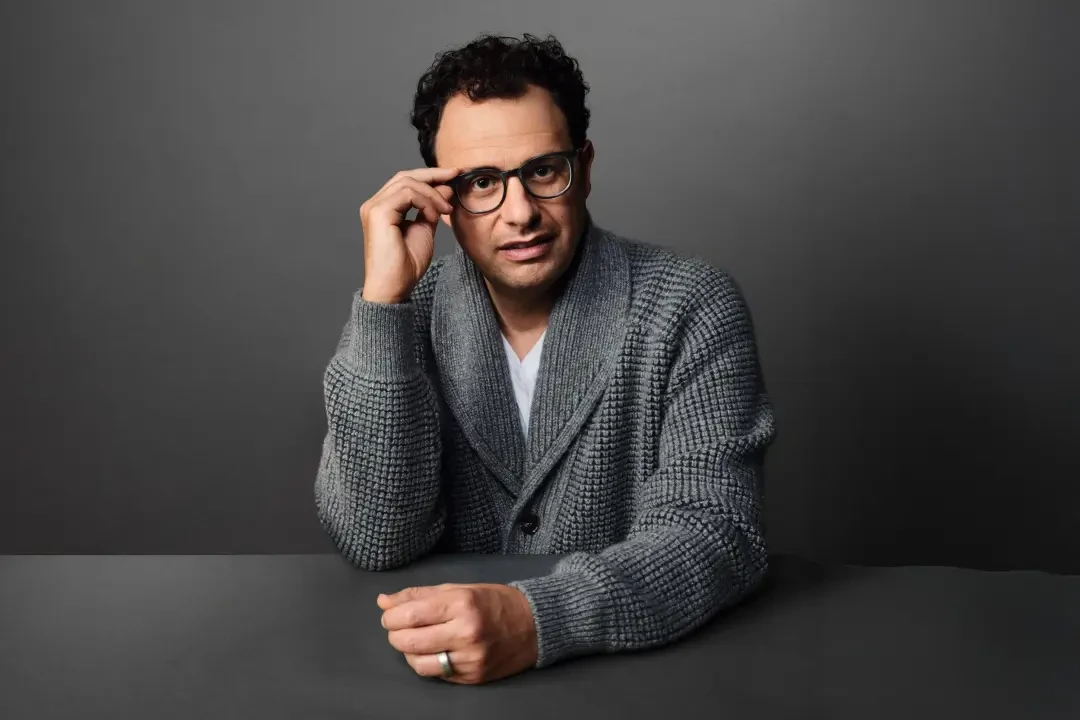
Recent official photo of Dario Amodei. Source: https://fortune.com
Born in 1983 in San Francisco to an ordinary immigrant family, Dario Amodei's father was an Italian-American leather craftsman who lived by his skills his whole life, with a stubborn personality who valued right and wrong above all. His mother was Jewish, managing library renovation projects, meticulous in her work, and instilled in Dario from a young age the philosophy that "responsibility is above all else."
This family atmosphere fostered in Dario a character of sticking to his principles and upholding bottom lines, tolerating no ambiguity or compromise.
As a child, Dario showed the traits of a scientific prodigy. He disliked crowds, wasn't good at socializing, and devoted all his energy to mathematics and physics. When textbook knowledge wasn't enough, he would immerse himself in the library, devouring various profound theoretical works. At that time, his greatest dream was to become a theoretical physicist, exploring the ultimate mysteries of the universe.
In 2006, Dario's father contracted a rare and difficult disease that couldn't be cured despite seeking out famous doctors, eventually passing away. His father's death was a devastating blow to the 20-year-old Dario, completely overturning his worldview.
Watching his father suffer from illness, witnessing the dilemma that medicine couldn't solve, he suddenly realized that abstract theoretical physics couldn't save the people in front of him, couldn't save ordinary people afflicted by disease.
So, he resolutely abandoned his long-studied theoretical physics and turned to biophysics instead, vowing to "use science to cure human diseases," carving the principle of "controlling uncontrollable risks" deep into his bones.
This obsession ran through his entire career:
He first entered the California Institute of Technology for his undergraduate studies, then transferred to Stanford University to complete his Bachelor's degree in Physics. Subsequently, he was admitted to Princeton University for a Ph.D. in Biophysics, becoming a Hertz Foundation Fellow, specializing in the relationship between biomolecular structure and disease. After his Ph.D., he did postdoctoral research at the Stanford University School of Medicine, continuing to delve into the biomedical field, trying to find ways to combat rare diseases.
It wasn't until 2014, when Andrew Ng extended an olive branch and invited him to join Baidu's US lab, that he first came into contact with artificial intelligence.
At that time, AI development was in its very early stages, mainly used for image recognition and speech synthesis. But Dario acutely realized that AI could not only change lives but could also become a super tool for countering risks and saving humanity. However, the prerequisite was that it must be strictly controlled and not allowed to go out of control.
After leaving Baidu, he joined Google Brain as a Senior Research Scientist, delving deeper into the field of deep learning, focusing on AI safety—specifically how to make AI obedient and prevent it from doing things that harm humans.
It was also during this phase that he began to contemplate how to truly embed human values into the foundation of AI, rather than simply applying post-hoc filters.
In 2016, shortly after its founding, OpenAI attracted top global AI talent with its motto of "open source, non-profit, promoting AI for the benefit of humanity." Dario was drawn to OpenAI's philosophy and joined. With his top-tier technical skills, he rose from the head of the AI safety team to Research Director, and then to Vice President of Research, fully participating in the development of GPT-2 and GPT-3.
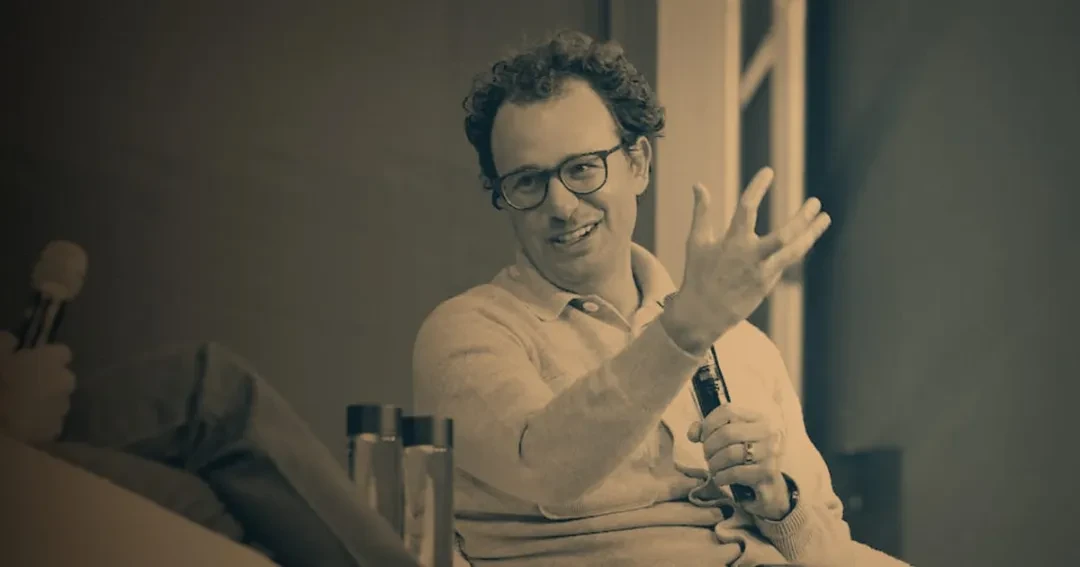
Photo of Dario Amodei during his early career (OpenAI/Google Brain period, approx. 2018-2021). Source: bigtechnology
During this time, he was also a co-inventor of RLHF (Reinforcement Learning from Human Feedback). Simply put, this technology uses human feedback to correct AI output, making it more aligned with human values. It later became the safety patch for the entire AI industry. At that time, Dario was wholly focused on how to safely implement and deploy AI. But he never imagined that his ideals would soon be shattered by reality.
The Internal Strife at OpenAI: The Split Between the Safety and Acceleration Factions
Actually, many people only know that Dario Amodei left OpenAI with his team in 2021 to found Anthropic. But few know that behind this "defection" was a years-long battle of ideas, a power struggle, and a "betrayal" that left a deep mark on Dario.
In its early days, OpenAI indeed adhered to the principles of "non-profit, safety first." Elon Musk was an early investor and always emphasized that AI safety was paramount. However, as time went on, especially after Sam Altman became CEO of OpenAI, the company's development direction began to shift significantly.
Sam Altman is a typical "accelerationist." He believes that the pace of AI development must keep up with the times: first, build larger and more powerful models, seize market opportunities, achieve commercialization, and only then address safety issues.
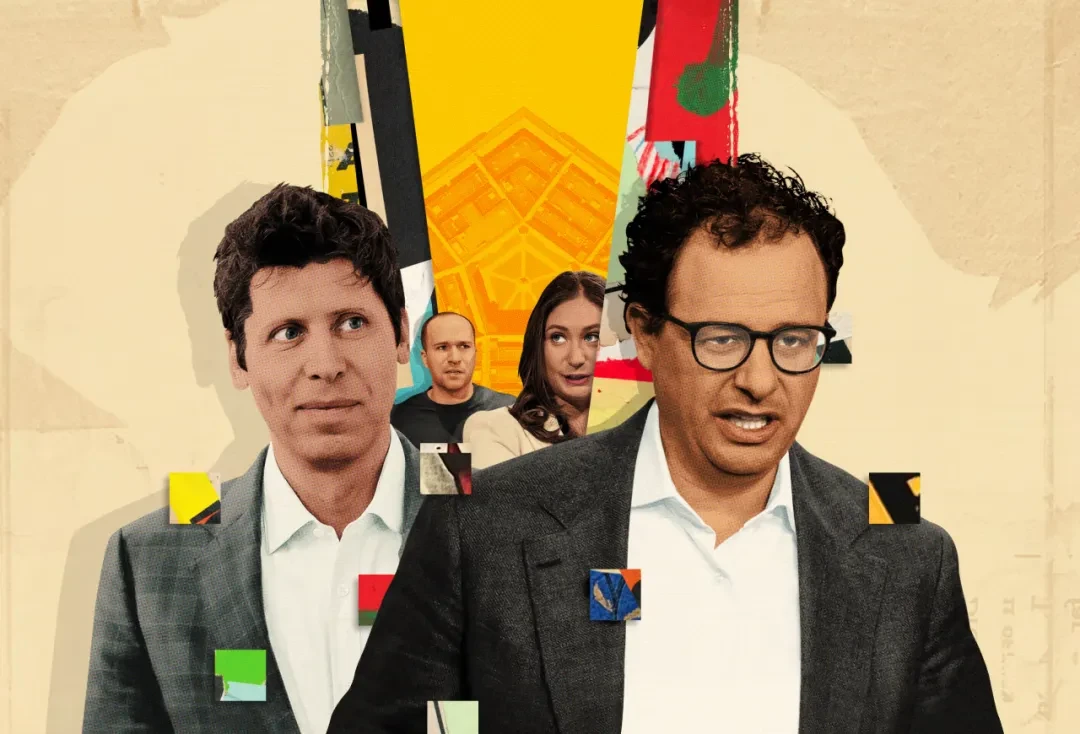
Symbolic image of the OpenAI and Anthropic faction split (Sam Altman vs Dario collage). Source: wsj.com
Under his leadership, OpenAI began to downplay its "non-profit" nature, actively sought commercial partnerships, and even actively courted Microsoft for more funding and computing power, all to rapidly iterate the GPT series models and seize a larger share of the AI market voice.
But all of this was unacceptable to Dario Amodei.
In his eyes, AI was not a tool for capturing market share but a "civilization-level force capable of either curing humanity or destroying it." If safety issues weren't resolved first, and AI-human alignment wasn't properly achieved, the consequences of a model going out of control would be catastrophic.
He repeatedly proposed internally to slow down the pace of model iteration, strengthen safety testing, and prioritize "alignment first." But his voice became increasingly marginalized.
In fact, the difference in ideas was just the surface. The deeper conflict lay in the power reshuffling and attribution of credit.
According to an in-depth 2026 report by the Wall Street Journal, Dario Amodei made core contributions to the development of GPT-3—it was he who spearheaded the implementation of the RLHF technology. Yet, in public promotions, his contributions were severely underestimated. The Sam Altman team preferred to emphasize "model scale and capabilities," neglecting the safety technology Dario led.
What also chilled Dario was that after Musk left OpenAI due to ideological differences, company leadership completely fell into the hands of Sam Altman. The budget for the safety team was drastically cut, many core safety R&D projects were suspended, and some senior executives even publicly stated: "Safety issues can be put on hold. Let's get commercialization done first. Once we have money, we can come back and solve safety problems later."
Dario knew that he could no longer realize his ideal of "making AI safe for deployment" at OpenAI. He later recalled this experience on Lex Fridman's podcast, speaking calmly but with a hint of finality: "Arguing with others about core visions is an extremely unproductive thing. Rather than wasting time, it's better to gather your own people and realize your own ideals."
In early 2021, AI prodigy Dario made a decision that shocked Silicon Valley. He left en masse with his sister Daniela Amodei (now President of Anthropic), OpenAI's core safety team, and key research personnel.
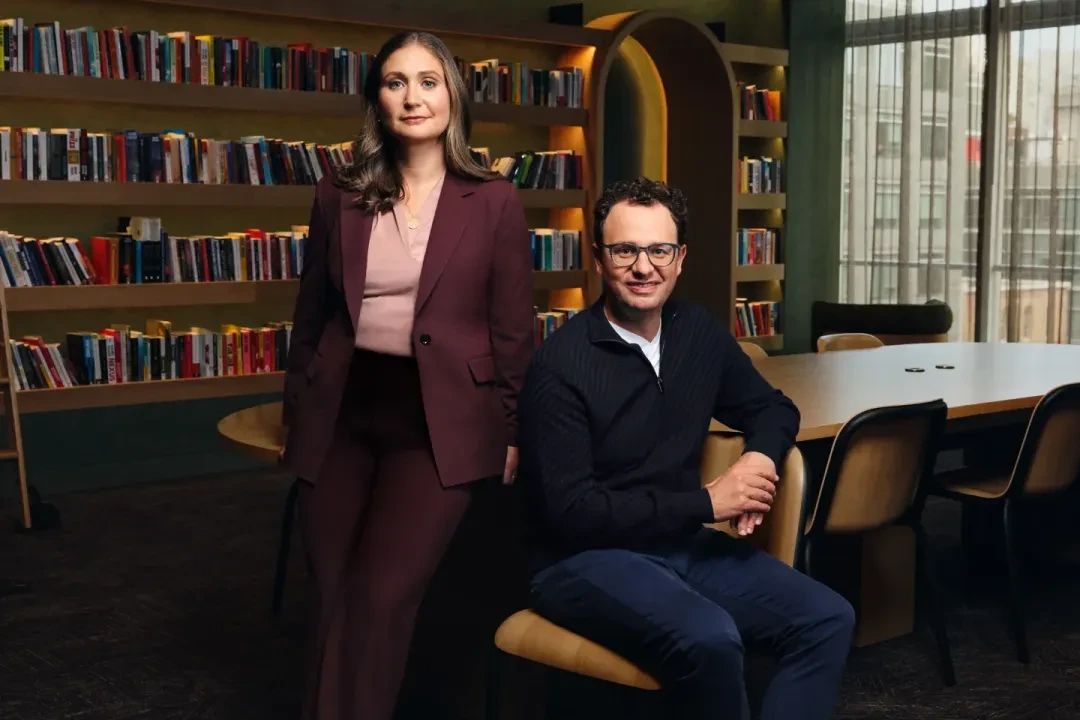
Photo of Dario Amodei with his sister Daniela Amodei. Source: Fortune
This departure was seen as a complete reckoning with OpenAI's accelerationism and a steadfast adherence to the principle of safety first.
At that time, OpenAI's official statement politely congratulated Dario's team on their new journey, but privately, the rift between the two sides was already irreparable.
What Dario took with him wasn't just top-tier talent, but also OpenAI's core safety technology and philosophy, which later became the foundation of Anthropic. Meanwhile, after Dario's departure, OpenAI completely embarked on the path of commercial acceleration, moving further and further away from Dario's original aspirations.
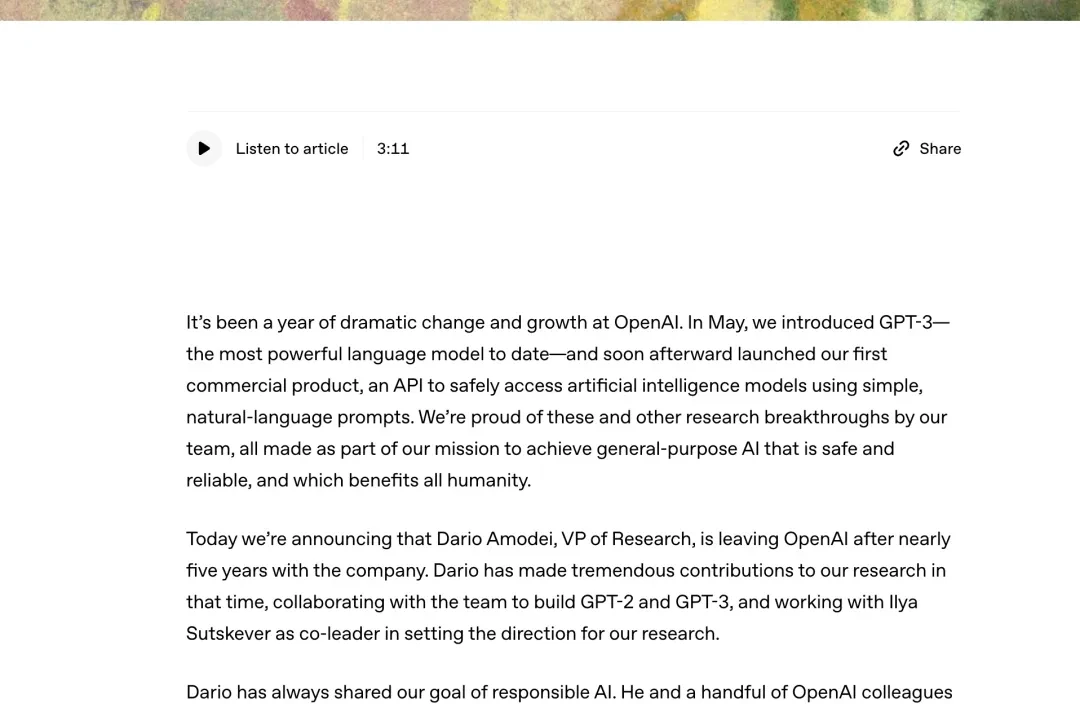
Source: https://openai.com/index/organizational-update/
Anthropic's "Safety Religion"
In February 2021, Dario Amodei formally established Anthropic, positioning it as a "public benefit corporation." This meant that the company's core goal was not profit maximization itself, but "promoting the safe and controllable development of AI for the benefit of humanity."
And his obsession with "controlling risk," born from his father's death, and his "safety初心" from leaving OpenAI, ultimately became Anthropic's core system, a "safety religion" etched into the company's DNA.
From its inception, Anthropic established a core invention called Constitutional AI. This was the crystallization of Dario's years of thinking about "AI safety" and the key differentiator from OpenAI and Google Gemini.
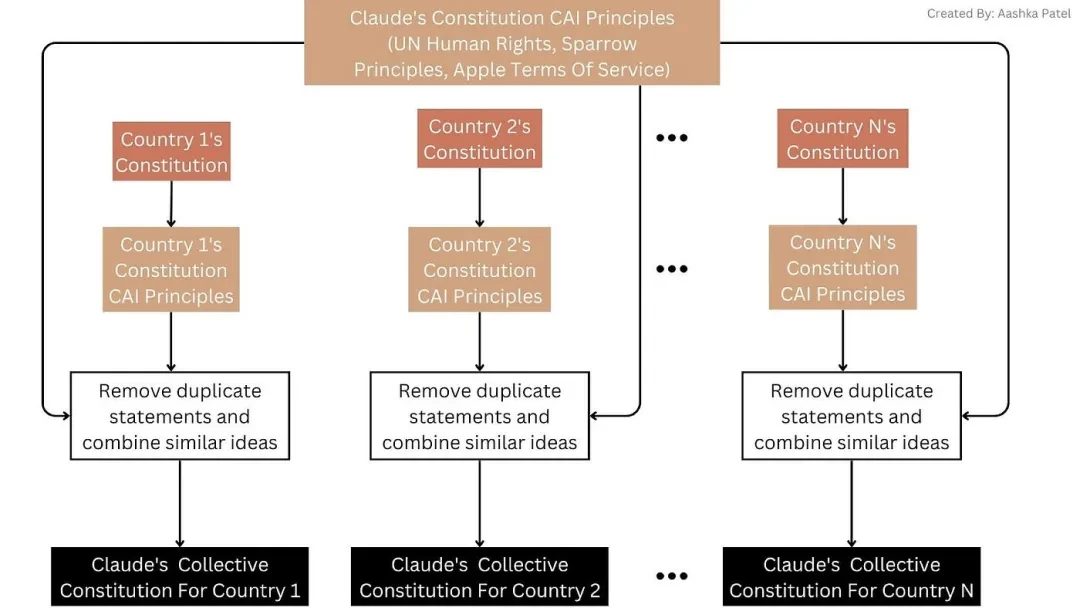
Principle diagram of Constitutional AI. Source: Aashka Patel
Constitutional AI did not follow OpenAI's practice of using RLHF as a "post-hoc patch." Instead, it embeds a "constitution" at the foundation of model training. This constitution integrates the UN Universal Declaration of Human Rights, common human ethical principles, and Anthropic's own safety principles. It requires the AI to "self-review" and "self-criticize" before generating any output or executing any command, ensuring the output aligns with human values and does not produce any dangerous content.
Dario personally wrote two long-form essays, "Machines of Loving Grace" and "The Adolescence of Technology," elaborating on his AI vision:
He believes AI is like a teenager—possessing great potential but full of uncertainty. It must be given rules and defenses in advance to prevent it from going astray. Constitutional AI is the "rule" set for AI, playing the role of that defense.
This safety religion is not only reflected in model training but also directly conveyed to every Anthropic product and risk control policy— Claude Code's high-permission design, paired with prompt injection probes and dialogue classifiers, ensures an extra layer of self-check before the AI executes commands; The preventive enforcement logic of risk control, preferring to mistakenly punish the innocent rather than let any suspicious behavior slip through, aims to nip risks in the bud.
The 2026 incident where Anthropic stood up to the US Department of Defense best exemplifies this "safety fundamentalism." This incident not only shocked Silicon Valley but also showed the world Dario Amodei's determination to forgo profit rather than abandon safety.
In early 2026, the US Department of Defense requested Anthropic to remove two of Claude's safety guardrails:
First, prohibit Claude from being used for "mass surveillance of US citizens."
Second, prohibit Claude from being used for the development and deployment of "fully autonomous lethal weapons."
The DoD promised that if Anthropic complied, it would sign a $200 million military contract and provide substantial computing support.
It's important to note that at the time, Anthropic was under significant computing and financial pressure. A $200 million military contract would have been enough to alleviate the company's immediate difficulties.
But Dario Amodei directly refused.
He issued a public statement with firm resolve: "We cannot go against our conscience to develop technology that could harm humans or violate human rights. Claude's safety guardrails are our bottom line. We will not compromise."
His refusal thoroughly angered the US Department of Defense. Under the Trump administration, the DoD directly placed Anthropic on a "supply chain risk" blacklist—the first time in American history a domestic AI company was added to this list, meaning all US defense contractors were prohibited from using Anthropic's products and services. Furthermore, the DoD threatened to invoke the Defense Production Act to force Anthropic to remove the safety guardrails.
Facing the pressure of the state apparatus, Dario Amodei directly sued the US Department of Defense, arguing that this action was "retaliatory punishment against Anthropic," violating US laws and values. Although an appeals court later denied Anthropic's request for a temporary injunction, Dario never compromised, even if it meant the company lost a huge contract and was ostracized by the entire US military-industrial complex. He steadfastly held onto his "safety bottom line."
Seeing this, we should





