屁股決定腦袋:Nikita 為什麼必須把商業灰產定性為「國家攻擊」?


- 核心觀點:X 平台產品負責人 Nikita Bier 將中文機器人泛濫定性為「中國國家級攻擊」,並非單純種族歧視,而是其個人所處的矽谷菁英身份、平台 KPI 壓力及中美地緣政治利益鏈共同驅動的結果,反映出平台治理成本轉嫁與認知錯位的結構性矛盾。
- 關鍵要素:
- Nikita Bier 的認知模板:畢業於 UC Berkeley 政治經濟學專業,長期從事美式增長黑客創業,缺乏對中文灰產商業邏輯的理解,使其將規模化異常行為自然歸因於地緣威脅。
- X 平台 KPI 生死鏈:中文機器人污染時間線與算法,導致用戶流失與廣告主顧慮。甩鍋「國家攻擊」可免責、立人設、示好監管,避免承擔技術改進成本。
- 矽谷創投地緣政治利益鏈:Nikita 兼任 Lightspeed 合夥人及 Solana 顧問。矽谷主流敘事將中國視為系統性對手,其言論符合政治正確,有助於鞏固個人聲譽與 VC 圈層利益。
- 中國灰黑產流量收割鏈:國內灰產市場規模超 2800 億元人民幣,從業人員超 800 萬,以 ROI 為驅動在 X 平台引流詐騙。這與國家行為無關,但 Nikita 因認知盲區將其誤判為組織性攻擊。
- 結構性矛盾後果:X 想吃全球流量紅利卻逃避多語言治理成本,中國灰產將平台當免費流量池,導致普通用戶成為最終受害者,問題陷入互相甩鍋的僵局。
On April 26, Nikita Bier, Head of Product at X, directly characterized the rampant Chinese-language porn bots and spam on the platform as a "Chinese state-sponsored bot army attack," sparking extreme dissatisfaction among many Chinese-speaking users. Many accused him of racism and arrogant scapegoating, claiming he couldn't even distinguish basic facts.
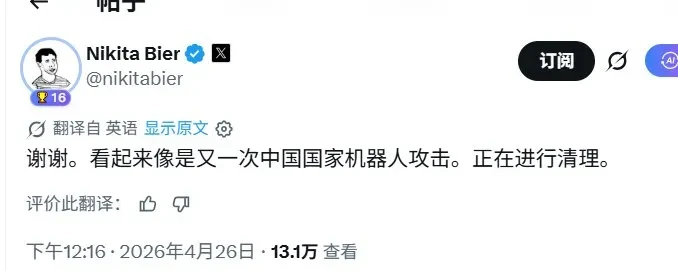
Of course, I think we shouldn't rush to moral judgment but first return to rationality. If we break this down into several chains of interests, you'll actually find that Nikita's attitude towards this fact is not at all thoughtless or a spur-of-the-moment outburst.
It is, in fact, more a result determined by his position, the resources he holds, and the cognitive frameworks in his mind. So rather than attributing it to his personal moral failings, it's better seen as the natural extension of interest chains.
Who is Nikita Bier? A "Political-Economic Man" Nurtured by American Growth Hacking Logic
If we want to understand why he said this, I think we first need to understand who he really is.
Nikita is actually a typical Silicon Valley elite.
I believe he carries three labels:
Political correctness, viral growth, and rapid monetization.
Regarding political correctness, as a distinguished graduate of UC Berkeley with dual degrees in Political Economy and Business, these majors essentially teach you to view the world through the frameworks of national interests and power games. So from his student days, his mind was instilled with the idea of thinking politically about everything. This fundamentally laid the groundwork for his underlying logic in forming opinions, or his values and worldview.
As for viral growth and rapid monetization, these two labels are about how he took "American growth hacking" to the extreme in his entrepreneurial journey.
- In 2012, he created Politify, a policy simulation tool that gained popularity through viral spread, honing his skills in "low-cost user acquisition."
- In 2017, he developed tbh, an anonymous compliment app targeting high school positivity, which he sold to Facebook/Meta within a few years for approximately $30 million, securing his initial capital.
- In 2022, he launched Gas, an upgraded version of tbh with paid reveals and gamification, sold it to Discord for another profit, becoming a well-known "serial successful entrepreneur" in Silicon Valley.
- In July 2025, he became Head of Product at X via a "posting your way up" approach, while also serving as a venture partner at Lightspeed and an advisor to Solana.
So for Nikita, all his success is built upon the closed loop of the Western youth market, psychological drivers, viral growth, and rapid monetization. This means he has never deeply engaged with the Chinese market, let alone had direct dealings with Chinese gray and black industries.
Therefore, in his eyes, any large-scale, anomalous user behavior isn't seen as commercial profit-seeking but as organized activity by external forces. This is his cognitive template formed over more than a decade from school to entrepreneurship — it's inherent. So you see why, whenever there's some slightly unusual interaction in the Chinese-language section, many users get asked to verify, or even face large-scale account bans during certain periods.
The Three Interest Chains I See
To see the essence of the problem, let's break down Nikita's statements into three interest chains for analysis.
First Interest Chain: X Platform's KPI Lifeline — His Rice Bowl, Easier to Keep by Passing the Buck
X's core revenue currently falls into three categories: advertising (the majority), Premium subscriptions (which likely just cover the salaries of blue check users), and Grok AI monetization.
So as Head of Product, Nikita's job is essentially to drive platform growth — user growth and revenue growth. I think his KPI boils down to just one thing: make all three of these revenue streams increase, and look good doing it.
But Chinese-language spam bots are precisely X's "cancer," with typical characteristics including:
- Large scale: Nikita himself mentioned a pool of 5-10 million accounts spamming in bulk every minute.
- Low cost: Chinese black ops use cheap servers, SIM cards, and VPNs, costing just a few cents per setup to register unlimited accounts.
- High damage: These bots don't attack X itself; they just sit there harvesting traffic, luring users to Telegram groups, scam schemes, and porn livestreams. This directly pollutes the timeline, search results, and recommendation algorithms, causing real user churn and potentially scaring off advertisers.
So, you think if Nikita admitted, "Our risk control model failed, our algorithm is insensitive to non-English traffic, we have accumulated technical debt," he'd definitely take the blame. He'd have to spend real money to fix the system, potentially impacting growth metrics. It's a big ship hard to turn; pulling one hair might affect the whole body.
Imagine, could someone like Musk tolerate a Head of Product saying, "Our technology isn't good enough"?
So the optimal solution is only one: shift the blame to "Chinese state-sponsored bots." The benefits are several:
Evade responsibility: It's not that our tech is bad, but the opponent is too powerful, it's a state action.
Build persona: X is defending global free speech, aligning with Musk's narrative, and gaining some goodwill.
Appease: Show loyalty to US regulators / Congress — "Look, we are fighting foreign interference" — potentially causing fewer policy headaches.
Is this a win-win deal?
Second Chain: Silicon Valley VC & Geopolitical Interest Chain — His Backers Need "Taking Sides" to Consolidate
Nikita isn't just X's Head of Product; as mentioned, he's also a venture partner at Lightspeed. Lightspeed is a typical Silicon Valley VC, having invested in BeReal, Flo Health, and other American-style consumer internet products, with virtually no connection to Chinese tech companies.
What's the mainstream narrative in Silicon Valley now?
China is a systemic adversary. The TikTok ban, data security reviews, supply chain decoupling — every issue pushes China towards the "enemy" camp. In this atmosphere, any "large-scale anomalous behavior" from China is automatically assumed to be a "state action." This is no longer just a matter of bias but a survival strategy.
X platform itself is caught in the crossfire of US-China rivalry. It wants to be a "global digital town square," monetizing global traffic, yet fears being accused by the US Congress of "abetting Chinese influence."
So I think Nikita's scapegoating perfectly hits the politically correct sweet spot: it helps Musk choose a side without affecting X's traffic from Chinese gray industries (since gray industry users won't subscribe to Premium anyway, they can't be monetized).
Of course, for him personally, taking this stance also has a hidden benefit: in Silicon Valley VC circles, "standing up to China" is a plus, boosting his personal reputation and making it easier to find projects and raise funds in the future.
Third Chain: Chinese Gray-Black Industry Traffic Harvesting Chain — The Real World He Doesn't Understand
Chinese internet gray-black industries are no small affair anymore.
I found some data from last year. According to Q1 2025 data, the domestic gray-black market scale exceeded 280 billion RMB, with over 8 million practitioners, forming a complete interest chain of intermediary traffic generation, technical support, legal disguise, and capital splitting. These operations have absolutely nothing to do with state actions. They only recognize one thing: ROI (Return on Investment).
A single click on a scam link earns a few cents; directing a user to a porn livestream earns a few dollars. An account can post hundreds of messages a day. As long as it breaks even, someone will do it. Due to X's relatively lenient moderation and huge global traffic, it's become their new battlefield. They don't intend to attack X; they just want to make money on it.
These black industries have no direct command relationship with the Chinese government. In fact, authorities in China are cracking down on VPNs and fraud. However, during "politically sensitive periods," their activity can indeed amplify because user attention is higher, increasing the success rate of scams.
Nikita fails to understand this chain:
Because he has never built products in China, he hasn't seen the underlying logic of "running scripts 24/7 for a 0.1 RMB click." He only sees "5-10 million timed accounts exploding" and concludes it's a "state action." This is a classic cognitive blind spot.
So, based on my analysis, you'll understand: Nikita isn't simply a "racist." He is a person completely defined by the economic chains he belongs to.
The triple identity of American growth hacker, Silicon Valley VC, and US platform executive naturally leads him to interpret "large-scale Chinese anomalies" as geopolitical threats rather than commercial gray industry.
This is a classic case of "position determines cognition." Sitting in that position, holding those resources, with those cognitive frameworks, the only thing he could say is exactly that.
So this isn't just Nikita's problem. I think it's more the inevitable result of the mismatch between the US and Chinese digital economy industry chains and the shifting of platform governance costs.
X wants to enjoy the benefits of global traffic but doesn't want to spend real money on multi-language gray industry governance.
Chinese gray industries want to make quick money globally but treat platforms as free traffic pools.
Neither side wants to pay for the "public good" (a clean digital square), leading to mutual scapegoating. You call it a "state-sponsored attack," I call it "incompetent tech." Neither will admit fault, neither will solve the problem.
Ultimately, the ones who lose are the ordinary users who just want to see real information and communicate normally on X. This is truly the most disheartening part of the whole affair.