






Tiger Research:鏈上風險操盤者,147兆與70億的市場體量鴻溝


- 核心觀點:去中心化金融(DeFi)借貸領域正從協議主導轉向專業風險操盤團隊驅動,行業核心已變為風控研判能力的競爭。傳統資管機構憑藉成熟風控經驗,處於最佳入局窗口期,但賽道體量尚小,先發優勢至關重要。
- 關鍵要素:
- DeFi 借貸領域催生「風險操盤者」這一專業資管角色,負責策略制定與風控,取代了早期協議與社群全權主導的模式。
- 截至 2026 年 5 月,全球風險操盤賽道管理資產約 70 億美元,前三名團隊(Steakhouse、Sentora、Gauntlet)佔據 70% 份額,資金向頭部聚集。
- 行業入局存在三種路徑:渠道分銷(外包風控)、資產供給(上鏈優質資產)、自主運營(自建風控團隊),決定話語權、能力與風險分配。
- DeFi 底層架構已複刻傳統金融分工:頂級資金募集(交易所)、中層策略風控(風險操盤者)、底層產品與託管(借貸協議)。
- 傳統資管機構最優入局點為策略管理層,其核心優勢在於專業風控研判能力,而非技術或流量,如 Bitwise 已率先透過自主運營模式深度參與。
- 當前 DeFi 市場體量(約 800 億美元)與全球傳統資管規模(147 兆美元)差距懸殊,預示巨大增長潛力,但早期風險操盤團隊享有規則制定主導權。
This report is authored by Tiger Research . In the realm of decentralized finance lending, the locus of control is gradually shifting from protocol projects to professional entities that hold risk management decision-making power. For industry entrants, there are essentially only three choices: leverage others' analytical capabilities, export your own, or build and control them in-house.
Key Takeaways
- The decentralized finance sector is giving rise to a new type of asset management role, and the era where protocols and community governance held absolute sway is over.
- The track is still in its early stages, but capital flows and channel resources are rapidly concentrating among top-tier risk management teams, whose track records are becoming the core benchmark for institutional entry.
- Three main entry paths exist: channel distribution (backed by risk management teams), asset supply (bringing offline assets on-chain), and independent operation (building an in-house team as the risk manager).
- The chosen path directly determines the entity's influence, required core competencies, and potential risks.
- The core decision for the industry isn't whether to enter decentralized finance, but how to allocate authority: which risk management decisions to delegate and which core powers to retain in-house.
1. Risk Managers: Professional On-Chain Asset Management Service Providers
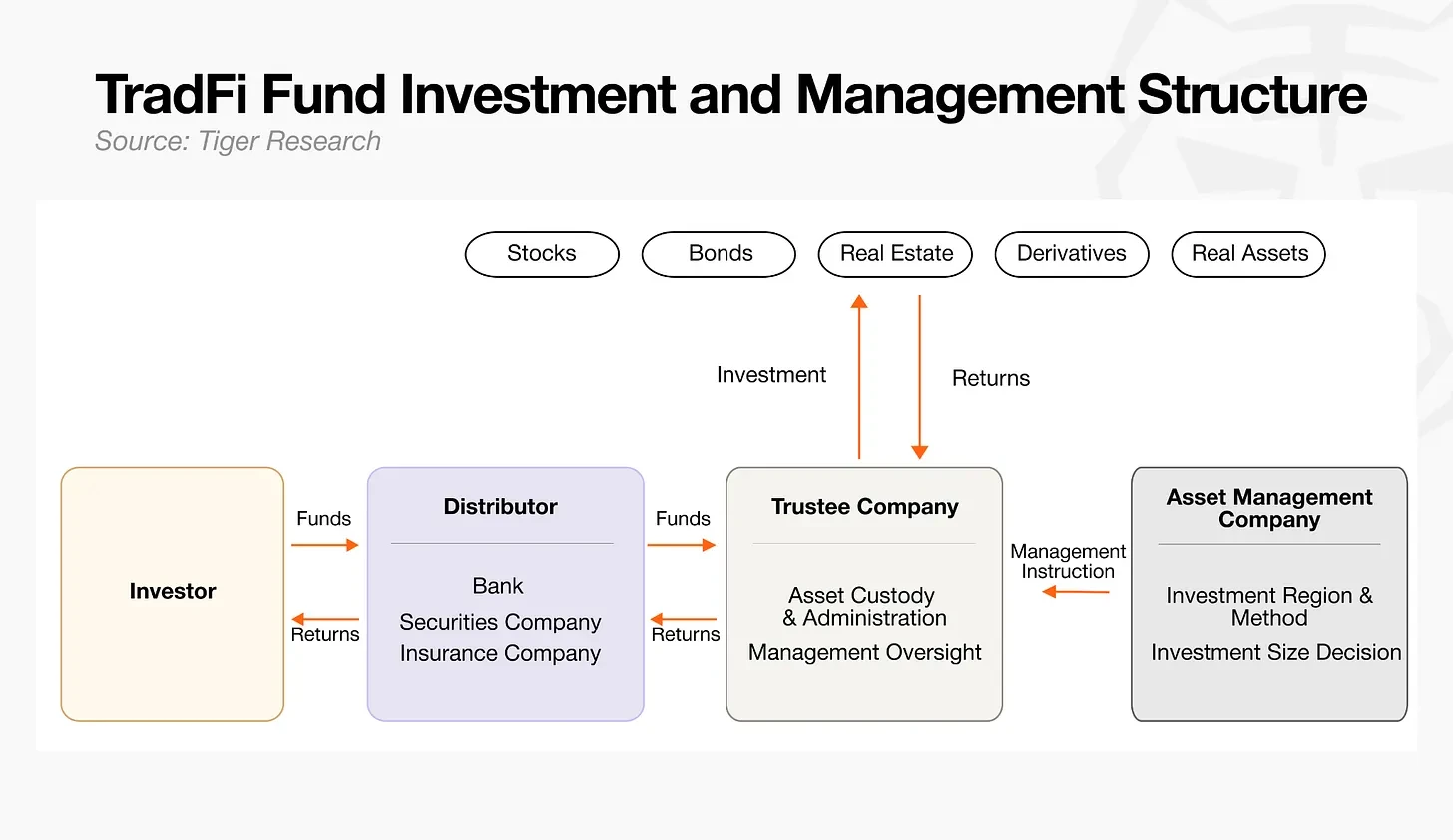
Traditional finance has long separated the responsibilities of decision-making analysis and trade execution. As the crypto market matures, various specialized functions have also developed their own dedicated professional operators.
Functional Division in Traditional Finance
- Asset Manager: The core decision-making hub for capital operations, formulating overall investment strategies and issuing specific execution instructions to custodians.
- Custodian: Responsible for the safekeeping of assets, strictly executing investment operations per the manager's instructions and overseeing asset security throughout the process.
- Channel Distributor: Sells fund products to investors, handling market fundraising and capital aggregation.
The crypto industry has evolved a corresponding functional system. Early DeFi relied entirely on smart contracts, but market practice has proven that code alone cannot fully prevent all potential on-chain risks. To ensure the stable operation of on-chain lending, a group of professionals specializing in complex risk assessment and coordination emerged – risk managers – who formally assumed the role of asset managers within the on-chain ecosystem.
2. Early DeFi Lacked Specialized Risk Management Roles
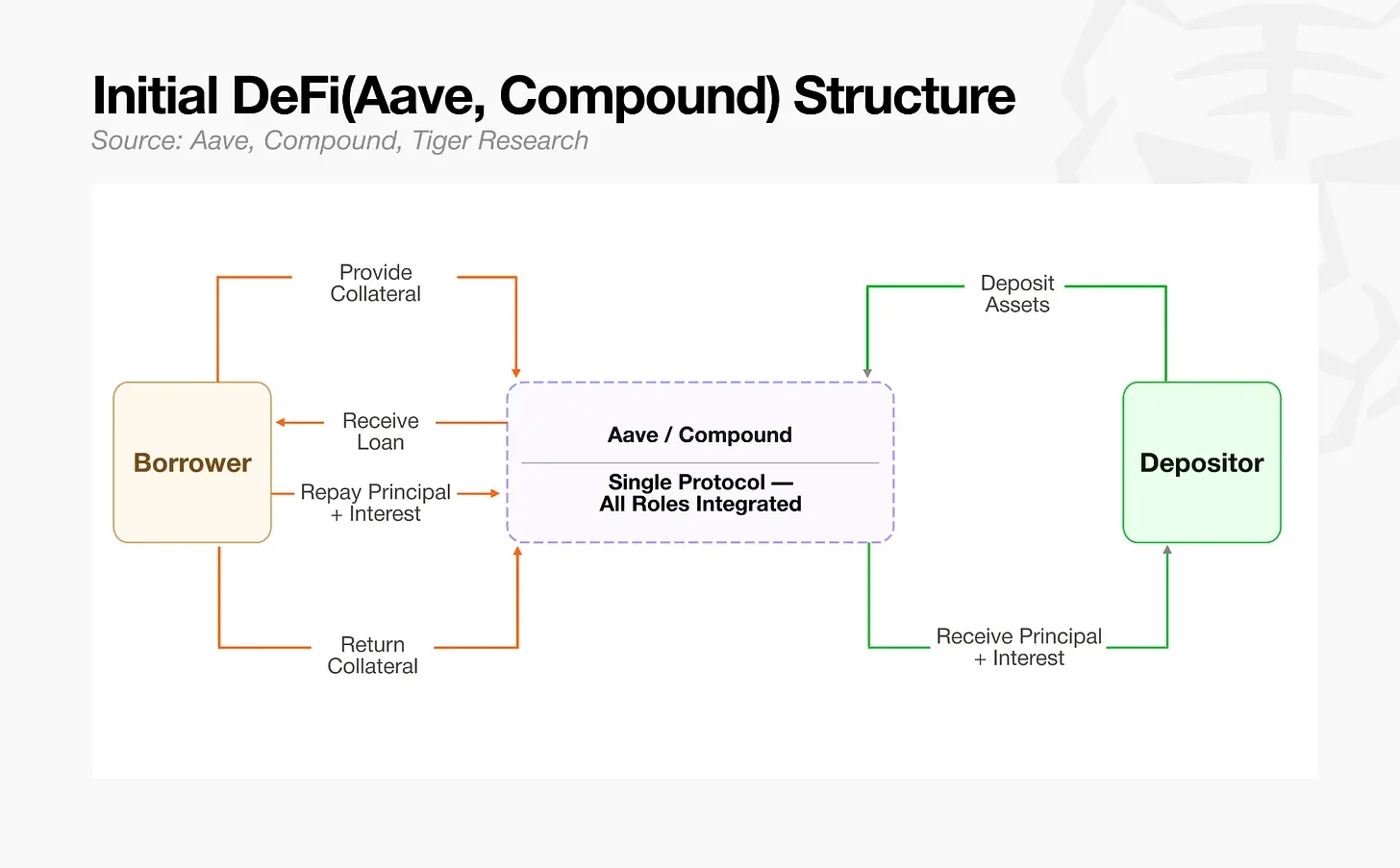
First-generation DeFi lending protocols like Aave and Compound deeply integrated lending infrastructure with risk management standards into a monolithic architecture. While practitioners related to risk management existed, all assets across the network were pooled into a single liquidity pool. Practitioners could only act as global risk administrators for the protocol, making minor adjustments to overall risk parameters. Once highly volatile assets entered the pool, the single-pool structure easily led to risk contagion, where losses from a single poor-quality asset could rapidly spread across the entire ecosystem. The industry urgently needed dedicated personnel to manage such chain risks.
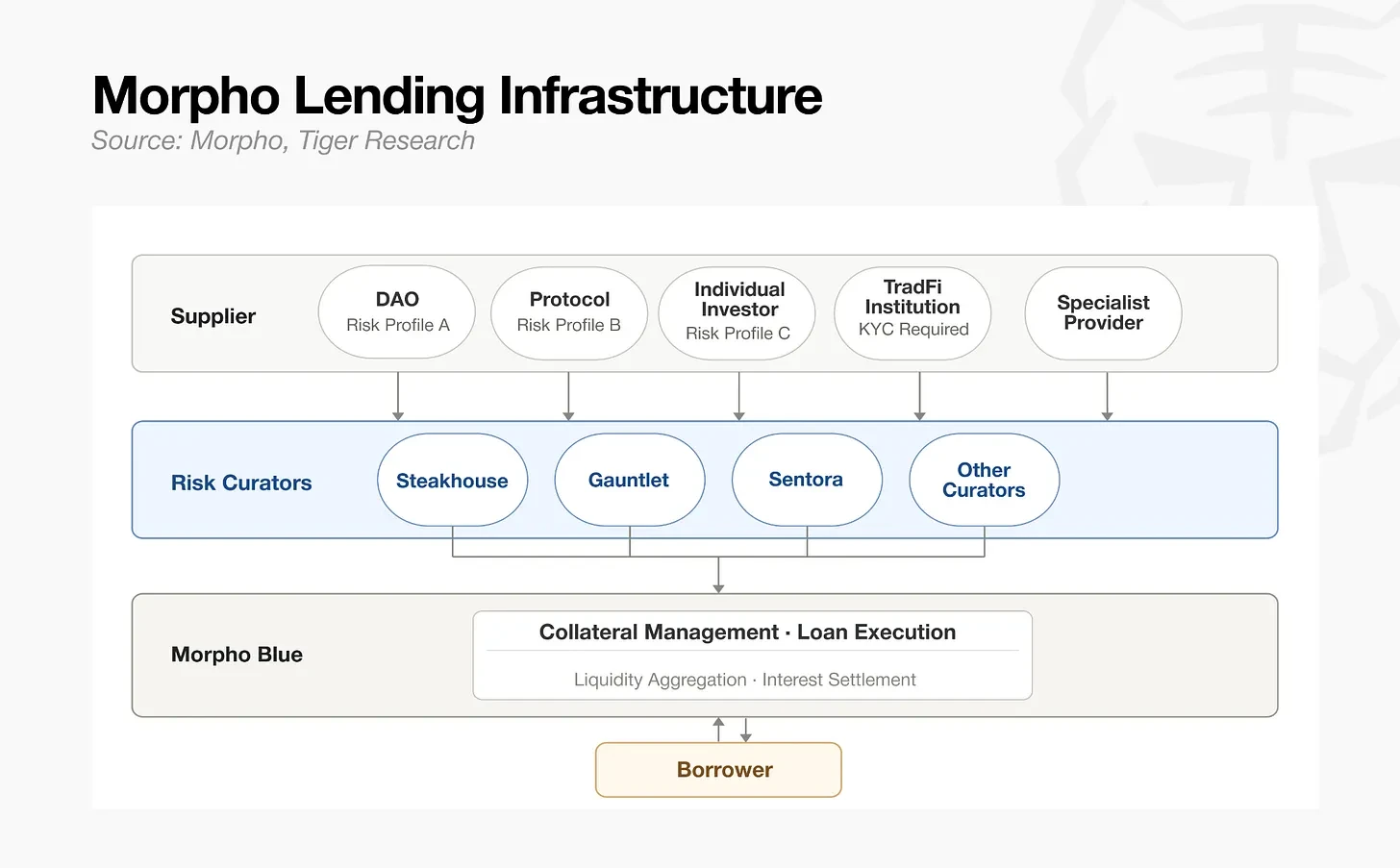
The landscape was fundamentally reshaped with the advent of Morpho. This project split collateral asset types and lending terms into independent trading markets, replacing the traditional single liquidity pool with a modular multi-vault structure, completely restructuring asset operations. Consequently, the role of risk managers underwent a complete transformation. Practitioners were no longer confined to passive risk management within a fixed protocol framework. External professional teams could autonomously set risk rules, independently build, and operate their own lending vaults. With the complete separation of underlying infrastructure and risk assessment authority, risk managers evolved from protocol-wide risk administrators into professional on-chain asset operators, independently managing multiple capital vault businesses.
3. Current Landscape of Top Industry Players
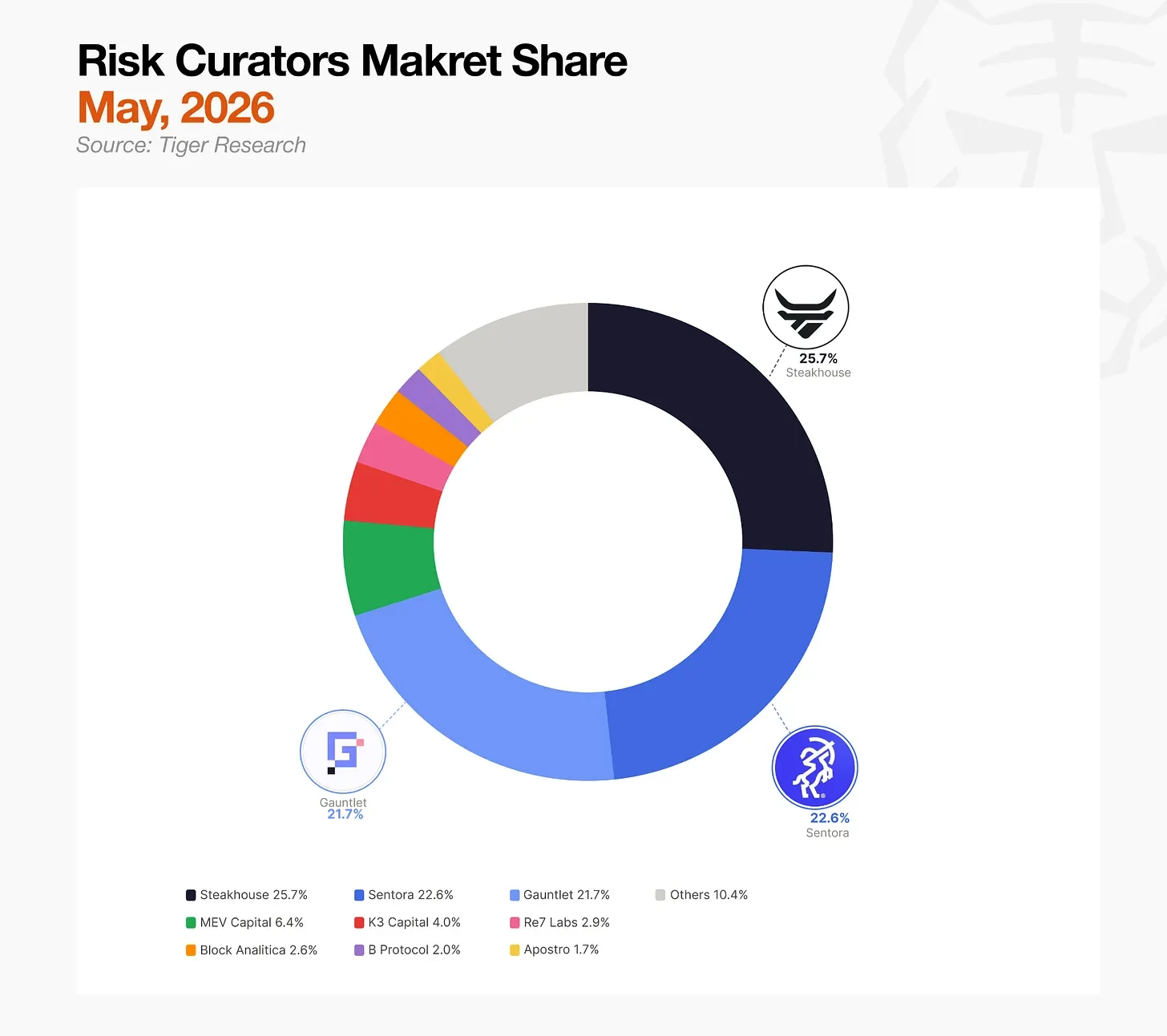
As of May 2026, the global risk management track manages approximately $70 billion in assets, with the top three teams holding 70% of the market share. This track only truly entered a period of explosive growth in 2025, and capital is now rapidly aggregating towards capable teams, with capital showing a strong preference for operators with proven track records.
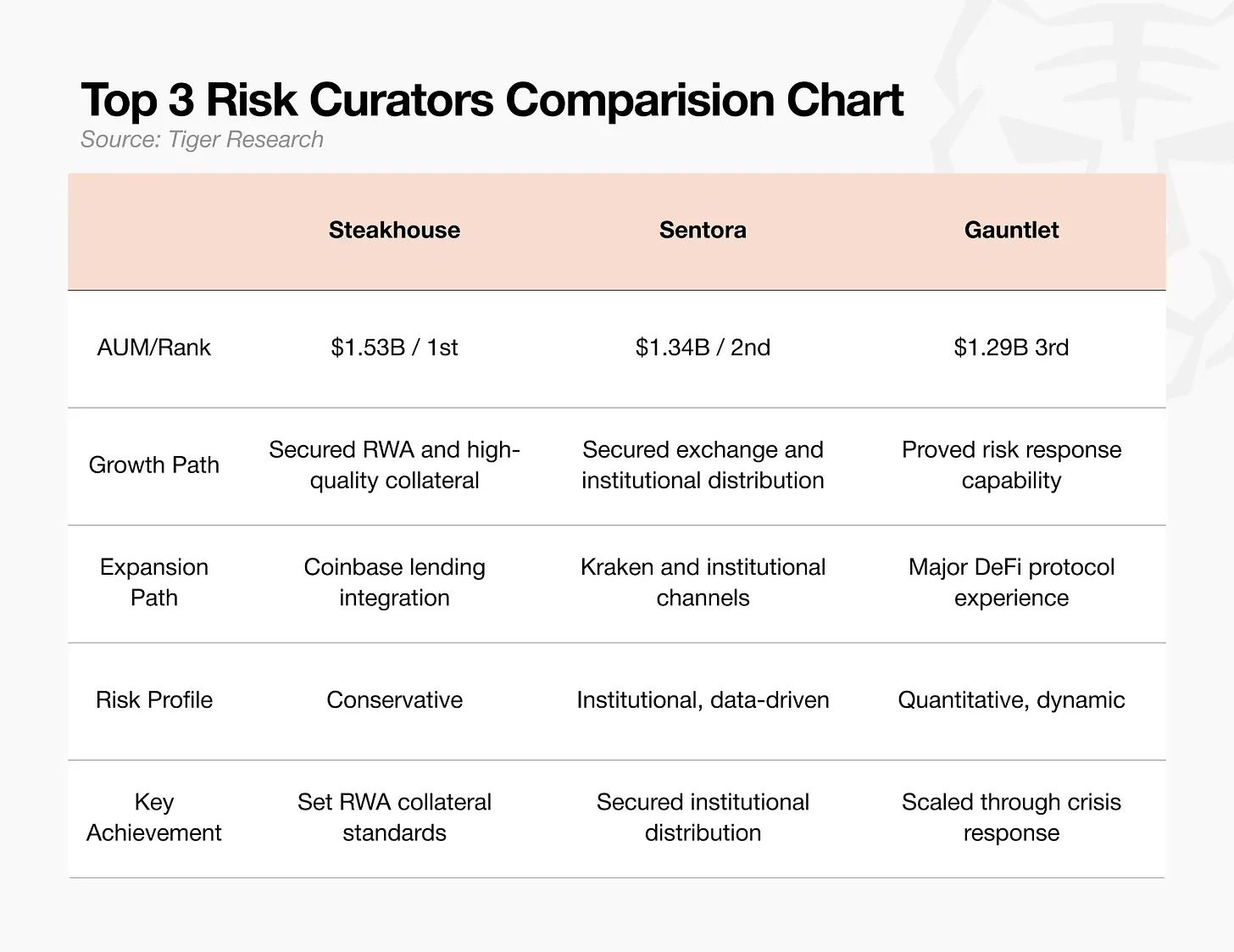
The three leading teams have different entry paths:
- Steakhouse: A conservative risk management institution, a pioneer in compliantly bringing quality Real World Assets like US Treasuries on-chain as collateral. As the exclusive backend risk management partner for Coinbase's lending business, it enjoys top-tier traffic channels. With $15.3 billion in Assets Under Management (AUM) as of February 2026, it ranks first in the industry and has been instrumental in setting the entry standards for RWA eligible for inclusion as compliant collateral in the DeFi ecosystem.
- Sentora: Built on an AI-driven risk model and institutional-grade data system, it is deeply integrated with the Kraken exchange as a backend service provider, securing institutional capital inflows. With $13.4 billion in AUM, it ranks second, focusing on bridging the capital flow between exchanges and institutional clients.
- Gauntlet: A veteran on-chain quantitative risk modeling firm, specialized in simulating various market risk parameters. In October 2025, it handled an influx of $775 million in capital, managing to rectify abnormal annualized returns within just 10 days. Its strong capability in managing large capital flows and crisis resolution is widely recognized. Currently managing $12.9 billion in assets, it is considered the industry benchmark for risk control and stability when handling large capital inflows.
At the current stage, competition in this track has moved beyond simple AUM comparison. The core battleground now revolves around three key barriers: standards for accepting collateral, channels for capital distribution, and the ability to handle sudden risk events.
4. Traditional Asset Management Model vs. DeFi Risk Management System
With Morpho's modularization of the market, different types of collateral assets require specialized teams for independent analysis and control. Professional risk management teams like Steakhouse have entered the scene as dedicated DeFi risk managers, gradually aligning DeFi operations with mature traditional asset management processes.
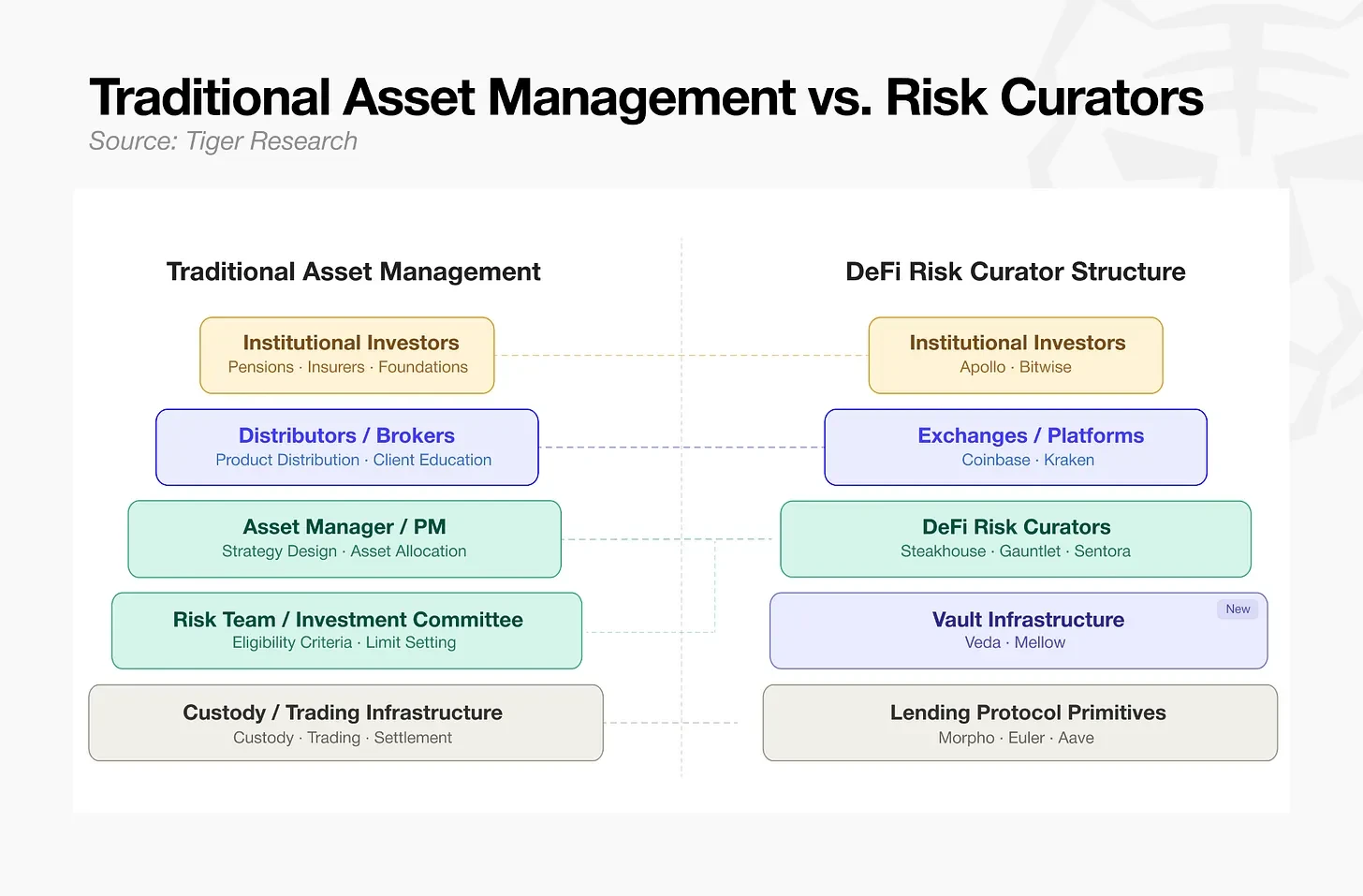
From top to bottom, it's clear that the current DeFi infrastructure has fully replicated the division of labor found in traditional finance:
- Top Layer: Fundraising and Distribution: Institutional investors are the primary source of capital. Massive funds flow into the on-chain ecosystem through major centralized exchanges and comprehensive service platforms, corresponding to the functions of traditional brokers and capital distribution channels.
- Middle Layer: Strategy Formulation and Risk Management: DeFi risk managers oversee the overall capital operation model, analogous to traditional portfolio managers and risk committees. They set asset admission thresholds, position limits, and construct the overall capital deployment strategy.
- Bottom Layer: Product Structuring and Asset Custody: Using vaults as vehicles, management strategies are translated into investable on-chain financial products. The lowest-level lending protocols handle asset storage and on-chain settlement execution, taking on the functions of traditional asset custody and trade clearing infrastructure.
From fundraising and strategy operations to asset custody and liquidation, the entire process is now fully benchmarked against mature traditional financial systems. For traditional financial institutions, on-chain lending is no longer a strange new frontier but a standardized market with clear logic and a comprehensive system, significantly lowering the barrier to entry.
5. Benchmarking Traditional Asset Management: Distribution of Opportunities in the Track
With the functional separation mirroring traditional asset management, on-chain lending has officially opened its doors to various institutions. However, the barriers to entry vary significantly across different layers of the track:
- Channel Distribution Layer: Faces the end-user market directly. Top crypto institutions have achieved market monopoly, making direct competition for traditional financial institutions offer low cost-effectiveness.
- Strategy Management Layer: The core competition is in professional financial analysis capabilities and access to specialized talent. Asset risk assessment, management, control, and product packaging are all core competencies of traditional asset managers. Without needing to develop complex underlying technology systems, leveraging existing modular infrastructure to implement proprietary risk frameworks allows for quickly establishing a stable, profitable business model. This is the optimal entry track.
- Asset Custody and Infrastructure Layer: Focused on blockchain technology R&D and implementation, this is a technology-intensive area requiring high-level L1 blockchain development skills. It is extremely difficult for traditional financial institutions to build their own systems for entry here.
Compared to other tracks that depend on traffic resources or underlying technology, the strategy management/risk control layer has the lowest entry barrier. Traditional financial institutions can quickly seize a dominant position in the industry by leveraging their mature, long-established risk management systems.
Currently, institutional entry into DeFi primarily follows three models. Regardless of the path chosen, the core competitive advantage remains the professional risk assessment and management capabilities of the risk management team.
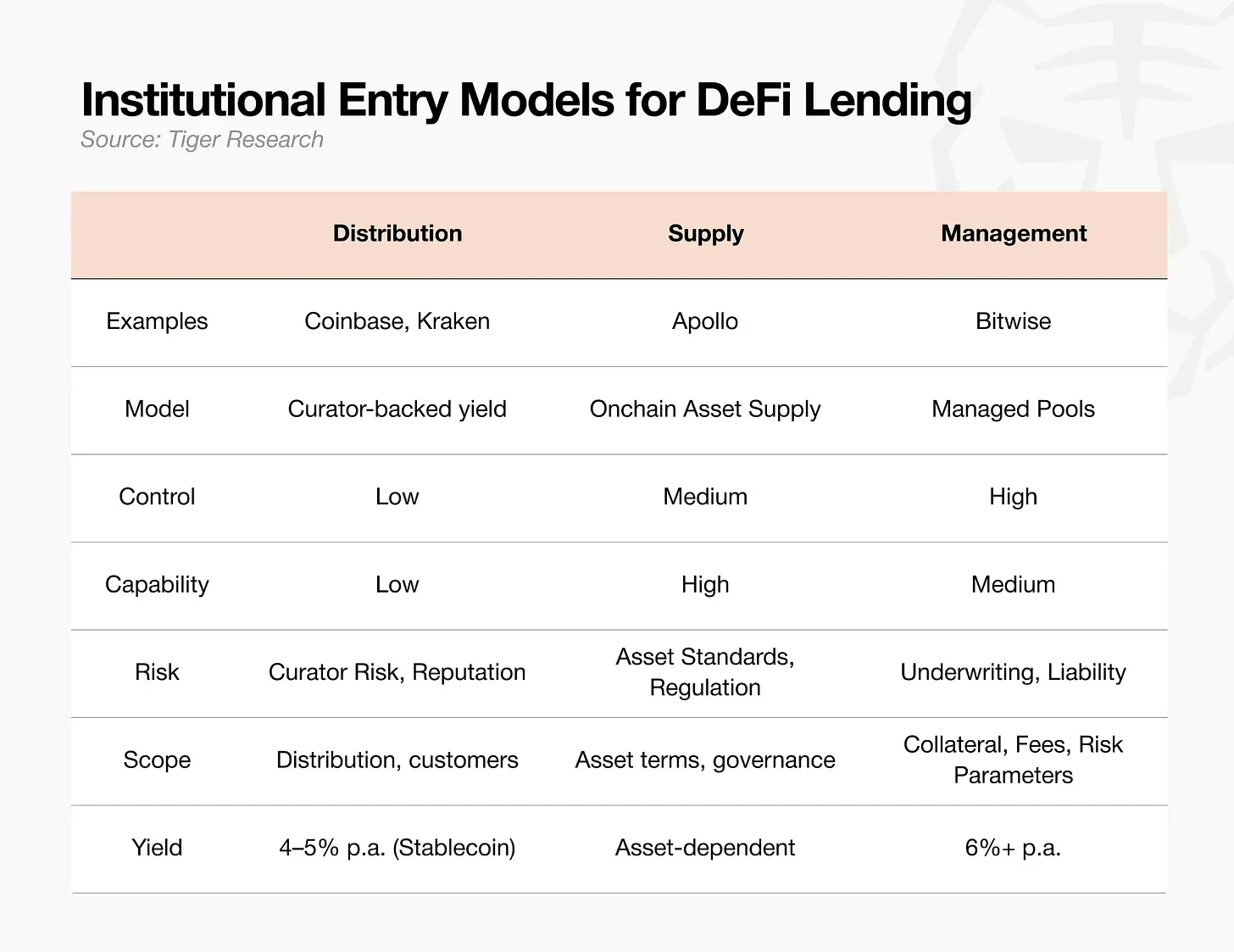
5.1 Channel Distribution Model: Leveraging Professional Teams as Backend Support
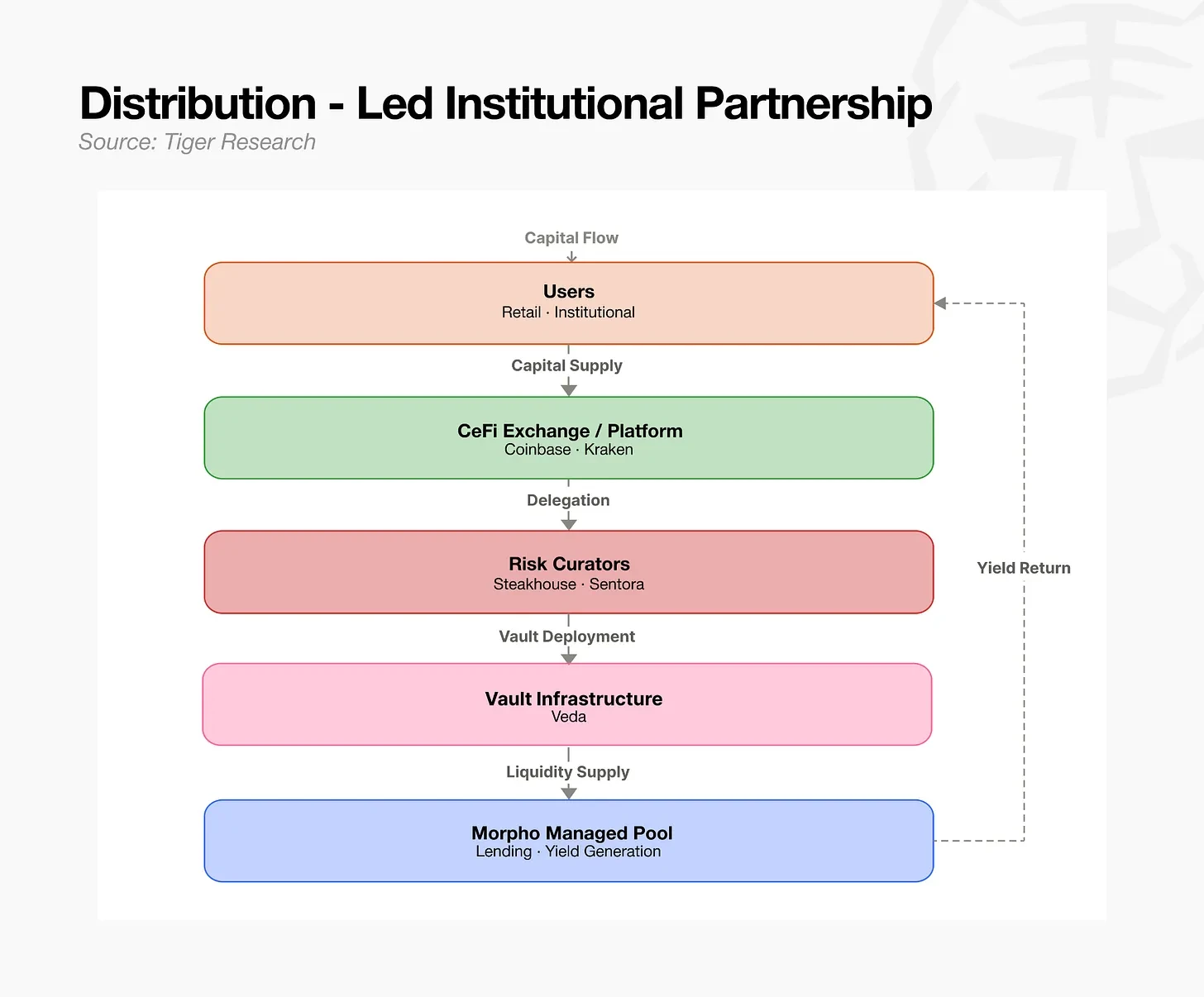
Leveraging mature external risk management teams as backend services to quickly capture market share. This model suits exchanges and fintech platforms with massive user traffic but lacking in-house on-chain risk management capabilities. Here, investment strategy is fully outsourced, but the brand reputation and operational liability risks associated with the partner team are still borne by the platform. Centralized exchanges holding end-user traffic but unwilling to deeply engage in complex on-chain lending risk management commonly adopt this model: partnering with an authoritative external risk team as the business backend to launch lending financial services. The platform handles large capital attraction using its own traffic, while collateral review and full-process risk management are entirely handled by the partner risk management team.
5.2 Asset Supply Model: Compliantly Bringing High-Quality Offline Assets On-Chain
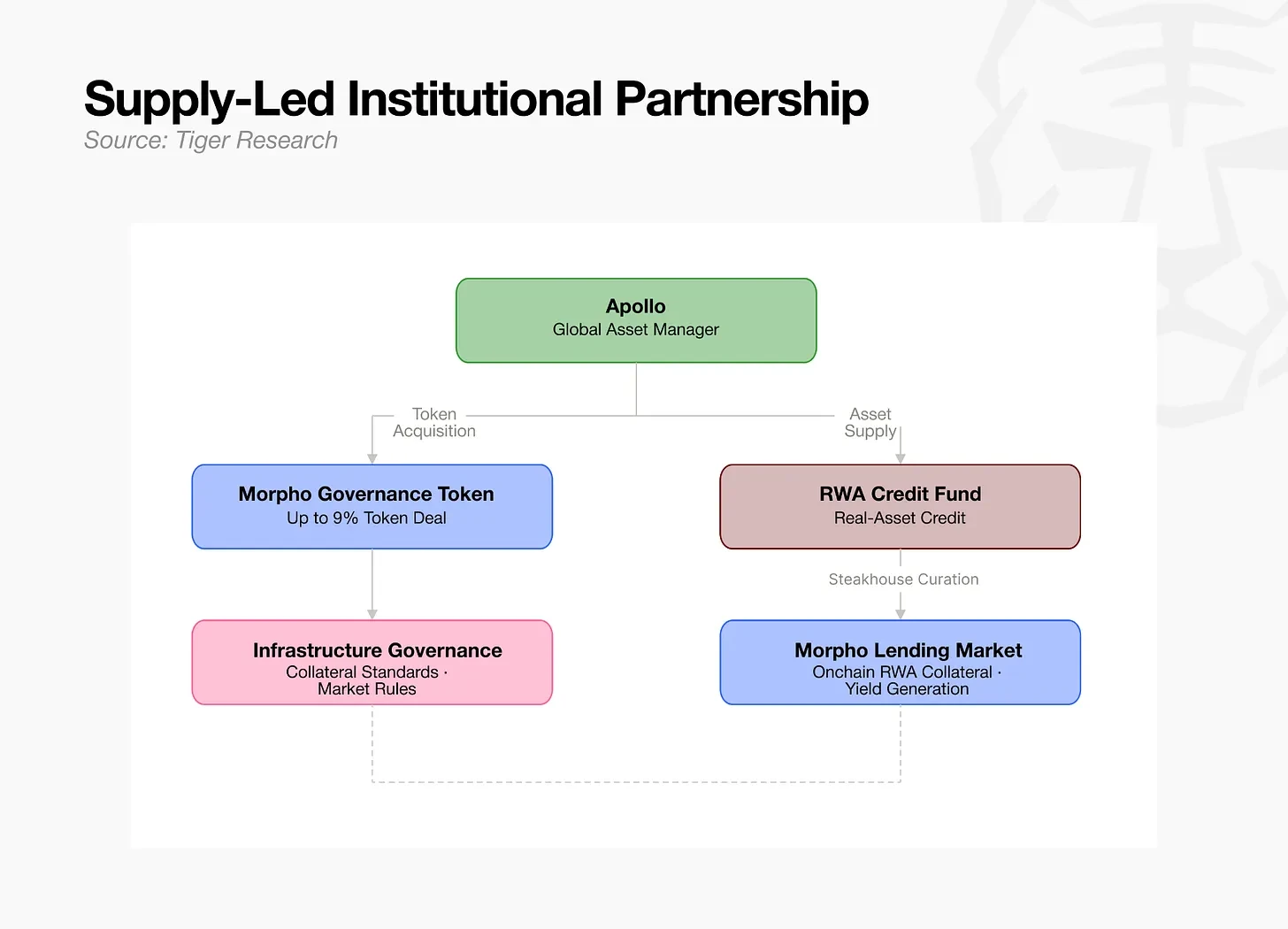
Asset managers holding high-quality underlying assets like Real World Assets or credit assets directly transfer their existing asset stock to the on-chain market. Using Apollo as an example, while supplying assets on-chain, the institution also acquires governance tokens of lending protocols, deeply participating in setting industry collateral admission rules suitable for its own assets. The core difficulty of this model is standardizing assets compliantly and building a supporting regulatory framework. Large private equity firms or holders of offline physical assets can directly connect their existing high-quality assets via on-chain financial channels. Apollo goes beyond simple asset supply by increasing its holdings of top lending protocol governance tokens, deeply engaging in industry rule-setting to promote its offline assets as officially recognized, higher-priority compliant collateral in the on-chain market. However, asset suppliers cannot arbitrarily include any asset as collateral. The market requires professional third parties to objectively verify the true safety of assets and confirm they can be quickly liquidated at full value on-chain. This process depends entirely on the rigorous qualification review and credit endorsement of risk management teams. Ultimately, the long-term viability of the asset supply model still relies on the asset manager's own professional risk verification capabilities.
5.3 Independent Operation Model: Building an In-House Team to Become the Risk Manager (Representative: Bitwise)
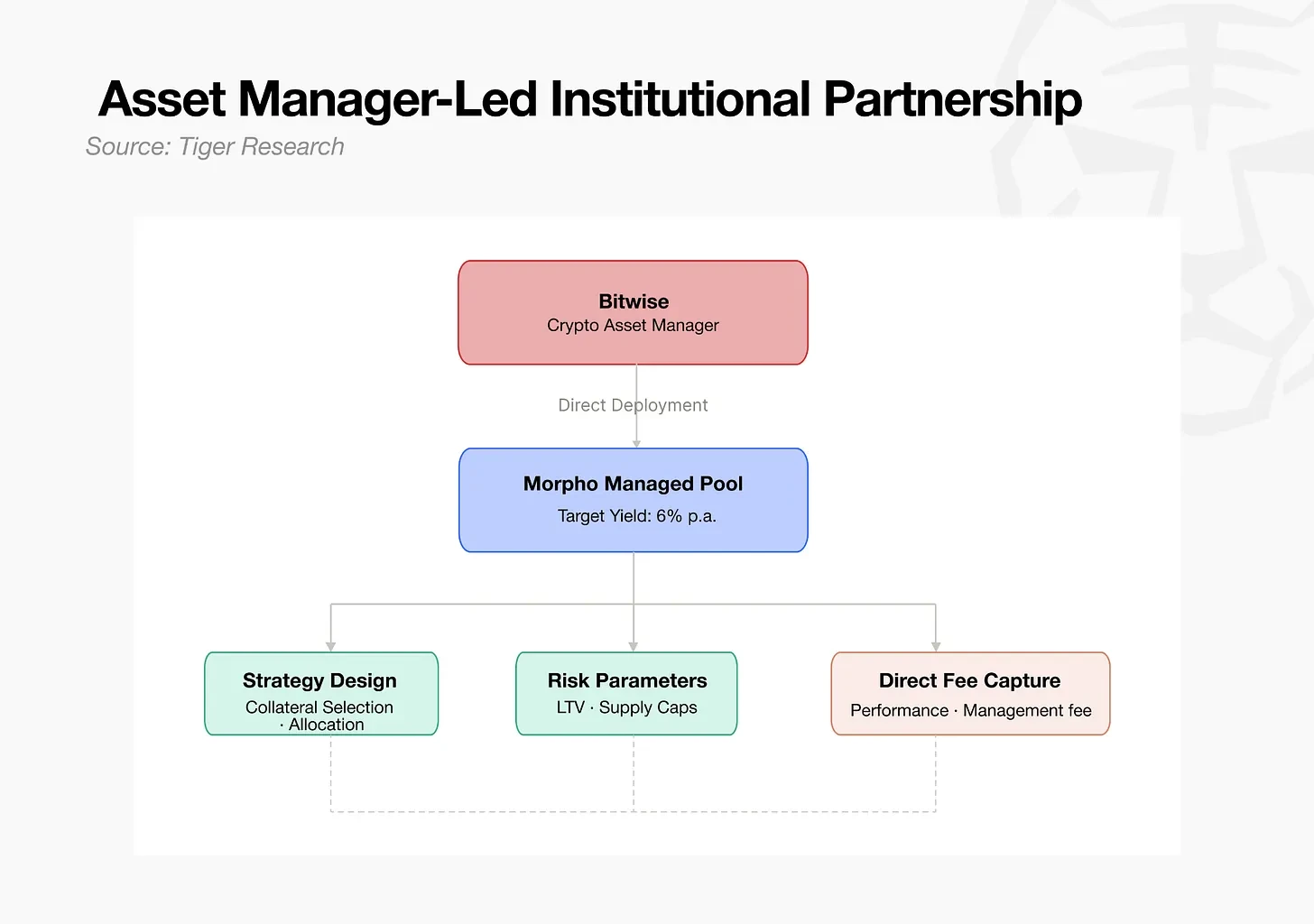
The asset management institution independently develops investment strategies and builds and operates its own on-chain vaults. Bitwise was the first to define on-chain vaults as version 2.0 exchange-traded funds, making a deep entry into the track. This model offers the highest degree of autonomy over fee pricing and collateral admission standards, but the institution bears all risks and losses from operations. It is suitable for large asset managers forming their own professional risk management teams. This model represents traditional asset managers transforming into independent risk managers, shedding reliance on external platforms. Bitwise, leveraging its mature portfolio construction and risk management systems, designs and fully controls the operation of on-chain vaults, directly generating stable management fees on-chain.
6. Industry Landscape on the Eve of Massive Traditional Capital Inflow
Looking at industry trends, as the on-chain lending ecosystem matures, traditional large asset managers possess the strongest advantages for entering the industry. With the modular functional separation of DeFi, the core market demand has shifted: The industry no longer needs more smart contract development talent. Instead, it desperately craves the professional financial capabilities honed in traditional finance, such as collateral due diligence review and risk limit setting. The practical risk management experience accumulated by traditional asset managers over decades can be seamlessly adapted and migrated to on-chain financial scenarios.
However, the current overall market size of DeFi is still insufficient to accommodate the direct large-scale entry of top-tier global mega-asset managers: The global traditional asset management industry totals a staggering $147 trillion. BlackRock alone manages $14 trillion in assets. In contrast, the entire DeFi track is only around $80 billion, with the risk management sub-track being merely $7 billion – less than one two-thousandth of BlackRock's AUM.
This vast difference in scale precisely highlights the immense growth potential of the track. Institutional capital always prioritizes risk control and only enters markets with robust risk management systems. Once risk management teams establish safe and stable on-chain capital flow systems, complemented by the formation of industry regulatory frameworks, the industry will undergo a qualitative transformation. Even a tiny fraction of capital diverted from the $147 trillion traditional asset management market could trigger explosive growth in the $80 billion DeFi market.
Many of the industry's dividends exist only in its early stages. Currently, there are very few top-tier risk management teams globally. The large-scale entry of institutions urgently requires mature and complete industry operating rules. The teams that first build the underlying industry infrastructure will firmly grasp the dominant power in setting industry standards. While later entrants may benefit from a more mature and standardized market environment, they will ultimately be competing within predetermined industry rules, missing the core influence and first-mover advantages of the early stage.


