






Coin Market Observer × ABGA Kevin: When AI Becomes Web3’s “Digital Avatar,” Mass Adoption Truly Begins


- Core Insight: ABGA's rebranding from the Asia Blockchain Gaming Alliance to the AI Blockchain Global Alliance reflects founder Kevin Shao’s judgment on the next industry direction: AI Agents, rather than human users, will become the primary driving force for mass Web3 adoption; blockchain will evolve into the underlying infrastructure for AI to autonomously execute on-chain interactions.
- Key Points:
- ABGA's brand upgrade embodies a logical complement: AI unleashes productivity, while blockchain addresses trust, payments, and rights confirmation between Agents—the two are inherently complementary foundational technologies.
- Kevin believes future mass Web3 adoption will be driven by AI Agents: wallet operations and on-chain interactions pose high barriers for users, but for Agents, they are merely automatically executable code instructions, enabling seamless on-chain interactions.
- Regarding the narrative that “Web3 VC is dead,” Kevin points out that primary market investment is inherently a high-failure-rate industry (70% of projects fail), and the current phase is a process of “disenchantment,” not the disappearance of the role.
- Focus on long-term trends like RWA: Since the STO era in 2019, stablecoins, RWAs, and traditional institutions have re-entered the space, validating directions that previously failed to gain traction.
- In the future Web3 ecosystem, AI Agents will become new participating entities, blockchain will recede into the background as underlying infrastructure, and DeFi will continue to evolve with accelerated iterations driven by AI.
- Kevin emphasizes that interest-driven passion is more important than “timing the market”: wealth involves an element of luck, but passion determines persistence when the industry is quiet, and opportunities often appear during less bustling times.
In the past year, the primary market has cooled down, GameFi has faded, and fundraising has become more difficult. Many once-popular narratives have quickly fallen silent. But at this very moment, ABGA, once focused on Web3 Game, recently completed a brand upgrade: from the Asia Blockchain Gaming Alliance to the AI Blockchain Global Alliance. Behind this change lies Kevin Shao's reassessment of the next direction for the industry.
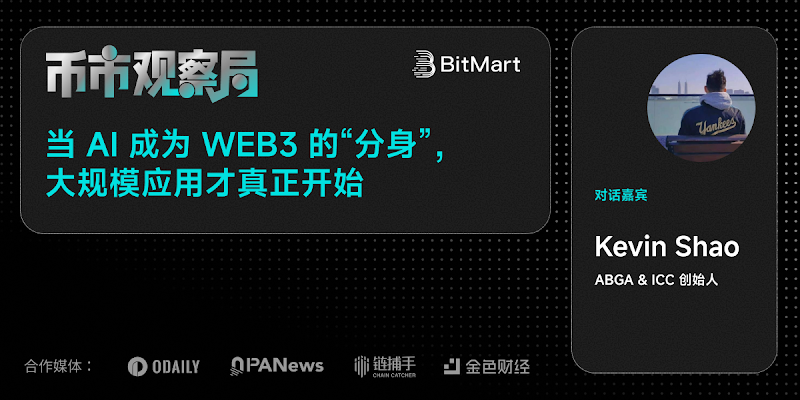
In this episode of "Crypto Market Observer," we spoke with Kevin Shao, founder of ABGA & ICC: When AI begins to enter Web3, what changes will the next wave of truly large-scale applications bring? Why does he believe Web3 VC isn't really dead? And, in today's fast-changing era, how should an entrepreneur view cycles, opportunities, and long-termism?
Guest: Kevin Shao, Founder of ABGA & ICC
Host: yuanyuan, BitMart Marketing VP
(Episode Listening Link: https://www.xiaoyuzhoufm.com/episode/6a057f061b7bd50295231bee )
From "Asia Game" to "AI Global": The Industry Has Changed, and Organizations Must Change Too
In 2013, Kevin was inspired by Chang Jia's "Bitcoin: A Real and Illusory Financial World," starting his journey in the blockchain industry through mining, later leaving his traditional finance job to go all-in. As the Web3 ecosystem expanded, he gradually shifted from pure investing to ecological and industry organizational work, which became the starting point for founding ABGA.
When ABGA was first established, it coincided with the boom in GameFi and public chain ecosystems. Asia had a mature gaming industry foundation at the time, so they used the "Asia Blockchain Gaming Alliance" as an entry point, connecting startups with capital and continuously holding large-scale developer events during global blockchain conferences.
Now, with ABGA renamed to AI Blockchain Global Alliance, the most obvious external reaction is that the track has changed, but Kevin sees it more as a logical completion. He believes that technological competition today has long been global, and AI is greatly unleashing productivity. Simply put: AI generates new intelligent agents, while blockchain solves the trust, payment, and rights confirmation between these agents.
These two are not about one replacing the other; they are inherently fundamental technologies meant to work together. The substantial resources accumulated over the past few years will continue to help ABGA base itself in Asia, connect globally, and reorganize resources within this new technological cycle.
Why AI Could Be the Next Driver for Web3
In Kevin's view, the protagonist of the "mass adoption" that Web3 has been touting for years might not be "humans" at all.
He stated bluntly in the conversation: "Agents belong to the blockchain, just as if they are born with innate skills." Wallet operations and on-chain interactions, which have a high barrier for ordinary users, are nothing more than code instructions that should be executed automatically for an Agent.
Therefore, he believes that future Mass Adoption may not be directly driven by humans. Humans have a long cognitive barrier to learning this technology. But when a person delegates most of their operations to their AI avatar to execute, the blockchain becomes a natural underlying gateway. The real explosion of Web3 might not come from ordinary users learning to use wallets, but from our AI Agents seamlessly completing all on-chain interactions for us in the background.
At the same time, he is also very focused on the combination of AI with finance and RWA. In fact, Kevin started paying attention to STO (Securities Token Offering) as early as 2019, but the industry environment wasn't mature then. Now, with stablecoins, RWA, and traditional financial institutions re-entering the market, many things that didn't materialize back then are being validated again. For him, whether it's AI or RWA, they are long-term trends, not short-term fads.
Demystifying Investment: The Primary Market Was Never a Myth of Huge Profits
Regarding the topic of "Web3 VC is dead," Kevin, an investor who has funded hundreds of projects, offers a different perspective.
He first believes that VCs shouldn't be categorized by "Web3." Although the primary market has indeed been difficult in the past few years, with "unable to invest and unable to exit" being the norm, he doesn't think the role of VC has disappeared. On the contrary, he feels this is a process of "demystification" for the industry. In the past, many people thought the primary market was too easy, but after engaging in long-term investing, one realizes that primary investment is inherently an industry with a very high failure rate; 70% of projects failing is the norm. VC is essentially hard work, demanding extremely high industry understanding and risk resilience from the team.
Kevin says he prefers to look at things that can transcend cycles. For example, from STO in 2019 to RWA now, this shows that truly valuable technological directions don't disappear. The key lies in whether you can persist and stay at the table during the downturns.
The Future Web3 Ecosystem: An Infrastructure Hidden in the Background
In Kevin's view, the future Web3 ecosystem will definitely look very different from today. The current industry core still revolves around "humans" conducting financial transactions on-chain. In the future, however, AI Agents will become new participants. When Agents start helping people execute complex trades, perform tasks, and handle automatic payments, the blockchain will gradually fade into the background, becoming a hidden infrastructure where AI handles all the complexity.
Meanwhile, DeFi will continue to evolve. Despite experiencing many bubbles, Kevin believes the value of blockchain in the financial sector is real and irreversible. Whether it's stablecoins or on-chain finance, they will continue to grow, and the addition of AI will only accelerate the iteration speed of these systems.
Interest-Driven is More Important Than "Timing the Market"
Throughout the conversation, Kevin repeatedly mentioned one word: Interest.
He is reluctant to label himself a "successful investor." For him, what's more crucial is whether he still maintains passion for this field. Wealth often involves an element of luck, but interest and passion determine whether a person can stay when the industry is at its quietest.
When asked if he would advise young people today wanting to enter Web3 or AI to go all-in, his answer was straightforward: "If you truly believe in it, just do it." Many opportunities arise precisely when the industry is least active.
It's like the case he shared in the podcast: a friend with poor English, overwhelmed by school emails for his three children, solved a specific problem using AI. This might not be a world-changing event, but it genuinely improved one person's life. This is precisely the most valuable aspect of AI—it doesn't have to solve the grandest problems first; it enters everyone's specific life.
Conclusion
By the end of the conversation, you find that Kevin is not someone swayed by industry sentiment. He doesn't become extremely optimistic because a certain track is hot, nor does he become completely pessimistic when a bear market arrives.
In his view, both AI and Web3 are still in their very early stages. Many things that seem unfeasible today might suddenly become obvious a few years later due to a breakthrough in some technological node. What truly matters isn't short-term price fluctuations, but whether you are willing to stay at the table, keep learning, and adapt to change.
Perhaps this is why, while many are discussing "Web3 VC is dead," he chooses to continue deepening his work with ABGA. Because truly long-term opportunities are often born when the industry is at its quietest. As for the rest, leave it to time.
This episode was recorded on: April 28, 2026
The full content can be found by searching and following "Crypto Market Observer" on Xiaoyuzhou, Apple Podcast, and Spotify.

Also, feel free to follow BitMart's TwitterX for more industry insights, market trends, and platform updates.
Risk Disclaimer
The opinions or views expressed in this column solely represent the personal stance of the guest and do not reflect the views of BitMart or its affiliates, nor should they be considered professional financial investment advice.
Cryptocurrency investment is highly speculative and carries significant risk of loss. Past performance, hypothetical scenarios, or simulated results do not guarantee future returns. The value of digital currencies may fluctuate, and buying, selling, holding, or trading digital currencies may involve significant risks. Before engaging in trading or holding digital currencies, please carefully assess their suitability based on your own investment objectives, financial situation, and risk tolerance. BitMart does not provide any investment, legal, or tax advice.


