能源危機逼近,美國正在輸掉伊朗戰爭


- 核心觀點:文章以羅伯特·卡根在《大西洋月刊》的認輸聲明為引,指出美國在伊朗的戰略失敗並非局部戰役失利,而是全球能源安全與海灣秩序主導權的根本性喪失。霍爾木茲海峽的關閉標誌「航行自由」體系被「許可制度」取代,美國無力重開海峽,引發全球能源危機與秩序重塑。
- 關鍵要素:
- 戰略失敗確認:長期為美國軍事干預辯護的羅伯特·卡根承認,美國在伊朗遭遇了「無法彌補也無法忽視」的決定性挫敗,性質與越戰、阿富汗戰爭完全不同。
- 霍爾木茲海峽被控:伊朗關閉海峽並建立通行許可制度,全球約20%海運石油被阻斷。美國海軍「自由計畫」一週僅護送兩艘商船通行,遠低於戰前日均130艘。
- 全球能源危機蔓延:斯里蘭卡實施燃油配給,巴基斯坦推行四天工作制,印度儲備僅剩6-10天,日本第二次釋放戰略儲備,多國採取稅減、限行、補貼等措施。
- 軍事能力與庫存見底:與伊朗「二流強國」僅數週作戰,美國武器庫存已消耗至危險低位,無法有效重開海峽,盟友拒絕接管任務。
- 海灣安全架構瓦解:沙烏地阿拉伯、阿聯酋等海灣國家親見美國無力保衛航道,正轉向與伊朗妥協,美國安全承諾被證偽,全球開始圍繞此事實重組自身。
- 政策欺騙與後果:戰爭被包裝為「快速勝利」,但決策者無視軍方警告(包括參謀長聯席會議對關閉海峽的預測),付出代價的是依賴供應鏈的普通民眾,如燃油車司機、小企業主和糧食消費者。
Original Title: Trump Has Officially Lost The War In Iran And The Great Energy Collapse Of 2026 Is Coming.
Original Author: Dean Blundell
Original Compiled by: Peggy
Editor's Note: When a military operation, initially packaged as a "quick victory," evolves into a prolonged blockade of the Strait of Hormuz, rising global energy prices, and nations implementing fuel rationing and strategic reserve releases, the consequences of war no longer remain on the battlefield but penetrate the underlying system of the global economy.
Using Robert Kagan's article in *The Atlantic* as a starting point, this piece points to a symbolic turning point: The person who has long provided strategic validation for American military interventions is now forced to admit that the U.S. has suffered not just a local setback in Iran, but a deeper strategic failure. What the author truly wants to discuss is not just whether the U.S. won a war, but whether the U.S. still has the capacity to underwrite global energy security, the Gulf order, and its alliance system.
What deserves more attention is not whether the Strait of Hormuz will reopen in the short term, but the fact that the global trust structure built around this strait has been rewritten. In the past, the U.S. maintained "freedom of navigation" through naval power and security commitments; now, the author argues, this mechanism is being replaced by a new "permit system," and the authority to grant permits is shifting to Tehran. Gulf states are recalculating their relationships with Iran, allies are questioning the validity of U.S. commitments, and energy-importing countries are responding to the new reality through rationing, reserves, alternative imports, and price controls.
The sharpness of the article lies in its understanding of military failure, the energy crisis, and domestic political deception as links in the same chain: War is not an isolated event but the cumulative result of years of strategic arrogance, policy miscalculations, and political theater. When decision-makers treat war as a victory narrative on television screens, the real costs are borne by those queuing at gas stations, small businesses dependent on diesel transport, the food system pushed higher by fertilizer prices, and all ordinary people who rely on the global supply chain to live.
When the U.S. fails to reopen a vital energy lifeline it long promised to protect, the global order has already begun to reprice itself around this fact. The cost of war will gradually transition from sentences in strategic reports to numbers on everyone's bills.
Below is the original article:
On Saturday, Robert Kagan published an article in *The Atlantic* titled "Checkmate in Iran."
Yes, the very same co-founder of the Project for the New American Century, husband of Victoria Nuland, brother of Frederick Kagan, and the "go-to philosopher" for every American war over the past thirty years.
In it, he writes that the U.S. has suffered "a complete defeat in a conflict, a setback so decisive that the strategic loss is neither repairable nor ignorable."
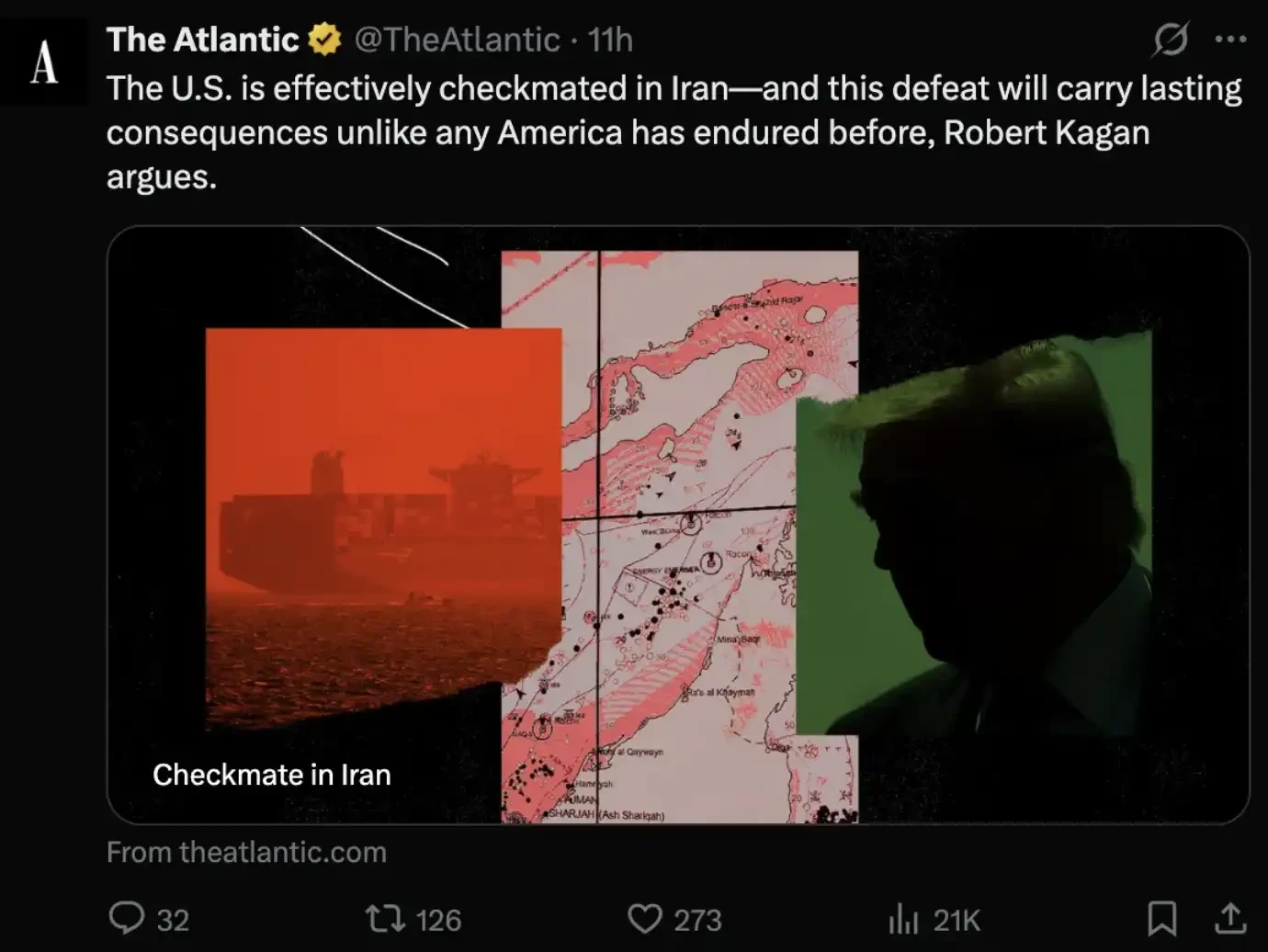
This is not an ordinary critic; it's the man who long provided strategic justifications for hawks like Dick Cheney. This is not an ordinary media outlet; it's the magazine that could almost always package every American military intervention as a "strategic necessity."
But now, precisely *they* are telling readers, in a language they would have likely dismissed as "defeatist" or even "unpatriotic" in the past: The U.S. just lost. Not a battle, not a military operation, but its position in the global order.
If Ronald McDonald himself started saying the hamburgers are bad, the problem is truly serious.
What should make every American stop and think seriously is this: While Kagan is writing his post-mortem of the strategic defeat on *The Atlantic*'s opinion pages, the real world – the world made of gas stations, supermarkets, refineries, and shipping costs – is already feeling the consequences.
Sri Lanka has begun rationing fuel via QR codes; Pakistan has implemented a four-day work week; India has only 6 to 10 days of strategic petroleum reserves left; South Korea has implemented odd-even license plate restrictions; Japan is conducting its second emergency reserve release this year. And in the U.S., the country whose Secretary of Defense publicly stated in February that Iran would "surrender or be destroyed," gas prices are rising, and its Strategic Petroleum Reserve is being drawn upon as part of the largest coordinated release in IEA history.
This is the reality of a "war of choice": The choice is made by a group of people willing to burn down their own country to manipulate markets and satisfy their fragile egos.
Let's break this down step by step.
I. Trump Told You This War Would Be Over in a Weekend
Let's rewind the clock (it's not hard, as it was only about 70 days ago) to February 28, 2026.
That night, the Trump administration, in coordination with Israel, launched "Operation Epic Fury," a coordinated air and naval strike. Within 72 hours, Iran's Supreme Leader was killed, its navy was destroyed, its defense industrial base was largely crippled, and an entire generation of its military leadership was decimated.
Before the smoke had even cleared, Trump announced "Peace Through Strength" on Truth Social. Pete Hegseth – who now insists on calling himself "Secretary of War" and seems unable to resist a bit of roleplay at press conferences – then took the Pentagon podium and, with his usual bluster and almost non-existent analytical depth, declared Iran had "no defense industry and no replenishment capability."
But he missed one key detail. What Iran needed to do next didn't require a defense industry. It just needed a map.
On March 4th, six days after Hegseth declared the war won, the Islamic Revolutionary Guard Corps announced the closure of the Strait of Hormuz. Not "impeded transit," not "restricted waterways," but closure. According to Iran, "not a single liter of oil" could pass without Tehran's permission. Any vessel attempting to transit and deemed related to "the U.S., Israel, or their allies" would be considered a "legitimate target."
Within 48 hours, war risk insurance premiums quintupled. Within 72 hours, the AIS transponders on numerous large oil tankers around the world went dark. The strait, which normally handles about 20% of global seaborne oil and a significant portion of LNG, had effectively fallen silent.
To be fair, the Joint Chiefs of Staff did warn Trump. According to multiple reports, during the briefings before Operation Epic Fury, the military clearly warned that the most likely Iranian countermeasure would be closing the Strait of Hormuz.
Trump's response, roughly translated, was: Iran would "surrender"; if they didn't, "we'll just open the strait back up."
But the reality is, the U.S. has not reopened it. And the U.S. cannot reopen it.
That sentence is the core of this entire story.
II. What Kagan Actually Admitted, and What He Still Can't Say
The most noteworthy aspect of Kagan's article is not what it predicts, but what it admits.
If you strip away the usual jargon of the strategic community and the rhetorical polish of *The Atlantic*, what remains is essentially a confession. More bluntly, he admits the following:
First, this is not Vietnam or Afghanistan. According to Kagan, those wars "did not cause lasting damage to America's overall position in the world." But this one, he states bluntly, is "completely different" in nature, and its consequences are "neither repairable nor ignorable."
Second, Iran will not give back the Strait of Hormuz. Not "not this year," not "not unless negotiations fail," but just will not. As Kagan puts it, Iran can now "not only demand tolls but also restrict passage to nations it has good relations with."
In other words, the "freedom of navigation" regime that has underpinned the global oil order since the Carter Doctrine – the core premise justifying the U.S. military presence in the Persian Gulf for the last 40 years – is over. In its place is a new permit system, and the authority to grant permits resides in Tehran.
Third, the Gulf monarchies must compromise with Iran. Kagan writes: "The United States will prove itself to be a paper tiger, forcing the Gulf states and other Arab countries to make concessions to Iran."
Translated more directly: Every Saudi and Emirati prince who has witnessed the U.S. fail to protect refineries and shipping lanes is now on the phone with Tehran, discussing new arrangements. This means the security architecture the U.S. spent half a century building in the Gulf is disintegrating in real-time.
Fourth, the U.S. Navy cannot reopen the strait. This point deserves close attention, as it is perhaps the most explosive admission in the entire article. Kagan writes: "If the United States, with its powerful navy, cannot or will not open the strait, then any coalition force, whose capabilities are a fraction of America's, certainly cannot."
German Defense Minister Boris Pistorius said almost the same thing more bluntly: Does Trump really expect a few European frigates to accomplish what the mighty U.S. Navy cannot?
This sentence can almost be read as an epitaph. The U.S. asks its allies to clean up its mess, and the allies ask: With what?
Fifth, U.S. weapons stockpiles are critically low. Kagan writes: "A few weeks of war with a second-rate power" – note the phrase "second-rate power" comes from this longtime advocate of regime change narratives – "have depleted U.S. weapons inventories to dangerously low levels, with no quick fix in sight."
If you are sitting in Taipei, Seoul, or Warsaw right now, reading this passage from *The Atlantic* does not make you feel safer. It makes you feel distinctly less safe.
Sixth, allied trust is damaged, U.S. security guarantees are falsified, and the assessments of China and Russia are validated. Kagan barely states this directly – he can't, at least not that explicitly in *The Atlantic* – but this conclusion is hidden behind every sentence like a corpse under the floorboards.
Of course, what he truly cannot say is: How did the U.S. get to this point?
Because he himself is one of the people who brought the U.S. here. He, his wife, his brother, the signatories of every Project for the New American Century open letter since 1997, every think tank researcher over the past 25 years who ceaselessly framed Iran as America's indispensable enemy – they are all part of this process.
There is not a trace of self-reflection in his article. Not a single moment of admitting that perhaps 30 years of maximum pressure forged the very opponent that now has the ability to put the U.S. in a corner.
The smoke is everywhere, and the arsonist is still wondering why there's a burning smell in the air.
So, what is his proposed solution?
You'll laugh first, then you won't be able to.
The answer is: A larger war. Specifically, he advocates for "launching a full-scale ground and naval war to overthrow the current Iranian regime and occupy Iran."
A man who just wrote 4,000 words explaining why the U.S. Navy cannot reopen a 21-mile-wide waterway against an opponent he calls a "second-rate power" concludes by advocating for invading and occupying a country of 90 million people located in one of the most defensible mountainous terrains in West Asia.
The arsonist's plan to put out the fire is to light a bigger one.
II
Over the past 40 years, Iran has been repeatedly told it has no leverage. Now, it holds the single most important card in the global economy. The next Iranian regime – and there will surely be one, as the airstrikes have killed enough of the old leadership to make a power transition almost inevitable – will inherit and use this card.
Thinking Iran will easily give it back shows a fundamental lack of understanding of what has just happened.
The Gulf monarchies can no longer openly confront Iran. Saudi refineries, UAE ports, Qatar's LNG terminals – all these facilities are within range of Iranian missiles, drones, and proxy forces. And these nations have just witnessed the U.S. fail to protect Israel's most strategic targets, fail to protect its own bases in the UAE and Bahrain, and fail to reopen the strait that connects their economic lifelines.
The so-called security guarantee has been falsified by reality.
Riyadh and Abu Dhabi will not bet their national survival on a guarantor who has just proven unable to provide the guarantee. They will seek deals. In fact, they are already seeking deals.
The U.S. military cannot realistically reopen the strait. This fact alone should make everyone outraged.
In absolute terms, the U.S. Navy is still the most powerful maritime force in human history. But it just spent 38 days in "major combat operations" against an opponent Kagan himself calls a "second-rate power" and depleted its weapons stockpiles to "dangerously low levels."
Now, the U.S. Navy has launched an operation with an increasingly euphemistic name, "Project Freedom," attempting to escort one merchant ship at a time through the Strait of Hormuz. The result? Only two ships got through in a week.
Two. The pre-war average was 130 per day.
On Tuesday, Rubio described "Project Freedom" as a "first step" towards creating a "protective bubble."
A bubble. The strait, once a highway, can now only be protected as a bubble by the U.S.
More importantly, no coalition is coming to take over. Boris Pistorius has made this very clear. The UK and French defense ministries have said similar things, albeit less directly. Trump demanded South Korea "join the mission" on Truth Social; South Korea politely responded that it would "review the proposal." In diplomatic language, this means "we are not joining."
Japan is busy depleting its own strategic reserves and has no intention of sending its navy to the strait. India is buying Russian oil. China, the country most dependent on Hormuz transit, is conspicuously absent – and clearly has no intention of cleaning up an American mess it didn't create and which, arguably, is benefiting China.
The U.S. asks the world for help. The world looks at the situation, does the math, and discovers a profoundly uncomfortable fact: For the first time in 80 years, the U.S. is effectively unable to underwrite global energy security.
This means the world is reorganizing itself around this fact. This is not a news cycle. This is a change of order. Just not the "regime change" that Trump and Hegseth originally envisioned.
III
We must be precise about what is being alleged here, because it matters.
This is not an unforeseeable disaster. It is not a black swan. Almost everything that has happened was predicted in advance: warned about by the Joint Chiefs in pre-war briefings; warned about by analysts at every major think tank not led by people like Kagan; warned about by every U.S. veteran with experience operating in the Gulf; and even repeatedly telegraphed by Iran itself in public statements over the past 20 years.
The Strait of Hormuz scenario has been war-gamed so extensively that it has its own Wikipedia category. Yet this administration went ahead anyway.
Why? Because Trump needed a victory. Because Hegseth needed to look like a real Secretary of Defense. Because the political logic of Trump's second term – domestic chaos, falling poll numbers, a restless base – demanded an overseas adventure: it needed a clear villain and, preferably, a victory narrative that could be quickly packaged for TV screens.
The Bush era called this a "nice little war." Hegseth, from the podium, called the 2025 preemptive strike "Operation Midnight Hammer" the "most complex and secret military operation in history." This statement, lacking any historical perspective, should have ended his tenure immediately.
But it didn't.
He is still there. He still calls himself "Secretary of War." He still goes to the Pentagon podium to announce that even though missiles are flying, the ceasefire hasn't broken down; even though ships are burning, the operation isn't offensive; even though the price of diesel in Los Angeles has hit $7.40 a gallon, Iran has been "destroyed."
This man is essentially a cable news pundit wearing a Pentagon suit. And the position he holds requires the most rigorous strategic judgment and logistical capability within the U.S. government. He possesses neither.
The consequences of this mismatch are now being borne in real-time by every person on Earth: the person driving to work, the student taking the bus, the small business owner dependent on logistics deliveries, the person eating food grown with nitrogen fertilizers, and the people living in countries that depend on imported diesel to function.
In other words, nearly all of us.
This war is illegal. Hostilities of this scale were not authorized by Congress, have no UN mandate, and there was no credible imminent threat. It only had a president who wanted a war, a Secretary of Defense who wanted a press conference, and a national security machine – trained over the past 30 years by people like Kagan and his ilk – that ultimately said "yes."
And those who once said "yes" are now writing 4,000-word articles in *The Atlantic* explaining how surprising it all is.
IV
I don't usually write practical advice sections. This newsletter usually isn't that type.
But Nuttall said "weeks." Sri Lanka, Pakistan, and South Korea are not waiting. The IEA reserve releases are not infinite. I think readers who have