SK海力士繼承者們:當財閥劇本失靈之後


- 核心觀點:SK集團第三代接班人打破了韓國財閥傳統的「長子、股權、婚脈、父親認可」的繼承劇本。在SK海力士市值因AI週期突破1000兆韓元的背景下,三位子女分別以生物製藥、地緣政治與AI醫療創業、顧問公司等非傳統路徑,各自構建獨立於家族企業的職業身份,繼承的核心從家族企業控制轉向應對全球AI產業博弈的能力。
- 關鍵要素:
- 傳統劇本失效:三星、現代等財閥遵循長子接班模式,但SK會長崔泰源公開表示繼承「還沒有決定」,並要求子女自行證明能力,將繼承轉變為公共合法性考試。
- 長女崔允貞主攻生物製藥:在SK生物製藥主導放射性藥物治療管線,並擔任SK Inc.成長支援部負責人,以科學訓練和高管職位而非婚姻確立繼承候選地位。
- 次女崔敏貞連接地緣政治:服役於韓國海軍,後任職SK海力士美國分公司處理國際通商與政策,並創辦AI醫療公司,其履歷映射了SK海力士作為地緣政治資產的新角色。
- 長子崔仁根選擇沉默:雖學物理、入SK後轉至麥肯錫,路徑接近傳統繼承人,但未持股份且無公開表態,證明僅憑長子身份已無法自動獲取接班合法性。
- 精英聯姻網絡重塑:長女嫁給AI基礎設施創業者,次女嫁給前美海軍陸戰隊軍官,聯姻網絡從國內財閥圈轉向矽谷和華盛頓,反映SK所需資源的變化。
On November 26, 2024, at the Walkerhill Hotel in Gwangjin-gu, Seoul, the 50th-anniversary ceremony of the Korea Foundation for Advanced Studies was held. The venue lights dimmed, and an AI-generated video appeared on the screen. It depicted Choi Jong-hyun, the second-generation chairman of SK Group and founder of the foundation.
He had passed away suddenly in Los Angeles in 1998, 26 years prior. In the AI video, he spoke again, addressing the young people who had gone abroad on the foundation's scholarships: "Plant a seed in your heart, and cherish the dream of it growing into a mighty tree; we are willing to wait until the seed you plant becomes a tree."
Seated at the central table below were his son, Choi Tae-won, the current chairman of SK Group and leader of South Korea's second-largest conglomerate, along with the two children he had brought to witness this scene: his eldest daughter, Choi Yoon-jung, and his eldest son, Choi In-geun. Choi Tae-won later explained to the media why he brought them: "This is our legacy, so they need to undergo training. They need to see what their grandfather did, what their father did." He said he "obligated them to attend." He also mentioned the proverb "When you drink water, remember its source" during the event: beneficiaries must remember those who originally dug the well.
SK Hynix's stock has surged over 700% in the past year, with its market cap recently surpassing 1,000 trillion won, overtaking its older rival Samsung Electronics and becoming the most valuable asset in the history of South Korea's conglomerates. As the AI cycle thrust Hynix into the spotlight of the Korean capital market, outside observers looking for the company's heirs discovered that SK's third generation has not followed the traditional conglomerate script. The eldest daughter entered the group's executive narrative first, the second daughter is most deeply connected to Hynix, Washington D.C., and the U.S. military network, while the eldest son, who appears most like the heir, is actually the quietest.
After Hynix's Surge, the Old Script for Korean Conglomerate Heirs No Longer Applies
Succession in South Korean conglomerates has historically revolved around four key elements: the eldest son, equity, marriage ties, and the father's approval. Samsung, Hyundai, and Hanwha have all repeated this script.
In October 2022, Samsung's third-generation leader, Lee Jae-yong, was officially appointed chairman, completing the group's generational transition; his eldest son, Lee Ji-ho, recently entered the Korea Naval Academy to prepare for military service early, a traditional "succession training move" for the new generation of Korean conglomerates. Hyundai Motor Group followed closely behind, with third-generation leader Chung Eui-sun taking the helm in 2020. In 2025, Hanwha Group Chairman Kim Seung-youn transferred half of the holding company's shares to his three sons, effectively handing the empire over to current Vice Chairman Kim Dong-kwan, who is 42 and whose status as the eldest son has never been questioned externally.
The core of this script is "letting the public and market recognize who the crown prince is early on." From Lee Jae-yong to Chung Eui-sun to Kim Dong-kwan, regardless of differences in personality, capability, or career path, they were all written into the "successor" position by their fathers, families, and the media, gradually approaching that seat through equity transfers, military service, education, and professional training.
SK is different. Choi Tae-won has three children with his ex-wife, Noh So-young: eldest daughter Choi Yoon-jung (born 1989), second daughter Choi Min-jung (born 1991), and eldest son Choi In-geun (born 1995). All three children are currently related to the group's future, but none can fit into the "crown prince" role.
Choi Yoon-jung was quickly labeled "the most obvious succession candidate" by the Korean financial media, but she works not in chips but in SK Biopharmaceuticals. Choi Min-jung previously handled international commerce and policy responses at SK Hynix's US subsidiary, but she left Hynix in 2022 to start a medical venture in San Francisco. Choi In-geun looks most like the traditional male heir, but he left SK E&S in July 2025 to join McKinsey's Seoul office. According to the norms for the third generation of Korean conglomerates, consulting firms are "external training" paths, not succession mandates.
Choi Tae-won himself stated plainly in a 2021 interview with BBC Korean: "Nothing has been decided yet. My children also have to work hard to earn their opportunities. My son is still young and will live his own life; I won't force him." When asked if children's involvement in management requires board approval, he answered "Yes."
This statement transformed succession from a family matter into a public legitimacy exam. All three children must prove themselves, and what they can use to prove themselves is no longer equity, marriage connections, or being the eldest child.
Choi Yoon-jung: The 'Most Obvious Heir,' from Lab to Boardroom
On June 28, 2024, at the SKMS Research Institute in Icheon, Gyeonggi Province, SK Group held its management strategy meeting. Attendees included the CEOs of major subsidiaries like SK, SK Innovation, SK Telecom, and SK Hynix, along with key family members, totaling over 30 people. Choi Tae-won was on a business trip in the US and participated via video. The meeting was described by the Korean media as an intensive discussion filled with a sense of crisis, a two-day, one-night event where the first day had "no preset end time" until a direction was formed.
Choi Yoon-jung sat at the table. She was the only attendee participating as Choi Tae-won's child and the youngest executive within SK Group. The media interpreted her "sudden appearance" as part of her management training.
To understand why she could sit at that table, we must look back at her training. Born in August 1989 at Seoul National Capital Area Hospital, her maternal grandfather, Noh Tae-woo, was the then-incumbent President of South Korea. She attended an international school in Beijing for her childhood and middle school, then studied biology at the University of Chicago, the same university her parents attended for their studies. During her undergraduate years, she also worked as a researcher at the Chicago Institute for Neuroscience for two years and had research experience at the Harvard Physical Chemistry Laboratory. After graduation, she worked as a consultant at Bain & Company for two years. This is a standard training ground for the third generation of Korean conglomerates.
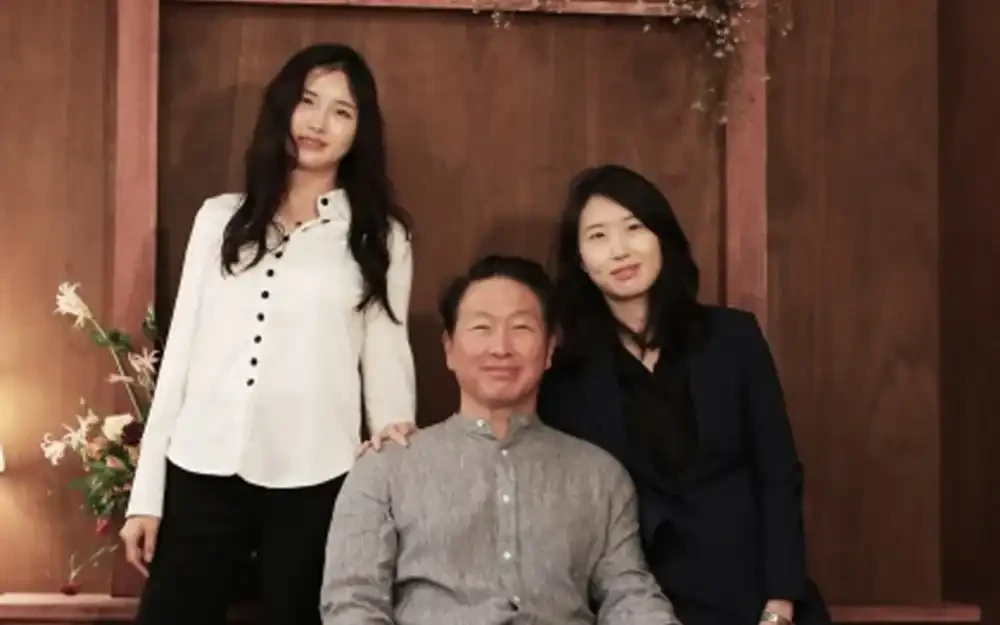
Choi Yoon-jung (left) with Choi Tae-won (center) and Choi Min-jung (right)
She joined SK Biopharmaceuticals in 2017 as the head of the Strategic Investment Team. However, in 2019, she made a decision that didn't quite fit the heir image: she temporarily left SK to pursue a Master's in Biomedical Informatics at Stanford. This was in computational biology, not general biology. Two years later, she returned to SK to continue in strategy, while simultaneously pursuing a PhD in Biological Sciences at Seoul National University. She is still pursuing her PhD, specializing in Genetics and Development.
In January 2024, she was promoted to Head of Business Development (Vice President level) at SK Biopharmaceuticals, leading the introduction of radiopharmaceutical therapy (RPT) and radioisotope supply contracts. This is a core pipeline for SK Biopharmaceuticals' transition from traditional neurological drugs to precision medicine in the AI era. Later that year, Choi Tae-won established a new "Growth Support Department" within SK Group's top holding company, SK Inc., responsible for mid-to-long-term planning, portfolio management, global expansion, and new business evaluation, and placed her in charge.
Her marriage also doesn't follow the old conglomerate script. In October 2017, she married Yoon Do-yeon, a colleague from Bain. Yoon Do-yeon graduated from Seoul National University's Business School and later became co-CEO of More (모레), a Korean AI infrastructure startup. The company develops software platforms for AI model training and computation parallelization, received a strategic investment from KT in 2021, and was valued at around 350 billion won in 2025. This is not a traditional conglomerate marriage, nor is it the "married a regular employee" often described by some media. It's a new type of elite network integration: the conglomerate's eldest daughter marrying a tech entrepreneur from the AI era.
In the succession narratives of female members of conglomerates like Samsung and CJ over the past decades, daughters were often seen in roles related to art museums, hotels, charitable foundations, luxury retail, or dowries. Choi Yoon-jung's position is different. She sits at the table where SK Group decides its future direction. Her visibility wasn't established by marriage, art, or image-building, but by scientific training, consulting experience, a doctoral thesis, strategic investments, and a senior executive position within the group.
The way conglomerate daughters are perceived is changing. Yet, Choi Yoon-jung rarely speaks publicly. While labeled "the most succession-like candidate" by the Korean media, her personal story remains quiet in public reports.
Choi Min-jung: The Warship, Washington, and Hynix's Globalized Heir
On October 13, 2024, also at SK Group's own Walkerhill Hotel, Choi Tae-won's second daughter, Choi Min-jung, and Chinese-American entrepreneur Kevin Hwang held their special wedding ceremony.
Approximately 500 guests attended, including Lee Jae-yong, Koo Kwang-mo, Kim Dong-kwan, and other SK family members. After their 1.38 trillion won divorce lawsuit, Choi Tae-won and Noh So-young appeared in the same space for the first time, seated side-by-side in the bride's parents' seats. Beside them was the dog shared by Choi Min-jung and Kevin Hwang.
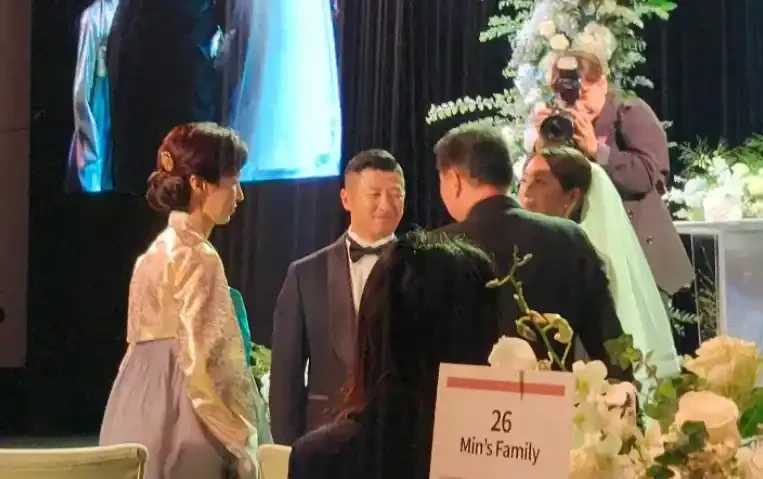
Choi Min-jung's wedding scene
After the groom entered, Choi Min-jung walked in alone, not escorted by her father. The entire wedding had no officiant. Her older sister, Choi Yoon-jung, gave a congratulatory speech, and the groom's brother spoke in English. Before the ceremony began, a moment of silence was observed for Korean and American veterans. A single empty table was set to the side, decorated with medals, military dog tags, roses, and a lemon – a US military tradition called the Missing Man Table, commemorating missing and fallen soldiers.
Born in 1991, Choi Min-jung attended high school at the High School Affiliated with Renmin University of China and earned her undergraduate degree in Business Administration from Guanghua School of Management, Peking University. Among the third generation of Korean conglomerates, almost none have studied in China for their undergraduate degrees; others typically go to Ivy League schools or stay at prestigious Korean universities. During her studies in Beijing, she reportedly funded her living expenses through scholarships, part-time work at convenience stores, and tutoring for entrance exams, largely without financial support from her parents. This "path of self-reliance" is an extremely rare marker among children of Korean conglomerates.
In 2014, she made a decision that baffled all Korean media: she applied for the 117th class of the Republic of Korea Navy Officer Candidate School. Military service is mandatory for men in South Korea but completely voluntary for women. This was the first time a woman from a Korean conglomerate family had voluntarily served. During her interview, she said she was inspired by Ernest Shackleton's spirit of challenge and leadership from the 1915 Antarctic expedition. During the 11-week pre-commissioning training, she often repeated a single phrase to visiting family and friends: "I am proud to be a daughter of the Republic of Korea. After going through this training period, I have an even greater sense of pride."
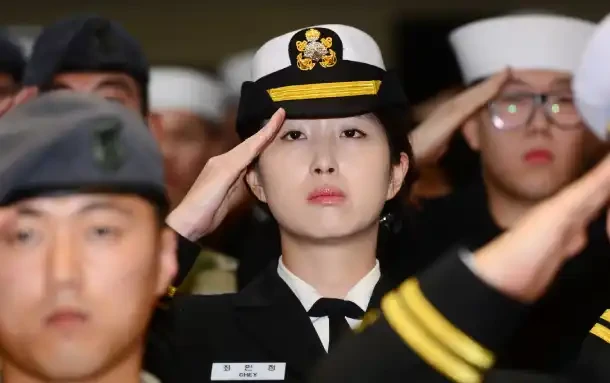
Choi Min-jung in military uniform
She was assigned to the ROKS Yi Sun-sin destroyer (DDH-975) as a Combat Information Officer. In December 2015, she deployed with the 19th contingent of the Cheonghae Unit to the Gulf of Aden near Somalia for anti-piracy escort missions. Before her discharge, she served as a Control Room Officer at the Command and Control Center, 2nd Fleet, and was discharged on November 30, 2017, with the rank of Lieutenant (junior grade).
After her military service, she returned to China, worked at an investment company for about a year, and then pursued a Master's in International Business and Policy at Georgetown University in the US. In August 2019, she joined INTRA, SK Hynix's department for external cooperation, handling international commerce and policy responses, commuting between Washington D.C. and Seoul. This was her direct connection point to SK Hynix. Not as an engineer, product manager, or factory operator. Her work was policy. She later moved to the strategy department of SK Hynix's American entity, responsible for M&A and investments.
It was also during this time that she met her husband, Kevin Hwang. They were neighbors in the Dupont Circle area of Washington D.C.
Kevin Hwang was born in Indiana, USA. He holds a BA from Harvard and an MBA from Stanford. He joined the US Marine Corps as an officer in 2016 and served in South Korea as a US Forces Korea logistics plans officer for about 9 months starting in October 2020. Both having military backgrounds, the Korean media described their relationship as "deepened by shared military experience."
In February 2022, Choi Min-jung took a leave from SK Hynix and went to San Francisco to work as an unpaid advisor at the telehealth startup Done Global. The Korean media later revealed she actually served as its CFO. A year later, she co-founded Integral Health with scholars from the Yale School of Medicine's Department of Psychiatry, serving as its CEO, focusing on AI-driven collaborative care and behavioral health integration.
Her current LinkedIn introduction reads: "Founder of Integral Health | Investor in Healthcare & AI | Veteran | 2x Exits." The "Veteran" tag remains in the most prominent position.
A recurring theme in Choi Min-jung's life is the military. From Shackleton to the Gulf of Aden, from SK Hynix's INTRA in Washington to marrying a former US Marine Corps captain. She hasn't entered SK's internal management layer like her sister, nor married into a prestigious Korean family following the traditional conglomerate script. Instead, she has embodied the new positioning of SK Hynix. A semiconductor company in the AI cycle increasingly resembles a geopolitical company, having to navigate US policy, trade regulations, supply chain security, and capital M&A. Choi Min-jung's resume fits precisely along this line.
Choi In-geun: The Heir Apparent, Yet the Most Silent
Choi In-geun's story begins in a hospital room.
In 2003, SK Group was embroiled in an accounting fraud scandal, leading to Choi Tae-won's imprisonment. That same year, his youngest son with Noh So-young, Choi In-geun, was diagnosed with juvenile diabetes at the age of 8; doctors said he would need lifelong insulin injections.
During that period, Noh So-young, the daughter of a former South Korean president, moved into the pediatric ward of Seoul National University Hospital with her son herself. At night, while Choi In-geun slept, she would sit alone beside him. Noh So-young later recalled in an interview that her son, even at 17, battled diabetes with difficulty, but he remained a cheerful boy, serving in the church choir, performing beatbox special songs during worship, and copying Bible verses with his mother and second sister, Choi Min-jung, at night.
Choi In-geun's educational path differed from his two sisters. He first attended a non-traditional middle school in South Korea known for its innovative education before transferring to a school in Hawaii. His mother Noh So-young's educational philosophy was "there's no need to stress about forcing a child into the same university as everyone else"; instead, one should explore different, creative ways of parenting. While Choi In-geun attended high school in Hawaii, Noh So-young lived there with him for over two years.
He later followed in his family's footsteps by enrolling at Brown University in the US to study physics. Choi Tae-won also majored in physics at Korea University, and Choi Tae-won's younger brother and SK Group Vice Chairman, Choi Jae-won, also studied physics at Brown University. This is the only clear academic continuity within the family. The father-son relationship between Choi In-geun and Choi Tae-won seems good; they communicate frequently, often play tennis together, and have been photographed talking with their arms around each other's shoulders in front of a restaurant outside Seoul.

Choi In-geun (left) with his father Choi Tae-won (right)
After graduation, he interned at the Boston Consulting Group for a time before joining SK