马斯克vs奥特曼,AI史上第一大案已开庭


- 核心觀點:馬斯克訴OpenAI一案正式開庭,核心爭議在於OpenAI是否違背了創辦時「非營利、開源」的創始協議,從而轉向商業化盈利模式。此案結果將直接影響OpenAI的轉型與估值,並可能重塑AI行業的權力格局。
- 關鍵要素:
- 馬斯克指控OpenAI及奧特曼違反創始協議,從非營利組織轉為微軟控制下的「閉源附屬」,要求其回歸非營利使命並賠償高達1500億美元。
- OpenAI反訴馬斯克,稱其因失去控制權而「嫉妒」並惡意干擾公司運營,目的是為xAI公司謀利,雙方進入雙向訴訟戰。
- 庭審預計進行四周,關鍵證物包括OpenAI前董事會成員齊利斯的證詞及格雷格的私人日記,法官Yvonne Gonzalez Rogers將分階段裁定責任與補救措施。
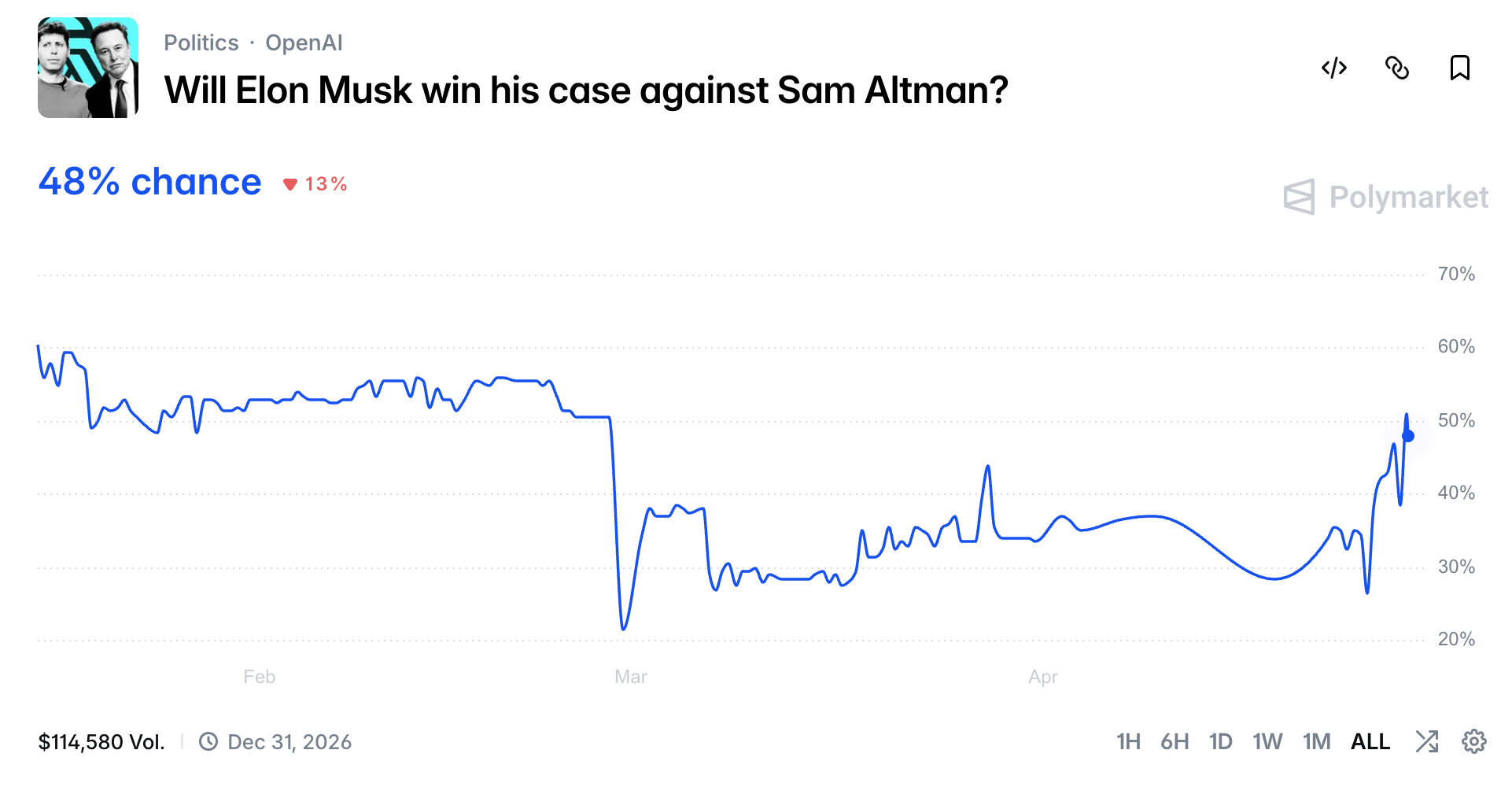
- 預測市場顯示雙方勝率接近五五開(馬斯克48%),案情細節的披露將是左右結果的關鍵變量。
- 該案不僅關乎歷史恩怨,還將直接影響OpenAI和SpaceX(馬斯克旗下)兩大萬億級公司的未來IPO進程,成為AI競賽格局中的重大非技術性變量。
原創 | Odaily 星球日報(@OdailyChina)
作者|Azuma(@azuma_eth)
The first major case of the AI era has officially begun trial.
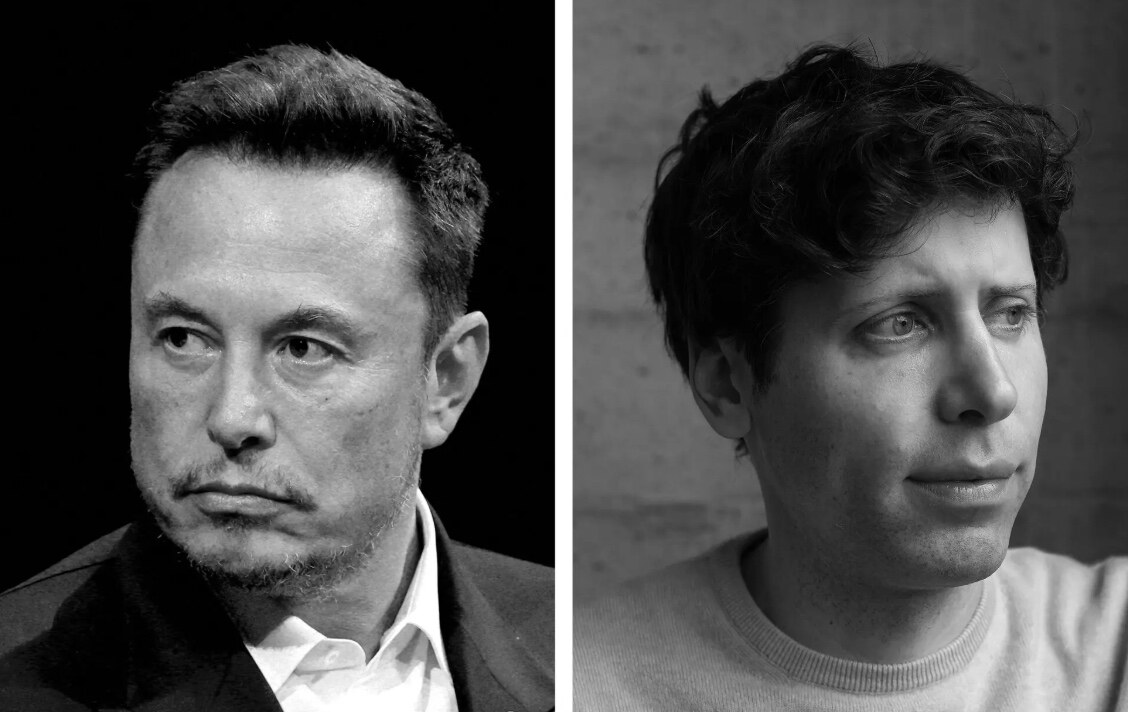
On April 27, the case of Elon Musk, the world's richest man, against OpenAI, the world's leading AI company, officially entered the trial phase in the U.S. District Court for the Northern District of California. The jury selection process began the same day, with opening statements expected to commence today. The presiding judge is Yvonne Gonzalez Rogers, and the trial is expected to last four weeks.
A Look Back at the Grudge
The animosity between Musk and OpenAI has a long history.
In 2015, Musk co-founded OpenAI with Sam Altman and others, both sharing the same idealistic vision: to create a non-profit, open-source AI organization to counter the AI monopoly of giants like Google. In the early days, Musk was even one of OpenAI's largest donors and played a key role on its board.
However, idealism quickly ran into harsh realities. In its early years, OpenAI's AI development lagged significantly behind Google's DeepMind. Under the dual pressures of funding shortages and lack of progress, Musk grew increasingly dissatisfied with the OpenAI leadership led by Altman. He even proposed merging OpenAI into Tesla, with himself as CEO, to gain tighter control.
Naturally, Altman and the leadership refused. The eventual outcome was that Musk was pushed out of the OpenAI board in 2018, ending their collaboration.
Subsequently, in March 2019, OpenAI officially abandoned its non-profit path and transitioned into a "capped-profit" company. That same year, it accepted a $1 billion investment from Microsoft, accelerating its commercial trajectory.
The year 2022 marked another critical turning point. OpenAI released the world-stunning ChatGPT, officially kickstarting the era of large language models (LLMs). Driven perhaps by lingering idealism, or simply jealousy over his former creation's success, Musk was reportedly furious about this turn of events.
Afterwards, Musk vociferously criticized OpenAI on social media for abandoning its open-source, non-profit principles, claiming it was no longer "OPEN" and was completely controlled by Microsoft. Notably, OpenAI has since announced ending Microsoft's exclusive rights. Meanwhile, Musk founded xAI to compete head-on with OpenAI.
On the other side, OpenAI perceived Musk's actions as sour grapes. They argued that Musk himself had supported the commercial transition while still on the board, as evidenced by historical emails, and only began criticizing the move after leaving. They claim his accusations of betraying the founding mission are merely excuses stemming from losing control.
Day in Court
With tensions escalating, Musk filed a lawsuit against OpenAI and its co-founders, Sam Altman and Greg Brockman, in 2024.
First, in March 2024, Musk sued in California state court, alleging OpenAI breached its founding agreement by transitioning from a non-profit to a for-profit entity, effectively becoming a closed-source subsidiary of Microsoft. He sought to force OpenAI back to its non-profit, open-source mission and prevent Microsoft from profiting. This initial lawsuit was quickly dropped, appearing to be a probing move.
In October 2024, Musk refiled the lawsuit in the Northern District of California, this time naming Microsoft as a defendant and escalating his allegations and demands. He accused OpenAI and Microsoft of fraud and misrepresentation, unjust enrichment, violating charitable trust, and conspiring to divert non-profit assets for commercial gain. He sought to block OpenAI's full transition to a for-profit company, revert it to a non-profit structure, claw back illegal profits, demand $134 billion to $150 billion in damages, and remove Altman and Brockman.
In April 2025, OpenAI countersued Musk, accusing him of harassment and malicious interference with its operations, claiming Musk was deliberately trying to slow down OpenAI's progress for personal gain, escalating the dispute into a two-way legal battle.
Subsequently, in September 2025, Musk's xAI filed another lawsuit against OpenAI, accusing it of stealing trade secrets, partly by hiring former xAI employees to obtain confidential information. The next day, Musk posted on X: "We sent them numerous cease-and-desist letters, but they continued to cheat. After exhausting all other avenues, a lawsuit was the only option."
Yesterday, this long-running saga finally entered the courtroom. With the trial now underway, more details are expected to emerge over the next four weeks. While an appeal by either side remains possible, the trial is certain to clarify the matter significantly.
Heated Exchanges
As the trial commenced, Musk and OpenAI engaged in heated exchanges on social media.
Last night, Musk posted or retweeted dozens of messages, even resorting to personal attacks, calling Altman "Scam Altman" and Brockman "Greg Stockman."
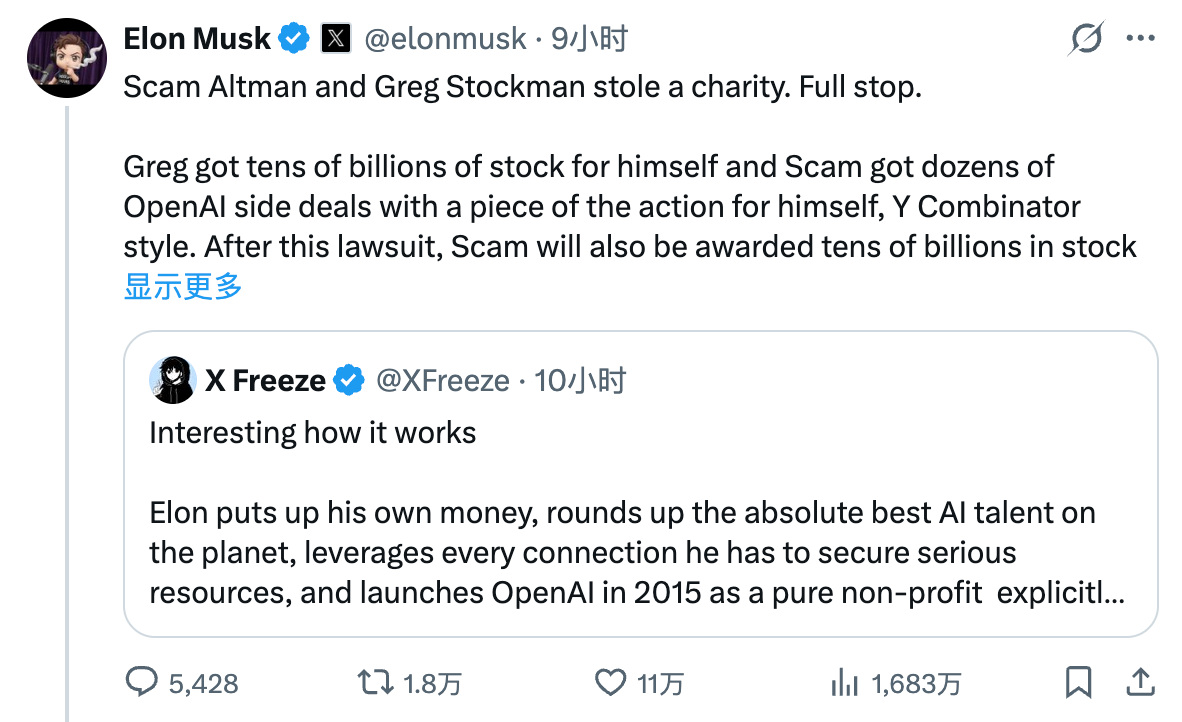
"Greg Stockman gave himself tens of billions in equity, and Scam Altman also took a cut through a bunch of OpenAI-related side deals resembling Y Combinator... I could have made OpenAI a for-profit company from the start, but I didn't. I founded it, funded it, recruited key talent, and taught them everything I know about building a successful startup – all for the public good. Then they stole this charity."
On OpenAI's side, while Altman and Brockman have not commented publicly, the company's official channels responded: "We can't wait to present our case in court, because the truth and the law are on our side. This lawsuit has been baseless and motivated by jealousy from the start, aimed at hindering a competitor. We will finally have the opportunity to question Musk under oath, before a California jury, about his attempts to sabotage our work to ensure AGI benefits all of humanity."
Outlook and Predictions
Over the next four weeks of trial, several heavyweight figures, including Musk, Altman, Brockman, and Satya Nadella (Microsoft CEO), are expected to testify.
According to various media reports, key factors influencing the case's outcome may include witnesses like former OpenAI board member Shivon Zilis (also the mother of four of Musk's children) and physical evidence like Brockman's private diary (recording internal strategic thoughts, already submitted as evidence).
Judge Yvonne Gonzalez Rogers, appointed by former President Barack Obama, is known for her pragmatic style and has handled major disputes between tech companies. In this case, Judge Rogers has significant discretion to determine if and what remedies are necessary. She has divided the trial into two phases: the first to determine liability for Altman and OpenAI, and the second, if necessary, to determine the remedy.
With the trial underway, prediction markets like Kalshi and Polymarket have listed related events. Currently, the odds are nearly evenly split, with Musk's chance of winning reported at 48%, pending further updates.
Looking further ahead, this "AI trial of the century" will not only adjudicate the historical grievances between Musk and Altman but will also directly or indirectly impact the subsequent IPO processes of two trillion-dollar valuation companies: OpenAI and SpaceX.
This represents the most significant non-technical variable in the current landscape of the AI race, with the potential to profoundly reshape the power dynamics of the future AI world.