






Cronos的单机哲学:被盗不算事,回滚就行了


- Quan điểm cốt lõi: Khi xử lý vụ tấn công vào giao thức cho vay Tectonic, Cronos đã lựa chọn tạm dừng mạng lưới và rollback trạng thái chuỗi về thời điểm trước vụ tấn công để loại bỏ khoản lỗ tiềm ẩn khoảng 75 triệu USD, nhưng hành động này phải đánh đổi bằng tính cuối cùng của giao dịch, gây ra tranh cãi nghiêm trọng về nguyên tắc bất biến của blockchain.
- Các yếu tố then chốt:
- Kẻ tấn công đã đẩy giá token TONIC tăng khoảng 100 lần rồi dùng làm tài sản thế chấp, vay khoảng 75 triệu USD tài sản từ Tectonic, trong đó chỉ có 6 triệu USD được bridge thành công sang Ethereum.
- Cronos đã tạm dừng mạng lưới vào ngày 30/8, sau đó rollback trạng thái chuỗi về block height 90896189, hủy bỏ toàn bộ các giao dịch bình thường trong 10.961 block từ sau vụ tấn công đến trước khi dừng chuỗi.
- Mặc dù thao tác rollback đã thu hồi thành công phần lớn số tiền, nhưng nó khiến các giao dịch chuyển tiền, thanh toán của người dùng thông thường trong khoảng thời gian đó bị hủy bỏ, có thể gây ra tranh chấp thực tế khi hàng hóa đã được giao nhưng tiền thanh toán lại biến mất.
- Sự kiện này làm suy yếu khái niệm "tính cuối cùng của giao dịch" trong blockchain, đặt ra câu hỏi cốt lõi: nếu 75 triệu USD có thể kích hoạt rollback, thì liệu trong tương lai các cuộc tấn công với số tiền thấp hơn hoặc các sự kiện phi bảo mật có thể dẫn đến việc lịch sử bị sửa đổi hay không.
- Đây không phải lần đầu tiên Cronos "sửa đổi lịch sử": vào năm 2025, họ từng có kế hoạch đúc lại 70 tỷ token CRO đã bị "đốt vĩnh viễn" vào năm 2021, và đề xuất này đã được thông qua do sự đảo ngược từ các holder nắm giữ lượng lớn khi bỏ phiếu.
- Phong cách quản trị của Cronos thiên về ra quyết định tập trung, khi đối mặt với các vấn đề quy tắc cốt lõi như nguồn cung hoặc trạng thái chuỗi, họ có xu hướng giải quyết nhanh chóng thông qua can thiệp trực tiếp thay vì đồng thuận cộng đồng.
Original: Odaily Planet Daily (@OdailyChina)
Author: Azuma (@azuma_eth)

On August 30, Tectonic, the largest lending protocol on Cronos, the public chain affiliated with Crypto.com, suffered a hacker attack.
The attack itself was not particularly complex. The attacker drove up the price of TONIC, Tectonic's governance token with extremely low liquidity, by approximately 100 times within about 20 minutes, then used these artificially inflated TONIC tokens as collateral to borrow other assets from Tectonic, involving approximately $75 million, of which about $6 million was bridged to Ethereum.
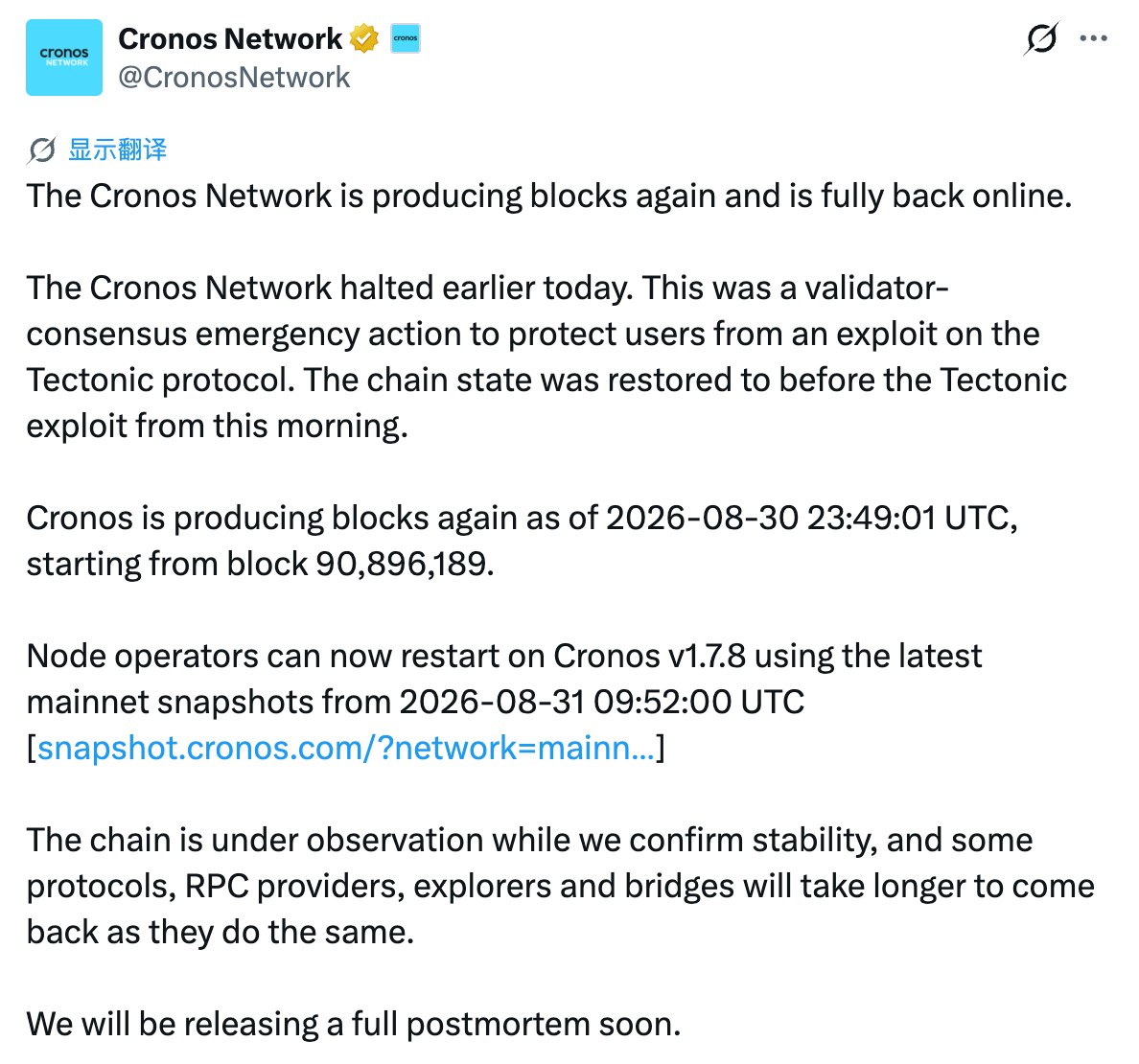
More dramatic than the attack method was Cronos's response plan. After the attack, Cronos first paused the network on the evening of August 30 (pausing at will, an early sign), blocking the outflow of other stolen funds; then on August 31, it released a network restart plan, announcing that the chain state would be rolled back to before the Tectonic theft on August 30, restarting the network from block height 90896189.
The Huge Controversy Surrounding the Rollback
The so-called blockchain rollback, simply understood, is to "restore" the network's state to a certain point in the past. Transactions, transfers, and smart contract operations that occurred after that point would, in principle, disappear from the new chain history.
This is exactly what Cronos chose to do this time. Looking purely at the outcome, this is indeed the most convenient and possibly the most effective solution. At the time of the attack, approximately $75 million in assets were affected, but before Cronos halted the chain, only about $6 million had been successfully bridged out, leaving the majority of the remaining assets still on the Cronos chain. Since the funds hadn't fled yet, why not simply delete the on-chain history after the attack with one click — theoretically, the vast majority of losses would disappear with it.
From the perspective of protecting user funds, it's hard to say Cronos's choice was wrong. If they hadn't done this, they might have had to watch helplessly as the attacker moved funds layer by layer, waiting for security teams to trace, freeze, and negotiate, leaving the final recovery amount entirely to luck.
Of course, the cost of the rollback is equally obvious. The attacker's transactions can disappear, but normal transfers, transactions, and liquidations made by regular users during that period will also disappear along with them. In this incident, the Cronos network restarted from block height 90896189, but before the chain halt, the network had reached block height 90907150, a difference of 10,961 blocks — meaning all normal transactions conducted within those more than ten thousand blocks have been canceled.
To give an extreme example, if you happened to be using the Cronos network for a transfer during that period (for instance, A paying B on-chain in exchange for B's goods or services), then with the rollback, the original payment transaction would be canceled, potentially leading to the extreme situation where goods have been delivered but the payment has vanished.
The bigger controversy lies in "finality." A key reason blockchain can serve as a value settlement network is that once a transaction receives sufficient confirmations, participants trust that it is irreversible — the money you received truly belongs to you, and the payment I completed won't suddenly disappear a few hours later.
Cronos's action this time undoubtedly weakens its "finality." As long as something serious enough happens, even a transaction with final confirmation may not truly be final.
Of course, choosing to roll back in extreme cases is not unprecedented; there have been instances in history where public chains modified chain states through community coordination after major security incidents. But the problem is, once this precedent is set, it becomes difficult to avoid a critical question: $75 million warrants a rollback, so what about $50 million? $10 million? Or, besides hacker attacks, what other events would be enough to make validators press the "load game" button again?
This is precisely where the biggest controversy lies. It does solve the problem at hand, but it also makes every participant on the chain realize — that so-called immutability is not an absolute rule for Cronos.
This Is Not Cronos's First Time "Rewriting History"
If this rollback can still be explained as "special measures for special times," then looking back a year, Cronos's attitude toward history had already shown signs.
In 2021, Crypto.com announced with great fanfare the burning of 70 billion CRO tokens, drastically reducing the total supply from 100 billion to approximately 30 billion. This burn was hailed at the time as one of the largest token burns in cryptocurrency history.
Then in 2025, Cronos proposed a rather straightforward plan: mint back the 70 billion CRO that had already been burned and allocate it to a strategic reserve, restoring the total CRO supply to 100 billion. The official reasoning at the time was that "reshaping Cronos's golden age requires substantial capital to support the Cronos roadmap," including driving US market expansion, supporting ecosystem development, institutionalization, and a potential CRO ETF.
This decision sparked tremendous controversy at the time. After all, the original burn was explicitly described as "permanent," and who could have imagined that a few years later they would "mint another batch back." Even more dramatic was that despite strong community opposition, as the vote was about to end, the outcome was reversed due to concentrated voting by large holders, ultimately allowing the proposal to pass.
- Odaily Note: See also "CRO Stages the Most Absurd Governance Farce in History, 70 Billion Tokens Created Out of Thin Air".
Cronos's "Standalone Philosophy"
Looking at these two events together, they are very much in Cronos's own style. Burned 70 billion CRO? No problem, mint them again. Stolen $75 million? No problem, roll back.
The former modifies the supply; the latter modifies the on-chain state. One brings back tokens that were supposedly "permanently burned"; the other erases from history transactions that have already occurred and even been confirmed.
Cronos has a justification for every operation — reminting 70 billion CRO was to support the ecosystem's long-term development; rolling back the chain state was to recover user assets as much as possible. Individually, both actions are not entirely incomprehensible.
But the problem is, when similar things happen one after another, it becomes difficult for people to continue viewing "immutability" as a principle of Cronos. What others see as blockchain history, at Cronos, looks more like a draft that can be revised according to the situation. Perhaps this is Cronos's "standalone philosophy": rules matter, decentralization matters too, but if modifying rules, modifying supply, or even rewriting history can solve problems faster, then there's no need to pretend it can't be done.
Even more blatant is that, when facing centralization controversies, Cronos never seems hesitant or tries to hide it.
In the blockchain world, where "decentralization" has always been the absolute political correctness, this style is truly one of a kind.


