






Nếu Strategy thực sự bán 491 Bitcoin, tác động đến thị trường sẽ lớn đến mức nào?


- Quan điểm chính: Trader kỳ cựu Lightcrypto chỉ ra rằng Strategy, công ty nắm giữ Bitcoin lớn nhất, có thể đã bắt đầu bán một lượng nhỏ Bitcoin (491 đồng), phù hợp với khuôn khổ bán 1,25 tỷ đô la Mỹ mới được công bố, đánh dấu sự chuyển đổi từ mua vào một chiều sang quản lý dòng tiền song song, tác động sâu sắc đến tâm lý thị trường và logic định giá của MSTR.
- Các yếu tố then chốt:
- Có thể đã bán 491 BTC (khoảng 30 triệu đô la Mỹ), chỉ chiếm 0,058% tổng lượng nắm giữ 847.000 đồng, áp lực bán trên thị trường giao ngay là cực kỳ nhỏ, nhưng ý nghĩa biểu tượng rất lớn.
- Strategy công bố "Khuôn khổ vốn tín dụng kỹ thuật số" vào ngày 29 tháng 6, cho phép bán tối đa 1,25 tỷ đô la Mỹ BTC, nhằm bổ sung dự trữ, trả cổ tức và lãi trái phiếu.
- Cổ phiếu ưu đãi vĩnh viễn STRC giảm xuống còn 84,86 đô la Mỹ (mệnh giá mục tiêu 100 đô la Mỹ), buộc công ty phải tăng tỷ suất cổ tức hàng năm lên 12%, chi phí hàng năm hóa khoảng 1,76 tỷ đô la Mỹ.
- Dự trữ đô la Mỹ hiện tại 2,55 tỷ đô la Mỹ có thể trang trải 17,4 tháng, nếu cộng thêm ủy quyền bán BTC, thời gian thanh khoản kéo dài lên khoảng 25,9 tháng.
- Giá MSTR trước giờ giao dịch tăng 7% sau khi công bố khuôn khổ, phản ứng ngắn hạn của thị trường với kế hoạch thanh khoản là tích cực, nhưng ngôn ngữ định giá trung hạn có nguy cơ bị hạ cấp.
- Nếu tỷ lệ giá trị thị trường trên giá trị tài sản ròng Bitcoin (mNAV) của MSTR thấp hơn 1, việc bán Bitcoin sẽ sạch sẽ hơn so với phát hành thêm cổ phiếu, nhưng sẽ làm suy yếu câu chuyện thị trường "người mua cuối cùng" của công ty.
Famous trader Lightcrypto hasn't spoken in a year, but when he does, it's explosive. He claims that Strategy, the company with the largest Bitcoin holdings, has started selling coins.
According to the address he provided, 491 Bitcoins were sold. At a rough price near $60,000 per coin, this amounts to less than $30 million. Within Strategy's total holdings of approximately 847,000 BTC, this is barely a drop in the bucket.
Of course, some argue that the behavior of this address doesn't align with Strategy's publicly disclosed operational logic for its addresses, so it's likely not Strategy. However, Lightcrypto is quite well-known for finding addresses, and a significant number of people do trust him.
There is indeed a possibility of coin sales, as Strategy just announced a new selling channel. On June 29, Strategy announced a "Digital Credit Capital Framework," with the board authorizing the company to sell up to $1.25 billion worth of BTC to supplement dollar reserves, pay preferred stock dividends and debt interest, repurchase preferred stock, and repurchase MSTR common stock.
What we need to consider is the next step. If those 491 coins have indeed been sold, what does it mean for the Bitcoin market and Strategy's stock mechanism, respectively?
Is 491 BTC a Big Deal?
First, let's look at the proportion.

From a spot market perspective, 491 BTC is very small. It accounts for only about 0.058% of Strategy's total holdings. If you imagine Strategy's holdings as a 100-liter water tank, 491 coins are like scooping out 58 milliliters.
Therefore, if the market only focuses on "selling pressure," 491 coins are not the key point.
The real comparison involves two other data points. At the end of May, Strategy sold 32 BTC, roughly $2.5 million. That seemed more like a temporary operation to meet preferred stock distribution requirements. A month later, the company formalized the coin sale framework, authorizing up to $1.25 billion, which at roughly $60,000 per coin, could cover about 20,000 BTC.
In other words, if the 491 coin sale is genuine, it's not "Strategy dumping." It's more like a trickle starting to flow from this pipeline.
Why Is It Selling?
The answer lies in STRC.
STRC is Strategy's perpetual preferred stock, with a target par value of $100. Its buyers are not typical crypto players but yield-seeking capital looking for stable cash flow. The original narrative for this product was smooth: investors buy STRC, Strategy uses the money to buy BTC, BTC supports the company's assets, and STRC continues to trade near its par value.
The problem is, STRC hasn't stayed near its par value.
On June 30, Yahoo Finance showed STRC closing at $84.86. Meanwhile, Strategy increased STRC's annualized dividend yield to 12% starting July. This creates an ugly scissors gap. The lower the price, the less the market believes, and the higher the interest the company must pay.
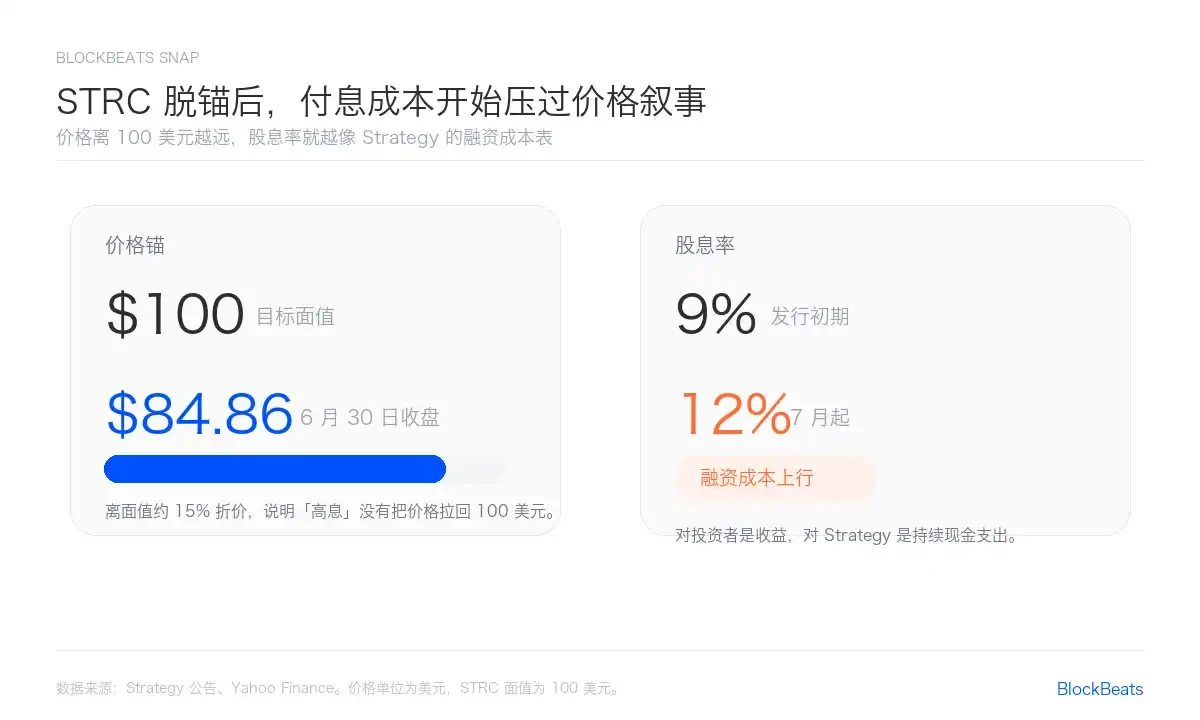
This 12% is not only the investor's yield but also Strategy's cost.
According to Strategy's June 29 announcement, the company's current annualized preferred stock dividend and debt interest expenses are about $1.76 billion. In layman's terms, it needs to prepare approximately $4.8 million daily just to maintain this capital structure.
This doesn't mean Strategy can't afford it. The company disclosed dollar reserves of about $2.55 billion, which alone can cover expenses for 17.4 months. However, it explains why the selling framework emerged. Selling BTC isn't about dumping coins on the market; it's about supplementing cash for the entire stock and preferred stock structure.
Are 491 Coins Bullish or Bearish for MSTR?
This needs to be viewed on two levels.
In the short term, the market might see it as bullish. After the framework's announcement on June 29, MSTR rose nearly 7% in pre-market trading. This reaction isn't contradictory. The market dislikes disorderly selling but appreciates companies clearly articulating their liquidity arrangements in advance.
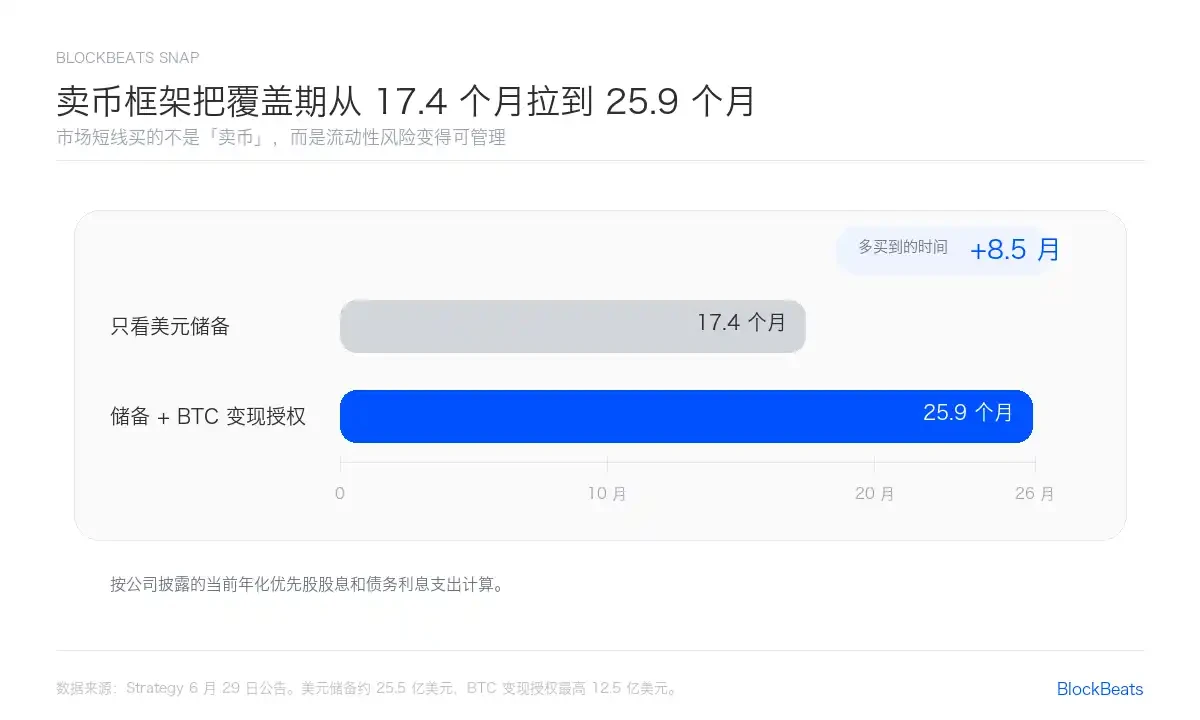
This chart explains why MSTR rose then. Relying only on dollar reserves, Strategy's coverage period is about 17.4 months. Adding the $1.25 billion BTC liquidation authorization extends the coverage period to approximately 25.9 months.
The market isn't buying "coin sales."
The market is buying "at least it won't collapse tomorrow."
However, in the medium term, this represents a downgrade in MSTR's valuation narrative. Previously, MSTR's strongest story was one-way accumulation: raise capital, buy BTC, increase BTC per share. Now there's a reverse action: sell BTC, replenish reserves, pay interest, repurchase discounted securities.
This isn't necessarily wrong; it might even be what a mature public company should do. But it transforms MSTR from "the perpetual marginal buyer" into "someone who sometimes needs to manage liabilities."
The key mechanism for the stock is mNAV, the multiple of MSTR's market capitalization relative to its net Bitcoin holdings value. When mNAV is above 1, Strategy issuing stock to buy BTC is interpreted by the market as accretive to BTC per share. But once mNAV falls below 1, further issuance is like selling its Bitcoin at a discount.
At that point, selling BTC becomes a cleaner financing method instead.
This isn't necessarily bad for common stock immediately. If the company uses proceeds from coin sales to repurchase discounted STRC, it can reduce future dividend pressure, which actually benefits common stock. However, the market will also re-evaluate a fundamental question: if even the biggest buyer is selling coins, what premium on BTC should MSTR still command?
What Does It Mean for the BTC Market?
491 coins won't change spot supply and demand.
But it will change traders' mental charts. In past market downturns, Strategy was often imagined as the buyer of last resort. ETFs outflow, miners sell, retail doesn't buy in, but there's still Saylor.
If the 491 coin sale is real, a crack appears in this narrative. Strategy could still be a long-term holder and could still continue buying. But it's no longer an account with only a buy button.
More troubling is that the selling framework is tied to STRC. As long as STRC trades below par value for an extended period, Strategy must choose between several options: increasing dividends, repurchasing discounted preferred stock, supplementing dollar reserves, or tapping into BTC. None of these choices is a disaster, but each one drags "Bitcoin faith" back to cash flow considerations.
If the 491 coin sale is genuine, it's just the first small ticket.
What truly matters is whether the market will continue to treat each subsequent small ticket as an exception.


